
See a Demo
You're just one step away from seeing Call Loop in action.
Enter your information below to watch a demo right now.

You're just one step away from seeing Call Loop in action.
Enter your information below to watch a demo right now.

A marketing manager has a list of mobile numbers, a short promotion ready to record, and a familiar concern: a traditional call may interrupt people, while a ringless voicemail drop seems more considerate. A healthcare communicator may face a similar choice when sending a reminder or follow-up. The message goes directly to voicemail, so it can feel like a quiet shortcut around the normal rules.
That assumption creates the first compliance problem. Avoiding the ring doesn't remove the communication from federal robocalling rules. Ringless voicemail compliance depends on permission, message routing, suppression, and records, not on whether the recipient hears the phone ring.
Core principle: Treat every ringless voicemail to a wireless number like a covered prerecorded call from the moment a contact enters your campaign.
The practical path is manageable. You need to understand how ringless delivery works, identify the consent required for your use case, stop messages when a recipient opts out, control timing, and preserve evidence that connects permission to the destination number and campaign purpose. Healthcare organizations also need to protect patient information and fit voicemail workflows into their HIPAA safeguards.
A sales team may want to notify prospects about an offer without filling their call logs with missed calls. A clinic may want to remind patients about an upcoming appointment without asking staff to dial each number manually. In both situations, ringless voicemail appears efficient because the recipient receives a message without the handset ringing.
The temptation is to treat that quiet delivery as a different category of outreach. A marketer might think, “We aren't calling the person, we're only placing a message in voicemail.” That reasoning is precisely what creates exposure when the destination is a wireless number and the message uses an artificial or prerecorded voice.
The safer approach treats compliance as a workflow design problem. The campaign should check permission before dispatch, apply suppression rules before routing, and retain records that explain why the message was eligible to send. A compliance review after delivery is too late, because the risky event has already occurred.
Suppose a contact once downloaded a guide but never agreed to receive automated marketing calls. The number is added to a ringless voicemail list, the recording identifies the business, and the message is delivered without a ring. The quiet experience may feel less intrusive, but the missing consent still matters.
An informational message can raise different questions from a promotional offer, yet the sender shouldn't assume that calling something a reminder solves every compliance issue. Purpose, permission, recipient type, content, timing, and opt-out history all need to align.
This guide focuses on the operating details that make ringless voicemail safer:
Compliant outreach isn't about finding a clever exception. It's about building a process in which the platform refuses to send when the required conditions aren't satisfied.
Think of ordinary calling as knocking on a door and waiting for someone to answer. Ringless delivery is closer to placing a note directly into the mailbox. The recipient may not hear a knock, but a sender still intentionally delivered a communication to that person's address.
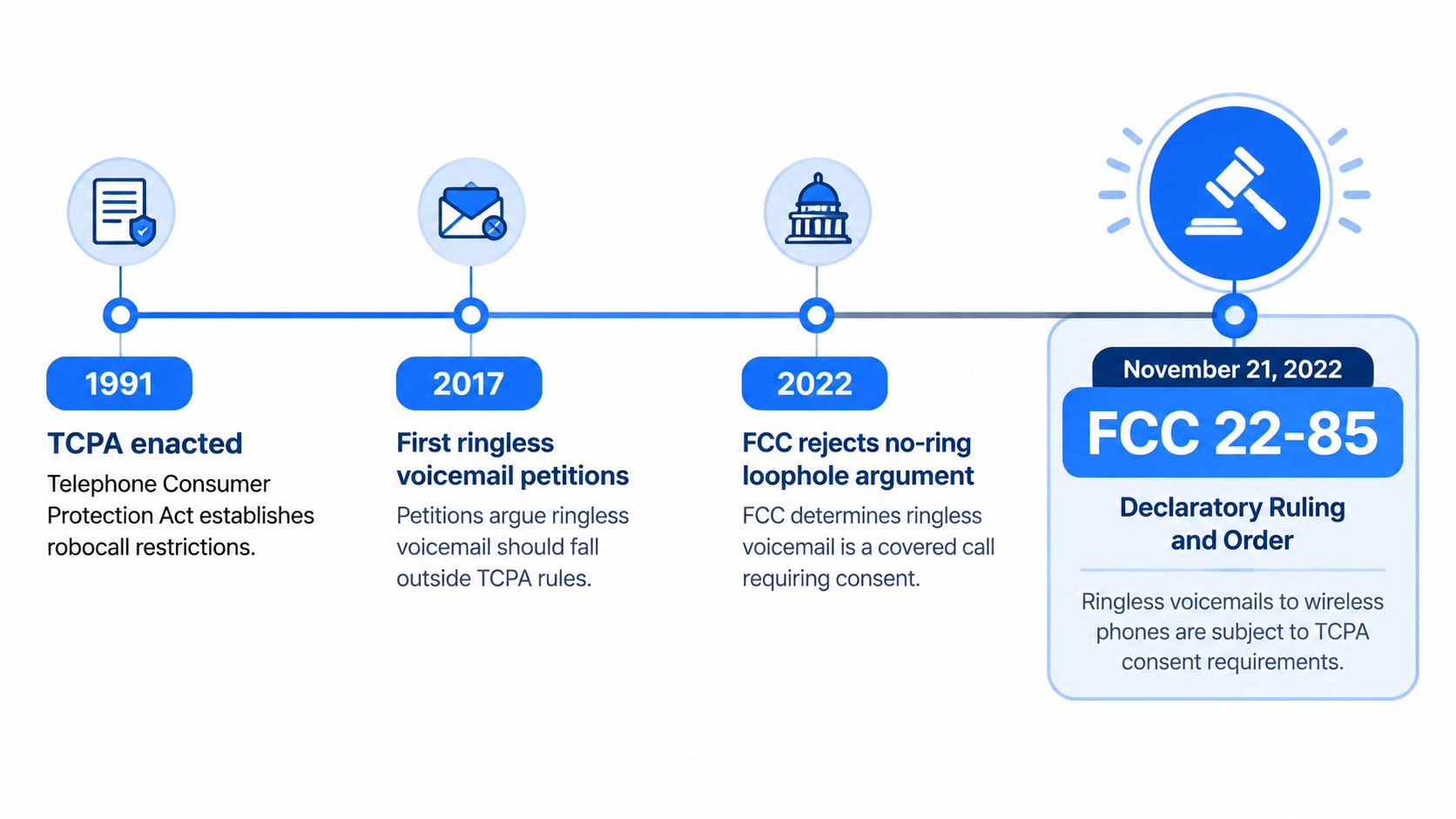
A ringless voicemail system routes an audio message to a voicemail destination without causing the handset to ring in the usual way. The technical path changes the recipient's experience, not the sender's responsibility. For a wireless number, the Federal Communications Commission treats ringless voicemail as a “call” using an artificial or prerecorded voice under the TCPA, as described in FCC Declaratory Ruling and Order FCC 22-85.
A responsible routing flow usually looks like this:
This is why ringless voicemail compliance belongs at the message-routing layer, not only at the dialing layer. A clean dialer doesn't help if a contact with revoked permission can still enter a prerecorded campaign.
A promotional recording that encourages a recipient to buy, renew, upgrade, or schedule a sales conversation deserves strict scrutiny. An informational message may have a different purpose, but that distinction doesn't eliminate the need for permission, clear identification, suppression, and appropriate records.
Readers who need a plain-language overview of the technology can review what ringless voicemail means and how it works. The important operational lesson is simple: no ring doesn't mean no call.
A campaign can pass through a routing system in seconds, yet the legal decision happens before delivery. On November 21, 2022, the FCC issued Declaratory Ruling and Order FCC 22-85, stating that ringless voicemail to wireless phones is a “call” under the TCPA because it uses an artificial or prerecorded voice. Bypassing the ring does not place the message outside the statute, as stated in the FCC's official order and announcement.
For businesses, the practical rule is direct: ringless voicemail sent to mobile numbers requires consumer consent before delivery. The campaign should apply the same permission, suppression, and recordkeeping controls used for other prerecorded or automated marketing calls.
The FCC's position turns compliance into a workflow design task. Before a message reaches the voicemail-drop queue, the system should:
A consent field without provenance is like a key without a label. It may exist, but the team cannot tell which door it opens. Healthcare campaigns also need HIPAA review at this layer. Patient information should not enter a voicemail workflow unless the message, recipient, authorization, vendor access, and disclosure settings fit the organization's privacy controls.
Teams can turn these requirements into assigned campaign controls with a practical TCPA compliance checklist, covering consent, timing, opt-outs, and documentation.
Federal rules place ringless voicemail alongside other prerecorded-call controls. Consent, quiet-hours practices, and recordkeeping still require attention, while the exact review may depend on the message, recipient, industry, and applicable state law. A national campaign should therefore treat federal compliance as the baseline, not the entire approval process.
The communication channel also affects the controls. A plain door to door soliciting definition helps illustrate why similar business purposes can face different rules across outreach methods. The principle remains consistent: permission must match the channel and purpose.
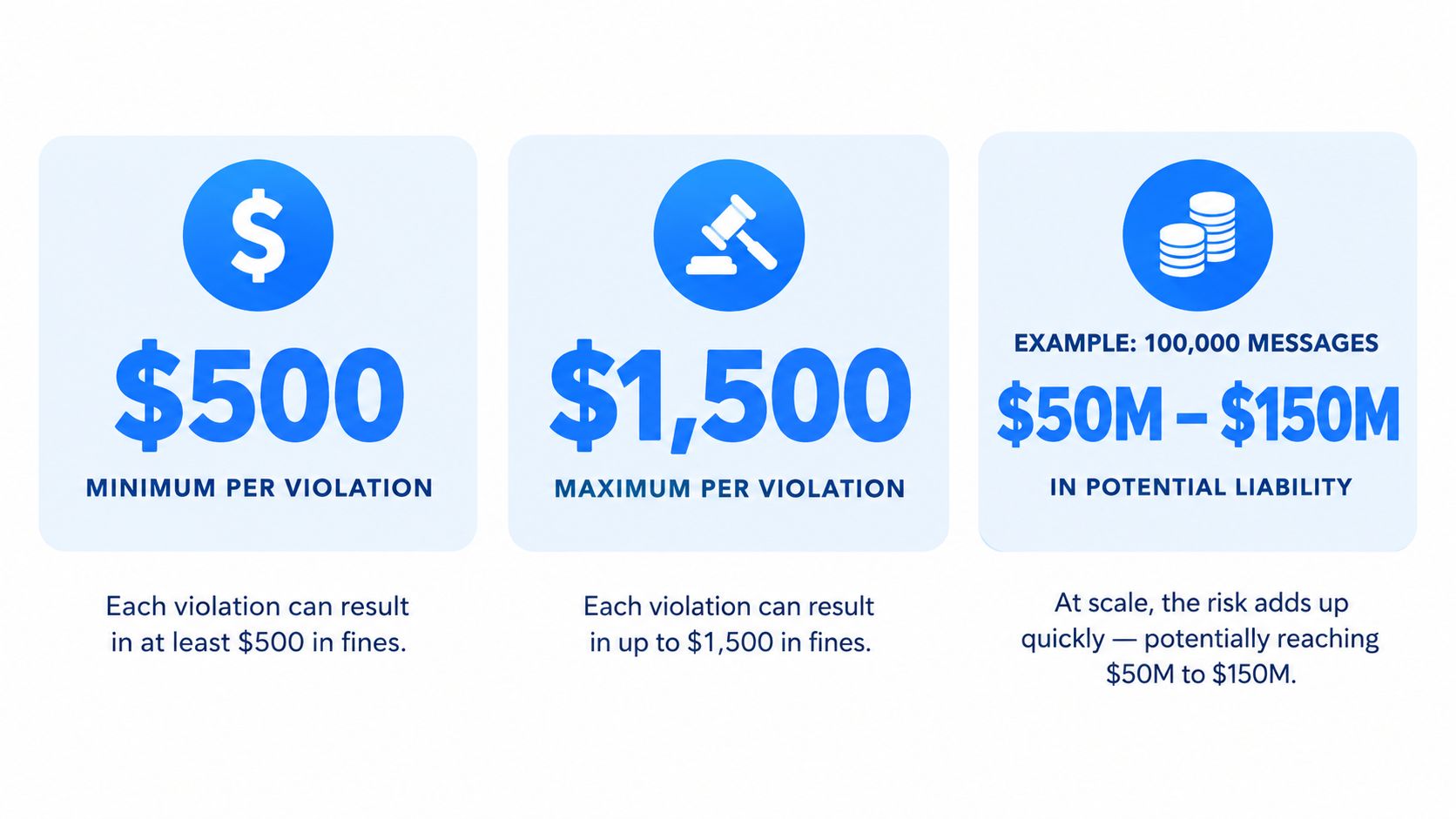
The TCPA's statutory-damages framework creates exposure of about $500 per violation and up to $1,500 for a willful or knowing violation, according to this ringless voicemail TCPA compliance analysis. That exposure makes each pre-queue routing decision part of the compliance record.
The largest mistake is treating compliance as a document someone checks after a campaign. A sender may have a polished recording, a carefully segmented audience, and a reputable delivery provider, yet still lack proof that every destination number was authorized for that exact type of outreach.
The financial exposure is calculated per violation. If a message is sent without the required consent, the statutory range is about $500 to $1,500 for each violation, with the higher amount associated with a willful or knowing violation, as summarized in TCPA basics for ringless voicemail. A high-volume campaign can therefore turn one flawed audience rule into a serious liability event.
Legal commentary on the FCC's ruling repeatedly emphasizes the same operational themes. The sender needs evidence of permission, a reliable opt-out process, and records that survive staff changes and system migrations. The FCC's treatment also rejects the idea that avoiding the ringing step changes the message's legal status, as explained in this analysis of ringless voicemail consent requirements.
Common failure points include:
Practical rule: If a reviewer can't trace permission from the destination number to the exact campaign, treat the contact as unready for dispatch.
Suppose a sender releases a campaign to a large audience without checking whether previous opt-outs were suppressed. Each disputed message may be evaluated separately, rather than treated as one indivisible campaign mistake. The risk therefore grows with the number of messages that fail the eligibility test, while the operational cost includes investigation, list reconstruction, complaint handling, and possible campaign suspension.
The most useful response isn't panic. It's prevention. Build the send process so that the system requires a valid consent record, checks current suppression status, and preserves the decision before it hands the message to the delivery layer.
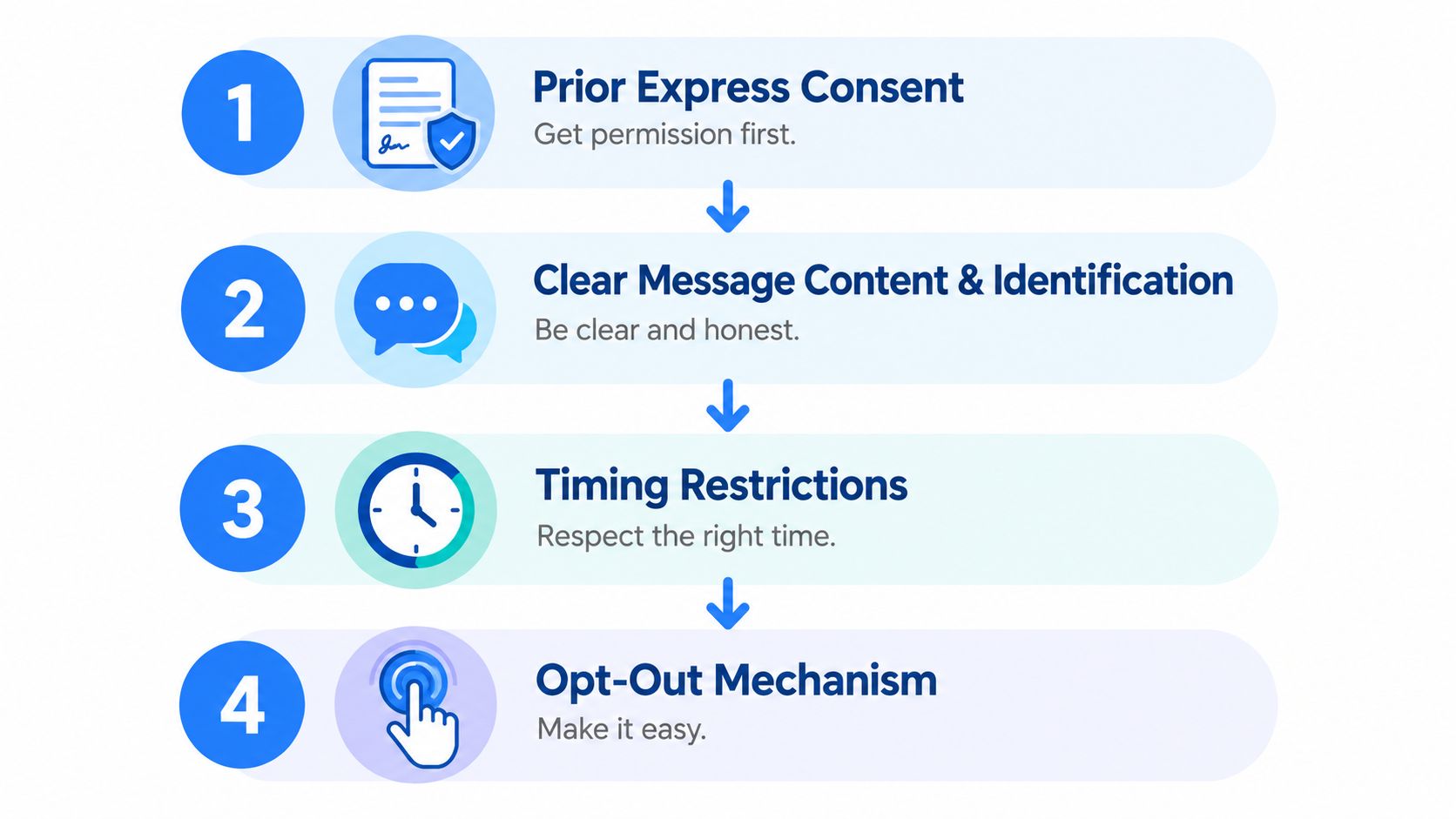
A compliant workflow follows a contact from acquisition through delivery. Start with the person, number, purpose, and permission before creating the recording. This order matters because routing rules can stop an ineligible message before it reaches the delivery provider.
Capture the consent source, destination number, date or event that created permission, and communication purpose. Preserve the language or form context that explains what the recipient accepted. A generic “yes” field cannot show whether the permission covered marketing, service communication, or another use.
Marketing campaigns need the clearest internal gate. Require documented consent for the intended automated outreach. If the record does not identify the authorized purpose, keep the number out of the ringless voicemail audience until someone resolves it.
The recording should identify the sender and explain its purpose without making the recipient guess who left the message. Avoid sensitive details, especially when a shared phone, family member, or workplace device could expose the content.
Give recipients a practical way to stop future messages. State the opt-out instruction clearly, then send the resulting request to the suppression record before another campaign can route to that number. The routing layer should treat suppression like a closed gate, not a note for someone to review later.
Use the recipient's local time instead of relying on the campaign manager's time zone. Before dispatch, apply internal do-not-call lists, campaign exclusions, prior opt-outs, and invalid-number results. A message should not reach the provider first and become compliant afterward.
Review eligibility in this order:
| Compliance Control | Marketing Messages | Informational Messages |
|---|---|---|
| Permission | Require documented consent for the intended automated outreach. | Confirm a valid relationship or permission basis, and do not assume the informational label resolves every issue. |
| Purpose match | Keep promotional consent separate from unrelated uses. | Limit the message to the stated service or account purpose. |
| Identification | State who is communicating and why. | Make the organization and reason for contact clear. |
| Opt-out handling | Provide a clear route to stop future marketing messages. | Record and honor requests consistently, even when the original message was service-related. |
| Sensitive content | Exclude confidential information from the voicemail. | Use minimum necessary detail, especially in healthcare workflows. |
| Records | Retain consent, suppression, campaign, and delivery evidence. | Retain the permission basis and message history for review. |
Healthcare organizations must connect ringless voicemail controls with HIPAA safeguards. A voicemail should disclose no more patient information than necessary. Systems handling contact data need secure access, appropriate safeguards, and controlled integrations. HIPAA also makes workflow boundaries important: the team should decide what may be left in the recording before routing patient-related outreach.
Call Loop provides ringless voicemail delivery, consent and suppression controls, do-not-call screening, scheduling, recordings, analytics, and integrations with systems such as ActiveCampaign, HubSpot, Keap, and Zapier. Teams can evaluate those functions against their consent, routing, privacy, and recordkeeping requirements.
A platform doesn't make an unlawful campaign lawful by itself. It can, however, turn policy into repeatable decisions that staff don't have to reconstruct manually for every send.
The most valuable feature is a pre-dispatch eligibility layer. Consent capture can begin with a web form, a double opt-in process, or a text-to-join keyword. The resulting record should travel with the contact, including the number, source, purpose, and status. Segmentation then separates marketing audiences from informational audiences instead of placing both in one broad list.
Do-not-call management, opt-out handling, number validation, and campaign exclusions should run before routing. If a recipient replies with an opt-out request, that status needs to reach every relevant sequence, not just the campaign that received the request.
Scheduling controls support the same principle. A campaign can use recipient-aware timing, approval steps, and pauses between messages so a contact doesn't move automatically from one channel into another after becoming ineligible.
Call Loop provides ringless voicemail delivery, consent and suppression controls, do-not-call screening, scheduling, recordings, analytics, and integrations that can connect outreach with systems such as ActiveCampaign, HubSpot, Keap, and Zapier. Teams evaluating those functions can review its ringless voicemail feature as one platform option.
Healthcare teams should avoid placing diagnoses, treatment details, appointment specifics, or other protected health information into a voicemail unless the communication and safeguards have been carefully reviewed. A safer message may identify the organization and ask the patient to return a call through an approved channel, rather than disclosing the reason in detail.
Integrations can reduce manual copying, but every connection becomes part of the privacy review. Confirm access permissions, data flow, retention, and vendor responsibilities before linking a CRM, scheduling system, automation tool, or patient workflow to a voicemail campaign.
Workflow insight: Automation reduces compliance risk only when it automates the right decision, with current consent and suppression data available at the moment of routing.
Analytics should support reconstruction, not just marketing measurement. Keep the campaign version, audience criteria, recording, consent state, suppression result, schedule, and delivery status so an internal reviewer can understand what happened without relying on memory.
A healthcare office schedules a reminder, but the patient's consent record is incomplete. A marketing team imports an old list, while a recent opt-out remains in another system. In both cases, the risk begins before delivery. A sustainable program treats compliance as routing logic that decides whether a message may proceed.
The operating rule is simple: permission must reach the dispatch decision. Consent records should identify the approved purpose, the recording should stay within that purpose, and suppression status should be checked again when the route is created. If any required value is missing or stale, the system should hold the message for review instead of sending it.
A short decision tree helps staff act consistently:
Healthcare teams should use a minimal voicemail script, such as identifying the organization and asking the patient to return the call through an approved channel. The recording should avoid diagnoses, treatment details, appointment specifics, and other protected health information unless the communication and safeguards have been reviewed.
Keep records that explain the decision, including the campaign version, consent state, suppression result, script, routing outcome, and delivery status. This creates an audit trail without relying on staff memory.
Call Loop supports SMS, voice broadcasting, and ringless voicemail workflows with consent capture, suppression tools, scheduling, recordings, and campaign analytics. Review Call Loop to assess whether its workflow fits permission-based outreach and existing team systems.
Chris Brisson
Chris is the co-founder and CEO at Call Loop. He is focused on marketing automation, growth hacker strategies, and creating duplicatable systems for growing a remote and bootstrapped company. Chat with him on X at @chrisbrisson


Trusted by over 45,000 people, organizations, and businesses like


