
See a Demo
You're just one step away from seeing Call Loop in action.
Enter your information below to watch a demo right now.

You're just one step away from seeing Call Loop in action.
Enter your information below to watch a demo right now.

“Don't Risk a $1,500 Per-Message Fine” gets attention because the TCPA is built that way, each unlawful call or text can create separate exposure, and outbound teams don't get much room for sloppy process. The law reaches SMS, voice calls, prerecorded messages, and ringless voicemail, so a campaign that looks harmless in the CRM can still create compliance trouble if consent, timing, or opt-outs are weak. The fastest way to reduce that risk is to work from a practical tcpa compliance checklist and make sure every channel follows the same rules, even when the message format changes.
The good news is that compliance doesn't have to slow outreach down. The businesses that stay clean are the ones that treat consent as recorded proof, DNC screening as routine hygiene, and caller identification as part of the message itself. That's especially true for multi-channel teams running SMS, voice, and ringless voicemail from the same list, because one bad record can contaminate the entire sequence. Get to the list quickly. No fluff, no theory, just the steps that protect your campaigns and keep customer trust intact.
Consent has to be more than a checked box. A defensible process ties the opt-in to the exact disclosure language shown, the consumer's affirmative action, the timestamp, the source channel, and the phone number. Keep that evidence with a reliable third party and audit it periodically for integrity, because that is the difference between “we think they agreed” and proof you can produce when a complaint lands. The FCC has been clear enough on this point that teams should treat consent records like primary campaign assets, not paperwork after the fact (ActiveProspect's TCPA compliance checklist).
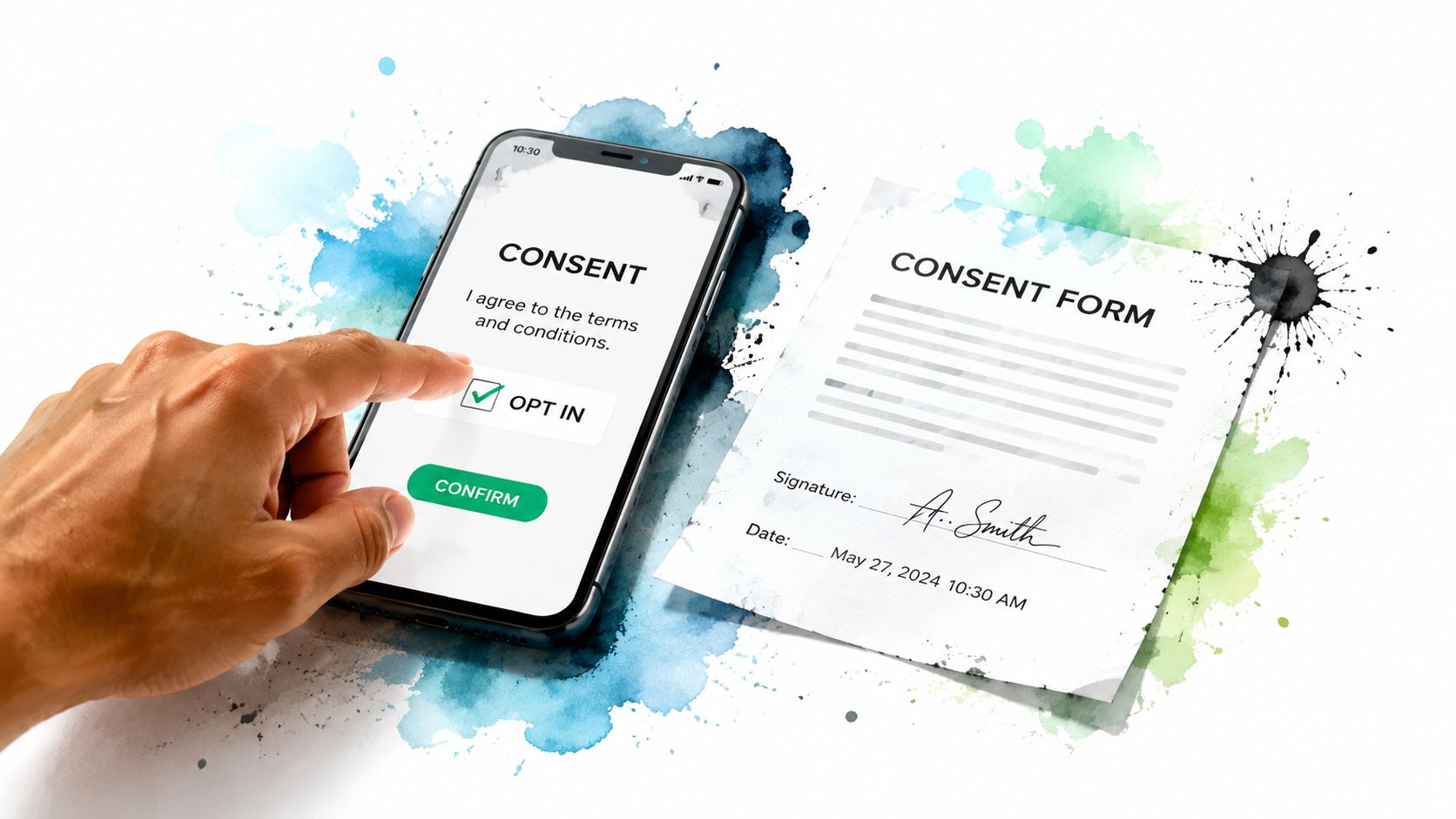
For SMS, text-to-join flows work well because they create a clean action trail. For voice broadcasts and ringless voicemail, written authorization still has to be stored and easy to retrieve, since those channels depend on the same underlying consent record. A checkout page with a clear opt-in checkbox, a healthcare onboarding form, or an event ticket purchase that includes voicemail consent can all work if the language is specific and the record is preserved. The defensible standard is simple, the user should know what they are agreeing to, and your team should be able to show that agreement without hunting through screenshots and spreadsheets.
Practical rule: separate consent by channel. A customer who opts into texts has not automatically opted into voice calls or ringless voicemail drops.
A few controls make that much stronger in practice:
Call Loop's express written consent guidance is useful because automated proof keeps a high-volume outreach program from turning into a records scramble later. The partner-facing conditions for text services should sit alongside that evidence, especially if your consent language is built into a broader signup flow. The point is not just legal defensibility, it is operational clarity. If your team cannot prove consent quickly, your team does not control consent well enough.
The National Do Not Call Registry is the first screen your outbound list should pass before any telemarketing call or ringless voicemail campaign goes out. FCC enforcement guidance and FTC Telemarketing Sales Rule materials both make the core expectation clear, scrub against the registry when no exemption applies, then keep the rest of your controls aligned, including calling-hour limits, consent records, caller ID, and internal suppression lists. Wipfli's TCPA compliance checklist lays out that same structure. The reason it matters is simple, a list that looked clean at upload time can become noncompliant if the scrub process is inconsistent.
Treat the registry as an active control, not a one-time cleanup. Compliance teams should be able to show which version of the list was used, when it was applied, and which numbers were removed before launch. For mixed outreach, that screening should cover voice broadcasts, ringless voicemail, and SMS whenever the same telemarketing rules apply.
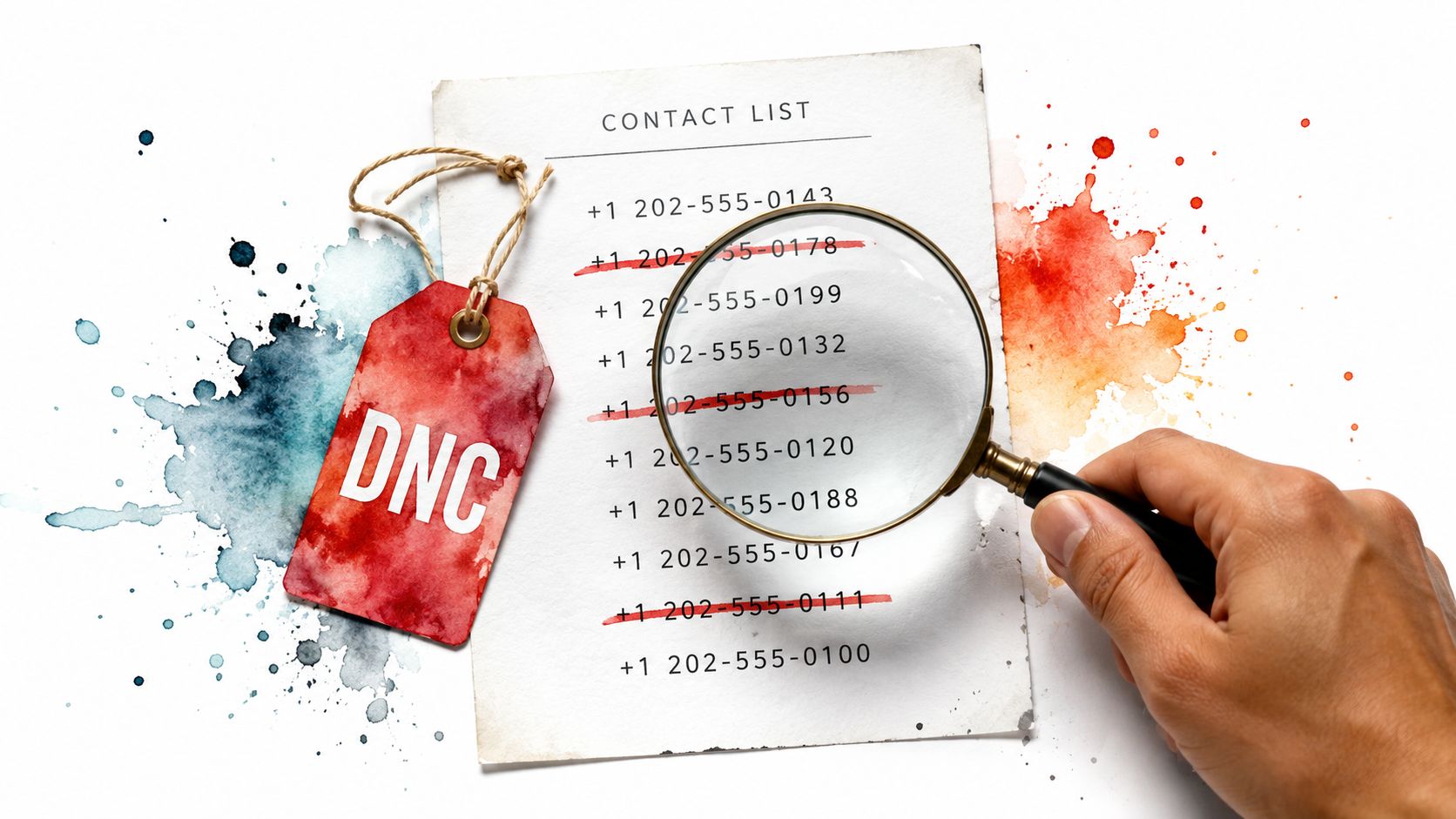
A workable process usually looks like this:
Manual scrubbing gives you more visibility, but it also leaves more room for human error. Platform-based DNC management lowers that risk by filtering numbers before delivery, which is why many outbound teams use it for repeat campaigns. If you want a practical reference point for that setup, Call Loop's do-not-call list compliance overview shows how suppression logic and proof of removal fit into one workflow. The value is not only removing bad numbers, it is showing that the removal happened before contact.
The national registry is only half the story. Every business also needs its own internal do-not-call list, because opt-out requests can come in by phone, SMS, email, or website form, and they need to be honored without delay. If someone says stop, the contact record needs to move into suppression logic fast enough that the next campaign never reaches them again.
SMS makes this easy to see because the STOP reply is familiar, but the same standard applies when someone tells a rep not to call during a live conversation. A healthcare office removing a patient from appointment reminders after one request, or a sales team documenting a prospect's no-call request in the CRM, both need the same discipline. The method changes, the obligation doesn't.
A slow opt-out process is a self-inflicted compliance problem. The business is telling the customer it heard them, then proving the opposite by sending another message.
Strong internal suppression control usually includes:
The trade-off is simple. A tightly managed internal DNC list can slightly reduce reach, but it sharply lowers complaint risk and protects deliverability over time. That's a better business outcome than squeezing a few more sends out of a dirty list. The best campaigns don't just find reachable people, they respect the people who asked to leave.
Classification drives the rest of the compliance stack. Commercial campaigns, such as promotional SMS or telemarketing voice outreach, need the strictest controls, while non-commercial debt collection or certain informational communications follow different rules. Ringless voicemail sits in the middle of a lot of confusion because the delivery method is different, but the message still has to be classified by content and handled under the correct consent and DNC framework.
A fitness studio sending class promotion texts, a marketing agency running lead-gen outreach, and a healthcare provider leaving appointment-related ringless voicemail are not operating under the same risk profile. The content determines how restrictive the controls should be, and if there's any doubt, the safer move is to treat the campaign as commercial. That conservative choice is usually easier to defend than trying to justify a borderline message after the fact.
Document the rationale, not just the category. If a campaign is informational, say why. If a message includes promotional content, mark it that way before launch. Teams that skip this step often end up with inconsistent scripts, mismatched consent records, and campaigns that look fine in isolation but don't hold together under review.
For ringless voicemail, this matters even more because the format can tempt teams to think it's somehow outside normal calling rules. It isn't. The message content still drives the compliance treatment, and the channel still needs the right consent, DNC handling, and caller identification logic. When classification is fuzzy, compliance gets fuzzy with it.
Calling-hour compliance is one of the simplest rules to state and one of the easiest to miss at scale. The TCPA and FCC rule on permissible calling hours set the window for telemarketing calls at 8 a.m. to 9 p.m. in the recipient's local time zone, so the deciding factor is where the person being contacted is located, not where your team sits. For national outreach, that means your records have to resolve time zone correctly before the first dial or voicemail drop, including ringless voicemail campaigns that still have to respect local-time rules.

The practical answer is automation. Schedule by recipient zone, not by rep judgment, so the system handles daylight saving changes, national calling lists, and multi-channel outreach without relying on someone to do the math by hand. That matters for voice calls and ringless voicemail alike, because the timing rule does not change just because the delivery method does.
For recurring campaigns, document the time-zone logic before launch. If the database assigns a recipient to the wrong zone, the send time is wrong too, even if the message content is otherwise compliant. Call Loop can help here by centralizing scheduling rules across SMS, voice, and voicemail drops, which reduces the chance that one channel slips outside the allowed window while another stays inside it.
Practical rule: if the database time zone is wrong, the campaign is wrong. Guessing is not a compliance strategy.
The gap usually shows up between policy and execution. The written policy says not to call early or late, while the dialer or CRM is often built to send immediately unless someone stops it. Good systems resolve that conflict automatically and block sends that fall outside the local window. Weak systems leave the rep to catch the problem after the fact, which is a bad place to put the risk.
A reliable process does three things well. It validates the stored time zone, applies the local-time window at delivery, and blocks exceptions unless an authorized reviewer approves them. That matters for healthcare reminders, event notifications, sales follow-up, and any other outreach where the recipient experience affects the complaint rate. If your timing feels intrusive, your compliance controls are already working against you.
Caller ID is not decoration. It's part of the compliance story, and the number you show has to be real, accurate, and associated with your organization or a legitimately authorized third party. Spoofing or misrepresenting a caller ID creates avoidable risk, and outbound programs should use a recognizable line that customers can call back if needed.
For a clinic, that might be the main office number. For an event organizer, it might be the branded line used for registration follow-up. For ringless voicemail, the same standard applies, because the recipient still needs to know who is reaching out and how to respond. A number that looks suspicious or impossible to call back will only create more complaints and more blocked contact attempts.
A few habits help keep caller ID clean:
The trade-off is that branded numbers may not always be the most aggressive conversion choice, but they're the safer long-term choice. A visible, trustworthy caller ID supports pickup rates and helps recipients distinguish legitimate outreach from spam. That's a compliance win and a brand win, and in outbound work those two usually travel together.
Every regulated message should answer two questions immediately, who is contacting me, and how do I respond or opt out. That applies to SMS, voice broadcasts, and ringless voicemail. In SMS, the business name or identifier should be visible, and the message should include a callback number or a clear STOP instruction. In voice and voicemail, identification needs to be spoken clearly, early, and in a way the recipient can understand without replaying the message.
The easiest way to fail here is to bury the identity in the middle of a long script. A better pattern is to open with the company name, the reason for contact, and the return number. Healthcare appointment reminders are a good example because the clinic name, purpose, and callback line all need to be obvious from the start. That same logic applies whether the message is promotional or informational.
If the recipient can't tell who called, your message has already lost trust.
Keep the language simple and stable across campaigns:
The practical payoff is obvious. Clear identification reduces confusion, reduces complaint volume, and makes opt-out handling smoother because recipients know exactly who they're dealing with. It also supports later audit work, because the message content itself shows the recipient wasn't left guessing. That's the kind of detail that separates a real compliance program from a loose set of scripts.
Ringless voicemail gets treated like a shortcut by teams that haven't worked with it closely. It isn't. The channel delivers audio straight to voicemail inboxes without ringing the phone, but it still sits under the same core compliance expectations as voice outreach, including prior express written consent, DNC screening, time-of-day controls, and accurate caller ID. It also needs careful delivery records, because successful drops and failed attempts matter operationally and financially.
That makes ringless voicemail especially useful for appointment reminders, class changes, and follow-up messages where voice mail is an acceptable touchpoint. A dental office, a karate studio, or an automotive service center can all use it well if the consent record is specific, the recipient list is scrubbed, and the timing logic respects the local calling window. The channel is efficient, but only if the records behind it are disciplined.
The operational controls are straightforward:
Call Loop's ringless voicemail marketing overview is relevant because the channel's biggest advantage is also its biggest risk. It can move fast, so the compliance controls have to move just as fast. A good ringless voicemail program doesn't just deliver messages, it proves every delivery was allowed.
| Item | Implementation complexity | Resource requirements | Expected outcomes | Ideal use cases | Key advantages |
|---|---|---|---|---|---|
| Obtain Prior Express Written Consent Before Initiating Outbound Calls or SMS | High, implement opt‑in flows and verification | Moderate‑High, opt‑in capture, storage, double opt‑in, audit logs | Defensible compliance, reduced TCPA penalty risk, higher engagement | Marketing SMS, ringless voicemail, voice broadcasts | Eliminates major TCPA exposure, creates audit trail, higher-quality list |
| Maintain and Update the National Do‑Not‑Call (DNC) Registry List | Medium, schedule regular screenings and integrations | Low‑Medium, DNC downloads/integration, logging, comparison tools | Fewer DNC violations, documented screening evidence | Large outbound call/SMS campaigns, telemarketing | Automatic filtering prevents contacting protected numbers, compliance documentation |
| Implement Company‑Specific DNC Lists and Honor Opt‑Out Requests | Medium, real‑time opt‑out capture and propagation | Medium, STOP handling, CRM sync, staff training, retention | Reduced complaints and lawsuits, immediate opt‑out enforcement | Ongoing customer communications, transactional messaging | Respects customer preference, immediate removal, audit trail for opt‑outs |
| Identify and Classify Calls as Commercial or Non‑Commercial (Including RVM) | Medium‑High, legal definitions and campaign policies | Low‑Medium, documentation, training, campaign tagging | Correct rule application, reduced misclassification risk | Mixed campaigns (marketing vs informational), RVM classification | Ensures appropriate controls per message type, lowers legal risk |
| Establish and Enforce Calling Time Restrictions (8 AM–9 PM recipient TZ) | Medium, require time‑zone detection and scheduling | Medium, time‑zone database, scheduling engine, testing | Avoids time‑of‑day violations, better recipient experience | National campaigns, time‑sensitive reminders, RVM scheduling | Automates compliance across zones, reduces late/early complaints |
| Maintain Accurate Caller ID Information and Display Valid Caller Identification | Low‑Medium, number validation and registration | Low, legitimate numbers, authorization, testing | Fewer spoofing violations, improved answer and callback rates | Voice broadcasts, callbacks, ringless voicemail | Builds trust, avoids Truth in Caller ID Act penalties, better deliverability |
| Provide Clear and Conspicuous Identification and Contact Information in Every Message | Low, update templates and scripts | Low, message templates, dynamic insertion, compliance checks | Greater transparency, fewer opt‑outs and spam complaints | SMS, voice messages, ringless voicemail | Clear sender ID, easier opt‑out, consistent regulatory compliance |
| Implement Ringless Voicemail Compliance and Track Per‑Drop Charges | High, RVM‑specific consent, delivery, billing, reporting | High, RVM platform, consent records, DNC screening, per‑drop accounting | Non‑intrusive reach, measurable per‑drop costs, compliance if managed | Appointment reminders, event notifications, service industry outreach | Higher delivery rates, pay‑per‑drop efficiency, complements multi‑channel campaigns |
A solid tcpa compliance checklist does more than reduce legal exposure. It gives outbound teams a cleaner operating model, because consent is documented, DNC lists are current, opt-outs are honored fast, and message identity is consistent across channels. That makes campaigns easier to run and easier to defend, which is exactly what smart outreach should look like.
The biggest mistake is treating compliance like a one-time policy document. In practice, it's a workflow issue. Teams need to capture consent at the point of signup, scrub lists before each launch, enforce the local-time window automatically, and keep records ready for review when a complaint comes in. The businesses that do this well usually spend less time cleaning up problems and more time improving message quality.
Ringless voicemail adds another layer, but not a separate standard. It still depends on consent, caller identification, DNC screening, and clear message content. The companies that succeed with it are the ones that treat it as part of the same outreach system, not as a loophole or a shortcut.
Platforms like Call Loop fit naturally into that model because they combine SMS, voice broadcasting, and ringless voicemail in one outbound workflow. That makes it easier to keep consent records, opt-outs, and delivery rules aligned across campaigns instead of scattered across tools and spreadsheets.
If you want a cleaner way to manage SMS, voice, and ringless voicemail from one place, visit Call Loop and see how its outbound tools fit into a compliance-first workflow. Use it to build consent, suppression, and delivery controls into the same system your team already uses to send campaigns.
Chris Brisson
Chris is the co-founder and CEO at Call Loop. He is focused on marketing automation, growth hacker strategies, and creating duplicatable systems for growing a remote and bootstrapped company. Chat with him on X at @chrisbrisson


Trusted by over 45,000 people, organizations, and businesses like


