
See a Demo
You're just one step away from seeing Call Loop in action.
Enter your information below to watch a demo right now.

You're just one step away from seeing Call Loop in action.
Enter your information below to watch a demo right now.

Ringless voicemail in 2026 typically costs $0.01 to $0.10 per successful drop, with the lowest rates reserved for high-volume plans. That range is only the starting point, because your actual cost depends on delivery rules, compliance controls, list quality, platform fees, and whether voicemail works alone or inside a broader outreach workflow.
You're probably looking at a vendor's pricing page right now, comparing a few cents per voicemail and wondering why the plans don't line up. One provider bills attempted sends, another bills confirmed deliveries, and a third bundles voicemail with SMS, automation, or a monthly platform fee. Those offers aren't directly comparable.
The useful question isn't “What's the cheapest ringless voicemail rate?” It's “What will I pay to place a compliant, deliverable voicemail in front of an actionable recipient?” This guide gives you the pricing models, cost drivers, campaign math, vendor questions, and contract terms needed to answer that question before you commit.
A vendor may quote a few cents per drop, yet your invoice can rise once validation, consent controls, filtering, and workflow tools are included. The first question is not whether the rate looks low. It is what event triggers the charge.
“Drop” can mean an attempted delivery, a completed voicemail placement, or a credit deducted after the platform processes a record. Those billing events produce very different costs. A per-drop rate is useful only after the vendor defines which records count and which are excluded.
In the 2026 market, successful ringless voicemail drops typically cost about $0.01 to $0.10 each. Published ringless voicemail pricing examples show pay-as-you-go pricing of approximately $0.10 per drop at 100 deliveries, $0.06 at 1,000, and $0.04 at 10,000, while volume plans can reach $0.02 or less per drop. Purchasing volume can therefore create a 5x to 10x unit-cost swing, before compliance and platform charges enter the calculation.
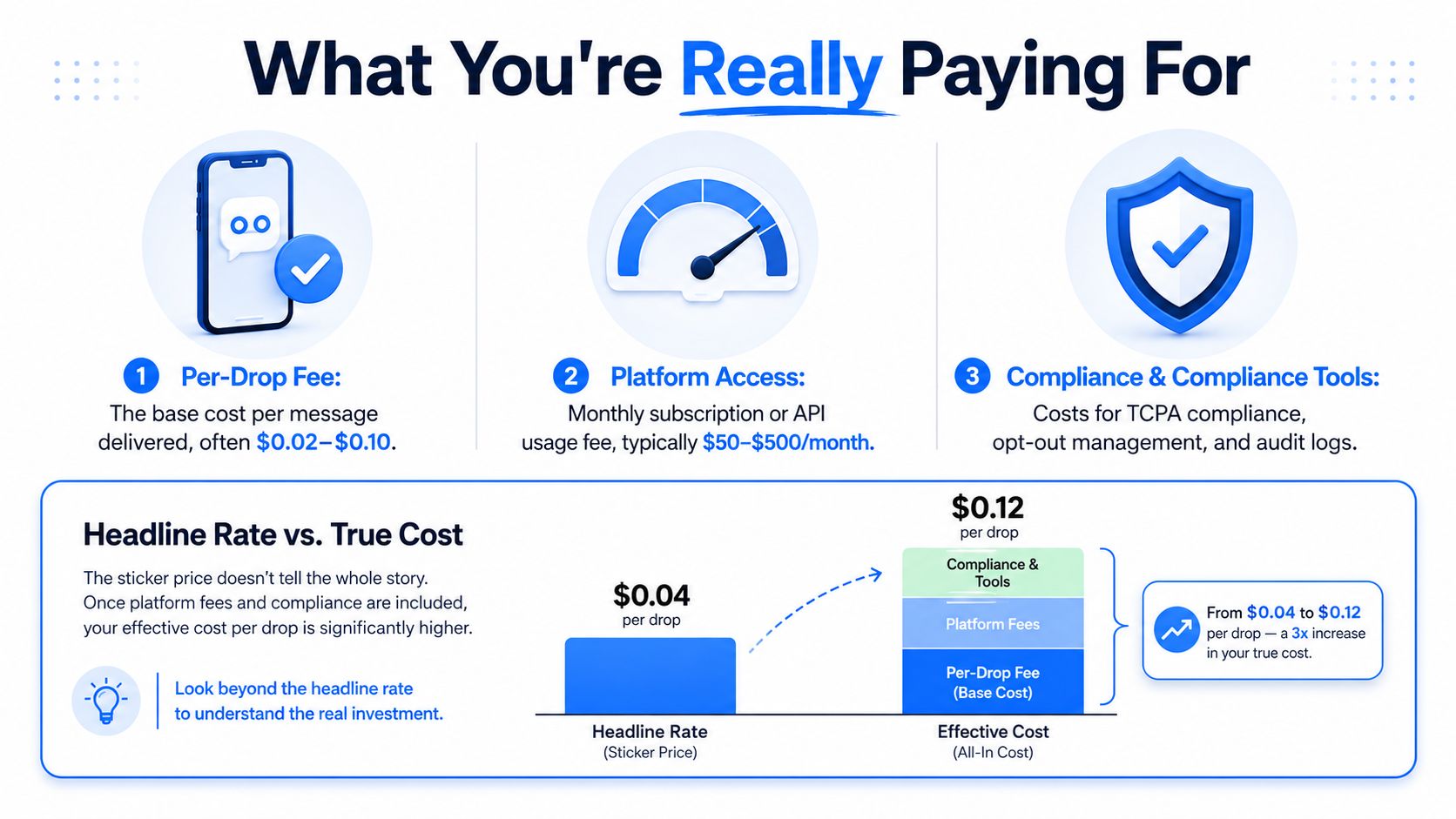
Your all-in cost may include:
Delivery filtering also changes the comparison. A platform that excludes screened-out landlines or VoIP numbers may quote a higher headline rate while producing less waste, because billing is tied to confirmed delivery rather than every attempted send. The guide to what ringless voicemail is explains the channel's basic operation, but each provider's billing definition still requires review.
Pricing rule: Compare per-drop rates only after confirming whether the vendor bills attempts, processed records, or successful deliveries.
Compliance belongs in the price model. Ringless voicemail to wireless numbers falls under rules for calls using an artificial or prerecorded voice. Prior express consent is required for wireless outreach, and prior express written consent is required for marketing messages. A low rate applied to an unverified list can create suppression work, failed delivery, and legal exposure that exceeds the initial savings. Before signing, ask how consent evidence, filtering results, opt-outs, and bundled SMS or voice services appear on the invoice.
Ringless voicemail vendors generally organize their offers around successful drops, usage, or subscriptions. Choose the model that matches how predictable your campaign volume is, not the one with the smallest number on the sales page.
This is the cleanest model for testing or irregular outreach. You pay when the vendor confirms delivery to the recipient's voicemail environment, subject to the provider's definition of success. It suits a local business running occasional reminders, a sales team testing a new audience, or an agency that doesn't want unused credits sitting in an account.
The trade-off is a potentially higher unit rate at lower volumes. That premium can still be rational because pay-as-you-go reduces commitment risk. If your list size changes every month, paying only for delivered drops may cost less than buying a subscription quota you won't use.
Ask whether unsuccessful attempts are excluded, and ask for the delivery report that proves the billing event. A “successful” status should be understandable enough for your finance team to reconcile against the campaign.
Per-minute pricing appears more often in platforms that combine voicemail with voice broadcasting or other telephony services. Instead of charging for each voicemail placement, the provider may calculate usage from audio duration, processing time, or a broader voice allocation.
This model can work when voicemail is one component of a larger voice operation. It's harder to forecast when message length varies or when the platform doesn't clearly separate voicemail usage from live calls, transfers, or other voice functions.
Before accepting usage billing, request a sample invoice. The invoice should show the unit measured, the rate applied, and how failed deliveries are treated.
A subscription gives you a recurring allowance of drops, features, or credits. It may include scheduling, analytics, integrations, support, or campaign controls that aren't available in a basic pay-as-you-go account.
Subscriptions make sense when your volume is stable and the included tools replace manual work. They become expensive when credits expire, overage rates are unclear, or the plan includes capacity your team rarely uses. Check rollover rules, minimum terms, auto-renewal, and the price for exceeding the allowance.
Practical test: Estimate your low, typical, and high monthly volume. If the subscription only wins in your high-volume month, stay flexible until demand becomes predictable.
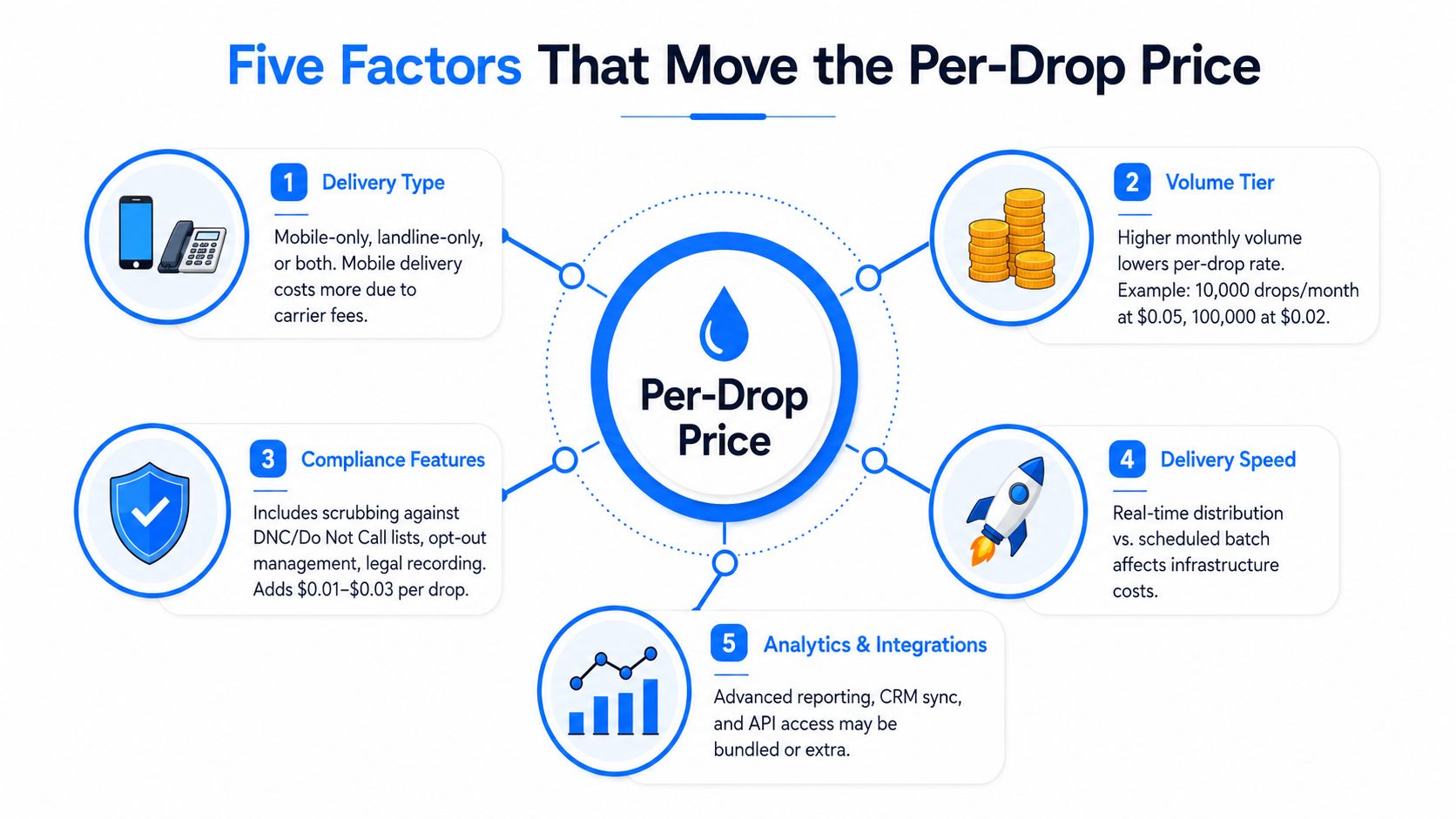
The headline per-drop rate is only the starting point. Your true cost also reflects compliance controls, delivery filtering, staff time, and any bundled channels or software. Five variables usually determine the invoice.
Mobile-only, landline-only, and mixed-number campaigns require different handling. Wireless ringless voicemail is treated by the FCC as a call using an artificial or prerecorded voice, so prior express consent is required for wireless outreach under TCPA rules, as noted earlier.
A vendor that screens number types, applies suppression rules, and records consent activity may charge more than a bare delivery service. Pay for those controls when they reduce wasted sends, manual review, and compliance exposure. A low rate without them can produce a higher all-in cost.
A quoted rate has limited value if it applies to attempted drops rather than confirmed deliveries. Ask whether the provider bills for delivered voicemail volume and how it handles disconnected numbers, ineligible landlines, and other failed attempts. CallLoop's pricing information provides a useful example of why billing units deserve close review.
Request definitions for delivered, failed, screened out, and pending. Those statuses should appear in campaign reporting. Without them, you cannot reconcile the invoice or calculate the actual cost per usable contact.
Published examples show lower unit pricing as order size rises, from roughly $0.10 per delivery at 100 drops to $0.06 at 1,000 and $0.04 at 10,000, with higher-volume plans reaching $0.02 or less. That creates a 5x to 10x unit-cost difference between low-volume and high-volume purchasing.
Use those figures as reference points, not as a budget. A large allowance can become expensive when credits expire, the list is not ready, or compliance review blocks part of the campaign. Buy capacity that matches verified demand.
Consent capture, do-not-call suppression, opt-out management, number-type screening, and audit logs all affect the all-in price. Some providers include these controls. Others charge for list cleaning, add-ons, or manual support.
Treat compliance as an operating requirement. Compare the cost of a compliant delivered voicemail, including review and filtering, with the cost of an unfiltered send. The cheaper per-drop rate is irrelevant if it creates unusable records or avoidable rework.
Native CRM connections and API access can reduce repetitive imports, status updates, and campaign triggers. Platforms may connect with HubSpot, ActiveCampaign, or Keap, while Zapier can connect campaigns to broader application stacks.
The integration earns its cost only when it removes measurable work. Map the workflow before comparing plans. If a higher-priced platform enrolls opted-in contacts, records delivery, and triggers follow-up automatically, it may cost less to operate than a cheaper tool that requires spreadsheet handling. Also check whether SMS or voice features are bundled, since unused channel capacity can inflate the apparent savings.
A campaign can look inexpensive on the pricing page and still cost more after filtering, failed delivery, compliance controls, and bundled channels enter the invoice. Run the math against confirmed deliveries, not uploaded records or headline rates. Use the vendor's quote as the final input, because published examples do not establish a universal rate for every campaign size.
As noted earlier, rates can fall from $0.10 at low volume to $0.02 or less at scale. A current vendor example lists 100 deliveries at $10 pay-as-you-go or $8 on a monthly delivery plan, and advertises plans above 10,000 monthly deliveries (Slybroadcast pricing information). Treat these figures as planning references, then verify billing rules, overages, minimums, and included features.
| Campaign Size | Pay-as-you-go Rate | Subscription Rate | Effective Cost per Drop |
|---|---|---|---|
| 500 delivered drops | Apply your quoted rate | Apply the vendor's quoted monthly rate | Total charge divided by confirmed deliveries |
| 5,000 delivered drops | Apply your quoted rate | Apply the vendor's quoted monthly rate | Total charge divided by confirmed deliveries |
| 50,000 delivered drops | Request a volume quote | Request an enterprise subscription quote | Total charge, including fees, divided by confirmed deliveries |
The table is a worksheet, not a forecast. A low per-drop figure has little value if filtering, compliance review, or follow-up tools sit outside the plan.
Suppose you upload 10,000 numbers and 30% are landlines or VoIP. This is a hypothetical planning example, not a market benchmark. If the provider removes those records and bills only confirmed mobile deliveries, the billable base becomes 70%, or 7,000 records, assuming every remaining record delivers successfully.
At a quoted rate of $0.04 per successful drop, the voicemail charge would be $280. That result applies only when the provider confirms both the filtering rule and successful-delivery billing. If billing covers attempted sends, filtered records may still produce charges.
Calculate subscription break-even by dividing the total monthly cost by its delivered-drop allowance. Compare that effective rate with pay-as-you-go pricing, then include overages, minimum commitments, unused credits, compliance fees, and bundled channel charges. The lowest advertised rate is not the lowest operating cost.
A campaign can show a low ringless voicemail rate and still cost more than expected. Compliance checks, deliverability filtering, failed attempts, and bundled follow-up channels determine the invoice. Compare the channel against the outcome you need: a recipient touch, a reply, a completed action, or a conversation.
SMS is commonly billed by message segment, with carrier charges and compliance requirements affecting the final cost. Longer copy can use multiple segments, while links, media, and automation may add platform fees. SMS usually puts the call to action directly in the recipient's text inbox, so it fits time-sensitive replies and link clicks. Its effective cost depends on message length, carrier treatment, and how many messages are needed to produce the desired action.
Voice broadcast is commonly priced by minutes or connected calls. Providers may bill live answers, machine answers, transfers, and failed connections differently. Voice supports a richer interaction path, but the workflow can require more infrastructure and human follow-up than a voicemail-only touch.
Ringless voicemail fits a recorded message that adds context without requiring a live conversation. It performs poorly as the only channel when recipients need an immediate reply, two-way exchange, or fast link click. Use it as a follow-up layer when SMS carries the direct action and voicemail adds urgency, explanation, or a more personal audio message.
Bundled plans can hide the true cost of each touch. A vendor may quote an attractive voicemail rate while placing SMS automation, compliance tools, filtering, or workflow fees elsewhere on the invoice. Separate those charges before comparing plans.
Build a channel-level worksheet with these columns:
Calculate cost per completed action, not only cost per drop or message. A cheaper channel can lose its advantage if filtering reduces reach, compliance work is manual, or the bundle charges for follow-up tools you do not use.
Channel rule: Choose voicemail because it improves the sequence, not because its sticker price looks lower than SMS or voice.
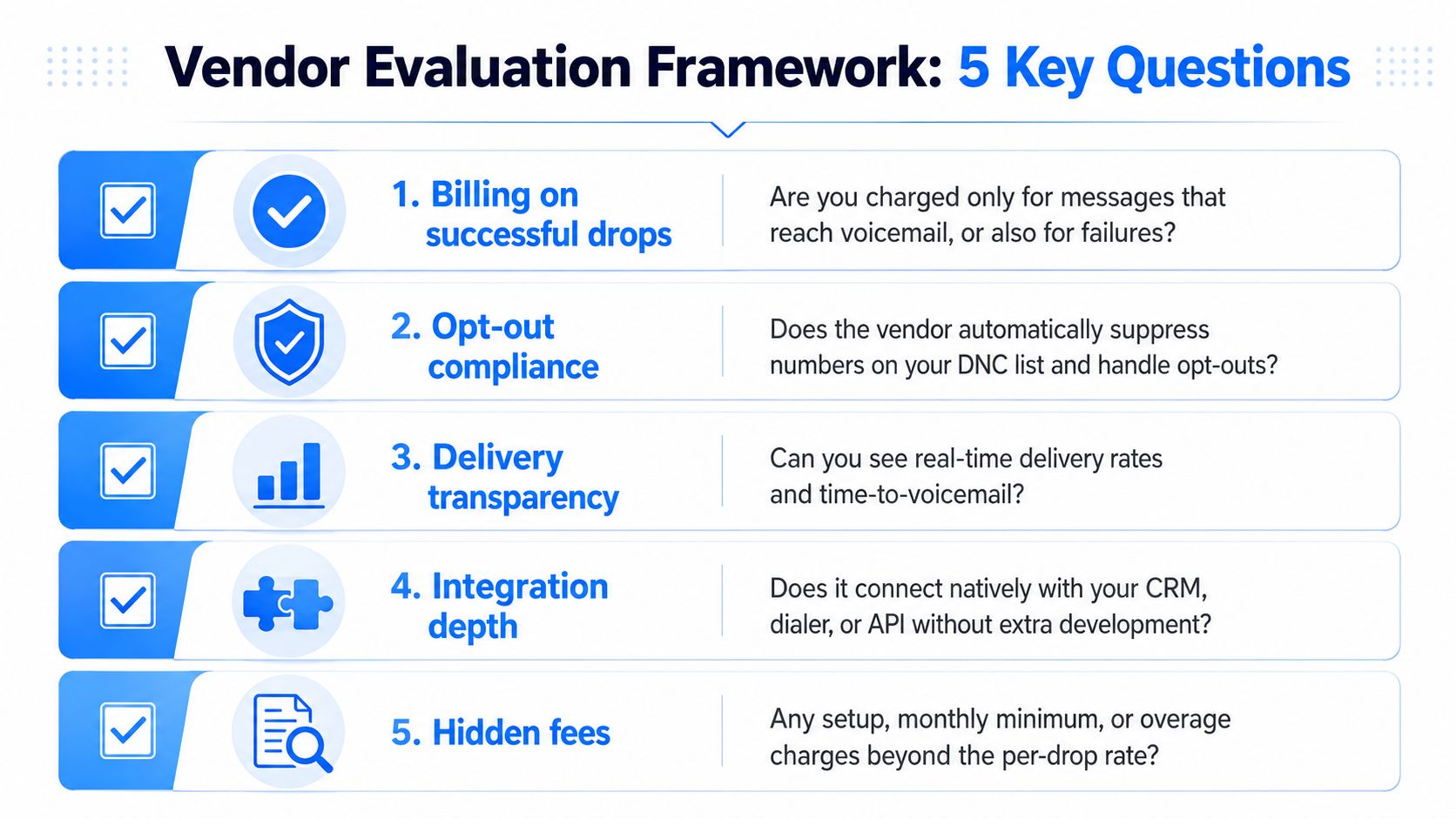
Two vendors can quote the same per-drop rate and produce different invoices. Use these five questions before comparing features.
Get the answer in writing. Successful-drop billing can protect your budget when numbers are disconnected, incompatible, or screened out. Attempt billing shifts list-quality risk onto you.
Ask for a sample delivery report and a sample invoice. The report should reconcile with the invoice without manual guesswork.
Confirm whether the service supports mobile numbers, landlines, VoIP numbers, or only a subset. Ask what happens when the platform identifies a number that can't receive the intended delivery.
A platform that pre-validates an opted-in mobile list can lower your effective cost per actionable voicemail by reducing non-compliant or undeliverable attempts. That value may not appear in the advertised rate.
“Delivery” needs a practical definition. Ask whether the vendor reports carrier confirmation, voicemail placement, processing completion, or an internal status. Also ask how failures are credited and how quickly the platform updates reporting.
Look for consent records, suppression lists, opt-out processing, number-type screening, and audit logs. Wireless outreach requires consent under the FCC's treatment of ringless voicemail, so a vendor that leaves all screening to your team creates operational risk.
Check native integrations, API access, webhook support, CRM field mapping, and automation triggers. A platform that fits HubSpot, ActiveCampaign, Keap, or a Zapier-connected workflow can reduce manual administration, but confirm whether those connections are included or separately priced.
The ringless voicemail feature overview is one example of the type of product detail buyers should inspect, including delivery behavior and workflow capabilities. Use the same standard for every vendor on your shortlist.
A low rate can hide expensive terms. Ask these questions before you approve a purchase order:
Negotiate the clauses that affect your downside. Focus on minimum commitments, auto-renewal, price increases, delivery remedies, data ownership, termination rights, support scope, and HIPAA-aligned terms if your organization handles protected health information.
TCPA exposure makes these details financially material. Independent legal summaries commonly describe statutory damages as $500 per violation and up to $1,500 per willful violation, as outlined in this TCPA compliance summary. Those figures are not a reason to panic, but they are a reason to demand consent controls and clear responsibility in the contract.
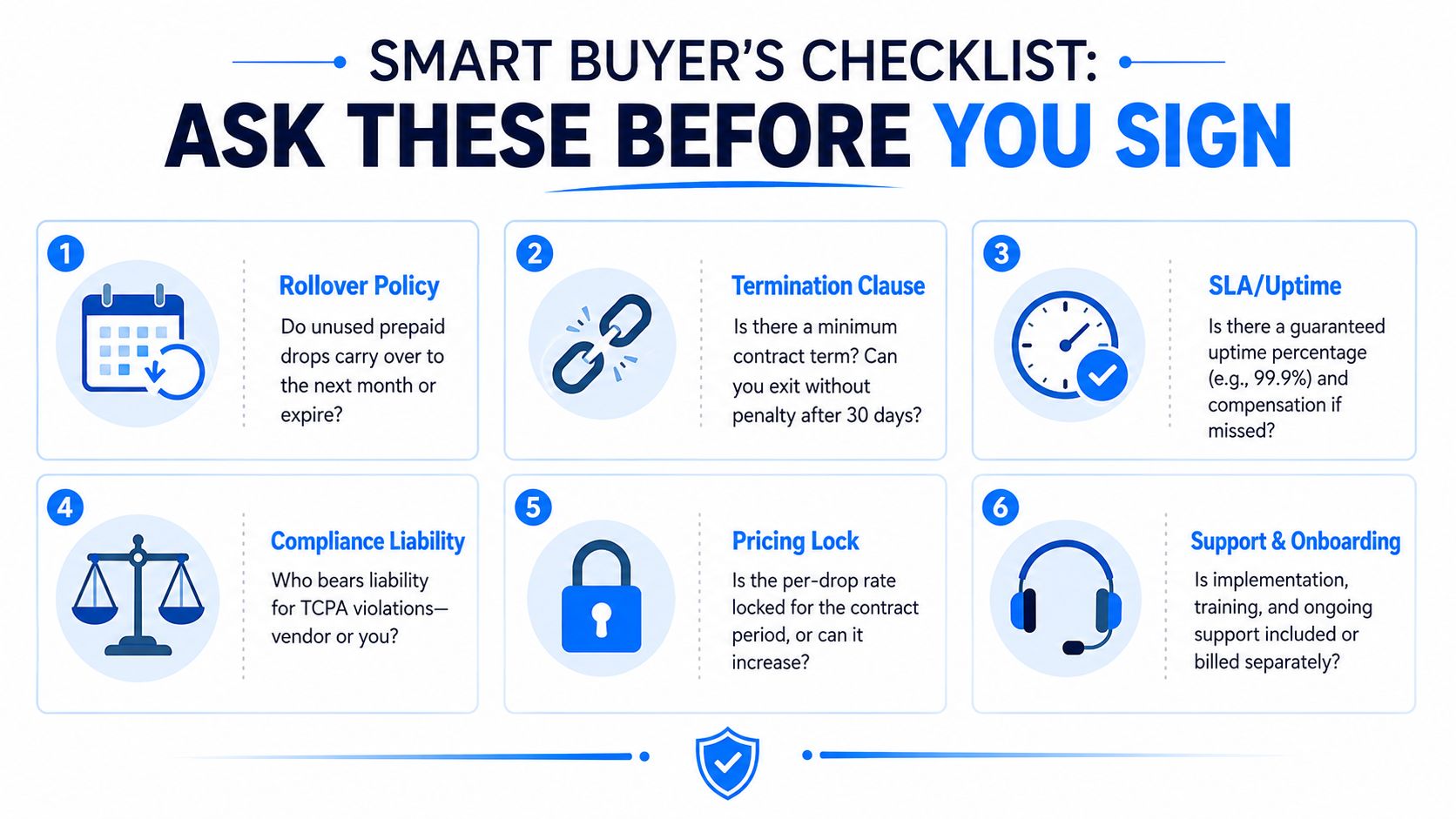
Read the TCPA compliance guidance before launching a marketing campaign, then ask the vendor to identify which controls it provides and which remain your responsibility. Avoid agreements that promise low pricing but say little about delivery failures, consent evidence, suppression, or data access.
Pick a ringless voicemail plan in four passes.
First, estimate delivered volume, not list size. Separate opted-in mobile numbers from records that require screening. Your forecast should show expected successful deliveries, failed records, and the number of follow-up actions the campaign needs.
Second, match the billing model to predictability. Pay-as-you-go works well for pilots and irregular campaigns. A subscription can make sense when your team consistently uses its allowance and the included automation replaces manual work. Don't accept a recurring commitment merely to obtain a lower theoretical unit rate.
Third, price the control layer. Add list validation, consent management, suppression, reporting, integrations, support, and overages to the per-drop comparison. Then evaluate voicemail alongside SMS and voice, especially when a bundled workflow can trigger the next message automatically.
Fourth, pressure-test the agreement. Confirm successful-delivery billing, mobile coverage, failure credits, opt-out handling, data ownership, termination rights, and price protection. A vendor is priced fairly when it makes the billing trigger, exclusions, compliance responsibilities, and extra fees easy to verify.
The central buyer question is whether a lower rate is worth the legal and operational risk. In most cases, it isn't. A slightly higher transparent rate can be the better purchase when it reduces failed sends, manual list work, and uncertainty about consent.
Use this decision rule when the quote arrives: choose the plan with the lowest verified cost per compliant, actionable voicemail, not the lowest advertised cost per attempt.
Call Loop supports coordinated SMS, voice broadcasting, and ringless voicemail workflows, with successful-drop billing, scheduling, delivery controls, and integrations for tools such as ActiveCampaign, HubSpot, Keap, and Zapier. Review your list, calculate your delivered volume, and visit Call Loop to compare the platform's workflow and pricing details against your vendor shortlist.
Chris Brisson
Chris is the co-founder and CEO at Call Loop. He is focused on marketing automation, growth hacker strategies, and creating duplicatable systems for growing a remote and bootstrapped company. Chat with him on X at @chrisbrisson


Trusted by over 45,000 people, organizations, and businesses like


