
See a Demo
You're just one step away from seeing Call Loop in action.
Enter your information below to watch a demo right now.

You're just one step away from seeing Call Loop in action.
Enter your information below to watch a demo right now.

In a crowded inbox, generic follow-ups are a one-way ticket to the trash folder. Prospects are overwhelmed, and the traditional 'just checking in' email no longer cuts through the noise. To capture attention and drive action, your follow-up strategy must be precise, valuable, and strategically timed. The difference between a closed deal and a cold lead often comes down to the quality and persistence of your follow-up sequence.
This guide provides a comprehensive collection of high-conversion sales follow up email templates designed for specific scenarios, from re-engaging a prospect after a demo to navigating complex buying committees. We will move beyond basic templates and explore the psychology behind why each approach works, providing copy-and-paste examples with personalization tokens. You'll also learn the best timing and cadence for deployment. To lay a strong foundation for your sales follow-up efforts, understanding what is EDM marketing entails is crucial.
Furthermore, we will detail how to amplify your email efforts with powerful cross-channel tactics. This includes leveraging SMS for immediate impact and using innovative tools like ringless voicemail drops to deliver a personal touch without being intrusive. A ringless voicemail allows you to send a pre-recorded message directly to a contact's voicemail server, making it a highly effective and non-disruptive follow-up method. By integrating these strategies, you can build a robust follow-up system that commands attention and keeps your deals moving forward.
Get ready to transform your follow-up process from a passive waiting game into an active deal-closing machine. Below, you will find 8 battle-tested templates to help you engage prospects effectively and ultimately, win more business.
Timing is everything in sales, and the first 24 to 48 hours after an initial meeting or conversation are critical. This initial follow-up email is your first opportunity to reinforce value, demonstrate you were listening, and keep the momentum going. Sending this message while the conversation is still fresh in the prospect's mind significantly increases your chances of getting a reply and moving the deal forward. It's one of the most fundamental yet powerful sales follow up email templates in any playbook.
The goal isn't to re-pitch your entire solution but to provide a concise, value-packed summary and define the next step. By referencing specific details from your call, you transform a generic template into a personalized, impactful message.
Subject Line Options:
Body:
Hi [Prospect Name],
It was great speaking with you earlier today and learning more about how [Prospect's Company] is tackling [specific challenge discussed, e.g., "manual data entry for your support team"].
I especially enjoyed hearing about your goal to [specific goal, e.g., "reduce ticket resolution time by 15% this quarter"]. Based on our conversation, I've attached a one-pager on how we helped a similar company in the [Prospect's Industry] industry achieve just that.
Are you the right person to discuss the next steps, or should I connect with someone else on your team?
Best,
[Your Name]
After the initial recap, your next move is to build credibility and demonstrate tangible results. This follow-up isn't about you; it's about showing the prospect what's possible for them by highlighting the success of others. By sharing relevant case studies, testimonials, or industry reports, you shift the conversation from a sales pitch to a consultative discussion, positioning yourself as a credible expert who understands their world.
This method, often used by companies like Slack and Zendesk, leverages third-party validation to overcome skepticism. Instead of just telling the prospect your solution works, you're showing them. This social proof is a powerful psychological trigger that builds trust and helps the prospect visualize their own success with your product or service.
Subject Line Options:
Body:
Hi [Prospect Name],
Following up on our conversation about [specific challenge discussed], I remembered a situation with another client, [Similar Company Name], that was facing a nearly identical issue.
They were struggling to [restate the pain point] and were able to achieve [specific, quantifiable result, e.g., "a 40% increase in lead conversion rates"] within six months.
I thought you might appreciate seeing how they did it. You can see the full story here: [Link to Case Study or Testimonial]
Does this story resonate with the goals you have for [Prospect's Company]?
Best,
[Your Name]
When a prospect has gone cold after your initial outreach or demo, the temptation is to send another "just checking in" email. This rarely works. The problem-focused re-engagement email is designed to re-ignite a stalled conversation by shifting the focus entirely away from your product and back onto the prospect's world and their specific business challenges. This approach positions you as a thoughtful consultant, not just a vendor pushing for a sale.
The goal is to prove you've done your homework and genuinely understand their industry's pressures. By leading with a relevant insight or a thoughtful question about their business environment, you demonstrate value before asking for anything in return. This is one of the most effective sales follow up email templates for breaking through the noise and re-capturing a prospect's attention when they've gone silent.
Subject Line Options:
Body:
Hi [Prospect Name],
I saw the recent news about [mention a specific company event, like a new product launch, an earnings call mention, or a leadership change]. It made me think about the growing pressure in the [Prospect's Industry] space to [mention a relevant challenge, e.g., "reduce customer acquisition costs amidst rising ad spend"].
Given your role as [Prospect's Title], I'm curious how your team is navigating this challenge, especially with your goal of [mention a goal they previously shared, if applicable].
Is this something on your radar for the next quarter?
Best,
[Your Name]
People are naturally influenced by the actions and choices of others. This follow-up email leverages psychological principles like social proof and Fear Of Missing Out (FOMO) to create a compelling reason for your prospect to act now. By highlighting competitor adoption, limited-time offers, or exclusive opportunities, you can gently nudge a hesitant prospect over the finish line. When used ethically, this is one of the most effective sales follow up email templates for accelerating a stalled deal cycle.
The goal is to show the prospect that their peers are already benefiting from your solution and that delaying a decision could mean falling behind or missing a valuable opportunity. It shifts the conversation from "why should I buy?" to "why haven't I bought yet?"
Subject Line Options:
Body:
Hi [Prospect Name],
Hope you're having a productive week.
I was thinking about our conversation regarding [specific goal] and wanted to share that we've recently helped [Competitor Name] and [Another Competitor Name] in the [Prospect's Industry] space achieve similar results. They’re now seeing [mention a specific, impressive outcome, e.g., "a 20% increase in lead conversion rates"].
Since we're focusing on this sector right now, I have the green light to offer you an exclusive [e.g., "15% discount for the first year" or "complimentary onboarding package"] if you decide to move forward before [Specific Date].
Would you be open to a quick 15-minute call next week to discuss this?
Best,
[Your Name]
Not every follow-up needs to be a direct sales pitch. Sometimes, the most effective way to re-engage a prospect is by offering pure, unadulterated value. The educational content follow-up does just that by providing high-value resources like guides, webinars, or industry reports that directly address the prospect's known pain points. This approach positions you as a helpful expert and builds trust, keeping the conversation warm without applying sales pressure. It's a strategic addition to any collection of sales follow up email templates.
The goal here is to be a resource, not just a vendor. By sharing relevant, insightful content, you prove that you understand their challenges on a deep level. This nurtures the lead and keeps your brand top-of-mind, so when they are ready to buy, you are the first person they think of.
Subject Line Options:
Body:
Hi [Prospect Name],
Following up on our conversation about [specific challenge discussed, e.g., "improving your team's project efficiency"], I came across this guide on [Content Topic, e.g., "5 Strategies to Streamline Workflows"] and thought it might be helpful for you and the team at [Prospect's Company].
Page 7 has a particularly interesting section on [specific takeaway, e.g., "automating task assignments"] that I think could directly impact your goal of [specific goal, e.g., "reducing project completion times"].
No need to reply, just wanted to share something I thought you'd find valuable.
Let me know if you have any questions after you've had a chance to look it over.
Best,
[Your Name]
Not every conversation ends in a sale, and sometimes, promising leads go cold. The breakup or win-back email is designed for these scenarios: targeting disengaged prospects, lost deals, or even churned customers. It’s a final, strategic attempt to re-engage by acknowledging the silence, offering a fresh perspective, or highlighting new value, giving the relationship a second chance. This is one of the more advanced sales follow up email templates, but it can resurrect seemingly dead opportunities.
The goal isn't to be passive-aggressive but to respectfully close the loop or reopen it with a new angle. By addressing the situation head-on and showing that your company has evolved, you can reignite interest by demonstrating that you've addressed their previous concerns or now offer something even more compelling.
Subject Line Options:
Body:
Hi [Prospect Name],
The last time we connected, we discussed how [Your Company] could help with [original pain point]. I understand that the timing wasn't quite right back then.
Since we last spoke, we've launched [new feature or improvement] that specifically addresses [previous objection or concern, e.g., "integrating with your existing CRM"]. We've seen it help clients like you achieve [specific positive outcome].
Would it be worth a brief 15-minute chat next week to see if this changes things for you? If not, I'll assume it's still not a priority and won't reach out again on this.
Either way, I wish you and [Prospect's Company] the best!
Best,
[Your Name]
In complex B2B sales, especially in enterprise environments, the decision is rarely made by one person. The multi-thread follow-up strategy acknowledges this reality by engaging multiple stakeholders within the target account. Rather than relying on a single point of contact, you build consensus and gain internal champions by connecting with various members of the buying committee, from influencers to final decision-makers. This approach is a cornerstone of modern account-based selling and one of the most effective sales follow up email templates for high-value deals.
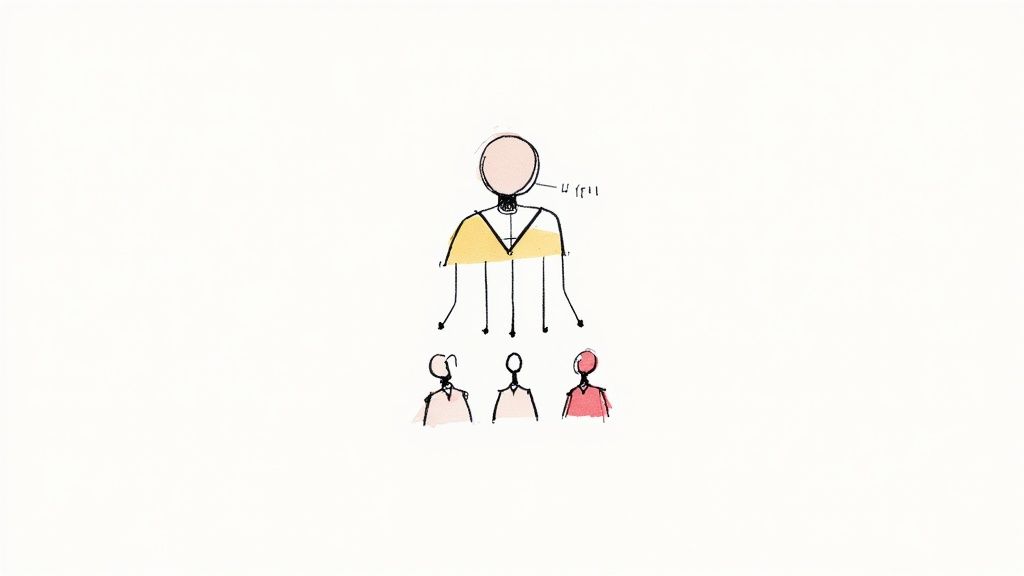
This email acknowledges your initial conversation while respectfully expanding your reach. It positions you as a strategic partner who understands the organizational structure and wants to ensure everyone involved has the right information.
Subject Line Options:
Body:
Hi [New Stakeholder Name],
I recently had a great conversation with [Initial Contact's Name] in your [Initial Contact's Department] department about their goals for [specific goal, e.g., "improving implementation security"].
They mentioned you were the best person to speak with regarding [the new stakeholder's area of responsibility, e.g., "the financial implications of new software procurement"].
Based on what I learned, our solution could help [Prospect's Company] achieve [relevant outcome, e.g., "a 20% reduction in operational costs"] by [briefly explain how]. I’ve attached a case study outlining the ROI for a similar company.
Would you be open to a brief 15-minute call next week to discuss this further?
Best,
[Your Name]
Shifting from a sales pitch to a collaborative problem-solving session can completely reframe the buyer-seller dynamic. This follow-up approach positions you as a strategic partner or consultant, not just a vendor trying to close a deal. By inviting the prospect to a "working session" or "discovery conversation," you create a high-value, low-pressure environment focused entirely on their challenges and potential solutions. It's a powerful way to build trust and uncover deep insights you might otherwise miss.
The goal is to move beyond a standard demo and engage the prospect in a joint exploration of their problem. You bring a framework or methodology, and they bring their business context. Together, you co-create a vision for a solution, making this one of the most effective sales follow up email templates for complex or enterprise-level sales cycles.
Subject Line Options:
Body:
Hi [Prospect Name],
Thanks again for our conversation last week. I've been thinking a lot about your team's goal to [specific goal, e.g., "streamline your onboarding process for new hires"].
Instead of a standard demo, I'd like to propose a more collaborative approach. Could we schedule a 45-minute working session for next week? My goal would be to map out a potential framework for achieving [specific goal] with you and anyone else from your team who would find it valuable.
We can use the time to:
Does a collaborative discovery session like this sound like a good use of time?
Best,
[Your Name]
We've explored a comprehensive arsenal of sales follow up email templates, each designed for a specific scenario, from the initial 24-hour touchpoint to the final breakup email. These templates provide a powerful framework, offering proven copy and strategic timing to re-engage prospects and push conversations forward. You now have the blueprints for everything from adding value with case studies and educational content to expanding your reach by multi-threading to new stakeholders.
The fundamental takeaway is that a one-size-fits-all approach no longer works. Effective follow-up is about being persistent, relevant, and human. It requires a deep understanding of your prospect's pain points and a commitment to providing value at every turn, not just asking for a meeting.
However, even the most perfectly crafted email can get lost in a crowded inbox. The true power move in modern sales is to orchestrate a symphony of outreach across multiple channels. The sales follow up email templates in this guide are your foundation, but amplifying them with other touchpoints is how you truly stand out and drive responses.
Think of it as a coordinated campaign:
Email + Ringless Voicemail: After sending the "Problem-Focused Re-Engagement Follow-Up," you can schedule a ringless voicemail drop for the next day. This non-intrusive message can directly reference the email, saying something like, "Hi [FirstName], just left a quick thought in your inbox about [Pain Point]. Give it a look when you have a moment." This creates a powerful, multi-sensory reminder without interrupting their day.
Email + SMS: When a prospect clicks a link in your "Value-Add Follow-Up" email to view a case study, an automated SMS can be triggered. A simple text like, "Saw you checked out the [Client Name] case study. That 35% efficiency gain we achieved for them is something I think we can replicate for you. Worth a quick chat?" is timely, personal, and highly effective.
This multi-channel strategy isn't about spamming prospects; it's about creating a persistent, professional, and respectful presence. It shows that you're thorough and committed to connecting. By layering your communication, you meet buyers where they are most active, dramatically increasing the odds that your message will be seen and acted upon.
Mastering the art of the follow-up is what separates top performers from the rest of the pack. It’s a discipline built on strategy, empathy, and the right technology. Your next steps should be to move from theory to practice.
Start by auditing your current follow-up sequences. Are they email-only? Where are the drop-off points? Then, begin integrating the templates and strategies from this guide. Don't just copy and paste; adapt them to your voice and your audience. A/B test your subject lines, your calls to action, and your timing.
Most importantly, begin building integrated workflows that combine your email efforts with SMS and voice. By doing so, you transform your follow-up from a series of isolated shots in the dark into a well-oiled, response-generating machine. This strategic persistence is the key to filling your pipeline, shortening sales cycles, and ultimately, crushing your sales goals.
Ready to automate your multi-channel follow-up strategy? Call Loop makes it simple to build automated drip campaigns that sequence emails with SMS messages, voice broadcasts, and ringless voicemail drops. Stop chasing leads manually and start building integrated workflows by exploring what Call Loop can do for you today.
Chris Brisson
Chris is the co-founder and CEO at Call Loop. He is focused on marketing automation, growth hacker strategies, and creating duplicatable systems for growing a remote and bootstrapped company. Chat with him on X at @chrisbrisson


Trusted by over 45,000 people, organizations, and businesses like


