
See a Demo
You're just one step away from seeing Call Loop in action.
Enter your information below to watch a demo right now.

You're just one step away from seeing Call Loop in action.
Enter your information below to watch a demo right now.


Sending a mass text is one of the most potent ways to get a message directly in front of your audience. It's a near-guarantee that your message will be seen. Emails can languish in an inbox for days, but a well-timed SMS campaign puts your promotions, updates, and reminders right into your customers' hands, usually within minutes.
In a world overflowing with digital noise, you need a direct line to your audience. Sending a mass text isn't the same as firing off a message to a group chat with your friends; it's a professional communication strategy that delivers unmatched speed and engagement for businesses of any size.
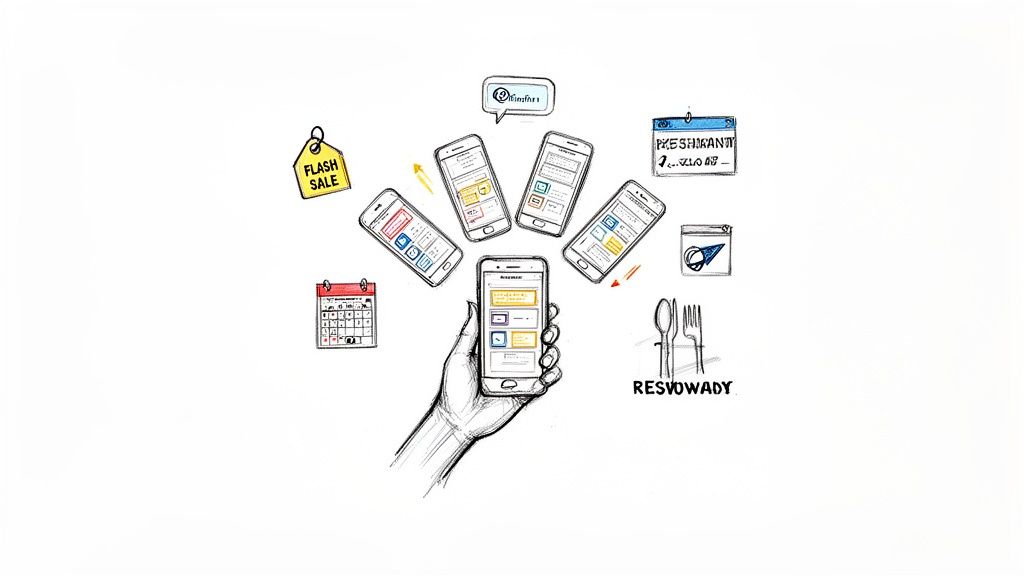
This direct channel helps you solve real business problems, fast. Picture a local restaurant having a slow Tuesday night. A quick mass text blast announcing a "2-for-1 special, tonight only!" can fill those empty tables in less than an hour. That's the kind of immediate impact that only SMS can command.
The numbers behind SMS marketing speak for themselves. The open rates are staggering, consistently hitting around 98%, with most people reading a text within just a few minutes of it arriving. That level of attention blows other marketing channels out of the water.
And it's not just about opens. The average response time to a text is about 90 seconds, making it the perfect tool for any time-sensitive offers you want to run.
To truly understand the difference between a professional tool and just using your phone, let's look at a quick comparison.
While you could technically send a message to multiple people from your phone, it's a world away from what a professional mass texting platform offers. This table breaks down the key differences.
As you can see, a dedicated platform is built for business. It gives you the tools you need to communicate effectively and legally at scale, which is simply impossible with a standard group chat.
The use cases for mass texting are incredibly diverse. Service-based businesses, from hair salons to HVAC companies, rely on automated messages to confirm appointments, which drastically cuts down on costly no-shows. In fact, one of the most effective uses we see is with proven patient appointment reminders, helping clinics streamline their entire patient flow.
A quick heads-up: using a professional platform for sending a mass text is a non-negotiable. Unlike a standard group message on your phone, dedicated services give you the essential business tools you need, like automation, compliance management, and detailed analytics.
While SMS is king for short, urgent messages, sometimes you need to say a little more. This is where a complementary tool like ringless voicemail really shines.
A ringless voicemail system lets you drop a pre-recorded audio message directly into someone's voicemail inbox—without their phone ever ringing. You could send a quick text about a flash sale and then follow up with a more personal, detailed voicemail explaining the benefits. This multi-channel approach helps you connect with your audience on their own terms, creating a much richer and more effective communication strategy.
Before you even think about sending a mass text, your success hinges on one thing: a healthy, compliant contact list.
A great message sent to the wrong people—or worse, people who never asked to hear from you—is a recipe for failure. Building your audience the right way isn't just an extra step; it's the absolute foundation of any successful SMS campaign.
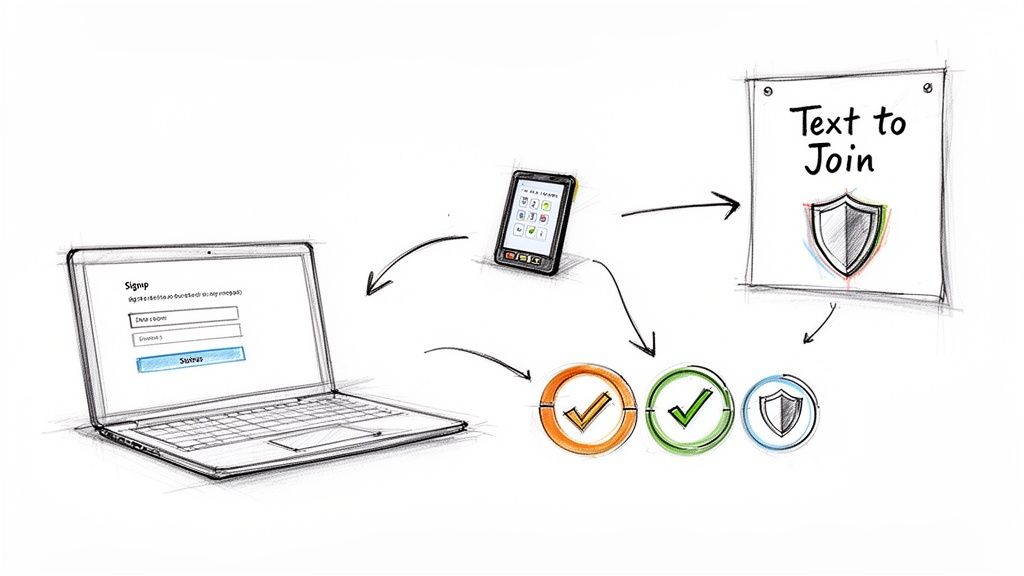
The cornerstone of any good list is explicit consent. You must get clear, unambiguous permission from every single person before you text them. This isn't just a best practice; it's a legal requirement that protects your business and shows respect for your customers.
There are several straightforward and effective ways to grow your subscriber list organically. Each one gives customers a clear way to say, "Yes, I want to hear from you."
If you want to go deeper on these strategies, check out our detailed guide on how to get people to opt-in to your text messages. It covers everything from the initial setup to more advanced techniques.
The phone number you use to send mass texts is a critical part of your brand identity and deliverability. You have two main options, and each is suited for different needs.
I've learned over the years that list building isn't just about quantity; it's about quality. A smaller, engaged list of people who actually want to hear from you will always outperform a massive list of unengaged contacts. Always.
Finally, keeping your contact list clean is an ongoing job.
Regularly validating your list helps you weed out invalid or deactivated numbers. This simple step is crucial for protecting your sender reputation with carriers, which directly impacts your deliverability rates and ensures your messages actually reach real people.
A clean list means you aren't wasting money sending texts into the void. It maximizes your campaign's ROI and prepares you for more advanced tactics, like sending targeted ringless voicemail drops to validated mobile numbers for a powerful follow-up.
Sending a mass text without knowing the rules is a bit like driving blindfolded—it’s a massive risk that can end in disaster. The legal side of SMS isn't just bureaucratic red tape; it's the foundation for building a sustainable, trust-based relationship with your audience. Get it wrong, and you're looking at crippling fines and a brand reputation that's tough to repair.
The big one you need to know in the United States is the Telephone Consumer Protection Act (TCPA). This law isn’t messing around. Penalties for breaking the rules can be severe, sometimes running into thousands of dollars for a single text message sent without the right permissions.
The absolute core of the TCPA is consent. You absolutely must have express written consent from every single contact before you send them any kind of promotional message.
Now, "written" doesn't mean you need a stack of signed papers. An electronic signature, checking an unticked box on a web form, or texting a keyword to join your list all count.
The key word here is unambiguous. You can't just bury the opt-in clause in the fine print of your terms and conditions. It has to be crystal clear and out in the open, explicitly stating that by giving you their number, they're agreeing to get marketing texts from your business.
Here's a common mistake I see: just because a customer gave you their number during a purchase doesn't mean you can start blasting them with promotions. Consent for transactional texts (like order updates) is totally separate from consent for marketing campaigns.
Think of this as a pre-flight checklist for every text you send out. To stay compliant, you need to include a few key things.
These elements are simply non-negotiable. For a much deeper dive into the dos and don'ts, you can check out our detailed anti-spam policy, which lays out all these requirements.
It’s also worth remembering that different channels can have their own set of compliance rules. Take ringless voicemail, for example. This tech drops an audio message directly into someone's voicemail box without making their phone ring.
There have been legal arguments that this falls under different rules than a standard text or call. While the legal landscape is constantly shifting, it just goes to show how important it is to know the specific rules for every channel you're using. No matter the medium, always, always prioritize getting clear consent first.
Building a high-quality, opted-in contact list is a major win, but it’s really just the starting line. The real magic happens inside the message itself. When you're sending a mass text, every single character counts toward driving the action you want—whether that’s a sale, a confirmation, or just a click.
Think of it this way: your audience gave you permission to show up in the most personal space on their phone. Your message needs to instantly prove their trust was well-placed by delivering immediate value. That means being clear, concise, and compelling from the very first word.
Personalization goes so much deeper than just plugging in a {FirstName} tag. Real personalization uses the segmentation data you’ve gathered to send messages that feel uniquely relevant to each person. It's the difference between a generic blast and a targeted, one-to-one conversation.
For instance, you could create segments based on things like:
This level of detail makes your audience feel seen and understood, not just like another number on a list. It transforms a generic mass text into something that truly connects.
Every single message you send should have a crystal-clear purpose, guided by a strong call-to-action (CTA). Your CTA is the specific instruction that tells your reader exactly what you want them to do next. Vague CTAs lead to confusion and, worse, inaction. You have to be direct.
Don't just say, "Check out our sale." Create urgency and clarity with something like, "Tap here to get 25% off before midnight!" or "Reply YES to confirm your spot." The goal is to eliminate any guesswork and make that next step feel effortless.
A common mistake I see is people packing too many actions into one short message. Pick one primary goal for your text—whether it's clicking a link, using a code, or replying with a keyword—and focus the entire message on driving that single action.
You don't need to reinvent the wheel for every single campaign. Having a toolkit of proven message templates saves a ton of time and ensures your communications are consistent and effective. While you'll always want to tweak them to fit your brand's unique voice, these structures provide a solid foundation.
Here are a few examples to get you started:
By mastering these core components—personalization, a clear CTA, and reliable templates—you're well on your way to crafting messages that not only get opened but also drive real, measurable results. To learn more about creating compelling campaigns, explore our complete guide to SMS marketing best practices.
You've built a compliant list and written a killer message. Now for the fun part: launch time. But hitting "send" isn't the finish line. How you execute the send and what you measure afterward is what separates a one-off text blast from a powerful, repeatable marketing engine.
Timing is everything. Sending a mass text at 3 AM is a guaranteed way to get unsubscribes, not sales. You have to sync your send time with your audience's daily rhythm. A restaurant pushing a lunch special? An 11 AM text is perfect. A retail store announcing a flash sale? Try sending it in the evening when people are relaxing at home and more likely to browse.
If you're messaging a big list, you absolutely need to think about throttling your broadcast. Throttling just means sending your texts out in smaller, controlled batches instead of all at once. This is a lifesaver. It prevents your support team from getting slammed with a sudden wave of replies and questions, making sure every single person who engages gets a fast, helpful response.
To pull this off without a headache, you'll want to send text messages online using a real platform. It makes scheduling, throttling, and handling two-way conversations in one inbox simple—something that's flat-out impossible from your personal phone.
Once the campaign is live, your job shifts from creator to analyst. You need to dig into the data to see what worked, what flopped, and why. This comes down to tracking a few critical metrics that tell the real story of your campaign's performance.
This simple flow chart breaks down how to think about structuring your messages to get results.
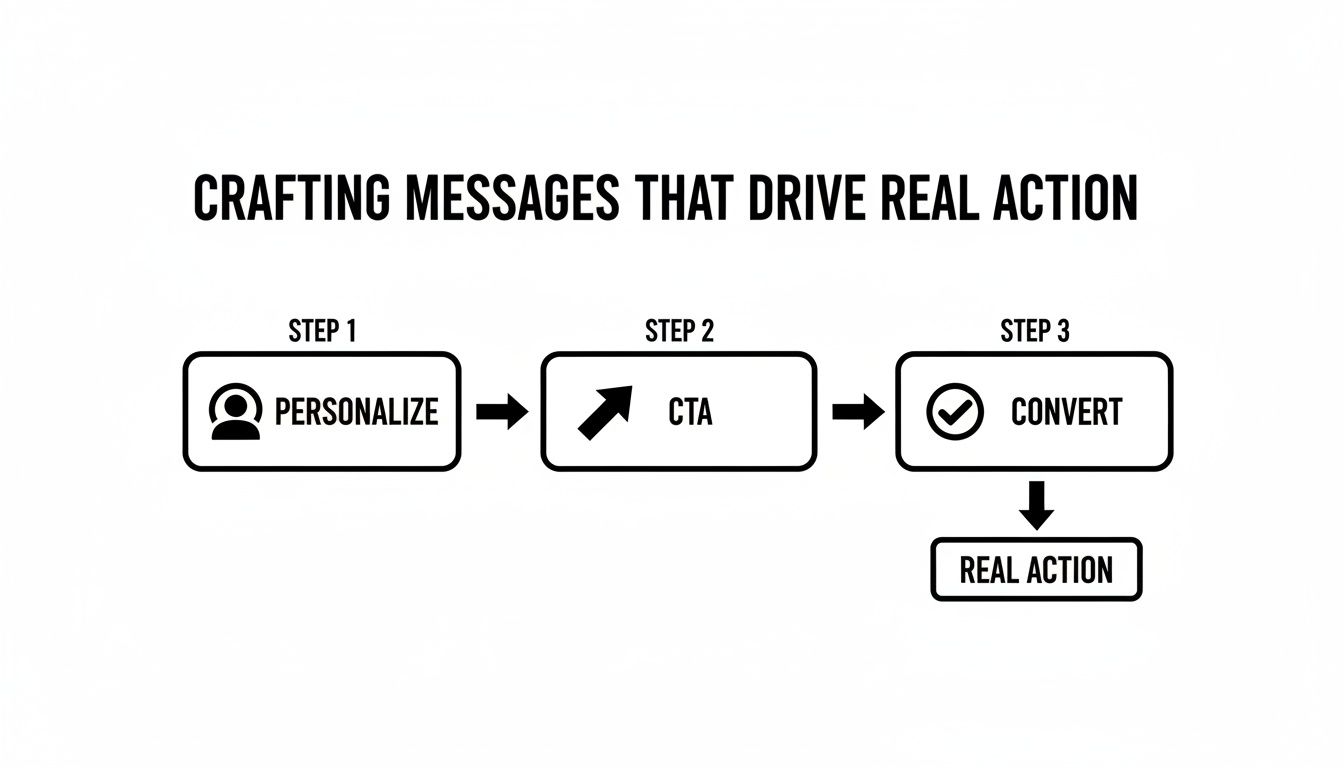
As you can see, every great text guides the user from a personalized opening to a clear call-to-action, directly driving that final conversion.
Never, ever assume your first draft is the best one. A/B testing is your secret weapon. The idea is simple: send two slightly different versions of your message to two small, separate groups from your audience and see which one performs better. You can test anything—different headlines, offers, link placement, or calls-to-action.
By constantly testing and analyzing your results, you can turn guesswork into a data-driven strategy. Even tiny improvements in your CTR or conversion rates can add up to a massive impact on your bottom line over time.
This is the cycle of success for mass texting: send, measure, and optimize. It’s how you guarantee that every campaign you run is smarter and more effective than the one before it.
Even with a killer strategy in hand, you're bound to have questions when you start sending texts out to your audience. Getting clear answers is the best way to build your confidence and sidestep the usual mistakes. Let's dive into some of the most common questions we hear from businesses getting started.
First up, a lot of people get tripped up on the difference between a mass text and a group text. A group text is what you use with friends—it’s one big conversation where everyone sees every reply. It’s personal, but not professional.
Sending a mass text with a professional service delivers one message to many people individually. Each person gets a private text directly from you. When they reply, it comes straight back to you, keeping the conversation private and professional.
Once you get the basics, the practical questions start popping up. We’re talking about costs, tools, and just doing things the right way. The most important shift to make is moving away from your personal phone and using a real business solution.
Seriously, don't use your personal phone. It's a huge mistake that we see all the time. Your carrier can—and will—flag your number for spammy-looking activity and block it. Plus, it just doesn't look professional and gives you zero tools to manage opt-outs or stay TCPA compliant.
Always use a dedicated platform with a verified business number for any campaign. It’s not just best practice; it’s essential for staying compliant and actually getting your messages delivered.
This brings us to the next big question: "What's this going to cost me?" Pricing for mass texting really depends on the platform, how many messages you're sending, and the type of number you’re using. Most services will offer monthly plans with a bucket of credits or a simple pay-as-you-go option. The good news is that the cost per message almost always drops as your volume goes up, so it scales nicely as you grow.
When you're mapping out your budget, don't forget to look at the full picture: the platform subscription, any fees for renting a number, and possible carrier surcharges. Knowing the total cost upfront means no nasty surprises later.
As you build out your SMS strategy, you’ll probably wonder how other tools can fit in. Ringless voicemail is one that comes up a lot. It’s a slick piece of tech that lets you drop a pre-recorded audio message right into someone’s voicemail box without their phone ever ringing. It’s way less intrusive than a cold call but still highly personal.
It’s the perfect partner for mass texting. Imagine sending a quick text about an urgent offer, then following up a bit later with a more detailed, personal message via ringless voicemail. This one-two punch lets you connect on different levels, reinforcing your message and boosting your chances of getting a response. It adds that human touch a text message sometimes can't quite capture on its own.
Ready to put these strategies into action and see real results? Call Loop provides all the tools you need—from HIPAA-compliant SMS and voice broadcasting to powerful ringless voicemail drops—to create campaigns that connect and convert. Start sending smarter messages today by visiting https://www.callloop.com.
Chris Brisson
Chris is the co-founder and CEO at Call Loop. He is focused on marketing automation, growth hacker strategies, and creating duplicatable systems for growing a remote and bootstrapped company. Chat with him on X at @chrisbrisson


Trusted by over 45,000 people, organizations, and businesses like


