
See a Demo
You're just one step away from seeing Call Loop in action.
Enter your information below to watch a demo right now.

You're just one step away from seeing Call Loop in action.
Enter your information below to watch a demo right now.

Picture this: you're trying to have a real conversation, but you're in the middle of a packed stadium. It's loud, chaotic, and almost impossible to be heard. That's what most marketing channels feel like. Now, imagine stepping into a quiet room for a one-on-one chat. That's small business text marketing. It gives you a direct, personal line to your customers that just plain works.
While so many businesses get lost in the endless scroll of social media feeds and overflowing email inboxes, text marketing simply cuts through all that noise. It’s an immediate, personal way to connect with your audience, making every single message feel like a direct conversation.
This is exactly why it delivers such a powerful return on your investment.
Before we jump into the nuts and bolts, it's good to get a handle on what ROI really means in marketing. If you need a quick refresher, check out this great guide on understanding Marketing ROI. Knowing the basics helps put into perspective just how impressive the results from SMS are.
Let's get straight to it: the biggest advantage of text marketing is its mind-blowing open rate. Emails can sit unopened for days. Social media posts get buried in an algorithm-driven feed. But text messages? They demand immediate attention.
This direct line to your customer's pocket ensures your promotions, reminders, and updates are actually seen right when it matters most.
The numbers don't lie. SMS messages boast a staggering 98% open rate. For comparison, email marketing averages a mere 20%. And get this—around 60% of people read their texts within the first five minutes of getting them. This makes it the perfect channel for any time-sensitive message you need to send. That huge difference in engagement means your marketing dollars are working harder and getting you real results.
For small businesses, every marketing dollar counts. Text marketing ensures your message isn't just sent—it's received, read, and acted upon, maximizing your return and building stronger customer relationships.
It helps to see the two channels side-by-side to really grasp the difference in performance. While email has its place, SMS wins hands-down for speed and visibility.
As you can see, when you need to get eyes on your message now, there's simply no contest.
A truly effective strategy is about more than just sending a basic SMS. The best platforms today combine several powerful tools, including ringless voicemail drops and voice broadcasts, allowing you to create a communication system that adapts to your message and your audience.
Here are the key tools you should have in your arsenal:
By blending these methods, any small business can build a robust communication machine. Tools like Call Loop make it incredibly simple to manage these different channels, so you can send the right message, through the right medium, at exactly the right time. That’s how you unlock the full potential and ROI of modern text marketing.
A solid small business text marketing plan is way more than just blasting out a single text. It's about creating a communication system that meets customers where they are, using the tools they prefer.
Think of it like a toolbox. You've got different tools for different jobs, but they all work together to build something awesome. The three essential tools in this kit are SMS/MMS, ringless voicemail, and automated voice broadcasting.
When you manage these three channels from one place, like Call Loop, you create a powerhouse for customer outreach. It gives you the flexibility to pick the perfect medium for any message you need to send.
This is the bedrock of any text marketing strategy. SMS (Short Message Service) is your go-to for fast, to-the-point, text-only messages up to 160 characters. It’s perfect for things like flash sale alerts, appointment reminders, and shipping updates. Its biggest strengths are its simplicity and directness.
MMS (Multimedia Messaging Service) kicks things up a notch by letting you add media. You can send pictures of a new product, a quick video tutorial, or a fun GIF to really grab someone's attention. The visual pop makes MMS perfect for more engaging, brand-heavy campaigns that help you stand out.
For example, a restaurant could shoot out an SMS for a "2-for-1 pizza tonight only!" special. But with MMS, they could send a mouth-watering picture of that pizza to make the offer impossible to resist.
Now for a really slick tool: ringless voicemail. Imagine dropping a personal, pre-recorded audio message straight into someone's voicemail box without their phone ever ringing. That's exactly what this does. This technique is often called a ringless voicemail drop.
It's a super respectful and non-intrusive way to connect on a more human level. Instead of just another text, your customer hears your actual voice, which goes a long way in building trust.
Here are a few ways businesses put it to work:
Ringless voicemail combines the personal impact of a phone call with the convenience of a text message. It allows you to be heard without interrupting your customer’s day, making it a powerful tool for relationship building.
This approach is killer for messages that really benefit from a human tone but don't need an immediate back-and-forth conversation. Plus, since you only pay for messages that are successfully delivered, it's a very cost-effective way to reach out directly. This is a cornerstone of any well-rounded small business text marketing plan.
The final pillar is automated voice broadcasting. This is all about sending a pre-recorded voice call to a huge list of people all at once. It might sound like ringless voicemail, but its purpose is totally different—and often much more interactive.
Voice broadcasting is built for large-scale announcements or campaigns where you want to get an immediate reaction from the person on the other end.
For instance, you can set up a campaign where people can "press 1 to speak with a representative" or "press 2 to confirm your attendance." That interactive element is its secret weapon, turning a simple announcement into a chance for instant engagement. It's a fantastic tool for generating inbound calls and qualifying leads without your team having to spend hours making individual calls.
Together, these three pillars give you the power and flexibility to communicate effectively in just about any situation.
Your text marketing is only as good as the list of people you're sending to. It's a simple truth. A smaller list of happy, engaged subscribers is infinitely more valuable than a massive list of people who couldn't care less. The foundation of any great small business text marketing effort comes down to two things: permission and relevance.
Plain and simple, you have to get explicit consent before sending a single message. Then, you have to follow through by sending content they actually find useful. This isn't just a friendly suggestion—it's a legal requirement that keeps both you and your customers protected.
The big one you need to know about in the United States is the Telephone Consumer Protection Act (TCPA). The legal jargon can look a little scary, but the core idea is straightforward: don't send marketing texts to people unless they’ve clearly given you the green light.
The most important rule is getting express written consent. Now, this doesn't mean you need a physical piece of paper with a signature. It just means you need a documented record of someone agreeing to get your marketing texts. This could be a customer checking a box on your website's checkout form (a box that isn't pre-checked) or texting a special keyword to your number.
The golden rule of text marketing is to treat your subscribers' inboxes with respect. Always get permission, always provide value, and always make it easy for them to leave. This builds trust and ensures your messages are welcomed, not resented.
You also have to give people a clear and simple way to opt out. The standard way is letting them reply with words like "STOP," "END," or "UNSUBSCRIBE." Any decent text marketing platform will handle these opt-outs for you automatically. This is critical because messaging someone after they've opted out can lead to some seriously hefty fines.
Once you've got the legal stuff down, you can get creative with inviting people to join your list. The secret is to offer a clear incentive. What’s in it for them?
Here are a few tried-and-true methods for list growth:
Remember, the goal is always quality over quantity. An engaged list of 100 subscribers who absolutely love your brand will make you more money than 1,000 people who don't even remember signing up. For more ideas, our complete guide to SMS marketing for small business has even more tactics you can use right away.
As your list starts to grow, the next level is to make your messages more relevant through segmentation. Blasting the same exact message to every single person on your list is a surefire way to get a lot of people to unsubscribe.
Segmentation is just a fancy word for dividing your audience into smaller groups based on things they have in common. Think of it as having different conversations with different types of customers. You wouldn't talk to a brand-new customer the same way you'd talk to a loyal regular who's been buying from you for years, right?
You can segment your list based on all sorts of things:
By sending these super-relevant messages, you turn your text marketing from a simple broadcast tool into a powerful engine for building real relationships and driving sales.
You've done the hard work of building a compliant, engaged subscriber list. Now for the fun part: turning that list into a predictable revenue stream.
A solid small business text marketing strategy isn't about reinventing the wheel. It's about having a playbook of proven campaign types, each one built for a specific job—whether that's driving a flood of sales or just making a customer's day a little better.
The secret to a high-impact campaign isn't complexity; it's clarity. Every single text you fire off needs three core components to do its job. Get these right, and you're golden.
Think of each text as a tiny, powerful marketing machine. To get it running smoothly, you need to bolt on a few key parts that work together to grab attention and get people to do something. Nailing this basic structure is the first real step toward crafting campaigns that just plain work.
Here are the non-negotiables:
When you fuse these three elements, you create a message that's not just easy to understand but incredibly difficult to ignore.
Alright, let's put that theory into practice. Here are a few real-world examples you can swipe and adapt for your own business. These campaign types are classics for a reason—they solve common business problems and get results.
1. The Flash Sale Campaign
2. The Appointment Reminder Campaign
3. The Order Update Campaign
Sending great texts is half the battle. The other half? Knowing what's actually working.
To really dial in your strategy, you have to measure the impact of every campaign. This is where features like link shortening and tracking become your best friend. A good small business text marketing platform automatically shortens any links you include in your messages.
This does two things: it saves precious characters, sure, but more importantly, it lets the platform track exactly how many people clicked that link. This click-through rate (CTR) is a vital sign for your campaign's health. It tells you point-blank how compelling your offer and CTA were. By seeing which messages get the most clicks, you can stop guessing and start making smarter decisions.
The financial return on investment from SMS marketing represents a compelling business case for small business adoption. For every single dollar a business invests in SMS marketing, they can expect to receive a significant return, with some studies showing an ROI as high as 7,500%. Over 54% of SMS revenue is driven by automated flows triggered by customer behavior, ensuring messages reach customers at optimal moments. When campaigns are targeted rather than sent as untargeted blasts, they can deliver substantially higher ROI. Learn more about SMS marketing statistics and trends.
This data-driven approach turns text marketing from a shot in the dark into a predictable system for growth. Each campaign becomes a chance to learn, helping you figure out what your audience loves so you can craft the perfect message, every single time.
Imagine nurturing leads and delighting customers without lifting a finger. That's the real magic of automation in small business text marketing. Instead of manually sending every single message, you can build 'set-it-and-forget-it' sequences that run for you 24/7, making sure no customer ever falls through the cracks.
This isn't just about saving time; it's about delivering consistent, timely follow-ups that build strong relationships and drive revenue on autopilot. Getting a solid grasp on the bigger picture of understanding marketing automation helps you see the full potential. It frees you up to focus on what you do best—running your business.
A drip campaign is just a fancy name for a series of automated messages sent to a subscriber over a set period. Think of it as your digital welcome wagon, guiding new contacts through their first experience with your brand. A simple "Welcome Series" is a fantastic—and highly effective—place to start.
Here’s a real-world example for a local retail shop:
This simple, three-step sequence does so much. It delivers the promised incentive, encourages social media engagement, and generates valuable social proof—all without any manual effort after the initial setup. Platforms with a powerful text message autoresponder, like Call Loop, make building these flows a breeze.
Once you’ve got the basics down, you can start building more advanced workflows that pull in different channels to make an even bigger impact. Not every message has to be a standard SMS. By mixing in other tools, like a ringless voicemail drop, you can add a personal touch that truly stands out from the noise.
Think about a new lead who fills out a form on your website. Instead of just a single text, you could design a multi-step, multi-channel follow-up sequence.
By automating multi-channel touchpoints, you create a persistent yet respectful follow-up system. A well-timed SMS, followed by a personal ringless voicemail, can dramatically increase response rates and move leads through your sales funnel more effectively.
No matter how complex the workflow, every high-impact campaign message shares the same core components.
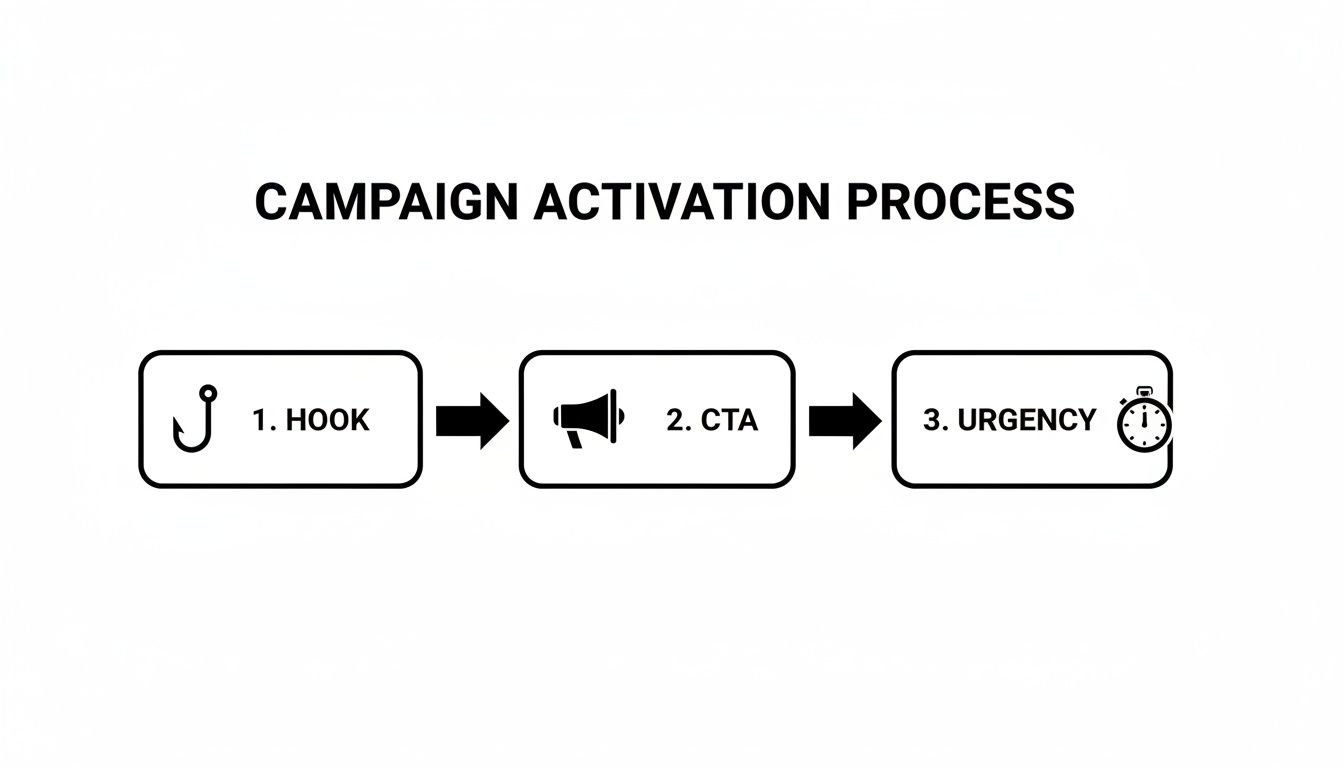
This simple flow chart really breaks it down. You need a compelling hook, a crystal-clear call-to-action, and a touch of urgency to get people to act.
Automation doesn't mean your messages have to sound like they came from a robot. With the right tools, you can personalize messages at scale, making each subscriber feel like you're talking directly to them. This is where the true power of small business text marketing is unlocked.
And the data doesn't lie. With over 50 million people globally having opted into text marketing, personalization is what separates the good from the great. In fact, 49% of consumers are happy to share their data if it means getting a more personalized experience. For businesses, this pays off big: 63% of marketers see higher conversions when they personalize their SMS campaigns.
Using custom fields, you can automatically drop in a subscriber's name, their last purchase, or an appointment time right into your automated messages. This small touch transforms a generic blast into what feels like a one-on-one conversation, deepening customer loyalty and making every automated sequence you build that much more effective.
Sending messages is the easy part. But turning those messages into a reliable source of revenue? That takes a little more finesse.
To really succeed with small business text marketing, you have to get comfortable with the data. It's how you stop guessing what works and start knowing. This is the secret to turning a simple communication channel into a predictable growth engine for your business.
Your analytics dashboard is where the magic happens. It's packed with key performance indicators (KPIs) that tell the story of your campaign's health. Ignoring them is like driving with your eyes closed—sure, you're moving, but you have no idea where you're headed.
To get a clear picture of your performance, you don't need to track a hundred different things. Just focus on a few essential metrics that give you direct insight into how your audience is responding.
These are the core numbers to keep on your radar:
Tracking these numbers is just the starting line. The real value comes when you start interpreting what they mean and using those insights to make better decisions. Your data is constantly giving you feedback, telling you what to do next.
For example, a low click-through rate might mean your call-to-action isn't strong enough or the offer just isn't hitting the mark. A high unsubscribe rate could be a signal that you're sending messages too often or the content isn't relevant to that group. For a deeper look at this, our guide on measuring marketing campaign effectiveness provides a complete framework.
Think of your analytics as a conversation with your customers. Each metric is a piece of feedback. A high CTR is them shouting, "Yes, more of this!" while a high unsubscribe rate is a clear, "Nope, this isn't working for me." Listen closely.
This is the key to long-term success: a continuous loop of launching, measuring, and optimizing.
By paying close attention to the data, you can methodically improve your campaigns, making sure every text you send is more effective than the last. This is how you transform text marketing from a collection of tactics into a cohesive, revenue-generating strategy.
Jumping into text marketing for your small business? You've probably got a few questions. Let's tackle some of the most common ones we hear from entrepreneurs just like you.
One of the best things about text marketing is how scalable it is—it can genuinely fit any budget. Most platforms, including ours, work on a per-message model. We're talking just a few cents for each SMS you send out. This means you can get a campaign off the ground with a really small upfront investment.
With other channels like ringless voicemails, you're typically only charged when the message is successfully delivered. You never waste money on a message that doesn't make it. The number to watch isn't just the cost, but the return on that cost. Given the crazy-high conversion rates of texting, even a modest, well-planned budget can bring in serious revenue.
Absolutely, yes—as long as you play by the rules. The big one you need to know is the Telephone Consumer Protection Act (TCPA). Its main requirement is that you get express written consent from someone before you send them any marketing messages.
This just means a person has to clearly and actively agree to get texts from you. You also have to give them an easy way to opt out anytime they want, like simply replying "STOP." A good, compliant platform will handle all of this for you automatically, so you're always covered.
At its heart, it all comes down to permission. As long as you have a clear record of a customer's consent and you honor their choice to opt out, your text marketing is on solid legal ground.
The three main channels each have their own strengths and are best used in different scenarios. Think of them as different tools in your communication toolkit.
Ready to see how these tools can completely change how you reach your customers? Call Loop gives you everything you need to launch compliant, high-impact SMS, ringless voicemail, and voice broadcasting campaigns. Start your free trial today and connect with your customers like never before.
Chris Brisson
Chris is the co-founder and CEO at Call Loop. He is focused on marketing automation, growth hacker strategies, and creating duplicatable systems for growing a remote and bootstrapped company. Chat with him on X at @chrisbrisson


Trusted by over 45,000 people, organizations, and businesses like


