
See a Demo
You're just one step away from seeing Call Loop in action.
Enter your information below to watch a demo right now.

You're just one step away from seeing Call Loop in action.
Enter your information below to watch a demo right now.


In a world of crowded inboxes and endless social media feeds, getting a client's attention is half the battle. This is where SMS marketing comes in. For real estate agents, it’s the most direct and powerful way to share new listings, remind clients about open houses, and announce price drops—cutting right through the noise to get an immediate response.
Let's be honest, in real estate, timing is everything. A hot property can be gone in hours. While emails and phone calls still have their place, they just can't match the speed needed to keep up with today's buyers and sellers. This is where a simple text message changes the game entirely.
Think about what happens when a new listing goes live. You send out an email blast, but it might sit unopened for a day or get buried under a pile of promotions. You try calling, but it goes straight to voicemail. A text message, on the other hand, gets seen almost instantly.
Here's a quick look at how SMS stacks up against the old-school methods.
| Metric | SMS Marketing | Email Marketing | Phone Calls |
|---|---|---|---|
| Open Rate | 98% | ~20% | N/A |
| Read Within 5 Mins | 82% | Rare | N/A |
| Response Rate | 45% | ~6% | ~15-30% (if answered) |
| Client Preference | Preferred for urgent updates | Often ignored | Can feel intrusive |
The numbers don't lie. When you need to get a message to someone right now, nothing beats a text.
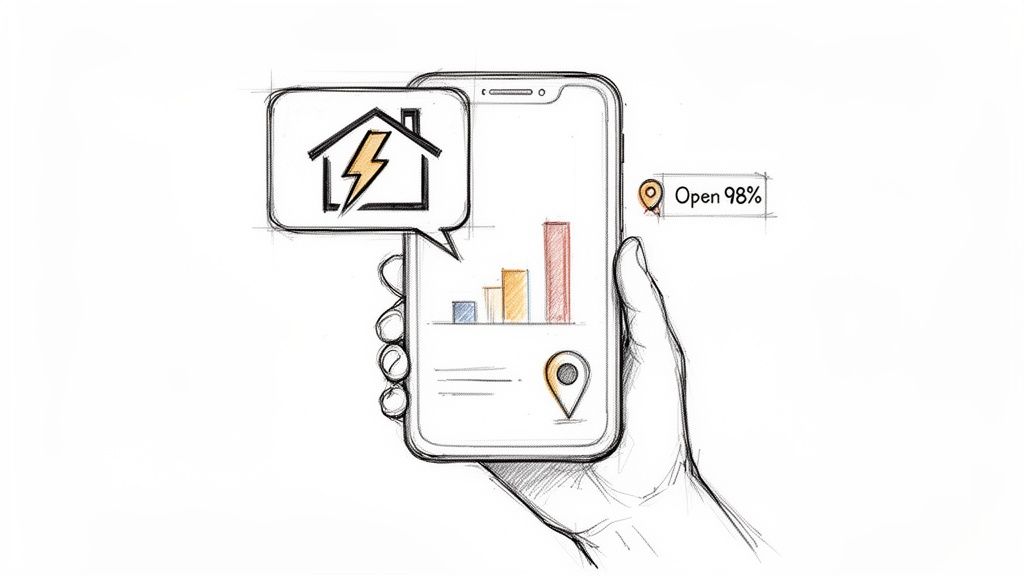
The stats behind texting are staggering. In the fast-moving world of real estate, SMS boasts a nearly perfect 98% open rate. For comparison, a good email open rate is around 20%.
Even better, a massive 82% of consumers read texts within five minutes, and the average response rate is a whopping 45%. Email sits at a distant 6%. This isn't just a small improvement; it's a complete shift in how you can communicate.
This kind of immediate engagement means your alert about a price reduction or a last-minute showing time is read right away, getting interested buyers to act fast. Of course, SMS works best when it's part of a well-rounded plan that includes other effective real estate digital marketing strategies.
The bottom line is simple: SMS puts your most critical updates directly into your clients' hands the moment it matters most.
The best agents I know aren't just blasting out random texts. They're using them strategically to build relationships and close deals faster.
Here are a few real-world plays that work every time:
Here's another great tool to use alongside SMS: ringless voicemail. This technology lets you drop a pre-recorded message straight into someone's voicemail without their phone ringing. It's far less intrusive than a cold call but feels much more personal than a text alone.
Imagine this: a new lead texts in to join your list. They get an instant automated welcome text. A day later, a ringless voicemail from you lands in their inbox with a personal introduction. It's a powerful one-two punch that combines the speed of SMS with the warmth of your own voice. It makes a killer first impression. This is often called a ringless voicemail drop, a non-intrusive method to add a personal touch.
Let’s be honest: an SMS marketing strategy without a solid contact list is like showing up to a listing appointment without the keys. It’s just not going to work. The real power of texting comes from sending valuable messages to people who actually want them. And that all starts with building your list the right way, with consent and compliance baked in from the very beginning.
Forget about buying lists or digging up old numbers from deals you closed years ago. In 2026, success is all about an opt-in-only audience. This isn't just about staying on the right side of the law; it's about making sure your messages land with an engaged group of buyers and sellers, which will send your results through the roof.

If there's one acronym you need to burn into your memory, it's TCPA—the Telephone Consumer Protection Act. This federal law is crystal clear: you must get express written consent before you send a single marketing text.
Now, "written" doesn't mean you need a pen and paper. It just means you need a documented record that someone agreed to get your texts. This consent has to be obvious and can't be hidden in the fine print. The person needs to know exactly what they're signing up for: promotional texts from you. You can get a deeper dive into the specifics in our guide on express written consent.
Bottom line: the burden of proof is on you. Keeping flawless records of every opt-in isn't just a best practice—it's a legal shield that protects your business from some seriously hefty fines.
Building a compliant list isn't nearly as hard as it sounds. It’s all about creating valuable, can't-miss opportunities for people to raise their hand and say, "Yes, keep me in the loop!"
Here are a few tried-and-true methods I've seen work time and time again:
If you want to build a truly engaged audience, I always push for a double opt-in process. Here's how it works: a prospect texts your keyword or fills out your web form. They then immediately get an automated text asking them to confirm their subscription by replying "YES."
This simple two-step process does a couple of crucial things. First, it confirms the phone number is real and that the person genuinely wants to hear from you. Second, it creates an ironclad record of their consent. Yes, it's one tiny extra step for the user, but it results in a list of contacts who are way more likely to engage with your messages later on. This means better conversion rates and a much higher ROI for your SMS efforts.
Okay, so you've built your SMS list. Now for the hard part: what do you actually say? This is where the rubber meets the road.
The messages you send will either get you a hot lead on the phone or a cold "STOP" reply. The goal is to write texts that feel personal and valuable, turning a name on a list into a scheduled showing and, eventually, a closed deal.
It’s not about some secret, complicated formula. It's about being human. Your texts need three things: a personal touch, a real reason to act now, and a crystal-clear next step.
Real estate is a relationship game. Generic, one-size-fits-all messages just don't work. Personalization is everything, and I don't just mean plugging in a [First Name] field.
I’m talking about using the data you have to make every text feel like a one-on-one conversation.
Did a lead ask about three-bedroom homes in a specific school district? Mention it. Did they favorite a listing on your website last night? Reference it. This proves you're paying attention and delivering real value, not just blasting your entire database.
The results speak for themselves. We're seeing response rates hit 45% and click-through rates (CTR) average an incredible 21-35% for personalized real estate texts. That’s often 6-10 times higher than email. Instead of a generic blast, agents are sending texts like, "Hey John, that 3-bed in Miami you loved? Price just slashed 8%—tap to tour!" and seeing huge engagement.
A text that says, "Hey [Name], just listed a new property!" is okay. A text that says, "Hey Sarah, a 4-bed with a pool just hit the market in the Northwood area, just like you wanted. Take a look: [link]" is a conversation starter.
Urgency is your best friend in real estate. SMS is the perfect way to light a fire under a lead by communicating time-sensitive info instantly. But there’s a fine line between genuine urgency and just sounding like a sleazy salesperson.
The trick is to tie the urgency to a real event. It's not a tactic; it's a service.
See the difference? You’re providing helpful, factual information that gives them a legitimate reason to act fast.
Text is fast and direct, but sometimes a 160-character message just doesn't cut it. That's when ringless voicemail becomes your secret weapon.
This awesome tool lets you drop a pre-recorded audio message straight into someone’s voicemail without their phone ever ringing.
Imagine a lead gets your text about a price drop. An hour later, they get a voicemail from you: "Hey, it's Mark. I just sent you a text about 123 Maple Street. I wanted to personally let you know the sellers are very motivated, and I think we could get a great deal. Give me a call back if you want to chat strategy."
This one-two punch feels incredibly personal and makes you stand out. The response rates are fantastic.
Every single text you send needs a point. If you don't tell your leads what to do, they'll do nothing.
Your call to action (CTA) needs to be simple, direct, and easy.
Here are a few CTAs that work well in different situations:
Notice how they’re all simple, low-effort requests. And always use shortened, trackable links for your property pages. This saves character space and, more importantly, tells you exactly who is clicking your links—gold for identifying your most engaged leads.
If you're still trying to manually follow up with every new lead, you're on a fast track to burning out. Seriously. Trying to remember who needs a market report, who you need to call back, and which new Zillow lead just came in—it's impossible to do at scale.
This is exactly where automation, specifically for your SMS marketing, becomes your best hire. It's the system that works 24/7 to nurture every single lead, so you can spend your time actually talking to warm prospects and closing deals.
The core of this strategy is building automated drip campaigns. Think of these as a pre-written series of text messages—and even voicemails—that get sent out automatically to new leads over a set period. Once you set it up, every new person who expresses interest gets a consistent, high-touch experience without you lifting a finger.
A great drip campaign shouldn't feel like marketing at all. It should feel like a helpful, one-on-one conversation that guides a lead from curiosity to commitment. Instead of just spamming "just checking in" texts, a smart drip delivers value and builds trust with every message.
Let's walk through a common scenario. A potential buyer texts your keyword from one of your "For Sale" signs. A powerful automated drip could play out like this:
See how that flows? It delivers what they want, opens the door for questions, provides extra value, and then moves toward a clear next step. All on autopilot.
Text messages are fantastic for speed and getting sky-high open rates, but sometimes you need to add a more personal, human touch. That's where ringless voicemail comes in, and it's a tool we've seen have a huge impact.
It lets you drop a pre-recorded audio message right into someone's voicemail box without their phone ever ringing.
This strategy is genius because it combines the personal feel of a phone call with the non-intrusive nature of a text. Your lead gets a message from you, in your voice, which makes you stand out from the army of agents relying only on automated texts. The key is to use it strategically inside your drip campaigns.
Imagine this: a new lead gets an instant SMS with property info, then a warm ringless voicemail from you a day later introducing yourself, followed by a text reminder for the open house. This multi-channel approach is incredibly effective at boosting response rates.
If you want to dive deeper into the tech, our team put together a full guide explaining what ringless voicemail is and how to best use it. It's especially powerful for waking up cold leads or adding that personal touch after a showing.
This is where things get really powerful. When you connect your SMS platform to your CRM, you can start triggering automations based on a lead's behavior or status, not just on a simple timeline.
It means your messages are always perfectly timed and hyper-relevant to where that person is in their journey with you.
Here’s what that looks like in the real world:
This simple flow—personalization, urgency, and a clear call to action—is the bedrock of effective real estate texting.

The big takeaway here is that each step builds on the last, guiding the lead forward in a way that feels natural and helpful. By automating these touchpoints, you guarantee that no one slips through the cracks and every interaction is working to get you closer to a signed contract.
Sending out texts and just hoping for the best isn’t a strategy. It's a gamble with your time and money.
The only way to turn SMS into a consistent deal-making machine is by actually measuring what works and what doesn't. If you’re not tracking your efforts, you can’t improve them. More importantly, you'll never know if you're getting a real return on your investment.
When it comes to SMS, a few simple metrics can tell you a powerful story about your audience and your messaging. This isn’t about building some complicated dashboard. It's about focusing on the numbers that actually matter.
Forget vanity metrics. In real estate, we only care about actions that lead to a closing. To get a quick pulse on the health of your campaigns, you really only need to watch these four numbers.
Monitoring these numbers gives you a real-time report card on your performance. It’s what allows you to make smart adjustments on the fly instead of guessing.
Knowing your numbers is only half the battle. The real skill is using that data to make your next campaign even better. It’s all about asking "why" and then testing your assumptions.
For instance, if your Click-Through Rate (CTR) is low, your message just isn't resonating. This is the perfect time to run a simple A/B test. Send one version of a new listing alert to half your list and a different version to the other half. Maybe one text emphasizes the brand-new kitchen, while the other leads with the price drop. The one with the higher CTR becomes your new template.
What if your opt-out rate is climbing? That’s often a sign that you're just being too noisy. Try dialing back your frequency from four texts a month to two and see if the rate stabilizes. It could also mean the content isn't relevant to that specific list segment, which tells you it's time to tighten up your audience targeting.
The goal is to create a feedback loop. You send a campaign, measure the results, interpret the data, and then use those insights to optimize your next message. This continuous cycle is how you systematically improve your ROI.
Let’s connect these numbers back to what really matters: your business goals.
Forget mailing out another round of flyers. Recent data shows SMS conversion rates can hit between 21-40%, blowing most other digital tactics out of the water. With 82% of businesses crediting SMS for revenue growth, it's no wonder over 60% of marketers are pumping more money into their SMS budgets for 2026.
Agents are seeing this firsthand by sending instant open house alerts or personalized texts like, "Price reduced 10% on your shortlist!" to get buyers off the couch and into a property. Read more about these compelling SMS marketing trends and stats to see the full picture.
Ultimately, tracking this performance helps you prove a clear return on investment (ROI). If you spend $100 on an SMS campaign that generates five qualified showing requests, and just one of those leads to a closed deal with a $10,000 commission, your ROI is astronomical. That’s the kind of hard data that validates your marketing spend and shows exactly how SMS contributes directly to your bottom line.
Jumping into a new marketing channel always brings up a few questions. That's a good thing—it means you're thinking strategically. I get asked these all the time, so let's clear up some of the most common questions agents have about using SMS.
Let's get the big one out of the way first: Is this even legal? Yes, absolutely, as long as you play by the rules. The main rulebook is the Telephone Consumer Protection Act (TCPA), and its biggest command is getting "express written consent" before you send a single marketing text.
This is the most critical part. You can't just grab a list of old contacts from your CRM and start sending messages. They have to explicitly agree to hear from you via text.
Here’s how you get that permission the right way:
And every message needs a clear way out. Something as simple as "Reply STOP to unsubscribe" is mandatory. This is why using a compliant platform is a non-negotiable; it handles all the consent records and opt-out requests for you, keeping you protected.
You want to be a welcome resource, not a pushy salesperson. For your general promotional stuff—new listings, market updates, or open house invites—stick to about 2-4 texts per month. That’s the sweet spot for staying on their radar without burning out your list.
Of course, this limit doesn't count for one-on-one, transactional messages. If a lead texts you a question, you text them back. If they requested a follow-up, you follow up. Those are expected conversations.
The golden rule here is to bring value with every single send. If you see your opt-out rates ticking up, that's your sign to dial back the frequency. It's always better to start slow, watch your metrics, and see what your audience responds to.
You bet. You just have to be smart about it. You can't cold-text a list of homeowners, but you can create campaigns that get them to opt-in willingly. It’s all about offering a hook they can't resist.
Think about running a postcard or social media campaign with a powerful call to action, like: "Get your free, instant 2026 home value estimate. Text VALUE to 55555 to see what your home is worth now."
The moment they text that keyword, you've got a warm seller lead who has given you permission to contact them. From there, you can put them into a drip campaign with helpful content like local market stats, tips for increasing home value, and testimonials from past sellers. This is also a perfect spot to mix in a ringless voicemail to add a more personal, human touch.
This is a classic question, but it's the wrong one to ask. It’s not about choosing one over the other. The real magic happens when you use them together. They each have their own strengths and are the perfect one-two punch for your follow-up.
SMS is built for speed and action. Nothing beats it for information that needs to be seen right now. Think of a price reduction alert: "Price Drop! 123 Main St is now $450K. Tour it this weekend: [link]." It's direct, creates urgency, and gets a quick response.
Ringless Voicemail is all about connection. It delivers the warmth and personality that a text just can’t. Dropping a personal voicemail the day after an open house to say "thanks for coming by" feels incredibly personal and makes a lasting impression, especially with leads that have gone cold.
A powerful combo play? Send an initial text, follow up with a warm ringless voicemail a day later, and then send one final text to circle back. That multi-channel approach feels personal and thorough—not aggressive—and will skyrocket your response rates.
Ready to automate your follow-up and close more deals? Call Loop gives you all the tools you need—from compliant SMS and ringless voicemail to powerful drip campaigns. Start engaging more leads today.
Chris Brisson
Chris is the co-founder and CEO at Call Loop. He is focused on marketing automation, growth hacker strategies, and creating duplicatable systems for growing a remote and bootstrapped company. Chat with him on X at @chrisbrisson


Trusted by over 45,000 people, organizations, and businesses like


