
See a Demo
You're just one step away from seeing Call Loop in action.
Enter your information below to watch a demo right now.

You're just one step away from seeing Call Loop in action.
Enter your information below to watch a demo right now.


Most advice about spam risk starts in the wrong place. It tells you to rewrite the script, buy a cleaner number, or add STIR/SHAKEN attestation, as if the label were a judgment about one call. In practice, the symptom is usually a connect rate that drops on one carrier while the others remain stable. That asymmetry points to a sender-reputation problem, not automatically a bad list or weak offer.
I run Call Loop for voice broadcasting and ringless voicemail, and Salesmsg for two-way business texting and calling, with around 45,000 customers between them. The operational lesson is consistent: a number can look healthy in one channel and lose trust in another. A flagged voice number may show Spam Risk to recipients, while its SMS messages fail to arrive and the sender still pays for the attempt.
That matters because spam exposure is still structurally large. Kaspersky's reported 2024 email data put spam at 47.27% of worldwide email traffic, while its anti-phishing systems blocked 893,216,170 attempts to follow phishing links. Mobile outreach sits in the same broader trust environment, where legitimate promotions, fraud campaigns, smishing, and account-takeover attempts compete for the same attention.
Spam Risk is AT&T's label, and AT&T uses Hiya as the analytics vendor behind its caller-labeling system. AT&T also displays separate labels such as Fraud Risk and Telemarketer, with AT&T providing the review path for those labels. Calling this “the carriers flagging your number” hides the most useful fact for an operator: a Spam Risk dispute is primarily a Hiya problem, not a universal carrier problem.
Hiya evaluates calling behavior and reputation signals, then sends a classification to the handset experience. Its reach also extends beyond AT&T. Hiya powers caller ID and spam protection in Samsung's Smart Call experience, so a reputation issue can surface on Galaxy devices even when your test environment uses only one AT&T line. Samsung's integration of Hiya-powered caller identification is why a single-line test can understate exposure.
Voice, SMS, and ringless voicemail aren't isolated reputational compartments. They may use different delivery systems, but recipients still associate the number, brand, and contact pattern with one sender. A business that calls repeatedly from a poorly regarded number can find that its texts receive less trust, while a business sending unregistered or unwanted texts can damage the broader identity attached to that outreach.
Email risk shows the same operational problem. Validity's 2025 benchmark recorded 83.5% average global inbox placement, with 6.7% of legitimate marketing emails landing in spam and 9.8% missing entirely. The report also found spam placement rose from 4.5% in Q1 to 8.6% in Q4 of 2024, which reinforces the point that delivery is a reputation outcome, not merely a technical send result.
Operator's rule: Registration, consent, authentication, and measured behavior matter more than a polished script when the vendor's scoring system sees unwanted contact.
There's also a conflict readers should understand. Hiya sells Hiya Connect, a branded-calling product that can replace generic warning labels with verified presentation. First Orion sells ENGAGE, and TNS sells Enterprise Authentication. The labeling companies and their branded-calling products are discussed in FCC open robocall docket materials, so the commercial relationship is part of the public record. That doesn't prove a label is wrong, but it does mean “clear it with the carriers” isn't one process. It means dealing with separate analytics ecosystems.
Registration should happen before the first campaign, not after delivery collapses. For voice and ringless voicemail, submit your business and numbers through Free Caller Registry. The registry is free, and one form covers Hiya, First Orion, and TNS. It helps prove ownership and provides business context, but it doesn't turn off behavioral scoring.
Use the listing carefully. Keep the display name, business category, and support contact current, because those fields help the ecosystem understand who is using the number. A registry record won't excuse repeated calls, weak consent, or an implausible calling pattern. It gives the vendor a better identity record, not immunity.
For US application-to-person texting, register the brand and campaign through A2P 10DLC before sending promotional or conversational traffic. The review process examines business identity, the relationship between the EIN and brand, the website privacy policy, sample opt-in flows, and the campaign's stated use case. Campaign vetting also affects the throughput available to that traffic.
SMS registration and voice registration solve different parts of the problem:
| Channel | Registry | Required assets | Lead time |
|---|---|---|---|
| Voice | Free Caller Registry | Business identity, numbers, category, support contact | Complete before dialing |
| Ringless voicemail | Voice number registration and platform compliance records | Ownership, consent records, suppression controls | Complete before delivery |
| SMS | A2P 10DLC | Brand details, EIN match, privacy policy, opt-in evidence, campaign samples | Allow review time |
A new number can also arrive with history. Wholesale VoIP numbers are often reassigned, and a number may sit inside a block with reputation shaped by previous users. Registration doesn't erase that record. It gives you a basis for review while you monitor the number's behavior.
For a practical walkthrough of messaging registration, use this 10DLC compliance guide. On the voice side, Free Caller Registry is free and takes roughly ten minutes to submit, but the review outcome still depends on the evidence and subsequent behavior.
Unregistered traffic is the fastest route to filtering. In messaging, the result may be an outright block rather than a visible consumer label. That distinction matters because a team can interpret a low delivery report as a platform defect when the carrier has rejected the traffic.
The labels sound interchangeable, but they aren't. Spam Risk belongs to AT&T and Hiya, Scam Likely is associated with T-Mobile and First Orion, and Potential Spam is associated with Verizon's filtering environment and its analytics partners. The same number can receive different treatment on the same day because the networks use separate data, thresholds, and decision paths.
| Label | Vendor | Primary signals | Likely carrier | Dispute path |
|---|---|---|---|---|
| Spam Risk | Hiya | Complaint history, call behavior, calling patterns, identity context | AT&T | Hiya and AT&T review process |
| Scam Likely | First Orion | Behavioral analytics, complaint signals, network data, enterprise reputation context | T-Mobile | First Orion or T-Mobile process |
| Potential Spam | TNS and carrier filtering systems | Reputation data, calling patterns, carrier rules | Verizon and related environments | TNS or carrier-specific process |
The terminology itself is often muddled in industry articles. A vendor comparison of caller-label systems explains that T-Mobile's Scam Likely experience is tied to First Orion, while Verizon uses a separate filtering stack. The practical conclusion is simple: there's no single universal appeal that clears every network.
If AT&T performance drops while other carriers hold steady, submit evidence to the Hiya and AT&T path. Include ownership, the business purpose, consent source, campaign timing, and examples of the number being used. If T-Mobile is the outlier, investigate First Orion. If Verizon shows the issue, use the relevant carrier and TNS route.
Don't expect one filing to clear every label. Carrier-label analysis from SIPNEX describes these systems as behavior-based reputation models that consider signals such as call volume, complaint history, answer rates, and related calling patterns. A dispute corrects identity or context when the record is wrong. It doesn't make unwanted behavior acceptable.
The conflict involving branded calling deserves scrutiny without overclaiming. Hiya Connect, First Orion ENGAGE, and TNS Enterprise Authentication all offer products that provide branded or authenticated presentation, while the same vendor ecosystems participate in labeling decisions. Businesses should evaluate those products on documented value, not on the assumption that buying one automatically repairs a poor reputation.
Anyone promising to “clear your number with the carriers” is describing three separate processes. Ask which vendor, which label, which evidence, and which number is being reviewed.
A campaign can have a valid offer and still look abusive if one number calls too quickly, repeatedly reaches the same person, or generates complaints. The vendors react to patterns, not to your internal belief that the business is legitimate.
The most effective operational tactic is a pre-call text. Send a short, consent-based message before dialing, identify the brand and purpose, and tell the recipient when the call will come. For example, “Following up on your quote request, calling from this number in ten minutes.” The call becomes expected, which can improve answer behavior and reduce complaints at the same time.
Confirm consent. Keep documented opt-in tied to the source and date. Don't use purchased data. Purchased lists create uncertainty about permission and can expose a campaign to spam traps.
Apply suppression. Scrub internal do-not-contact records, carrier or regulatory suppression records, disconnected numbers, and prior opt-outs. A number that opted out yesterday isn't a prospect for today's dial.
Validate numbers. Remove invalid and recycled records where your validation process identifies them. Failed attempts and unwanted retries create avoidable reputation pressure. Call Loop includes number validation, double opt-in, DNC management, and per-number campaign controls for this operational layer.
Check cadence. Review calls per number per hour, not only the daily total. A modest daily volume can still look aggressive if it is concentrated into a short period or repeated against the same person.
Send the advance text. Use it only for recipients with documented consent, include the brand, and make the purpose clear. Keep SMS registration and content requirements separate from voice registration.
Pause on complaint movement. If complaint velocity rises on one number or carrier, stop increasing volume. Investigate before rotating more numbers into the same pattern.
| Behavior | Voice impact | SMS impact | RVM impact |
|---|---|---|---|
| Advance notice | Makes the call expected and can improve answer quality | Sets context before a call | Gives the recipient a reason to check the inbox |
| Suppression scrub | Removes DNC and prior opt-outs | Reduces block and complaint risk | Prevents unwanted voicemail drops |
| Number validation | Removes unreachable or recycled records | Reduces failed sends and retries | Improves destination quality |
| Controlled cadence | Limits velocity signals | Avoids carrier traffic spikes | Prevents repeated drops to one recipient |
| Clear identity | Helps recipients recognize the caller | Supports trust and opt-out handling | Identifies the business before the message plays |
Australian consumer research illustrates why repeated mobile contact deserves its own risk metric. ACMA's consumer research on spam SMS found that 24% of adults, or 27% of mobile users, received spam SMS in the previous month. Among recipients, 66% received 1 to 3 spam texts monthly, 18% received 4 to 29, and 2% received 30 or more. Among people receiving spam SMS more than nine times monthly, 47% said it was always or often a problem.
The lesson isn't to chase an arbitrary universal cap. It's to treat repeated contact as measurable risk and use consent, suppression, and cadence controls before the vendor has to infer your intent from complaints.
STIR/SHAKEN proves identity and call origination information. It doesn't prove wantedness. An A-attested call can still arrive from a number that recipients don't recognize, call at an implausible rate, or carry a history of complaints. Authentication is necessary in many voice programs, but it isn't a reputation reset.
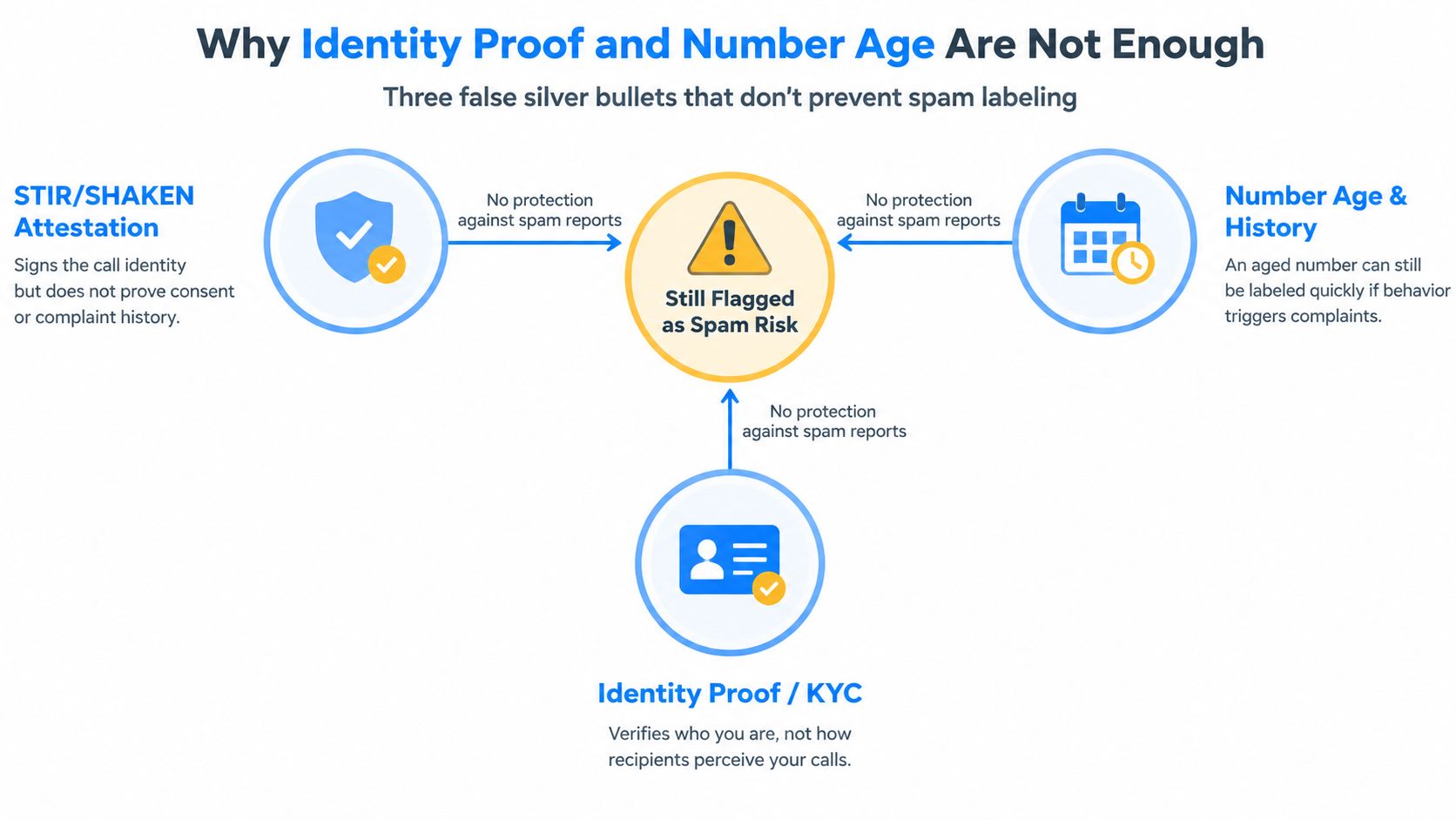
Attestation tells the network who authorized the call. It doesn't tell Hiya whether the recipient asked for the call.
Number age tells you how long a number has existed, not whether its current owner has earned trust. Recycled numbers can arrive with prior complaint history, and the block itself may carry a reputation shaped by other users. A “new” wholesale VoIP number may already have a record.
Identity verification confirms the business behind the account. It doesn't establish that recipients perceive the contact as relevant or welcome.
That is why number validation and reputation hygiene belong together. Validation can identify unreachable or problematic destinations, but it can't replace permission or behavior controls.
There's a commercial tension here. Hiya assigns Spam Risk and sells Hiya Connect. First Orion participates in Scam Likely analytics and sells ENGAGE. TNS participates in carrier authentication and reputation services and sells Enterprise Authentication. Businesses should draw their own conclusions, but the operational fact is clear: identity attestation alone leaves the reputation decision with the analytics vendor.
The useful distinction: STIR/SHAKEN answers “Who placed this call?” Spam scoring asks “How do recipients and networks experience this sender?”
Ringless voicemail has the same limitation in a different form. A direct-to-inbox delivery may avoid a ringing handset, but it doesn't eliminate consent, suppression, or recipient-perception risk. A clean identity record helps. It doesn't make an unwanted message wanted.
Start with the carrier split, not with a new list. If AT&T answer rates fall while T-Mobile and Verizon remain stable, that asymmetry points toward an AT&T and Hiya issue. If the same offer, reps, and list perform normally on one network but collapse on another, rewriting the offer is usually theater.
Don't use a hard percentage threshold unless your own baseline supports it. Smaller samples can swing from normal variance, while large campaigns can hide a concentrated problem in one segment. Compare matched lists, the same calling window, the same number pool, and the same offer before assigning blame.
| Symptom | Likely vendor | Evidence to capture | Dispute path |
|---|---|---|---|
| AT&T voice performance drops alone | Hiya | Number, time window, answer rate, complaint history, consent records | Hiya and AT&T review |
| T-Mobile voice performance drops alone | First Orion | Calling pattern, number ownership, opt-in evidence, carrier split | First Orion or T-Mobile review |
| Verizon shows a warning while others hold | TNS and Verizon systems | Label examples, delivery data, campaign details | TNS or Verizon process |
| SMS fails on one network | Carrier-specific filtering ecosystem | Message IDs, registration status, content, delivery codes | Messaging provider and carrier route |
| All carriers decline together | List, offer, consent, or operational issue | Matched-list performance and suppression audit | Internal remediation first |
The owner of a Call Loop campaign described the most useful real-world symptom this way: the incident rarely begins with a visible alert. Connect rate falls on one carrier while the others hold steady. That asymmetry is the diagnosis. When AT&T is the outlier, investigate Hiya before throwing away a healthy list.
Track labeled-call rate, answer rate, delivery rate, and complaint rate by carrier over rolling periods. For voice, opens and clicks don't exist, and they aren't valid substitutes for pickup or complaint data. The clean measurement is a matched-list test with the same reps and offer, one changed variable, and carrier-level reporting. If you haven't run that test, don't reverse-engineer a performance claim from aggregate reporting.
The broader threat environment supports this cautious approach. Recent SMS fraud coverage from Constella describes smishing, account takeover, and SMS fraud as an interconnected campaign ecosystem. ACMA's 2025 action-scams report also shows why filtering isn't the whole answer. Bad actors can use delivery methods that bypass ordinary carrier paths, so businesses need layered controls, verification, and trust signals.
A clean launch starts with records, not optimism. Before every campaign, confirm who consented, when they consented, what they agreed to receive, and whether they later withdrew that permission.
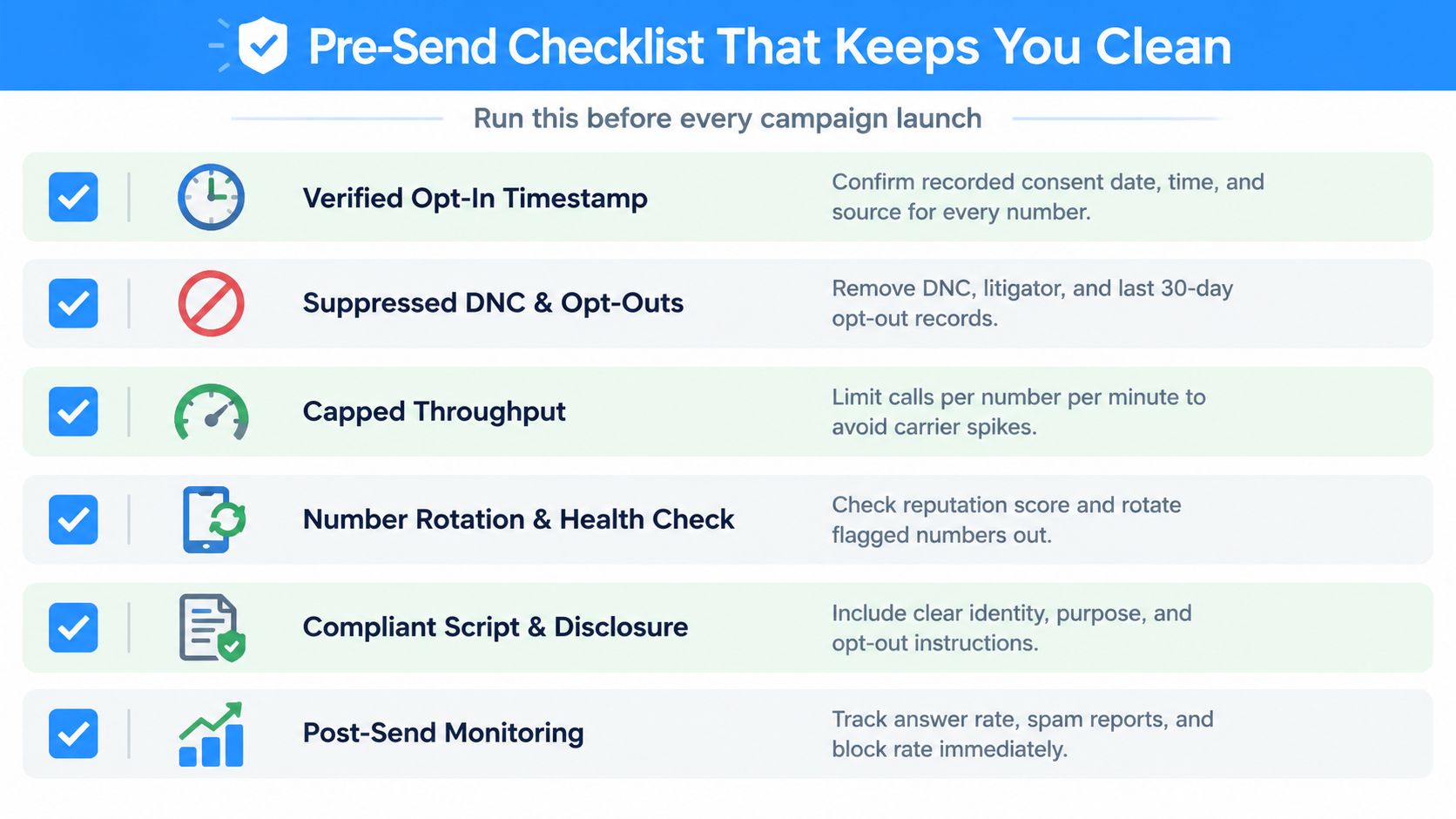
Use webhooks or equivalent event listeners for delivery failures, opt-outs, complaint signals, and label changes. A nightly report segmented by carrier can reveal a reputation issue before a weekly aggregate report buries it. Store the number, campaign, timestamp, carrier result, and action taken so the next dispute contains evidence rather than guesses.
A practical cadence keeps the work from becoming a one-time compliance exercise:
Quarantine a flagged number instead of immediately recycling it into another campaign. Review the prior owner, acquisition history, call velocity, complaint events, and consent source before returning it to service. Number rotation can distribute volume, but it won't fix a campaign that creates the same unwanted pattern on every number.
For the messaging side, this SMS compliance checklist can support the pre-send review. The platform choice matters less than whether the workflow enforces the controls. A system that can capture consent, maintain suppression lists, validate numbers, schedule a pre-call text, manage voice broadcasts and ringless voicemail, and export carrier-level outcomes gives operators the evidence needed to correct a reputation problem.
The goal isn't to avoid all filtering through a clever trick. It's to make the sender's identity, permission, cadence, and recipient experience consistent enough that analytics vendors have fewer reasons to classify the traffic as unwanted.
Call Loop supports compliant outbound campaigns across SMS, voice broadcasting, and ringless voicemail, with tools for consent capture, number validation, suppression management, scheduling, and delivery measurement. If you're diagnosing carrier-specific spam risk or building a pre-call text workflow, visit Call Loop to see how the platform can fit into your outreach process.
Chris Brisson
Chris is the co-founder and CEO at Call Loop. He is focused on marketing automation, growth hacker strategies, and creating duplicatable systems for growing a remote and bootstrapped company. Chat with him on X at @chrisbrisson


Trusted by over 45,000 people, organizations, and businesses like


