
See a Demo
You're just one step away from seeing Call Loop in action.
Enter your information below to watch a demo right now.

You're just one step away from seeing Call Loop in action.
Enter your information below to watch a demo right now.


Let's be honest, traditional marketing feels like shouting into a void sometimes. For a small business, where every single customer connection matters, you need something that cuts through the noise. Text marketing is that direct line—it's not just another gadget in your toolbox; it’s a core part of how you grow today.
Ever feel like your marketing messages are drowning in a sea of crowded email inboxes and chaotic social media feeds? You’re not alone. The biggest challenge for any small business is getting your message seen by the people who matter.
The good news? The solution is already in their pocket.

This isn’t about spamming people with generic ads. It's about creating real, personal connections that get people to act. Think about a local salon texting a last-minute opening and filling the spot in minutes. Or a boutique announcing a flash sale and seeing orders pour in almost instantly. That's the power of talking to people where they actually listen.
The numbers don't lie. For businesses like a local karate studio or a growing ecommerce shop, text marketing has become a lifeline. It delivers engagement stats that make email and social media look ancient.
Recent 2025 data shows that SMS messages have a mind-blowing 98% open rate, and 95% of those texts are read within just three minutes. Compare that to email, which struggles to get a 20-37% open rate. It's not even a fair fight. You can find more great stats on this from the folks at The Boutique Hub.
To really put it in perspective, let's look at a side-by-side comparison.
The data clearly shows why SMS is the go-to for immediate impact.
The takeaway is simple: when you need to get your message seen now, nothing beats a text.
But thinking about text marketing as just plain SMS is selling it short. A truly smart strategy mixes different formats to create a better experience for your customers. It’s all about using the right tool for the job.
By weaving these tools together, you're not just sending messages; you're building a communication plan that feels personal and actually gets results. And that's exactly what this guide is going to walk you through, step by step.
Let's be blunt: your text marketing is only as good as the list you're sending to. A top-notch, engaged subscriber list is everything, and it has to be built on a foundation of trust and clear permission. This isn't about buying lists or sneakily adding numbers without asking. It's about inviting your customers into a conversation they actually want to be a part of.
The best way to start is by making it ridiculously easy for people to say "yes." You need to sprinkle clear, compelling invitations at every single place you interact with your customers.
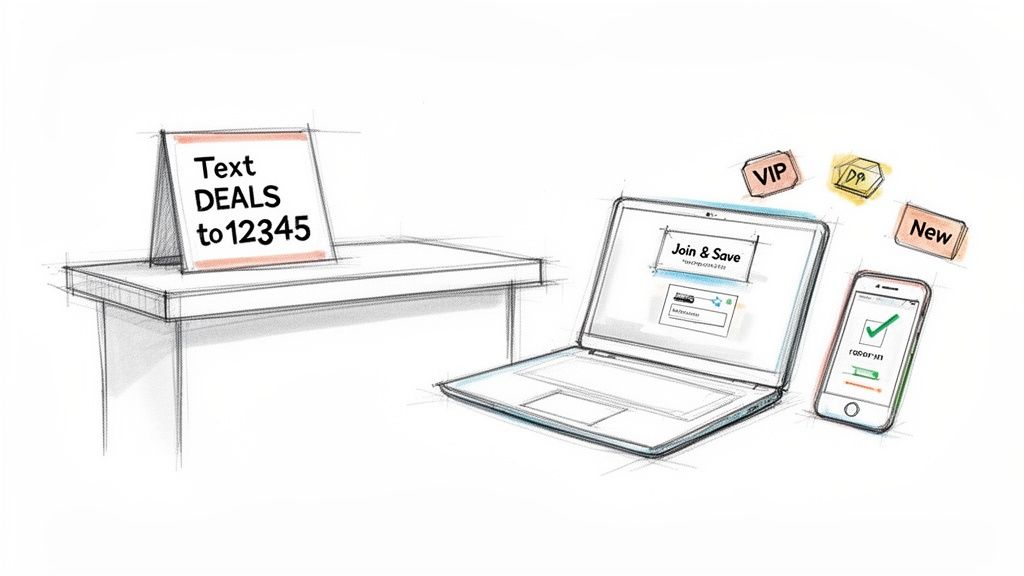
Forget about complicated setups. For most small businesses, the simplest and most direct methods are the ones that actually work. The goal is to catch people's interest right when they're most engaged with your brand.
Here are a few tried-and-true ways I've seen businesses grow their lists:
The secret to a good opt-in is making the benefit for the customer totally obvious. It doesn't matter if it's a discount, early access, or useful info—the value they get in return has to be a no-brainer.
There are tons of ways to get creative with this. If you want to dive deeper, you can check out some more ideas on 5 ways to grow your SMS marketing list starting today to see what sparks an idea for your business.
Before you even think about hitting "send," you have to get one thing straight: express written consent. This is the absolute cornerstone of doing text marketing the right way. It just means you have clear, documented proof that a specific person gave you permission to text them for marketing.
It’s not as scary as it sounds.
When a customer texts your keyword (like "DEALS") to your short code, that's them giving you consent. If they fill out a form on your website and check a box that clearly says they agree to receive texts, that counts, too.
The key is transparency. Your call-to-action needs to spell out what they're signing up for. Something like, "By texting JOIN, you agree to receive promotional messages from us. Msg & data rates may apply. Reply STOP to opt out." This simple language protects you and, just as importantly, respects your subscribers.
So, what about that list of customer phone numbers you already have? It's tempting, I know. But you can't just upload them and start blasting out marketing texts. Those contacts must have previously given you that explicit permission specifically for text marketing.
If you have a list from an old system where you know consent was properly gathered for texting, you can probably import it. But if it's just a list of phone numbers you collected at checkout without a specific marketing opt-in, you can't use it for promotional campaigns. The risk of getting into legal trouble—and completely destroying customer trust—is just not worth it.
Smart marketing is personal. You can start sorting your audience into different groups right from the moment they sign up, which will let you send way more relevant messages down the road. This one simple step can make a huge difference in how well your campaigns perform.
Think about setting up different keywords for different interests:
By letting customers choose what they're interested in, you make sure they only get messages they actually care about. This keeps people from opting out and helps you build a much stronger, more loyal group of subscribers. It’s a proactive move that sets you up for success from the very beginning.
Alright, you've built an engaged, consent-based subscriber list. Now for the fun part: turning those contacts into loyal customers and real revenue. Crafting the right message is part science, part art. The goal isn't just to fire off a text; it's to create a brief, compelling experience that makes someone feel valued and nudges them to act right now.
The best text marketing moves beyond simple blasts. It’s about creating genuine value. Whether it’s a time-saving reminder or an exclusive offer, your campaign needs to deliver something your audience actually wants.
Your first big decision is choosing the right format. Each has its strengths, and knowing when to use which can make or break your campaign's performance.
SMS (Short Message Service): This is your workhorse for speed and simplicity. With its 160-character limit, SMS is perfect for clear, urgent messages. Think appointment reminders, shipping notifications, quick flash sale alerts, or simple discount codes. Its power is in its directness—there are no distractions.
MMS (Multimedia Messaging Service): When you need to grab someone's attention visually, MMS is your go-to. It lets you send images, GIFs, and short videos. Use it to showcase a new product, send a digital coupon that looks like a physical one, or share a mouth-watering picture of your restaurant's daily special. Visuals almost always drive higher engagement and make your offer feel more tangible.
For example, a salon sending a simple SMS saying "Your appointment is tomorrow at 2 PM" is perfect. But that same salon could use an MMS to send a picture of a new hairstyle with the text, "New look just dropped! Book now and get 10% off." That visual element makes the offer so much more enticing.
With only 160 characters in a standard SMS, every single word has to earn its spot. Your copy needs to be concise, clear, and compelling. There’s zero room for fluff.
Here are a few tips I've seen work time and again for writing texts that get clicks:
The most effective campaigns feel like they’re coming from a person, not a faceless company. Keep your tone conversational and true to your brand’s voice.
For small businesses chasing a high return, text marketing is an incredibly efficient channel. Every dollar spent can stretch remarkably far. Industry stats show an average return of $71 for every $1 spent—a staggering 7000% ROI that blows email and social media out of the water. Top-performing brands often see returns of 32x to 45x their investment. If you want to dive deeper into these numbers, you can explore detailed SMS marketing statistics.
Sometimes, a text message just doesn't feel personal enough for a really important interaction. This is where a tool like ringless voicemail can be a game-changer. A ringless voicemail drop delivers a pre-recorded audio message directly to a person's voicemail inbox without ever making their phone ring.
It’s exceptionally effective for adding a human element back into your communication. It’s far less intrusive than a cold call but feels much more personal than a standard text.
Consider using a ringless voicemail for:
Think of it as a strategic partner to your SMS and MMS campaigns. A smart play might be to send an MMS with a high-value offer, and if a customer doesn't click the link within 24 hours, follow up with a warm, personal ringless voicemail drop as a gentle reminder. This multi-channel approach helps you connect with customers on their own terms, making sure your message is not only seen but also felt.
As a small business owner, you already know your time is the one thing you can't get more of. Automation isn't some fancy tech buzzword; it's how you get your day back while still giving every customer the attention they deserve. It’s all about setting up smart, automated sequences that do the heavy lifting for you, making sure no lead or customer ever falls through the cracks.
Think about it. A new subscriber signs up for your list. A second later, their phone buzzes with a welcome text and a special offer. You didn't have to do a thing. That’s the magic of automated text marketing—it turns a single action into an ongoing conversation that builds real relationships. These sequences, often called drip campaigns, are the secret to scaling your communication without cloning yourself.
The whole point of automation is to send the perfect message to the right person at exactly the right moment. The way we do that is with triggers—specific actions or dates that kick off a pre-planned series of messages. This keeps your communication relevant and timely, not random and annoying.
Here are a few automated workflows that practically every small business should have running:
By automating these key touchpoints, you create a seamless customer journey that feels personal and attentive, all while you focus on actually running your business. It's about consistency without the constant effort.
Sometimes, a single text message just isn't enough, especially if you're promoting a higher-ticket item or a really important event. This is where a multi-channel automated flow can make all the difference. You can build sequences that escalate your communication if a customer doesn't respond to the first touch.
For example, your workflow could kick off with a standard SMS. If the person doesn't click the link in your text within 24 hours, the system could automatically send another message. Still no dice? The next step could trigger a ringless voicemail drop. This sends a pre-recorded audio message straight to their voicemail—it feels personal and grabs attention without the intrusion of an actual phone call.
Here’s a simple visual of how you can stack different campaign types in a flow:
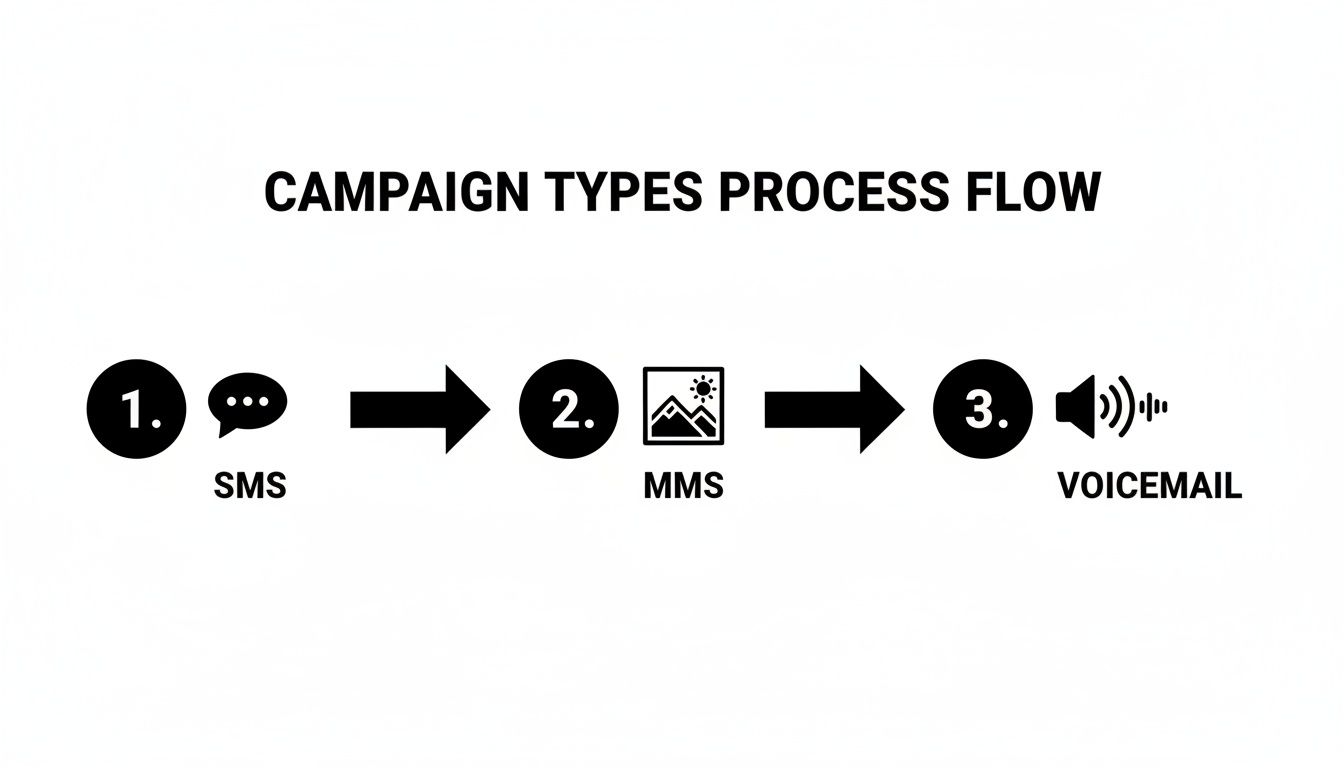
This shows how you can mix simple texts (SMS), messages with images or GIFs (MMS), and even voice to create a much more robust and effective strategy. If you want to dive deeper into this, you can learn more about creating a marketing automation workflow and see how all the pieces fit together.
Beyond triggered automations, simple scheduling is one of the most powerful tools in your arsenal. You don't have to be glued to your computer to send out campaigns. You can sit down once and plan out your entire week or month of promotions.
This is a lifesaver for things like:
This kind of control turns your marketing from a reactive, time-consuming task into a well-oiled machine that drives predictable results for your business.
Diving into text marketing can be really exciting, but let's be honest—the word "compliance" can bring that excitement to a screeching halt. Don't let the legal jargon scare you off, though.
Thinking about compliance isn't just about avoiding trouble. It's about building a solid foundation of trust that turns one-time subscribers into loyal customers for life.
The core idea is simple: respect the customer. When you treat their phone number like the personal space it is, you earn the right to communicate with them there. This respect is what separates marketing people actually want from spam they can't wait to delete.
The main regulation you’ll hear tossed around is the Telephone Consumer Protection Act (TCPA). It sounds complex, but its rules for texting really just boil down to a few straightforward ideas.
At its heart, the TCPA is all about one thing: permission.
Compliance isn't a roadblock; it's the guardrail that keeps your customer relationships strong. By respecting their inbox, you prove your business is trustworthy, making them far more likely to engage and buy.
For certain industries, you've got to think about extra layers of compliance. A big one is healthcare, which must follow the Health Insurance Portability and Accountability Act (HIPAA).
This means any message containing Protected Health Information (PHI)—think appointment details, lab results, or billing info—has to be sent through a secure, HIPAA-compliant platform. Using a standard, non-compliant service for these messages can lead to massive penalties.
This is exactly why choosing a professional service built with security in mind is so important for clinics, dental offices, and other healthcare providers. For a deeper dive, you can learn more about the core principles of SMS marketing best practices that cover many of these details.
Using your personal phone or some basic app might seem like a cheap shortcut, but it's a compliance nightmare waiting to happen. A professional, secure platform is designed to manage these rules for you.
These platforms are built to automatically handle opt-outs, document consent properly, and provide the secure setup needed for sensitive industries. By choosing the right tool, you ensure your text marketing is not only effective but also built on a solid, legal, and trustworthy foundation. That peace of mind lets you focus on what really matters: crafting great messages and growing your business.
Look, marketing without data is just guessing. Once your text campaigns are out in the wild, your job shifts from just sending messages to understanding what actually happens when they land on your customers' phones.
Tracking the right numbers is the only way to know what’s working. It lets you stop throwing money at campaigns that fall flat and double down on the ones that are bringing in business. The goal isn't just to see numbers; it's to understand the story they tell about your customers and your offers. This is how you turn text marketing from a simple tool into a real, predictable engine for growth.
Diving into a sea of data can feel overwhelming, so let's keep it simple. You only need to focus on the handful of metrics that have a direct impact on your bottom line. Think of these as the vital signs of your text marketing health.
Here are the essential numbers to watch:
Think of these metrics as a feedback loop. A high CTR but a low conversion rate tells you something important: your message was interesting enough to get a click, but the landing page or the offer itself didn't seal the deal. That specific insight tells you exactly where you need to focus your improvements.
Once you get a handle on your metrics, you can start making targeted improvements. Optimization isn't a one-and-done task; it’s an ongoing process of testing, learning, and tweaking your approach to get better and better results.
A great place to start is with A/B testing, sometimes called split testing. It’s simple: you create two slightly different versions of a message and send them to two small, separate groups from your list. You can test different headlines, offers, calls-to-action, or even the time you send the message to see what performs better.
For instance, you could test two different offers:
By comparing the CTR and conversion rates for each version, you get clear, data-backed proof of what your audience actually wants. This takes the guesswork out of the equation and helps you craft much more effective campaigns down the road.
Finally, get in the habit of actually reading your campaign reports. They'll help you spot your most engaged subscribers—the ones who consistently open and click. You can segment these VIPs into their own list to receive exclusive offers or early access, which is a fantastic way to build loyalty and encourage repeat business. Every text you send should be a strategic move that contributes directly to your bottom line.
Stepping into text marketing usually brings up a few last-minute questions. I get it. Let's tackle some of the most common ones I hear from small business owners so you can get started with total confidence.
This is one of the best parts—it's incredibly affordable to start. Most professional platforms, like Call Loop, work on a pay-as-you-go or credit system. That means you literally only pay for the messages you send. No big upfront investment needed.
You can kick things off with a tiny budget, see the results firsthand, and then scale up as your revenue grows. The key thing to remember is the ROI. Text marketing consistently delivers some of the highest returns you'll see from any marketing channel, period.
I know it’s tempting. It seems easier, right? But trust me on this, it's a bad idea for a few critical reasons. Professional platforms are designed to handle legal compliance automatically, like managing opt-out requests, which is a non-negotiable legal requirement.
Plus, you'd be missing out on all the tools that actually make this work: bulk sending, scheduling campaigns in advance, and analytics to see what's actually driving sales. Using a dedicated service keeps your personal number private and makes sure your business looks professional and reliable every time.
Ringless voicemail is a powerful tool for adding a personal, human touch. It's perfect for non-urgent but important messages where the warmth and nuance of your voice can make a real impact.
Think of ringless voicemail as a secret weapon. It’s a slick piece of tech that drops a pre-recorded audio message straight into someone's voicemail box without their phone ever ringing. It’s a fantastic way to add a personal, human touch to your campaigns.
It’s perfect for those moments where a text feels a bit impersonal. Use it for a heartfelt thank-you after a big purchase, a special announcement from you (the owner), or a follow-up that just feels better coming from a real voice.
Ready to put all this into practice? Call Loop gives you everything you need—SMS, MMS, ringless voicemail, and easy automation—to build powerful, compliant campaigns that will genuinely grow your business.
Chris Brisson
Chris is the co-founder and CEO at Call Loop. He is focused on marketing automation, growth hacker strategies, and creating duplicatable systems for growing a remote and bootstrapped company. Chat with him on X at @chrisbrisson


Trusted by over 45,000 people, organizations, and businesses like


