
See a Demo
You're just one step away from seeing Call Loop in action.
Enter your information below to watch a demo right now.

You're just one step away from seeing Call Loop in action.
Enter your information below to watch a demo right now.

When you want to connect with customers, where do you go? If you're like most small businesses, you're probably fighting for attention in crowded email inboxes and endlessly scrolling social media feeds.
There’s a better way. Text message marketing for small business is the most direct and effective way to reach people where they spend their time—on their phones. With sky-high open rates that leave other channels in the dust, it's your best bet for driving real sales and building loyalty that lasts.
This guide is your complete playbook for creating SMS campaigns that actually work.
Let's be honest, cutting through the digital noise is tough. Your customers' inboxes are overflowing, and a post on social media has a lifespan of minutes, if you're lucky. It feels almost impossible to consistently capture someone's attention.
This is exactly why text message marketing has gone from a "nice-to-have" to a must-have strategy for small businesses.
The real magic of SMS is how immediate and personal it feels. People carry their phones everywhere. A text notification is something we're wired to check almost instantly, giving you a direct line to your customer that no other channel can match.
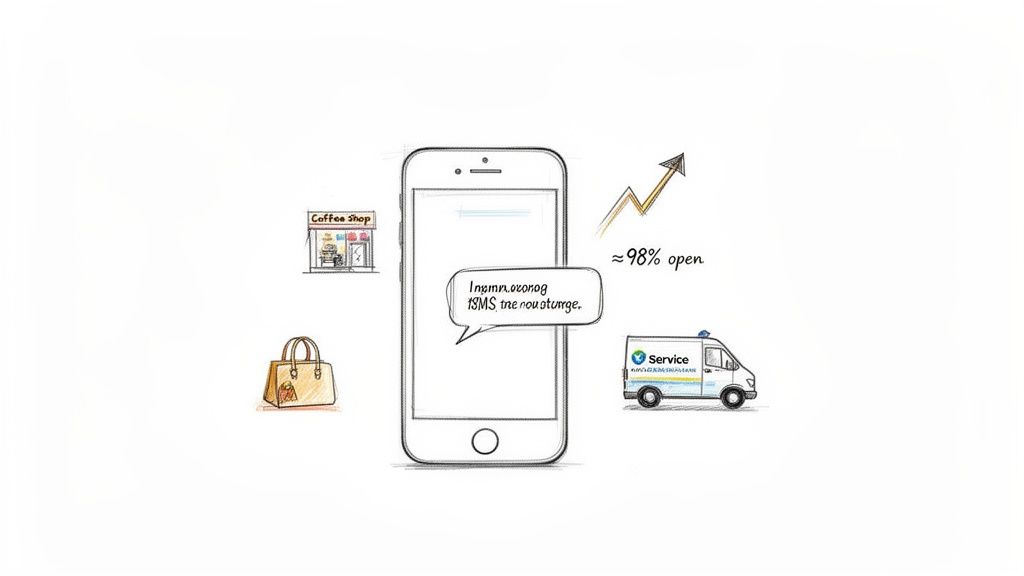
If you're still on the fence, the stats speak for themselves. After 2020, businesses woke up to the power of text, with startups and retailers ramping up their SMS marketing investment by a massive 56%.
Here's why:
What does this mean for you? For a local service pro, an automated appointment reminder text can slash no-shows overnight. For an online boutique, a flash sale text can trigger an instant flood of orders.
Text message marketing isn't just about blasting out promotions. It's about creating timely, valuable touchpoints that build real relationships and drive predictable revenue.
To give you a clearer picture, here's how SMS stacks up against the channels you're probably already using.
As you can see, the immediacy and visibility of SMS are in a league of their own. It's the closest thing to having a one-on-one conversation with your customers at scale.
While SMS is your foundation, a truly standout strategy layers in other channels. This is where tools like ringless voicemail can make a huge impact. It lets you drop a pre-recorded audio message straight into someone's voicemail without their phone ever ringing. This is often referred to as a ringless voicemail drop.
Imagine this for a local contractor:
This one-two punch feels personal, professional, and incredibly responsive. You've combined the speed of a text with the human element of your voice, instantly setting yourself apart.
Texting is just one powerful piece of a bigger puzzle. To see how it fits into a complete strategy, check out a practical guide to digital marketing for small businesses. By meeting customers on the device they never put down, you turn their phone into your most powerful tool for building relationships and growing your business.
Let's be blunt: your text message marketing campaign is only as good as the list you build. Forget about buying lists or sneaking contacts in without permission. That’s a fast track to hefty fines and, worse, alienating the very people you want to connect with.
The real goal is to build a high-quality list of people who genuinely want to hear from you.
This whole process starts and ends with one simple, non-negotiable principle: explicit consent. Under the Telephone Consumer Protection Act (TCPA), you need clear, documented permission from every single person before sending them a marketing text. This isn't just about dodging legal trouble; it’s the foundation for building real trust with your audience.
Think about it. When subscribers willingly opt-in, they’re much more likely to actually read your messages, click your links, and buy something. Your texts become a welcome update, not an annoying interruption.
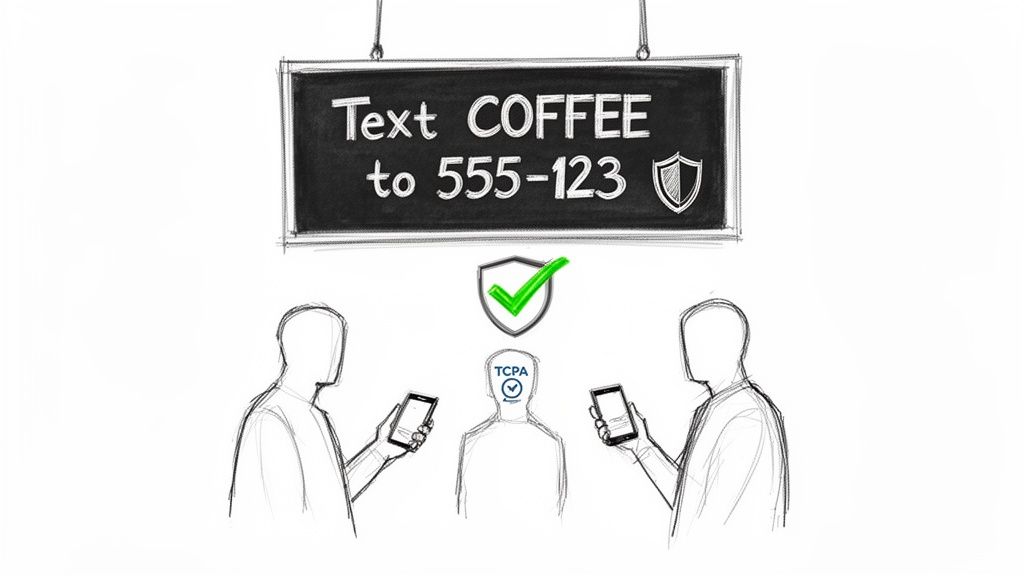
Getting that crucial opt-in means you have to offer something valuable. People guard their text inboxes, so give them a compelling reason to let you in.
Here are a few real-world strategies I've seen work time and time again:
The trick is making the incentive immediate and worthwhile. A vague promise of "updates" won't get you far. A concrete offer, like 20% off today's purchase, is what really drives action.
Remember, the TCPA requires "express written consent," but that doesn't mean you need a physical signature. It can be an electronic record, like a customer texting a keyword, submitting a form, or checking a box. The critical part is having a clear trail of when and how each person said "yes."
While a single opt-in checks the basic legal box, using a double opt-in process is just plain smart. It adds a quick confirmation step that filters for your most engaged subscribers—the ones who truly want to be there.
This extra step dramatically cuts down on incorrect numbers and spam complaints, which helps protect your sender reputation and keeps your messages from getting blocked.
Here’s how it works:
This simple two-step dance verifies the phone number and re-confirms their intent, giving you an airtight record of their consent. To get into the nitty-gritty, you can find more details in this guide on how to opt-in for text messages the right way.
Growing a list isn't a "set it and forget it" task. It requires ongoing maintenance and, most importantly, respect for your subscribers. You must always give people a clear and simple way to opt out of every promotional message you send.
The standard is to include "Reply STOP to unsubscribe" at the end of your texts. Your SMS marketing software should handle these requests automatically, making sure anyone who opts out is immediately removed from your active list. Honoring these requests instantly isn't just good manners—it's a legal requirement.
Anyone can send a text. That’s the easy part. The real challenge is getting someone to stop scrolling, read your message, and actually do something. That's a whole different ballgame.
Effective text message marketing isn't about some secret formula. It's about crafting a message that feels personal, valuable, and urgent—all within about 160 characters. Every text should land less like a corporate broadcast and more like a hot tip from a friend.
Think of a great marketing text like a recipe. If you miss an ingredient, the whole thing just falls flat. After sending millions of texts, we've found the most successful ones nail these four elements every single time.
This simple structure makes your message easy to digest and act on in a split second, which is exactly what you need for a mobile audience.
Using a customer's first name is table stakes. Real personalization goes much deeper. You need to segment your audience based on what you already know about them—their past purchases, their interests, their location.
A local pet store, for example, wouldn't send a generic "20% off" blast. Instead, they'd send an offer on cat food only to customers who've bought cat food before. That's the kind of detail that makes a message feel incredibly relevant, showing you're paying attention, not just spamming a list. For more on this, check out these essential text message marketing best practices.
Sometimes, 160 characters of plain text just won't cut it. That's where MMS (Multimedia Messaging Service) comes into play. Adding an image, a GIF, or even a short video can make your message pop and dramatically boost engagement.
Imagine a local restaurant texting about their new burger special. Which of these is more likely to get you in the door?
No contest, right? The visual makes the offer tangible and way more enticing. A boutique can show off a new dress, or a salon can use a GIF to add some personality to an appointment reminder. It just works.
No need to reinvent the wheel every time. Having a few solid templates on hand saves a ton of time and keeps your messaging sharp.
The power of SMS is undeniable. Globally, 84% of consumers have opted into business texts, and small businesses are reaping the rewards with response rates hitting 45% or more. This is driven by customer preference, as the majority of consumers under 44 prefer texts over other channels. You can dive deeper into the latest SMS marketing statistics for 2026 and see why it continues to outperform other channels.
By focusing on these core principles—a clear hook, obvious value, real personalization, a sense of urgency, and a strong CTA—you can craft messages that don't just get opened; they get results.
As a small business owner, you’re already wearing a dozen hats. Manually texting every lead, sending follow-ups, and managing reminders just isn't a good use of your time. This is where automation really shines—it lets you scale your outreach without having to scale your team.
By setting up automated sequences, you can build a customer journey that runs like clockwork. Imagine a new lead fills out a form on your website. Instead of you scrambling to reply, an automated workflow can kick in instantly, making that potential customer feel heard and valued from moment one. This isn't just about saving a few minutes; it's about creating a professional, responsive experience that builds immediate trust.
At its core, every effective text message follows a simple, powerful formula.
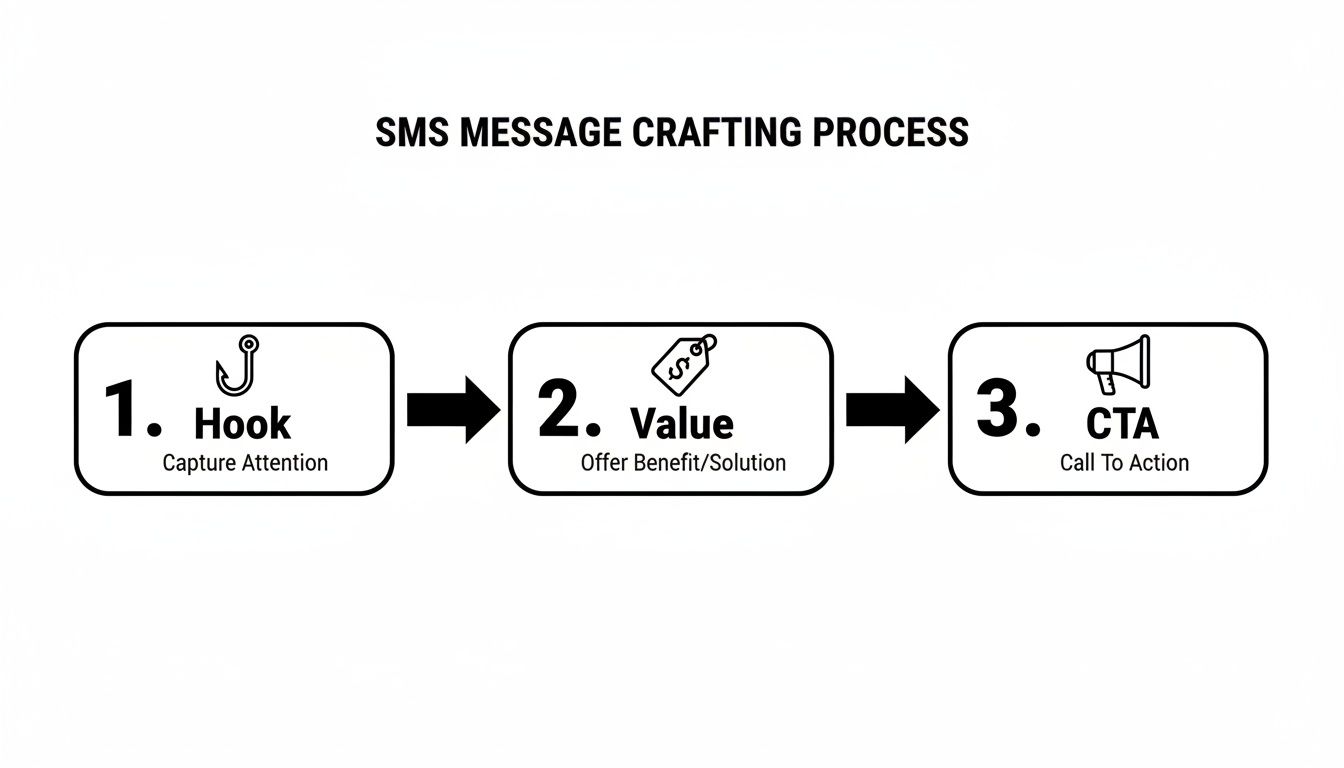
Each piece—the hook, the value, and the call-to-action—has a job to do. When they work together, they guide your customer from interest to action in just a few seconds.
While SMS is perfect for quick, direct communication, sometimes you need to add a human touch to cut through the noise. This is where ringless voicemail comes into play. It’s a pretty slick technology that drops a pre-recorded audio message directly into someone's voicemail box without making their phone ring.
It's a fantastic way to add a layer of personalization that text just can't deliver. Hearing your actual voice can build a much stronger connection and make your outreach feel genuinely personal. Think about using it for a warm welcome, a thank-you message after a purchase, or a gentle follow-up that feels less like a sales pitch and more like a helpful check-in. This voicemail marketing tactic sets you apart from competitors who rely solely on text.
Let’s map this out with a real-world example. Say you run a local home cleaning company, and a potential customer requests a quote on your website.
Here’s what their automated journey could look like:
This multi-channel approach is so effective because it connects with people on different levels. The initial text is fast and professional. The voicemail adds a personal touch. The final offer creates a compelling reason to act now.
This entire sequence nurtures a lead from initial interest right through to conversion, all without you having to lift a finger after the initial setup. You get to focus on providing an amazing service while your marketing system works in the background to keep your schedule full.
Once you’ve got SMS and voicemail down, you can start exploring broader strategies to make your business even more efficient. For a deeper dive into how all the pieces can fit together, check out a comprehensive guide to sales and marketing automation. It will open your eyes to more advanced concepts that can save you countless hours and drive serious growth.
Getting a text message marketing campaign off the ground is one thing. But what separates the short-lived experiments from the long-term profit centers? Two things: staying on the right side of the law and knowing your numbers.
It's not just about firing off texts. It's about building a program that's both safe and smart—one that respects your customers' inboxes and uses data to get better with every single send.
Let's get the legal stuff out of the way first. The main rulebook here is the Telephone Consumer Protection Act (TCPA). It sounds heavy, but the core ideas are just common sense. You need to get someone's explicit permission before you text them, give them an easy way out, and respect their decision immediately.
Don't skim this part. Getting it wrong can mean fines from $500 to $1,500 per text. That's the kind of mistake that can sink a small business fast. The whole point of compliance is to treat your subscribers' phones with respect.
Here’s what that looks like in practice:
These aren't just hoops to jump through; they're the foundation of trust. When customers feel respected, they stick around.
The proof is in the numbers. Healthy SMS lists see an average opt-out rate of under 3%. Why? Because when businesses play by the rules, customers are more than happy to stay in the loop. This trust is what makes SMS so ridiculously effective.
Once your compliance is locked down, it's time for the fun part: seeing what works. You can't improve what you don't measure. Think of your SMS platform's analytics dashboard as your mission control.
To start, you need to get familiar with a few key metrics, or Key Performance Indicators (KPIs):
Keeping an eye on these KPIs shifts you from guessing to knowing. For example, a weak CTR isn't a failure—it's a signal. It tells you to try different wording, a stronger call to action, or maybe an MMS with a killer image next time.
At the end of the day, you need to know if all this is actually making you money. Calculating the Return on Investment (ROI) for your SMS campaigns is surprisingly simple, and it's the best way to prove the channel's value.
Here's the basic formula: (Revenue Generated - Campaign Cost) / Campaign Cost
Let's say you spent $100 on text credits for a flash sale. That sale brought in $1,500 in new orders. Your ROI would be a staggering 1400%. This isn't fuzzy math; it connects your marketing spend directly to your bank account.
The data for small businesses is especially eye-opening. A whopping 63% of all businesses using text marketing are small to medium-sized, and for good reason. Marketers report earning an average of $71 for every dollar invested, and 96% say it has directly boosted their revenue. Want to go deeper? Check out these powerful SMS marketing stats and insights for businesses.
When you pair rock-solid compliance with disciplined measurement, you build an SMS program that delivers real, predictable growth.
Jumping into text message marketing for your business can feel like a big move, and it’s smart to have questions. To give you some clarity, we’ve put together answers to the most common things we hear from business owners just like you.
One of the best things about SMS is that it won't break the bank. Most platforms run on a pay-as-you-go model or a low monthly fee based on how many messages you send. We're talking just a few cents per text.
When you stack that up against the ever-rising cost of a click on social media or search ads, the return on investment with SMS is pretty remarkable. A small business can get a real, effective text campaign off the ground for well under a hundred dollars a month. That makes it one of the most accessible marketing channels out there, period.
Think of SMS and ringless voicemail as two different tools in your outreach kit, each with a unique job.
SMS is your classic text message. It lands right in their phone’s inbox and is perfect for quick, direct info like promo links, discount codes, or appointment reminders. Its superpower is being immediate and getting seen—fast.
Ringless voicemail is a different beast. It delivers a pre-recorded audio message directly to someone's voicemail without making their phone ring. This is your go-to when you want to add a more personal, human touch without being intrusive. It’s fantastic for thank you messages, special announcements, or follow-ups where the warmth of your voice can build a much stronger connection.
The real magic happens when you use them together. Imagine an automated text confirming an order instantly, followed by a personal-sounding ringless voicemail a day later thanking them. That’s how you stand out.
Yes. One hundred percent, yes. The TCPA (Telephone Consumer Protection Act) isn't messing around. Fines can range from $500 to $1,500 per violation. Let that sink in. A single non-compliant text sent to 100 people could theoretically put your business in a very deep hole.
This is exactly why getting explicit written consent before you send marketing texts isn't just a good idea—it's the law. You also have to give people a clear and easy way to opt out (like replying 'STOP') and honor that request immediately. The smartest and safest way to handle this is by using a reputable platform with compliance tools built right in to protect yourself.
Simple: offer something they actually want. Nobody is signing up for more ads. You have to give them a compelling reason to let you into their inbox.
Here are a few tactics that work every time:
The better your offer and the more places you promote it, the faster you'll build a list of engaged people who actually look forward to hearing from you.
Ready to put the power of direct, automated outreach to work? Call Loop gives you all the tools you need—from compliant bulk SMS and personalized ringless voicemail to powerful drip campaigns that nurture leads 24/7. Join over 45,000 businesses and start building stronger customer connections today.
Chris Brisson
Chris is the co-founder and CEO at Call Loop. He is focused on marketing automation, growth hacker strategies, and creating duplicatable systems for growing a remote and bootstrapped company. Chat with him on X at @chrisbrisson


Trusted by over 45,000 people, organizations, and businesses like


