
See a Demo
You're just one step away from seeing Call Loop in action.
Enter your information below to watch a demo right now.

You're just one step away from seeing Call Loop in action.
Enter your information below to watch a demo right now.

At its most basic, a toll-free call means the person dialing the number isn't charged a dime. Instead, the business or organization on the other end picks up the tab.
Think of it as a pre-paid invitation for your customers to get in touch.
A toll-free number completely flips the usual billing model on its head. Normally, the caller pays for connection time or long-distance fees. With a toll-free number, your business absorbs those costs.
It’s the digital equivalent of stuffing a postage-paid return envelope in a letter. You're removing any financial hesitation that might stop a customer or prospect from reaching out.
This all works thanks to special prefixes the phone network recognizes instantly. When someone dials a number starting with one of these codes, the network routes the billing straight to the business account tied to that number.
The most famous prefix is 800, but over the years, several others have been added to meet the growing demand. These codes are the universal sign that a call is free for the person dialing.
Common toll-free prefixes include:
Don't get too hung up on the specific code. An 888 number works exactly the same way an 800 number does. The variety simply creates a much larger pool of available numbers for businesses to claim.
To make the distinction crystal clear, let's break down how a toll-free call stacks up against a standard phone call.
This table shows the core differences from both the customer's and the business's point of view.
| Feature | Toll-Free Call | Standard (Toll) Call |
|---|---|---|
| Who Pays for the Call? | The business that owns the number. | The person making the call. |
| Cost for the Caller | $0. Completely free to dial. | Varies. Can incur local, long-distance, or mobile minute charges. |
| Common Prefixes | 800, 888, 877, 866, 855, 844, 833 | Geographic area codes (e.g., 212, 310) or non-geographic codes. |
| Primary Business Goal | Encourage inbound calls for sales, support, and marketing. | General-purpose communication. Cost is a factor for the caller. |
| Customer Perception | Professional, established, and customer-focused. | Standard, local, or personal. |
Ultimately, one is designed to remove friction for the customer, while the other places the cost burden on them.
Understanding what a toll-free call means goes way beyond the billing. It’s a powerful tool for your entire communication strategy.
By offering a free and easy way to connect, your business instantly looks more established, professional, and serious about customer service. That accessibility is vital for building trust right from the very first interaction.
A toll-free number is a clear signal to your customers that you value their business and want to hear from them. It removes friction and opens the door to stronger relationships, better support, and more sales.
A toll-free number can also become a central hub for your modern communication efforts. It can be your main caller ID for outbound voice broadcasts, SMS marketing campaigns, and even ringless voicemail drops. This ensures all of your outreach has a consistent, professional identity. It's not just a way to receive calls; it's a core part of your entire communications toolkit.
Think of a toll-free number as less of a phone number and more of a smart switchboard for your entire business. It's a virtual number, which means it isn’t chained to a single, physical phone line. This gives you some serious control over where your calls go.
When a customer dials your 800-number, it doesn't just ring a phone on a desk. Instead, the call instantly checks in with a central database run by a Responsible Organization (RespOrg). This database acts like a traffic controller, telling the network precisely where to route that call.
This whole process is the secret sauce behind its flexibility. The destination isn't set in stone; you can change it on the fly. You can set up all sorts of rules to direct calls wherever you need them to go.
This is where things get interesting. Smart routing isn't just a cool feature; it’s a powerful tool for managing every call that comes into your business. You can build rules that automatically send callers to the right person or department, every single time.
This quick chart breaks down how a toll-free call gets from your customer to you.
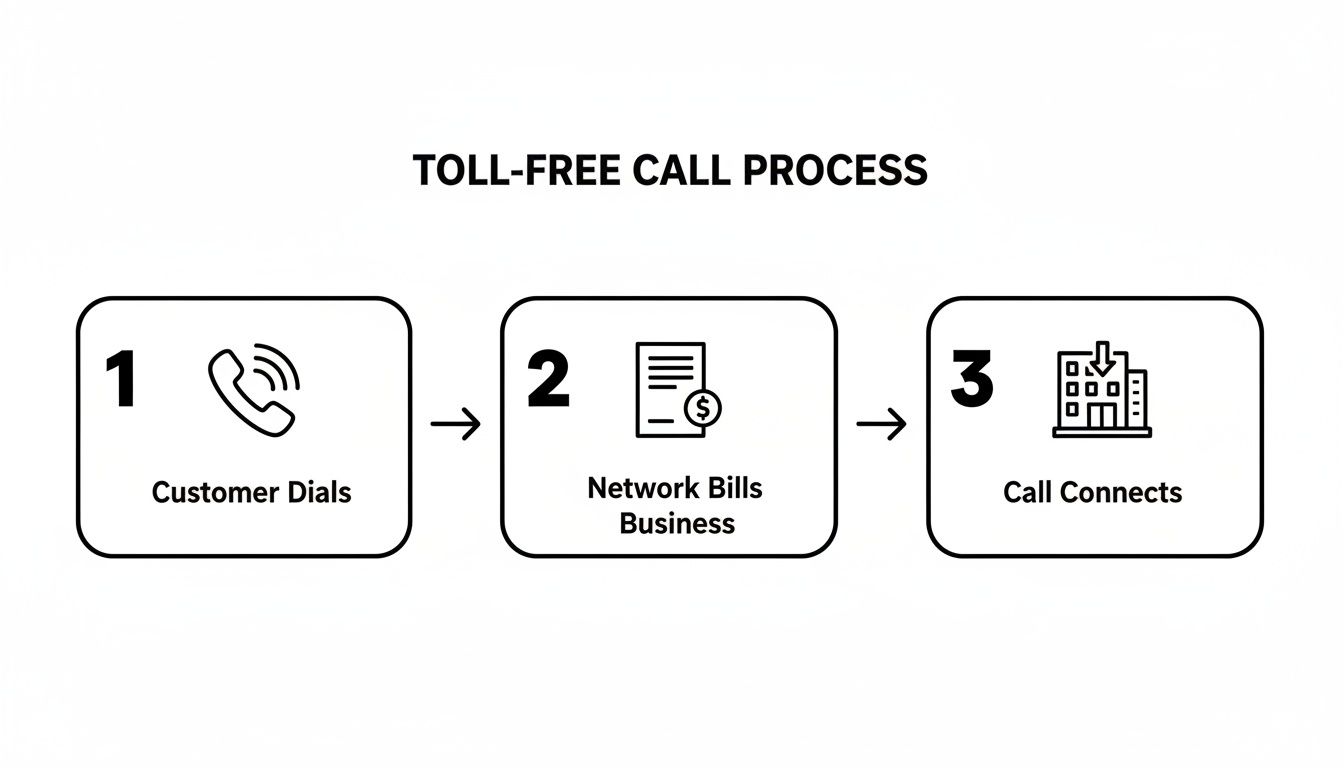
As you can see, the system is built to connect your customer seamlessly while the billing happens behind the scenes. This all happens in milliseconds, so your caller just gets a smooth, professional experience.
A toll-free number decouples your business phone number from a physical location. It’s a virtual asset that forwards calls to any destination you choose—an office landline, a remote agent's mobile phone, or even an automated IVR menu.
This opens up a ton of possibilities. For example, you can forward calls based on:
Since your business is footing the bill for these calls, it’s important to know how you'll be charged. You'll generally run into two main billing structures.
This combination of flexible routing and straightforward billing is what gives a modern communications platform its power.
So, you’ve got a toll-free number. Most people stop there, thinking of it as just a free way for customers to call in. But that’s only scratching the surface.
When you treat your toll-free number as a core business tool, it transforms from a simple contact method into a powerhouse for marketing, sales, and even outbound outreach. It becomes the central nervous system for tracking what works and what doesn't.
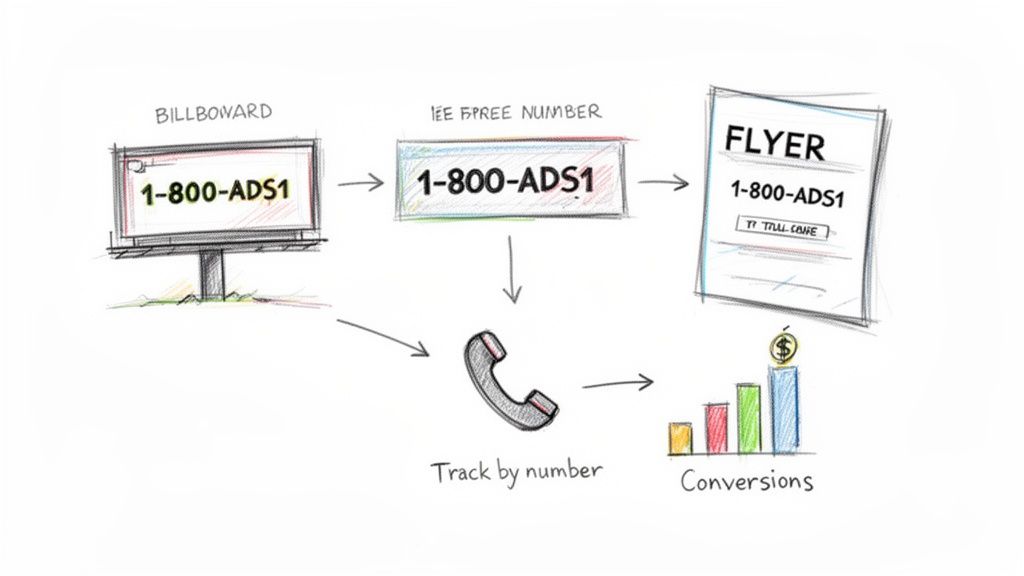
The easiest way to see this in action is with call tracking.
Imagine you're running ads on a billboard, a local radio station, and in a print flyer. How do you really know which one is bringing in calls? Instead of guessing, you assign a unique toll-free number to each campaign. Now, when a call comes in from the number you put on the billboard, you know exactly what inspired that customer to pick up the phone. It’s that simple.
Fielding inbound calls is a given, but a toll-free number really starts to pull its weight when you use it for outbound communication. Using that same recognizable number as your caller ID for all your outreach builds instant trust and creates a professional, consistent brand image with every single touchpoint.
This opens up a ton of modern strategies:
These outbound tactics shift your number from a passive waiting game to an active tool that drives sales and keeps your audience engaged. The ringless voicemail feature, especially, lets you connect with people on their own terms.
The real magic happens when your toll-free number becomes the heart of your entire communications strategy. It’s no longer just about inbound or outbound; it’s about both. Your team can be answering support questions one minute and launching a targeted SMS campaign the next, all from the same trusted number.
This unified approach is a major reason the contact center industry is exploding. The global contact center market was valued at around $352.4 billion in 2024 and is on track to hit nearly $500 billion by 2030. That massive growth shows how much businesses are investing in centralizing their communications—and toll-free numbers are at the core of that trend. You can dig deeper into these numbers by exploring call center statistics.
By combining the accessibility of inbound calls with smart, proactive outbound strategies, your toll-free number becomes a complete communication engine. It's the key to tracking marketing, driving sales, and building real customer relationships.
Ultimately, knowing what a toll-free call is is just step one. The real value comes when you put that number to work in every part of your business.
Using a toll-free number for SMS marketing or voice broadcasts is incredibly powerful. But with great power comes—you guessed it—some serious rules you have to follow. When you’re reaching out to customers, you're stepping into a legally regulated space.
Ignoring these rules isn't just a slap on the wrist. It can lead to crippling fines that could shut your business down for good.
These regulations are all about protecting people from unwanted calls and texts. The big one you absolutely need to know is the Telephone Consumer Protection Act (TCPA). The TCPA is the law of the land for automated calls and texts, and it all boils down to one word: consent.
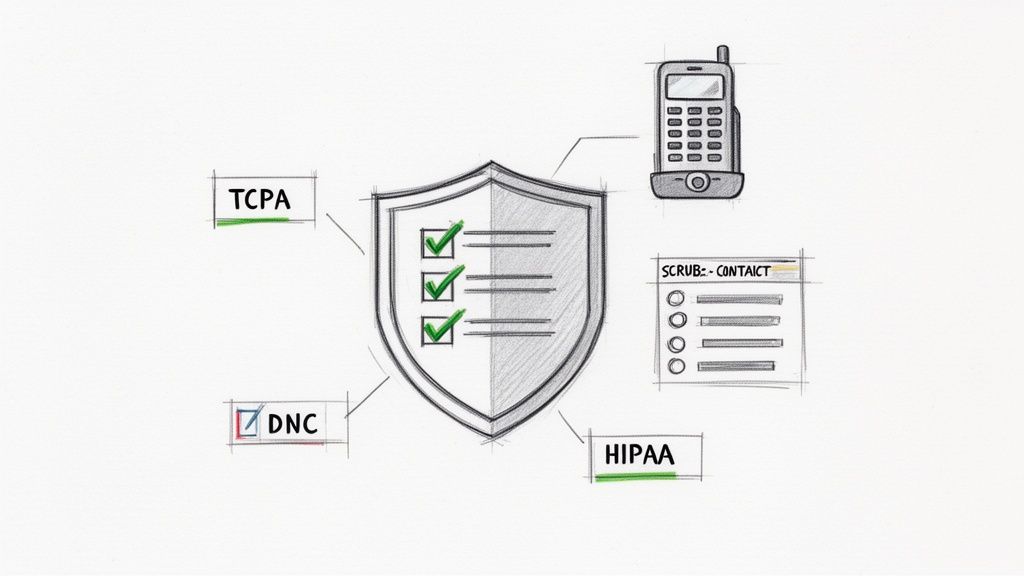
If you’re sending marketing messages with an automated system, the TCPA requires you to get express written consent from every single person on your list. This isn’t a suggestion; it’s the law. You need a clear, documented paper trail showing that someone explicitly agreed to get marketing messages from you.
Just having a customer’s phone number isn’t nearly enough. To be compliant, you must prove they took a specific action—like checking a box on your website or texting a keyword to join your list—that gave you permission to contact them. If you want to get into the nitty-gritty, you can learn more about how express written consent works and why it’s a non-negotiable for your campaigns.
Another huge piece of the puzzle is the National Do Not Call (DNC) Registry. Before you launch any outbound calling campaign, you have to "scrub" your list, which just means removing any phone number that's on the DNC registry.
And here's why this is so critical: breaking TCPA and DNC rules can cost you anywhere from $500 to $1,500 per violation. For a business sending thousands of texts, those penalties can add up to a devastating amount, fast.
If you’re in the healthcare space, the rules get even tighter. On top of the TCPA and DNC, you have to navigate the Health Insurance Portability and Accountability Act (HIPAA).
HIPAA sets the gold standard for protecting sensitive patient health information (PHI). This means any message containing PHI—even a simple appointment reminder that connects a patient’s name to a specific clinic—has to be handled with the utmost care.
To stay on the right side of the law, healthcare providers must use a platform that guarantees:
Using a non-compliant platform to talk to patients is a massive gamble. A HIPAA violation can trigger enormous fines and do permanent damage to your practice’s reputation. For any healthcare-related communication, from appointment reminders to critical patient updates, choosing a secure, HIPAA-compliant platform like Call Loop is an absolute must.
So, you've decided a toll-free number is right for your business. Smart move. Now comes the fun part: getting it set up and working for you.
Choosing the right provider is about more than just getting a number. You need a platform that bundles everything together—SMS, voice broadcasting, and ringless voicemail—all under that one toll-free number. This keeps your brand looking sharp and consistent, no matter how you're reaching out.
One of the first decisions you'll face is whether to go with a standard, randomly assigned number or a slick vanity number.
A standard number gets the job done. It's functional, professional, and ready to go in minutes. Think 1-877-555-1234. Nothing wrong with it.
But a vanity number? That's a marketing powerhouse.
1-877-555-1234 works perfectly for general use. It tells customers you're a legitimate, accessible business.1-800-GROWTH is instantly memorable. It sticks in a customer's head after hearing it on the radio or seeing it on a billboard, making it a killer branding tool.Vanity numbers can have a higher upfront cost, but the brand recall and marketing boost often deliver a massive return. Your choice really boils down to your budget and how you plan to use the number in your ads. For a deeper dive, check out our guide on how to buy a phone number that fits your strategy.
Getting your new number live is pretty straightforward. Just follow these steps to get it integrated into your business and start seeing results.
Picking a provider isn't just a small task; it's a strategic partnership. More and more businesses are outsourcing their communications, which means the tech partners they choose are mission-critical. The global call center outsourcing market is expected to explode from $381.53 billion in 2026 to $655.98 billion by 2032. This trend just underscores how important it is to pick a powerful platform that can grow with you. You can read more about these market trends on givainc.com.
Once you start digging into toll-free numbers, a few common questions always seem to pop up. It's totally normal.
Let's clear the air on the big ones so you can get moving with confidence.
Yes, you absolutely can. This is probably one of the biggest myths out there.
A modern toll-free number isn't just for voice calls anymore. You can fully text-enable it, which means you can send and receive both standard SMS texts and even MMS picture messages.
This unlocks a ton of potential. You can now use that single, professional number for everything—from answering customer calls to sending out SMS marketing offers and photo updates. It pulls all your communication under one trusted brand identity.
For the person dialing, yes. A toll-free call means it costs them absolutely nothing to reach you, as long as they're calling from inside the designated area (like the U.S. and Canada).
The business that owns the number, however, does pay for the calls. You'll typically pay a per-minute rate or have a monthly plan that includes a bucket of minutes.
Think of it as a strategic investment. You're footing the bill to make it as easy as possible for customers to connect with you, which is a proven way to improve service and drive more sales.
Functionally? There is no difference. A call to an 888 number works exactly the same as a call to an 800, 877, or any of the other toll-free prefixes. They are all free for the caller.
The only reason we have so many different prefixes is that the original 800 numbers got so popular they simply ran out. To meet demand, new prefixes were rolled out over the years. An 833 number is just as good as a classic 800.
Ringless voicemail is a really clever outbound tool. It lets you drop a pre-recorded audio message straight into someone's voicemail box without their phone ever ringing.
The best part? Your toll-free number still shows up as the caller ID, so they know exactly who the message is from and can easily call you back.
Here are a few ways businesses use it:
Because it's non-intrusive, it's become a go-to for sales and marketing teams who want to connect without being disruptive.
The whole point of a toll-free number is to make communication easier. Modern features like two-way SMS and ringless voicemail just take that idea a step further. They let you connect with customers on their terms, on the channels they actually use, all from one professional business number.
It’s how you build a communication strategy that’s not just effective, but also respectful.
Ready to put these powerful tools to work for your business? With Call Loop, you can get a toll-free number and immediately start using SMS, voice broadcasts, and ringless voicemail to connect with your customers. Explore Call Loop's features today!
Chris Brisson
Chris is the co-founder and CEO at Call Loop. He is focused on marketing automation, growth hacker strategies, and creating duplicatable systems for growing a remote and bootstrapped company. Chat with him on X at @chrisbrisson


Trusted by over 45,000 people, organizations, and businesses like


