
See a Demo
You're just one step away from seeing Call Loop in action.
Enter your information below to watch a demo right now.

You're just one step away from seeing Call Loop in action.
Enter your information below to watch a demo right now.

You’ve probably seen it on a storefront window, event banner, church slide, or Facebook ad.
Text DEALS to 12345.
Text JOIN to get updates.
Reply YES to confirm.
If you’ve wondered what that “SMS code” is, you’re not alone. Business owners often lump several different things into the same phrase. Sometimes they mean the keyword. Sometimes they mean the short number. Sometimes they mean the one-time verification text a customer gets after signing up.
That confusion matters, because once you understand how these pieces fit together, SMS stops feeling technical and starts feeling practical. It becomes a straightforward system for collecting leads, confirming consent, sending reminders, and following up at the right time.
A local business owner usually runs into this the same way. They see a competitor with a simple call to action on a sign:
Text JOIN to 55555 for specials
It looks easy. It also raises a pile of questions. Is “JOIN” the SMS code? Is 55555 the SMS code? Is this the same thing as the code a bank texts for login security?
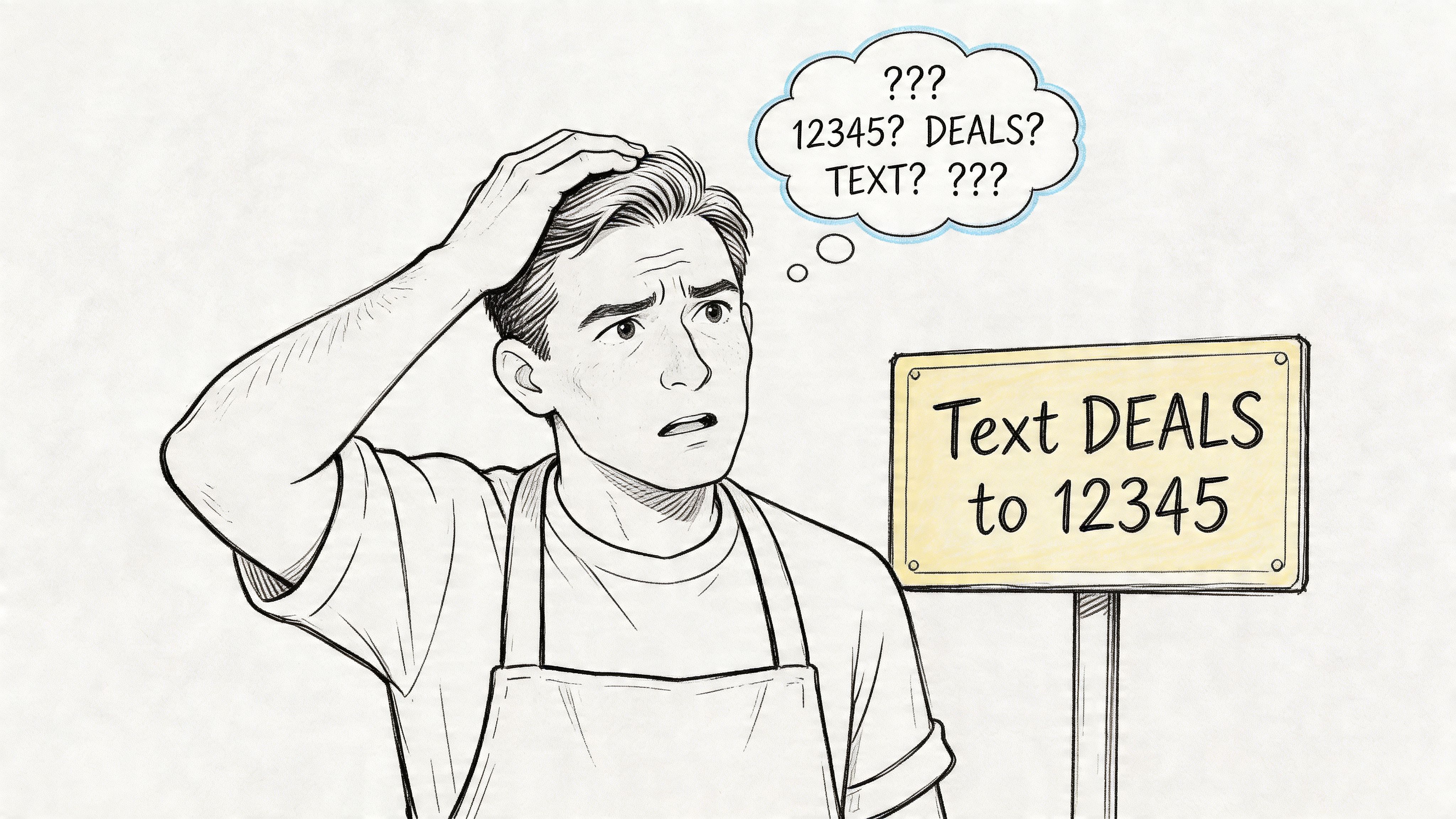
All of those questions are reasonable. The industry uses “SMS code” loosely, and that’s where most articles lose people. A business owner doesn’t need jargon. They need to know what to put on the sign, what happens after the customer texts in, and how to stay compliant while growing a list.
What makes the channel worth learning is simple. SMS has a 98% open rate compared to email’s 20-28.6%, and 90% of messages are read within 3 minutes. Businesses that text customers are 5.89 times more likely to report digital marketing success, with an average ROI of $71 for every dollar spent according to Infobip’s SMS marketing statistics.
If you run a gym, med spa, karate school, dental office, real estate team, or ecommerce brand, those numbers explain why so many businesses now put text calls to action everywhere customers already look.
A simple keyword campaign can help you:
Practical rule: If a customer can act in one tap or one text, response friction drops.
If you want to see what that signup experience looks like in practice, this text-to-join workflow shows the exact kind of process businesses use to turn a keyword into a subscriber.
The easiest way to understand what is sms code is to split it into three parts. The same phrase gets used for three different things, and they serve different jobs.
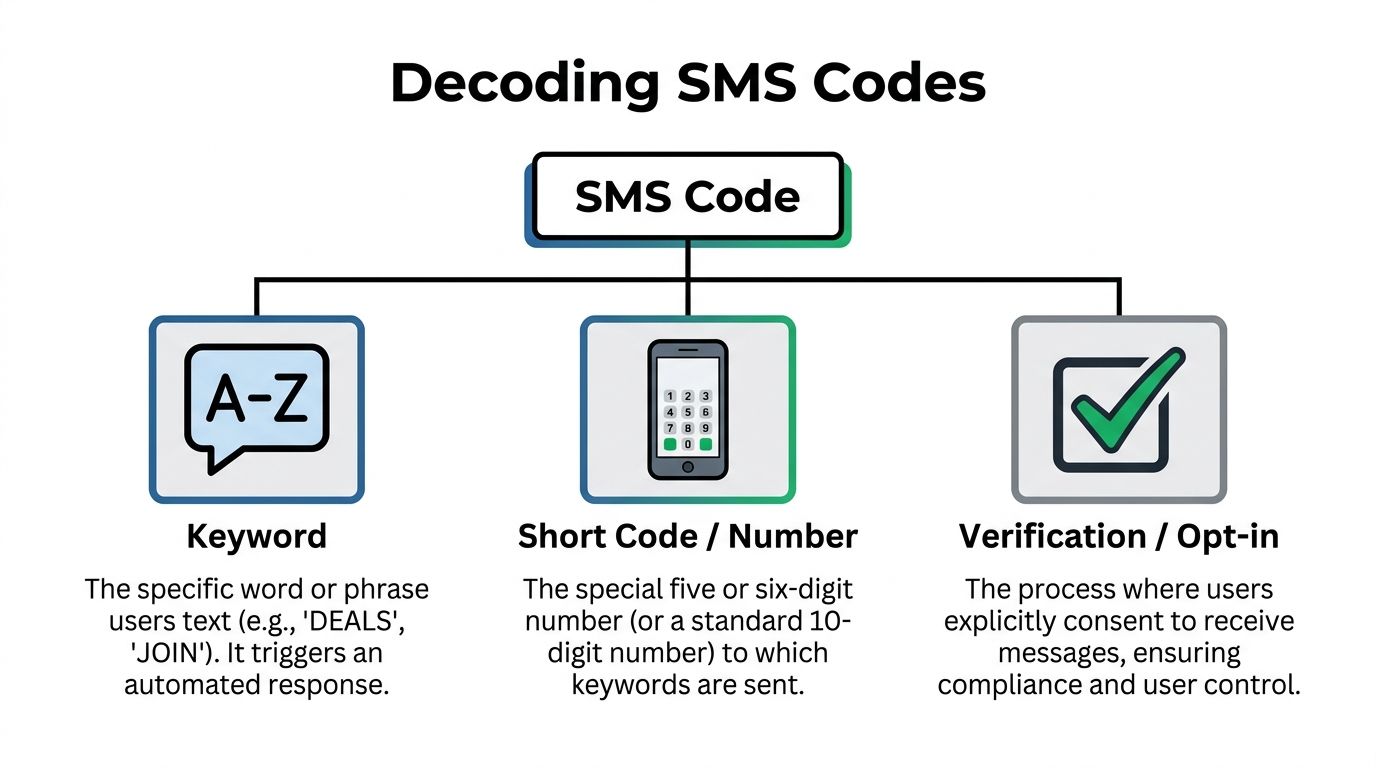
The keyword is the word someone texts in. It serves as a door opener.
Examples include:
When a customer texts that word, the system knows what action to take. It might send a coupon, add the contact to a segment, trigger a reminder flow, or ask for confirmation.
A good keyword is short, easy to spell, and tied to the offer. “JOIN” works for general list growth. “KARATE” works better on a flyer for a free class. “CHECKIN” works for events. “REMIND” fits service businesses.
The number is where the text goes. This is often the first part that comes to mind.
It can be:
Short codes are built for business messaging at scale. According to AWS’s guide to SMS short codes, short codes start at 100 messages per second and scale higher, which is why they’re preferred for large campaigns.
The number is the address. The keyword is the instruction.
The third meaning is the verification code, also called an OTP or one-time passcode.
This is the text a customer gets to confirm an action, such as:
In a marketing workflow, verification-style messages often support consent. Someone texts your keyword, then receives a follow-up asking them to confirm they want messages. That extra step protects both the business and the subscriber.
The cleanest SMS programs treat consent as part of the customer experience, not a legal box to check later.
Here’s the simple model:
| Part | What it is | Example | Job |
|---|---|---|---|
| Keyword | The word texted by the customer | JOIN | Triggers the workflow |
| Number | The destination number | 12345 | Receives the text |
| Verification | The confirmation message or code | YES or one-time code | Confirms permission or identity |
When people ask what is sms code, they’re often referring to one of these parts. In real campaigns, you usually use all three together.
A karate studio is a good example because the workflow is easy to picture and easy to mess up if the pieces aren’t connected.
The studio puts this on a flyer handed out at a community fair:
Text KARATE to 38470 for a free trial class
That one line does a lot of work. It gives the prospect a low-friction way to respond. It also tells the business exactly what offer generated the lead.
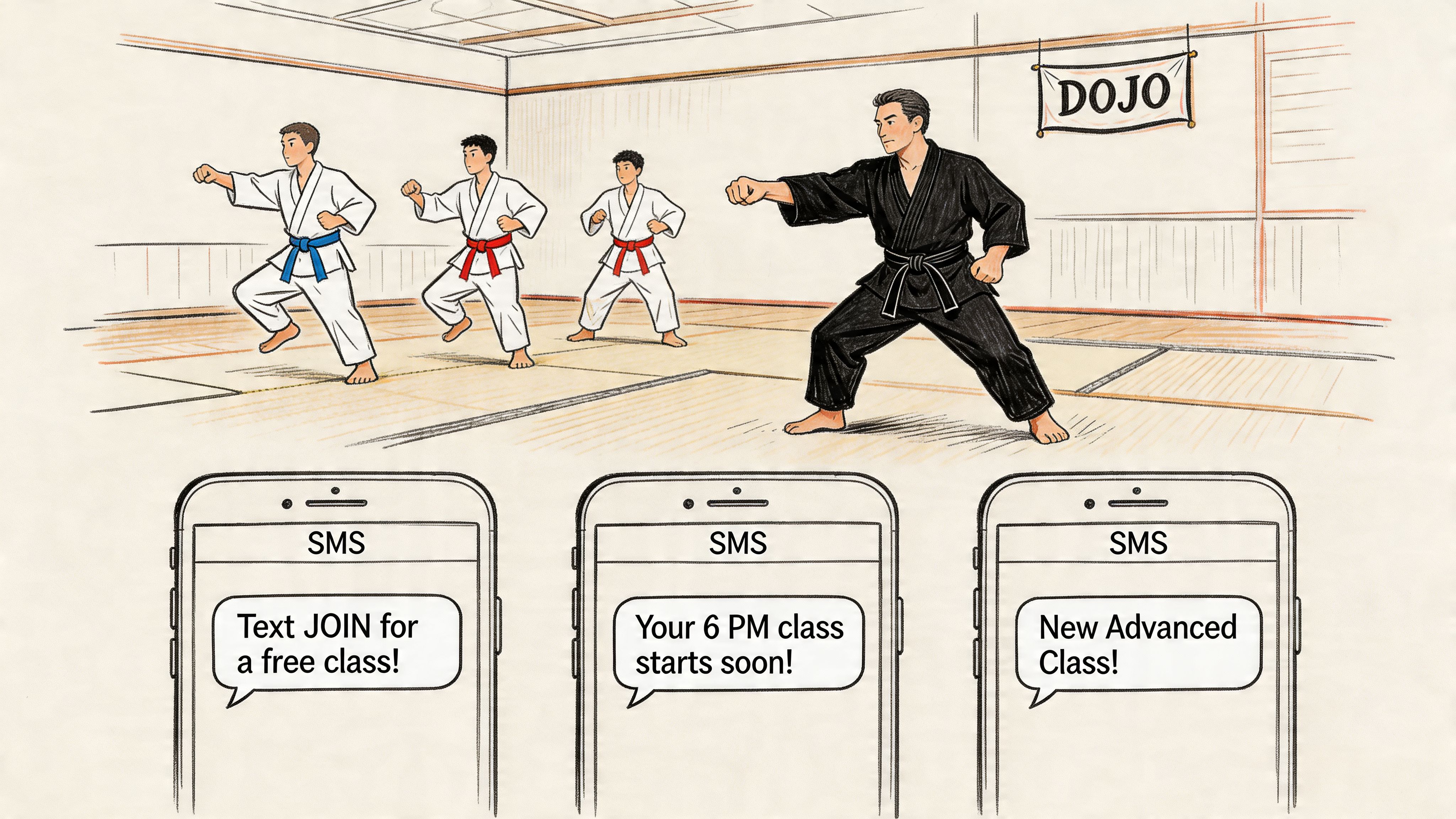
The prospect texts KARATE.
The system replies with a welcome message that confirms consent and delivers the promised offer. If the business is doing things properly, at this stage, the list gets built the right way instead of dumping numbers into a spreadsheet and texting them later.
Keyword-triggered opt-ins help drive compliant list growth, contributing to an 84% consumer opt-in rate for business texts. These workflows also show an average 45% conversion rate and a $71 return per dollar spent, while 72-75% of consumers make a purchase after receiving a marketing text according to SimpleTexting’s 2025 texting and SMS marketing statistics.
That matters because the first reply shouldn’t just say “thanks.” It should move the customer toward the next step.
A practical version looks like this:
Most businesses stop too soon. They send the first text and hope the lead remembers to act later.
The better move is a short follow-up sequence.
For a karate studio, that might look like this:
That multi-channel pattern works because each message does a different job. SMS gets seen fast. Ringless voicemail adds a human voice without forcing a live call. A final reminder catches people who were interested but distracted.
When a lead goes cold after the first text, it usually isn’t lack of interest. It’s timing.
For teams that live inside a CRM, syncing SMS responses with tools such as Salesforce CRM can make follow-up cleaner. Sales staff can see who opted in, who clicked, and who replied, instead of chasing disconnected conversations.
What works
What doesn’t
SMS codes transition from being a definition to a working system.
The number behind your SMS campaign shapes more than delivery. It affects reply handling, approval time, brand perception, and how easily your team can turn a text into a booked appointment or sale.
Business owners usually choose a number type too early based on cost alone. That creates problems later. A roofing company that needs two-way scheduling has different needs than a franchise pushing a national keyword campaign, and both are using "SMS codes" in different ways. One may need a local-style number to manage replies. The other may need a short code so customers can text a keyword like JOIN to a memorable number.
A dedicated short code is built for scale and recall. It is the classic "Text DEALS to 55555" setup. If your business runs large promotions, nationwide campaigns, or high-volume alerts, short codes make that experience cleaner for customers and easier to remember.
They also require more commitment. Setup takes longer, the approval process is stricter, and the monthly cost is higher than other options. For smaller businesses, that investment only makes sense if SMS is already a major revenue channel or if message volume is high enough to justify the speed and branding benefits.
Short codes are a strong fit for:
If you want a closer look at how short codes work, this guide on what short codes are covers the basics.
A 10DLC number is a standard 10-digit number approved for business texting. For many service businesses, this is the best starting point because it supports the kind of SMS workflow that drives revenue. Customers ask questions. Staff confirm appointments. Leads reply after hours. The thread stays conversational.
That matters if your SMS code strategy includes more than one code type. A customer might text a keyword to join your list, receive a confirmation text from your 10DLC number, then later get a verification code or appointment reminder from the same business. That feels more natural than pushing every interaction through a campaign-only number.
10DLC works well for:
In Call Loop, 10DLC is often the practical choice for businesses that want text conversations, automation, and CRM-friendly follow-up without the cost of a short code program.
Toll-free sits between the other two options. It gives your business a professional identity and works well if you want one number for texting and voice-related outreach.
This is often the cleanest setup for companies using Call Loop across channels. A toll-free number can support SMS promotions, customer support, reminder messages, and voice workflows tied to the same brand. If you also use ringless voicemail, keeping messaging coordinated under one business contact path makes campaigns easier to manage and easier for customers to recognize.
It is a good fit for:
| Feature | Dedicated Short Code | 10-Digit Long Code (10DLC) | Toll-Free Number |
|---|---|---|---|
| Best for | High-volume campaigns | Conversational business texting | Business messaging with voice and SMS |
| Number format | 5-6 digits | Standard local-style number | Toll-free business number |
| Throughput | High | Lower than short code | Moderate |
| Setup speed | Slower approval process | Faster to launch | Typically faster than short code |
| Cost | Highest | Lower cost option | Mid-range |
| Branding | Memorable for campaigns | Familiar and personal | Professional and recognizable |
| Good fit for ringless voicemail support | Limited | Yes | Yes |
The practical choice comes down to workflow.
Use a short code if you need memorability and volume. Use 10DLC if replies and conversations drive the sale. Use toll-free if you want one recognizable business number across SMS and voice.
For many small and midsize businesses, Call Loop makes the decision easier because you can match the number type to the campaign instead of forcing every use case into one setup.
Businesses usually think about compliance after they’ve already started texting. That’s backwards.
The safest SMS strategy is built around consent from the first touch. If someone texts a keyword, replies to a campaign, or signs up through a form, the business should be able to show what the customer agreed to receive.
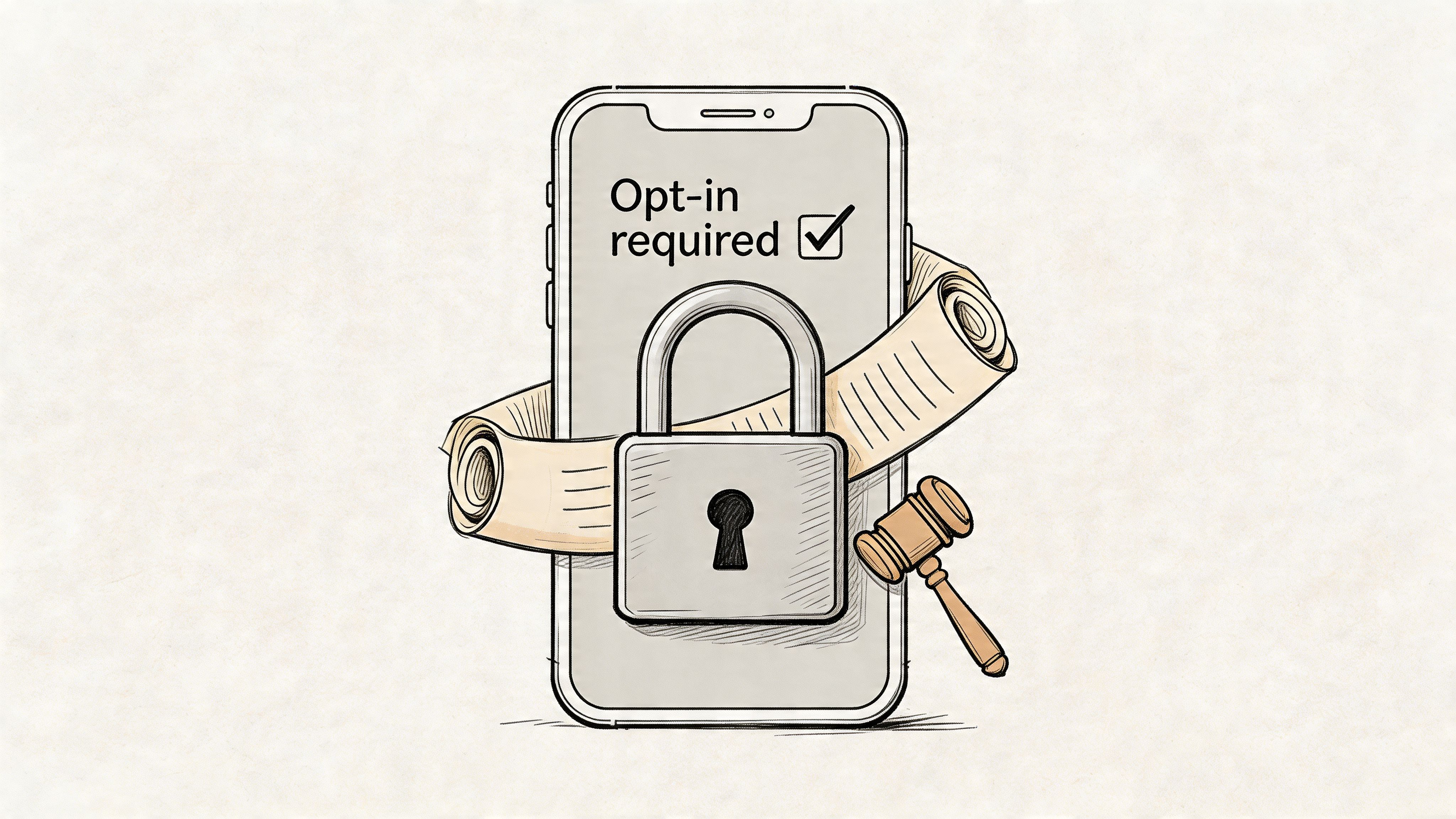
In practical terms, that means:
Many businesses create problems for themselves by collecting numbers at checkout, importing old lists, or texting leads from a trade show with no clean record of permission.
That approach doesn’t just create legal risk. It also hurts trust and deliverability.
A healthy SMS list is smaller than most businesses want and more valuable than most businesses expect.
For businesses sending on 10DLC, registration and compliance aren’t optional. This overview of 10DLC compliance is a useful reminder of how carrier rules now shape deliverability.
Healthcare teams have more to think about because reminders can drift into protected health information quickly.
The safe approach is straightforward:
Appointment reminders, schedule confirmations, and basic follow-up texts can be useful. But a healthcare practice should treat message content carefully and avoid stuffing sensitive details into routine texts.
That same caution applies to ringless voicemail. A voicemail reminder can be effective, but the content should be written with privacy in mind.
Businesses also use SMS codes for verification, login support, and double opt-in. That’s useful, but it isn’t risk-free.
NIST has raised concerns about SMS OTP vulnerability to interception, including SIM swap attacks, which surged by 30% in the US according to 2025 FTC data, as summarized in this SendHub guide on SMS codes.
That doesn’t mean SMS has no place in verification. It means businesses should treat security seriously and avoid pretending that a texted code solves every identity problem.
A sound setup looks like this:
Compliance is often framed as a burden. In real operations, it’s a filter that removes weak tactics and forces cleaner messaging.
A good SMS campaign isn’t complicated. It’s structured.
The mistake most businesses make is launching with a list and a message. The better move is to build the path first, then send traffic into it.
Pick the number type based on how you’ll communicate.
If you need high-volume speed and a memorable number, short code may fit. If you want everyday texting and replies, 10DLC is often more practical. If you want a business identity that also supports broader outreach, toll-free can be a strong choice.
What matters most is getting setup right. After post-2023 10DLC registration mandates, businesses that failed to comply saw deliverability drop by as much as 30%. Setup is much faster for long codes at 1 day than for short codes at 3-8 weeks, according to Twilio’s short code glossary.
That’s the first lesson. Don’t rush the plumbing.
Create one keyword tied to one outcome.
Bad setup looks like this:
Good setup is cleaner:
A single keyword should answer a simple question: what should happen when this person texts in?
At this point, many campaigns either become durable or become a mess.
Your welcome message should do three jobs:
That might be a coupon, class details, appointment info, or a next-step question.
If you’re reviewing your legal exposure, this write-up on Telephone Consumer Protection Act violations is a useful outside reference for understanding where businesses get into trouble.
Operator note: The fastest way to weaken an SMS program is to treat consent as something you can reconstruct later.
At this point, the campaign starts behaving like a system instead of a one-off blast.
A practical small-business sequence often looks like:
Ringless voicemail works best when the contact already knows who you are. It supports the text campaign. It shouldn’t replace it.
For appointment-based businesses, a ringless voicemail can reduce no-shows when used as a supportive reminder after the original SMS. For sales teams, it can revive warm leads who ignored a text but will listen to a short voicemail from a real person.
A list gets expensive when it’s sloppy.
Before scaling any campaign, tighten these operational basics:
The strongest programs don’t isolate SMS. They connect it to voice, CRM activity, appointment scheduling, and sales follow-up.
That’s where multi-channel strategy becomes practical. A customer might:
That’s the fundamental answer to what is sms code for a business. It’s not just a word or a number. It’s the trigger that starts a coordinated communication workflow.
If you want to turn keywords, SMS follow-ups, voice broadcasts, and ringless voicemail into one clean system, Call Loop is built for exactly that. You can launch text-to-join campaigns, automate double opt-ins, validate numbers, track clicks, segment contacts, and run multi-step SMS and ringless voicemail drips without stitching together separate tools.
Chris Brisson
Chris is the co-founder and CEO at Call Loop. He is focused on marketing automation, growth hacker strategies, and creating duplicatable systems for growing a remote and bootstrapped company. Chat with him on X at @chrisbrisson


Trusted by over 45,000 people, organizations, and businesses like


