
See a Demo
You're just one step away from seeing Call Loop in action.
Enter your information below to watch a demo right now.

You're just one step away from seeing Call Loop in action.
Enter your information below to watch a demo right now.

Your CRM has purchase history. Your website has click paths. Your inbox has replies from prospects who almost bought. Reviews mention the same friction points again and again. Most SMBs aren't short on customer data. They're short on clarity.
That's where AI-driven customer insights become useful. Not as a buzzword, and not as a dashboard you check once a month. Used well, they help you identify who's ready to buy, who's drifting away, what message fits each segment, and which channel should carry it.
For outbound teams, that matters because insight without activation goes nowhere. If your system spots interest but your follow-up is late, generic, or sent through the wrong channel, the insight is wasted. The practical value comes when you connect analysis to action, especially across direct channels like SMS and ringless voicemail where timing and relevance matter.
A familiar pattern shows up in growing businesses. Data keeps piling up, but decisions still rely on gut feel because nobody has time to stitch everything together. The sales team sees one slice. Marketing sees another. Support hears recurring complaints, but those signals rarely reach campaign planning fast enough.
AI-driven customer insights solve that bottleneck by turning scattered inputs into usable direction. Instead of exporting spreadsheets and waiting for someone to interpret them, teams can work from signals that update as customer behavior changes. That shift matters when you need to decide who gets a discount offer, who needs a reminder, or who should receive a ringless voicemail instead of another email.
The practical shift is simple. You stop asking, “What happened last month?” and start asking, “What should we do next?”
That usually affects three areas first:
If you already track calls, campaign responses, or lead sources, combining those signals with call tracking and analytics insights gives you a stronger base for outbound decisions.
Practical rule: If your team still exports data just to decide who to contact this week, you don't have an insight problem. You have an activation problem.
Many SMB owners think they need a giant data team before any of this becomes realistic. They don't. They need a cleaner view of customer behavior and a tighter process for acting on that view. The businesses that get traction aren't always the ones with the most data. They're the ones that use available signals to prioritize the next conversation.
AI-driven customer insights are findings generated from customer data that help you understand behavior, preferences, likely intent, and the next useful action. They're different from static reports because they don't just summarize the past. They help you respond to what's happening now.
Think of them as a tireless analyst sitting across your CRM, site activity, reviews, replies, and support history. That analyst does more than say, “These customers opened messages.” It says, “These customers are showing stronger buying intent, these accounts look at risk, and these contacts should receive different messaging based on sentiment or behavior.”
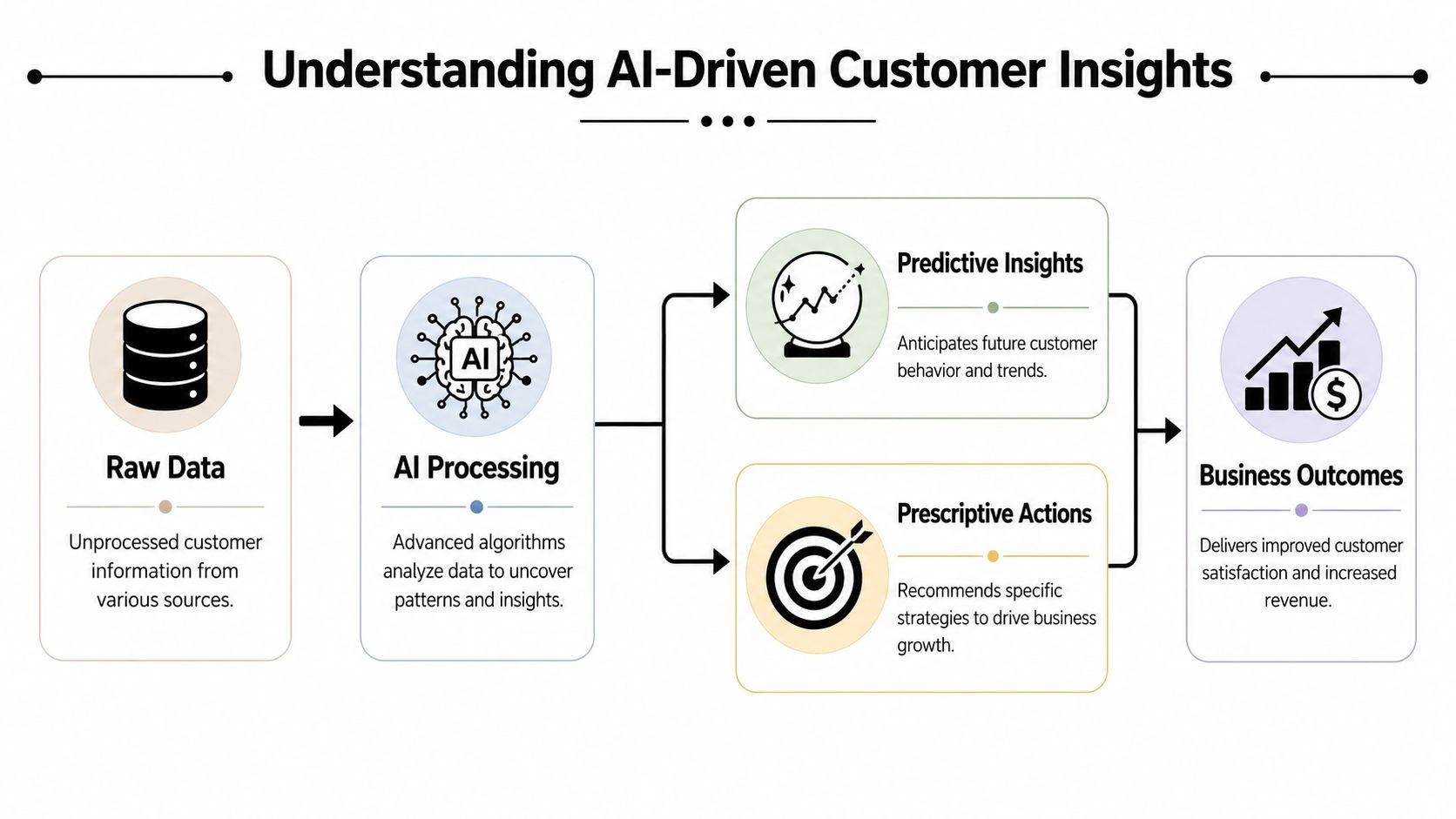
Traditional reporting is often delayed, static, and descriptive. It tells you what happened after the window to respond has passed.
AI-based insight generation is more dynamic. One industry source notes that AI platforms can process thousands of customer interactions in real time, and reports that 87% of customer experience leaders plan to increase AI usage in CX according to Thematic's overview of AI in customer insights. For an SMB, the takeaway isn't the trend line alone. It's that real-time analysis is becoming a normal operating model, not an experimental side project.
Here's the practical difference:
| Approach | What you get | Operational result |
|---|---|---|
| Static reporting | Monthly summaries, lagging metrics, broad segments | Slow follow-up and generic campaigns |
| AI-driven insights | Pattern detection, dynamic segmentation, likely next actions | Faster targeting and more relevant outreach |
In a real business workflow, these insights often show up as:
AI is most useful when it reduces decision friction. If it produces another report nobody uses, it isn't helping the business.
The best way to think about AI-driven customer insights is this. They compress time between customer behavior and business response. For SMB teams that need to move fast, that compression is where the value starts.
For most individuals, a deep technical lecture is not required. They need to know how the machine works well enough to trust the output. The simplest way to understand it is through a three-part flow: ingest, analyze, act.
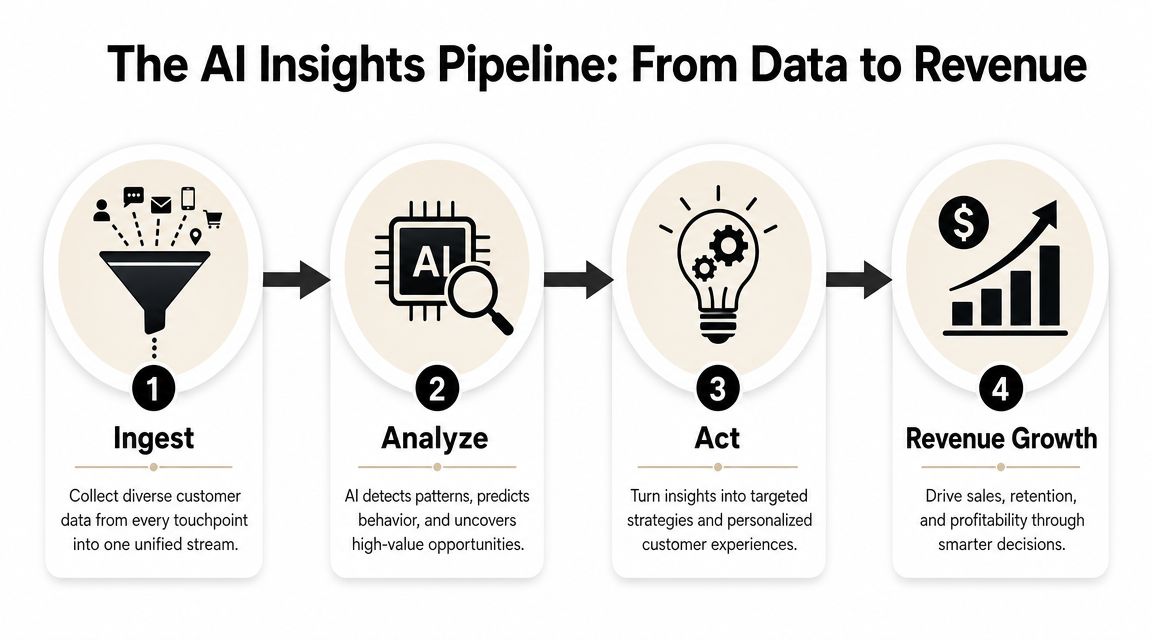
Your raw ingredients come from both structured and unstructured data.
Structured data includes fields like purchase history, lead source, order frequency, appointment status, or lifecycle stage inside your CRM. Unstructured data includes replies, reviews, chat transcripts, survey comments, and support notes. Useful AI systems need both, because customer intent often shows up in messy text before it appears in a clean report.
A practical starting point for dormant or aging records is to review how teams explore Aim Set Win database services for reactivation workflows. That kind of work highlights an important truth. Old databases still hold value, but only if you clean and segment them before outreach.
The middle layer does the heavy lifting. AI-driven customer insights typically rely on a pipeline that combines machine learning, NLP, and big-data processing to unify structured and unstructured customer signals, often using a customer data platform to cleanse and standardize the data before analysis, as outlined in Tealium's guide to AI and customer data.
That data-quality step is where many projects ultimately succeed or fail. If one customer appears under multiple records, if opt-in status is unreliable, or if sales notes never match CRM fields, the model can't produce dependable guidance.
A simple analogy helps:
Revenue doesn't come from analysis alone. It comes from using outputs in campaigns and workflows.
Common outputs include propensity segments, churn-risk lists, sentiment-based groupings, and timing recommendations. For outbound marketing, those outputs become decisions like:
Clean data doesn't guarantee good insight, but messy data almost guarantees bad action.
The revenue link is straightforward. Better inputs create better segmentation. Better segmentation produces better timing and messaging. Better timing and messaging improve the odds that each outreach attempt reaches the right person with a useful reason to respond.
The value of AI-driven customer insights shows up when teams make faster, better decisions with less guesswork. That's especially important in SMB environments where one missed follow-up can mean a lost sale, a no-show, or a customer who stops buying.
Genesys describes AI-enabled customer insight systems as improving both speed and decision quality by processing multi-channel data in real time, detecting behavioral patterns, segmenting customers, and supporting predictive actions such as churn prevention and personalization in its explanation of AI-enabled customer insights. The practical question for an operator is simpler. Which business outcomes should you expect, and what should you measure?
One of the strongest use cases is spotting customers before they disappear. A drop in engagement, fewer purchases, negative sentiment, or missed appointments can trigger a save motion before the account fully goes cold.
That's where direct outreach works well. A re-engagement SMS can handle convenience and speed. A ringless voicemail can add a more human touch for renewals, appointment reminders, or win-back campaigns where tone matters.
Track metrics such as:
Personalization often gets framed as inserting a first name into a message. That's not the actual gain. The main gain is changing the message, timing, and channel based on what the customer is likely to need next.
A customer who abandoned a quote request shouldn't get the same sequence as a loyal repeat buyer. A parent who needs a class reminder should receive a different touchpoint than a prospect comparing options. AI helps separate those cases so the outreach feels earned instead of random.
For campaign evaluation, use marketing campaign effectiveness benchmarks and methods to keep the focus on business outcomes rather than vanity metrics.
Here's a simple way to think about measurement:
| Benefit | What to watch | Why it matters |
|---|---|---|
| Churn prevention | retention trends, save responses, follow-up speed | Shows whether risk signals lead to intervention |
| Personalization | reply quality, conversion by segment, offer uptake | Tells you if relevance improved |
| Upsell and next-best action | cross-sell acceptance, repeat purchase patterns, booked conversations | Reveals whether the insight engine identifies real opportunities |
Don't ask whether the model is impressive. Ask whether the outreach became more relevant and whether customers responded differently.
The businesses that get the most from AI-driven customer insights usually don't treat them as a reporting layer. They use them as a control system for outbound communication. Once that happens, SMS, ringless voicemail, and follow-up workflows become more precise, less noisy, and easier to justify.
Most SMBs should not start with a full transformation project. Start with one business problem, one usable data set, and one response workflow. That's how AI-driven customer insights become operational instead of theoretical.
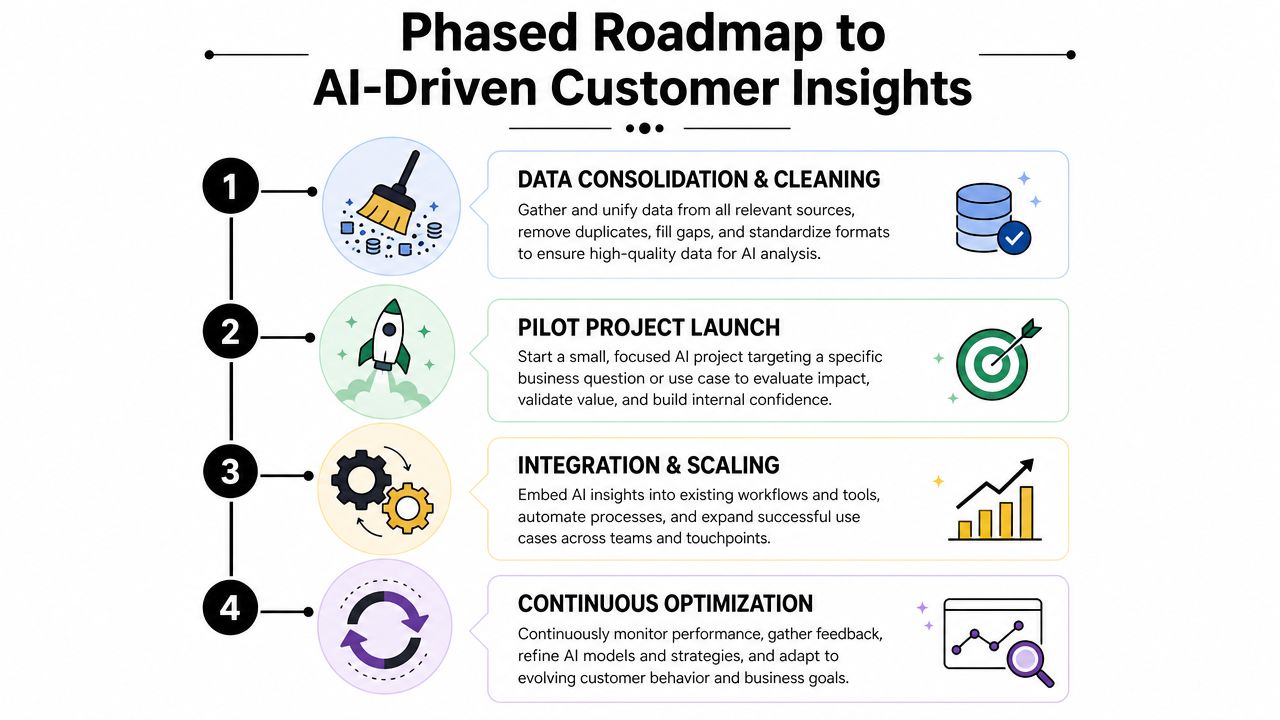
Before selecting tools, tighten the basics. Pull together the customer fields and behavioral signals you use to make decisions. That might include purchase dates, last response, booking status, lead source, message history, and support notes.
Then fix what usually breaks activation:
If you sell through marketplaces or manage multiple channels, outside examples can sharpen your thinking. For retail operators, Insights for Walmart marketplace sellers offers a useful view into how AI changes platform-level marketing decisions.
Pick one use case with visible economic value. Good candidates include churn prevention, missed appointment reduction, quote follow-up, or dormant customer reactivation.
Avoid broad goals like “improve customer experience.” Choose something your team can act on next week.
A solid pilot usually has these traits:
This is where many projects stall. The model works, but nobody operationalizes the result.
Build rules that translate signals into action. For example, if a customer misses an appointment and has a history of responding to mobile outreach, send a reminder text. If a high-value lead stops engaging but still fits the ideal profile, queue a ringless voicemail with a concise callback prompt. If a segment shows renewed browsing activity, trigger a customized offer instead of restarting the entire nurture flow.
Field note: The best automation feels like fast follow-up, not machine enthusiasm. Keep messages short, specific, and clearly tied to the customer's recent behavior.
After launch, look for decision quality, not just activity volume. Did the segment make sense? Did the channel match the context? Did the follow-up happen fast enough to matter?
Use a lightweight review process:
This is the pattern that works. Clean a manageable data set. Run a narrow pilot. Connect it to outbound action. Improve the model through actual campaign feedback. SMBs don't need a large data science bench to do this well. They need disciplined implementation and a willingness to start smaller than their ambition.
AI-driven customer insights can improve outreach, but they also make mistakes faster when the foundation is weak. Most problems fall into two buckets. The first is technical. The second is trust.
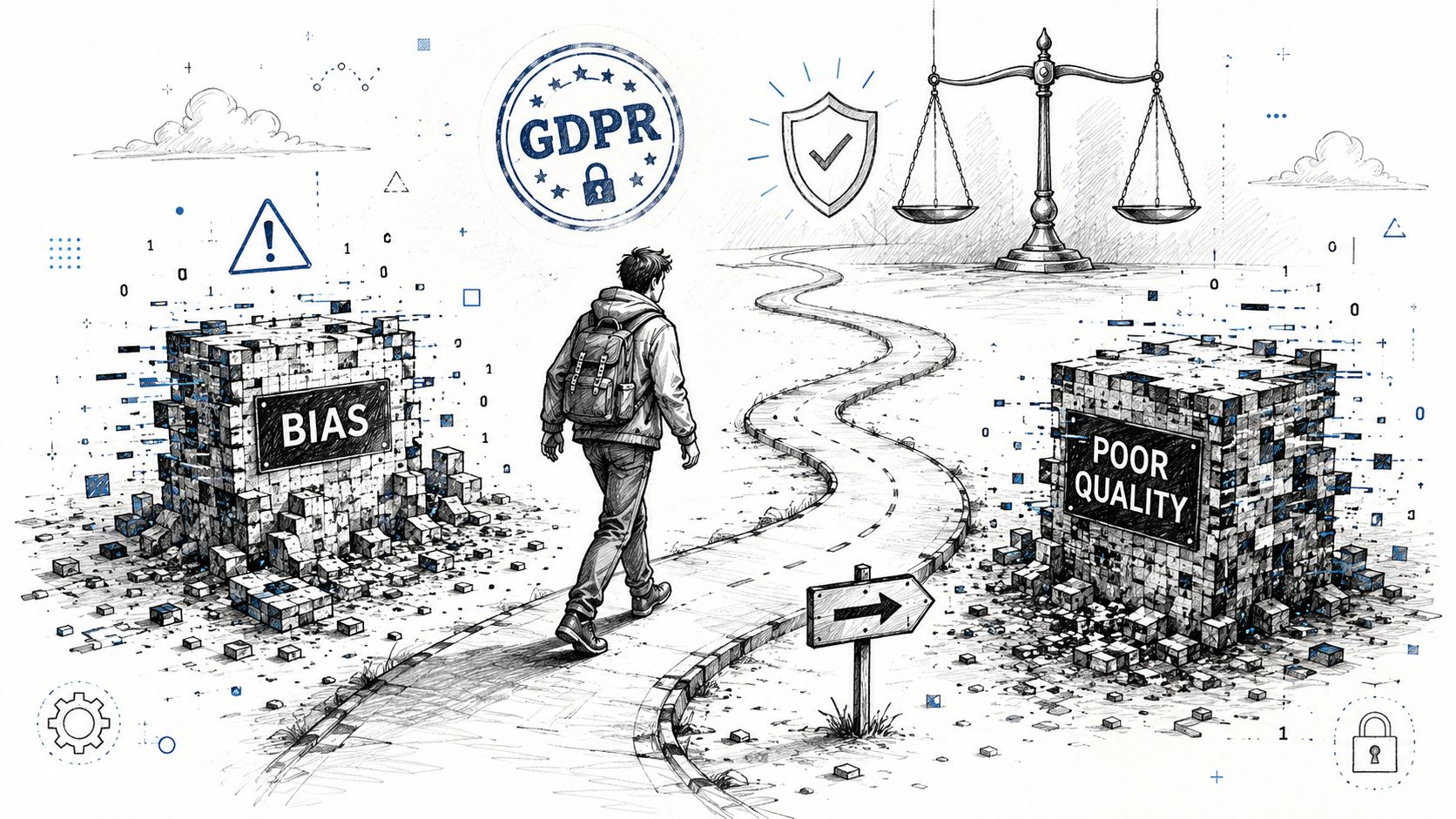
Bad data quality is the obvious issue, but stale models are just as damaging. Berkeley's California Management Review highlights that AI models must be updated regularly to reflect new behaviors and market shifts to avoid stale segmentation, as discussed in its article on AI-driven customer experience challenges. That matters because customer behavior doesn't stand still. Seasonality changes. Channels shift. Buyer expectations move.
When the model goes stale, the symptoms show up in operations:
A simple prevention checklist helps:
| Risk | What causes it | Preventive move |
|---|---|---|
| Stale segmentation | old patterns still driving logic | retrain and review segments on a fixed cadence |
| Low-confidence signals | messy or missing records | standardize core fields before automation |
| False urgency | every trigger treated as high intent | rank signals by business importance |
The more precisely a business understands customer behavior, the more careful it needs to be in how that understanding gets used. Relevance can quickly cross into discomfort if the message reveals more inference than the customer expected.
That's especially important in regulated environments, and it's one reason consent practices need to be explicit. If your outreach includes text or voice channels, make sure your workflow reflects express consent requirements for compliant messaging before you automate anything.
Some insights should guide internal decisions without being spelled back to the customer word for word.
A good rule for messaging is to be helpful without sounding invasive. Use signals to improve timing, segmentation, and offer selection. Don't turn every inferred behavior into a line of copy. In healthcare and other sensitive sectors, governance matters even more because privacy expectations are higher and communications can carry legal risk.
The strongest operators treat compliance as part of campaign design, not a final approval step. That keeps AI useful without letting it damage trust.
Most businesses don't need more dashboards. They need a better way to decide who to contact, what to say, and when to say it. That's the core value of AI-driven customer insights. They reduce noise, sharpen targeting, and help teams act while the opportunity is still open.
The practical win isn't “using AI.” It's creating outreach that feels timely and relevant because it's based on live customer signals instead of stale assumptions. For SMBs, that can mean smarter segmentation, better follow-up, stronger reactivation campaigns, and more effective use of channels like SMS and ringless voicemail.
There's also a leadership question behind all of this. Harvard Business Review notes that brands face a trust tradeoff when deciding whether to share AI-driven insights with customers. Disclose too much and it can feel like surveillance. Disclose too little and you lose transparency benefits, as discussed in Harvard Business Review's piece on sharing AI-driven customer insights. That balance will matter more as businesses become better at inference.
The companies that get this right won't be the ones with the flashiest models. They'll be the ones that use insight carefully, connect it to useful communication, and respect the line between personalization and intrusion.
If you're ready to put insights into action across SMS, voice, and ringless voicemail, Call Loop gives teams a practical way to automate timely outreach, personalize follow-up, and scale conversations without losing control of compliance or campaign visibility.
Chris Brisson
Chris is the co-founder and CEO at Call Loop. He is focused on marketing automation, growth hacker strategies, and creating duplicatable systems for growing a remote and bootstrapped company. Chat with him on X at @chrisbrisson


Trusted by over 45,000 people, organizations, and businesses like


