
See a Demo
You're just one step away from seeing Call Loop in action.
Enter your information below to watch a demo right now.

You're just one step away from seeing Call Loop in action.
Enter your information below to watch a demo right now.

Think of express consent as a clear, enthusiastic 'yes' from a customer. It’s them giving you direct permission to send them marketing messages. This isn't a guess or an assumption based on what they might want; it's a solid agreement that builds a foundation of trust right from the start.
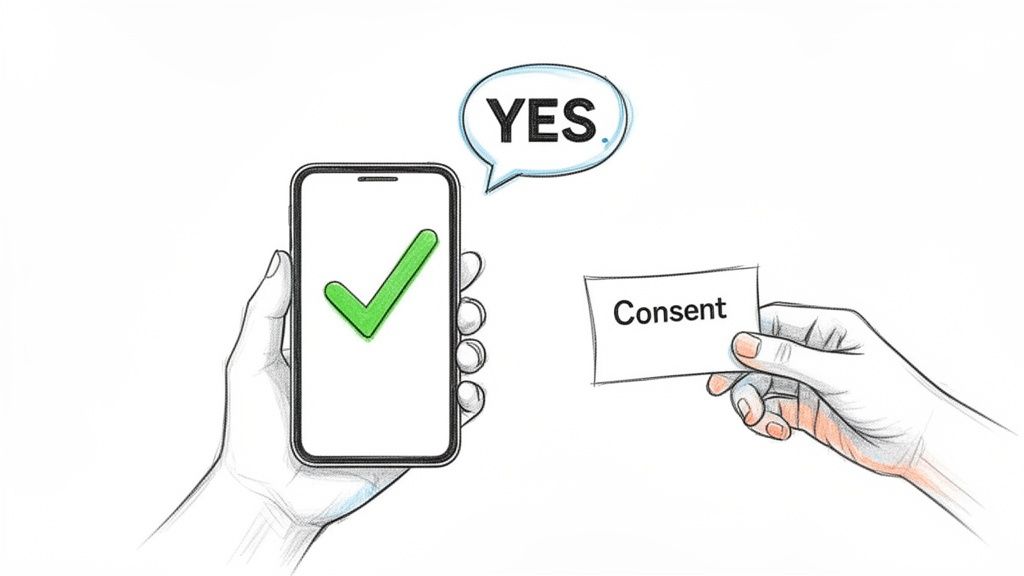
So, what is express consent in simple terms? It’s when someone takes a specific, deliberate action to say, "Yes, you can send me marketing stuff." It's not a subtle hint. It’s them actively checking a box, texting a keyword, or verbally agreeing to hear from you.
This is a huge deal because it sets clear boundaries and shows respect for their inbox (and their phone). When a customer gives you express consent, they’re inviting your brand into their world. That’s a fundamentally different relationship than one built on assumed permission.
To really get why express consent matters so much, it helps to see how it stacks up against the other types. Each level of permission gives you different rights and comes with its own set of rules. Nailing these distinctions is your first step toward a compliant—and effective—marketing strategy.
As you can see, the level of consent directly impacts what kind of messages you're allowed to send. For most marketing, especially anything automated, you'll be aiming for one of the "express" categories.
Getting the right kind of consent isn't just about being polite; it’s a legal must-have with some pretty scary consequences. Laws like the Telephone Consumer Protection Act (TCPA) are notoriously strict and don't hesitate to slap businesses with heavy fines for sending messages people didn't ask for.
Violations can cost you anywhere from $500 to $1,500 per violation. When you're talking about class-action lawsuits, those numbers can balloon into the millions faster than you can say "unsubscribe." If you use automated systems for SMS, voice calls, or even ringless voicemail, getting this wrong is a massive financial gamble.
This is exactly why mastering consent isn't just a "nice to have"—it’s essential for protecting your business. For a deeper dive into the highest standard of permission required for most automated marketing, check out our detailed guide on express written consent.
Getting a handle on express consent is one thing. But truly understanding the powerful laws that demand it is what will shield your business from serious trouble. These legal frameworks aren't just gentle suggestions; they're strict rulebooks with massive financial teeth.
For anyone in the United States using automated messaging, the big one you absolutely have to know is the Telephone Consumer Protection Act (TCPA).
The TCPA was originally designed to stop consumers from getting hammered with unwanted calls and texts. It specifically covers automated telephone dialing systems (ATDS), prerecorded voice messages, and SMS/MMS text messages. Even though it was passed long before everyone had a smartphone glued to their hand, its rules are rigorously applied to today's communication channels.
A critical takeaway from the TCPA is that it sets an extremely high bar for marketing messages. It requires prior express written consent for any promotional texts or calls sent using an automated system. This means a simple verbal "yes" on the phone just won't cut it anymore; you need a documented, concrete agreement from the consumer before you even think about hitting send.
The TCPA is notoriously specific, so you can't afford to guess. For any promotional texts or automated calls, your opt-in process has to be completely "unambiguous." In simple terms, the person signing up must know exactly what they're getting into. This means putting key information right on the opt-in form itself.
Your consent language has to clearly state:
This level of transparency isn't optional. If you miss these disclosures, your consent records could be worthless, putting you at risk even if a customer genuinely wanted to sign up.
This push for crystal-clear consent isn't just a U.S. thing; it's a global movement. Europe’s General Data Protection Regulation (GDPR) and Canada's Anti-Spam Legislation (CASL) have raised the bar in similar ways, driving home the point that consent must be explicit, informed, and easy to take back.
These international laws signal a worldwide shift toward giving consumers more power. If you operate across borders, you have to navigate this complicated web of rules. Getting familiar with the broader principles of regulatory compliance is essential for any business dealing with these legal frameworks.
Regulators are not messing around, and the penalties for slipping up can be crippling. Under laws like GDPR and the California Consumer Privacy Rights Act (CPRA), getting express consent is a must-do. Since May 2018, European regulators have dished out over 2,600 GDPR fines totaling more than €6.7 billion. In the U.S., California has jacked up CPRA penalties to nearly $8,000 per intentional violation and scrapped the 30-day grace period to fix things, making immediate compliance vital.
The consequences of non-compliance are not just theoretical. A single text message sent without proper consent can trigger a fine of up to $1,500 under the TCPA. For a campaign sent to thousands of people, the potential liability can quickly reach millions of dollars.
This kind of financial risk makes it obvious why a rock-solid consent strategy isn't just good marketing—it's a survival tactic. By respecting the rules and making clear, unambiguous consent your top priority, you not only protect your business from huge fines but also build stronger, more trusting relationships with your customers.
Let's clear up one of the most common points of confusion in marketing. It's a simple distinction, but getting it wrong can land you in hot water.
Imagine a customer leaves their business card on the counter at your shop. You could probably use that number for a quick, one-time follow-up about their visit—that's implied consent. It’s based on the context of your interaction and is extremely limited.
Now, picture that same customer handing you their card and saying, "Hey, text me your weekly deals." That's express consent. It's direct, specific, and leaves zero room for guessing. They've given you a clear green light for marketing.
This difference is the bedrock of compliant communication. Implied consent is flimsy and really only good for transactional messages, while express consent is the absolute minimum you need for any kind of marketing.
Implied consent comes from an existing business relationship. A customer buys something from you, so it's implied that you can send them a receipt or a shipping update. You're just fulfilling your end of the deal they started.
But here's where people get into trouble: you can't take that implied permission and stretch it to cover your weekly promotions or special offers. That's a fast track to a compliance nightmare. For any promotional content, you need something much stronger.
That’s where express consent comes in. It's an active, definite "yes" from the consumer. They have to take a clear action—like checking a box or texting a keyword—that shows they actually want to hear from you.
The core difference is this: Implied consent is passive and assumed from a customer's actions. Express consent is active and given through a customer's direct words or clicks.
This proactive permission is what makes it a defensible and trustworthy foundation for your marketing campaigns, whether you're sending SMS, making calls, or even dropping a ringless voicemail.
To add one more layer, you have to know the difference between standard express consent and the TCPA's gold standard: express written consent. They sound almost the same, but that little word—"written"—is a game-changer for marketers.
Express Consent: This can be verbal. If a customer says over the phone, "Sure, you can call me back with more information," that counts. It’s a direct agreement, but it can be a real headache to prove you ever got it.
Express Written Consent: This requires a documented, signed agreement. The "signature" can be electronic—think checking an unambiguous box on a web form, replying "YES" to a text, or providing a digital signature.
For most automated marketing—including bulk SMS, prerecorded voice messages, and promotional ringless voicemail drops—the TCPA mandates this higher, documented standard. A simple verbal nod just won't cut it.
To make these distinctions crystal clear, let's break down exactly what each level of consent allows you to do. Knowing these rules is non-negotiable; it helps you pick the right opt-in method for every campaign and keeps you on the right side of the law.
Ultimately, while it's good to understand all three types, your focus for any real marketing outreach should be squarely on getting express written consent. It gives you the highest level of legal protection and ensures your entire communication strategy is built on clear, enthusiastic permission from your audience.
Okay, so you know what express consent is. That's half the battle.
The other half is actually building a practical, bulletproof system to get and manage that permission. This isn't just about slapping a checkbox on a form. It's about creating a clear, auditable trail that proves every single person on your list wants to hear from you.
Think of it like a bank vault. Getting consent is the deposit; managing it is having meticulous records of every transaction. You need both to stay secure and keep everyone's trust.
The best way to get express consent is to make it simple, transparent, and impossible to misunderstand. You've got a few solid tools in your toolbox, each perfect for different situations.
Here are the most common and compliant ways to do it:
This chart breaks down the levels of consent, moving from the weakest (implied) to the strongest (written), which is your goal for most marketing.
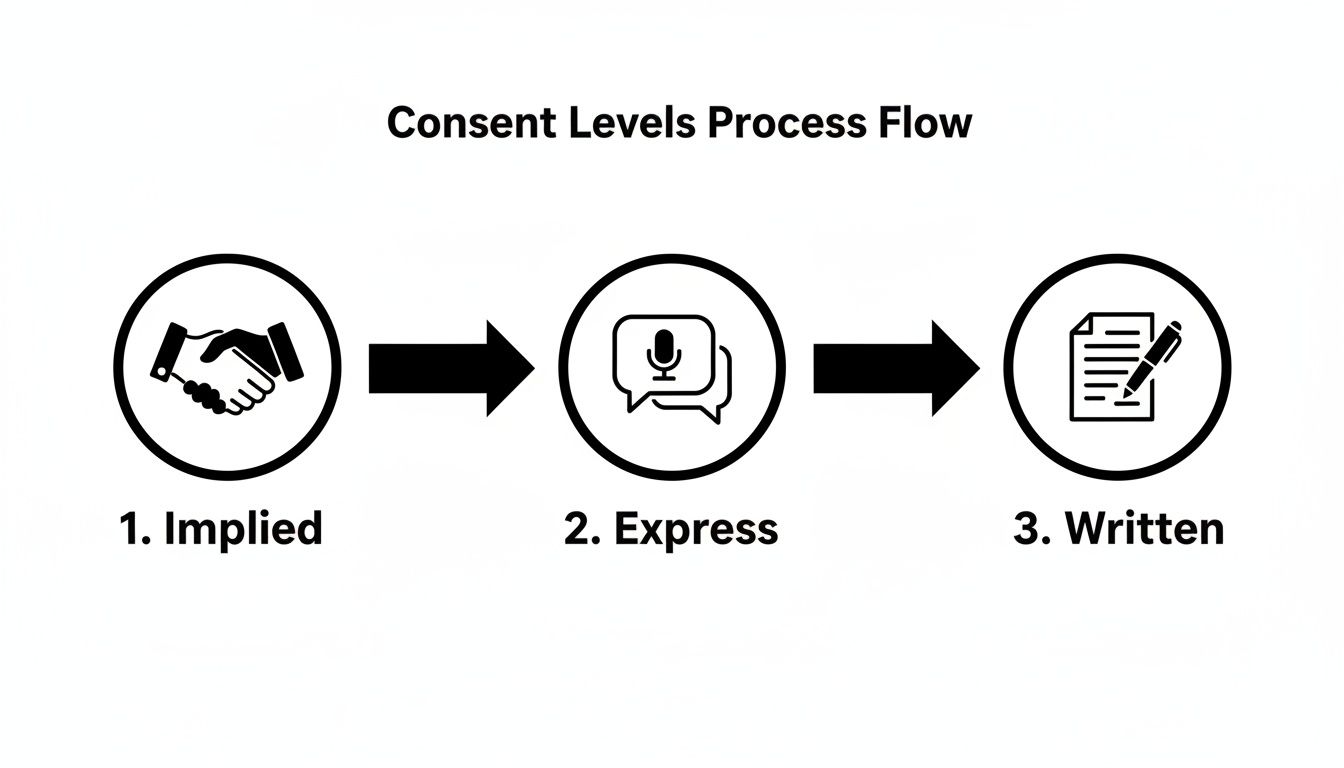
As you can see, the moment you move from a basic business relationship to active marketing, the level of permission you need gets much more explicit and documented.
Want to make your consent process truly undeniable? Use a double opt-in system. This is the gold standard for creating a verifiable audit trail and it's a core feature inside Call Loop.
Here’s the simple two-step process:
This process kills any doubt about their consent. You now have a timestamped record of their initial request and a second one for their explicit confirmation. You can learn more about writing these messages in our guide to building your text opt-in list.
Getting consent is just the first step. You absolutely must maintain detailed records to prove it if you ever get challenged. Think of your records as your first line of defense, showing a clean history of compliance for every single contact.
Your consent records must include:
This kind of meticulous tracking isn't just an IT task anymore; it's a core business function. The global market for Consent Management Platforms is expected to jump from $766.1 million in 2024 to $2.6 billion by 2030. This surge is driven by companies realizing they need robust systems to manage permission correctly.
Just as people have the right to opt in, they have an absolute right to opt out whenever they want. Your system has to process these requests instantly and automatically.
A consumer's right to revoke consent is non-negotiable. Honoring "STOP" requests immediately is not just a best practice—it's a legal requirement under the TCPA. Failing to do so can result in significant penalties.
For SMS, the industry standard is to honor keywords like "STOP," "QUIT," "END," "CANCEL," and "UNSUBSCRIBE."
When someone sends one of those keywords, your system should automatically remove them from all marketing lists and send one final message confirming they've been unsubscribed. Platforms like Call Loop handle this DNC (Do Not Contact) process for you, making sure you stay compliant without any manual work.
Different communication channels are governed by different rules, and getting these details right is absolutely crucial for compliant marketing. The permission you need for a text message isn't always the same as for a voice call. Let’s break down exactly what you need for each channel.
When it comes to SMS and MMS marketing, there is zero ambiguity: you must have prior express written consent. This is the highest level of permission you can get, and it's a non-negotiable requirement under the TCPA for any promotional text messages sent using an automated system.
This means your opt-in process has to be perfectly clear. Your request for permission must include specific disclosures so the person knows exactly what they’re signing up for.
Your opt-in language must clearly state:
If you miss any of these elements, your consent could be considered invalid, exposing you to some serious legal risk. Every single text-to-join keyword campaign or web form you create has to feature this language, front and center.
Just like with SMS, automated voice broadcasts fall squarely under the TCPA’s strict regulations. If you're using a prerecorded message or an artificial voice to send marketing messages to mobile phones or residential lines, you need prior express written consent. The same tough standards for clear and obvious disclosures apply here, too.
Think of it this way: if a machine is making a promotional call for you, you need a documented "yes" from the recipient beforehand. Simply having a business relationship isn't enough to justify sending automated marketing calls.
The whole point of the TCPA is to protect people from unwanted contact through automated technology. Whether it's a text or a prerecorded voice, if it's promotional and automated, express written consent is the only safe way to go.
This strict requirement ensures that people aren't bugged by marketing calls they never asked for, hammering home the importance of a clear and positive opt-in.
Ringless voicemail is a unique piece of tech that drops a voice message directly into someone's voicemail box without their phone ever ringing. This has kicked off a major legal debate: is a ringless voicemail even considered a "call" under the TCPA?
The legal landscape here is, frankly, a bit of a mess. Some court rulings have suggested that since the phone doesn't ring, it doesn't cause the kind of disruption the TCPA was designed to prevent. Others have argued that any automated message sent to a phone number should be treated as a call. For years, this has left ringless voicemail drops in a regulatory gray area.
Given all the legal back-and-forth and the potential for TCPA lawsuits, the safest and most recommended approach is to treat ringless voicemail with the same caution as you would traditional calls and texts.
To minimize your risk, you should get prior express consent before sending marketing-related ringless voicemail messages. While some interpretations might suggest a lower standard is okay, relying on that is a gamble. Securing express consent shows you’re acting in good faith and gives you a strong defense if your practices are ever challenged. If you want to dive deeper into this technology, you can learn more about ringless voicemail and how it's used.
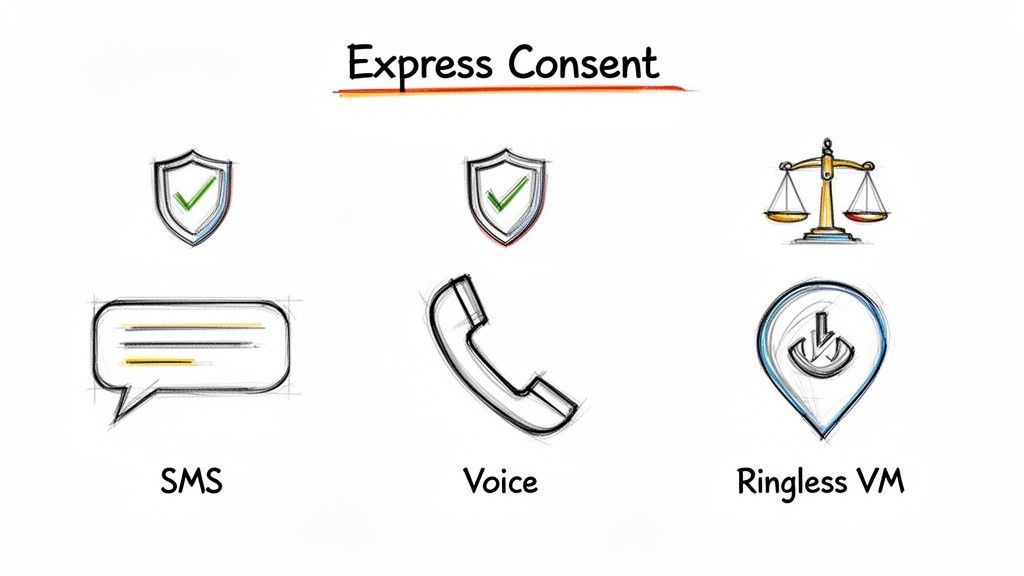
By sticking to a consent-based strategy across all your channels—SMS, voice, and ringless voicemail—you’ll build a marketing program that's not only effective but also compliant and built to last.
As you start putting these rules into practice, you're bound to run into some specific, "what if" scenarios. Let's tackle some of the most common questions and tricky situations that pop up, so you can feel confident you're doing things the right way.
Absolutely not. Regulators are crystal clear on this one: a pre-checked box does not count as valid express written consent. Why? Because it assumes permission instead of earning it.
The whole point of the TCPA is to ensure a consumer takes a clear, deliberate action to say "yes." Think of it as them actively raising their hand. A pre-checked box is the equivalent of you raising their hand for them. To stay compliant, always leave those checkboxes empty by default. The choice to opt in must be 100% theirs.
Technically, under the TCPA, express consent doesn't have an official expiration date. It’s valid until the moment a customer revokes it. But that doesn't mean you should treat it as a lifetime pass to their inbox.
Smart marketers know that a stale list is a risky list. It’s a best practice to re-confirm consent for contacts who haven’t engaged with you in a long time—say, 18-24 months. This simple step keeps your list healthy, your engagement high, and your complaint risk low. Most importantly, remember that consent can be withdrawn at any time, and you have to honor that request immediately.
If a regulator or a lawyer ever comes knocking, your records are your only defense. You need to keep a meticulous audit trail for every single person on your list. Being able to say "I have proof" is everything.
A rock-solid consent record has to include:
Keeping this data isn't just about checking a box; it's about protecting your business and proving you've done your due diligence.
For most marketing messages, especially those sent using an autodialer or containing a prerecorded voice, verbal consent is not enough. The TCPA demands a higher, more defensible standard: prior express written consent.
While a simple "yes" over the phone might be okay for certain informational, manually dialed calls, it won't cut it for promotional texts or calls. The "written" part is key, but it can be electronic. A customer checking a box, replying "YES" to a text, or providing a digital signature all count as a signed, documented agreement.
Ready to build an outreach strategy that’s both effective and compliant? Call Loop gives you the tools you need to manage express consent effortlessly. From double opt-in features to automated DNC management for SMS, voice, and ringless voicemail, we've got you covered. Start your free trial today and see how easy compliance can be.
Chris Brisson
Chris is the co-founder and CEO at Call Loop. He is focused on marketing automation, growth hacker strategies, and creating duplicatable systems for growing a remote and bootstrapped company. Chat with him on X at @chrisbrisson


Trusted by over 45,000 people, organizations, and businesses like


