
See a Demo
You're just one step away from seeing Call Loop in action.
Enter your information below to watch a demo right now.

You're just one step away from seeing Call Loop in action.
Enter your information below to watch a demo right now.

Think of an autoresponder text message as an automated SMS that fires off the instant a contact takes action, like texting a keyword or filling out a form. It’s your immediate digital handshake—a way to confirm their action, deliver instant value, and kick off the entire customer relationship on the right foot.
Let's be real: in a world of overflowing inboxes and ignored notifications, grabbing a customer's attention is a daily battle. While email is still a workhorse, its power for immediate engagement is definitely slipping. This is exactly where autoresponder text messages come in to save the day, slicing right through the noise to land your message where you know people are looking—their phones.
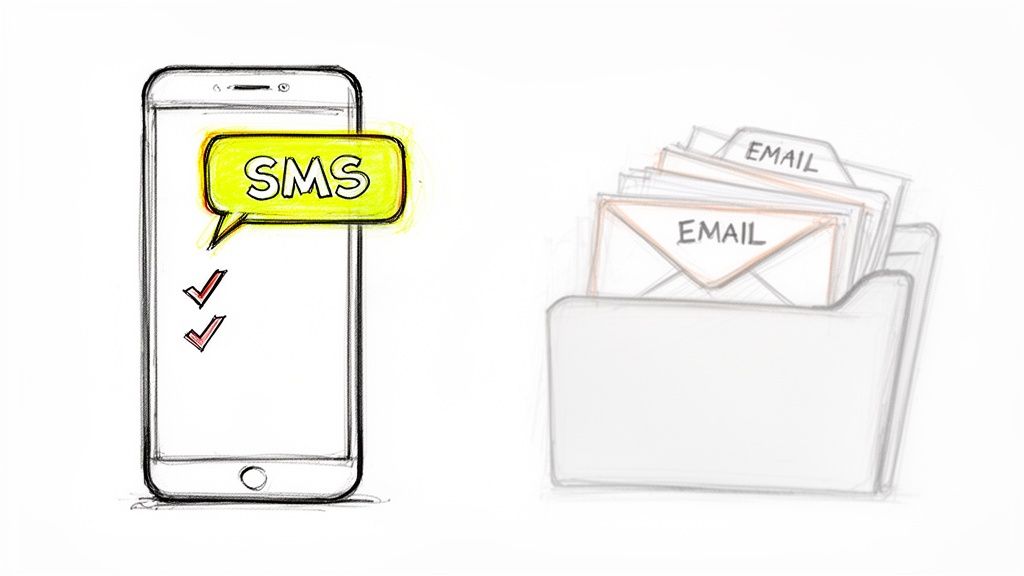
The magic of SMS is all about speed. Just think about your own habits. When a text comes in, you glance at it almost immediately. An email? It might sit there for hours, even days, buried under a pile of other messages. This simple behavioral difference has a massive impact on marketing.
And it’s not just a hunch; the numbers are staggering. Autoresponder texts boast jaw-dropping 98% open rates, a figure that completely changes the game for businesses needing instant engagement. Emails often get lost in the shuffle, hitting maybe 20-30% open rates if you're lucky.
But it gets better. About 95% of texts are read within three minutes of being sent. The response rates are just as impressive, hitting 45% or higher, which completely dwarfs email's average of 6%. If you're curious, you can dig deeper into these SMS marketing statistics to see the full picture.
The real power here is starting a conversation at the absolute peak of a customer's interest. An autoresponder meets them in the exact moment they've raised their hand, making your brand feel incredibly responsive right from the get-go.
If you’re still weighing your options, this quick breakdown shows just how stark the difference is between SMS and email for immediate, automated follow-up.
The takeaway is crystal clear: for speed and engagement, SMS is in a league of its own.
This isn't just a strategy for online stores. All kinds of businesses are getting real, tangible results with automated texts.
In every case, the autoresponder turns intent into a meaningful interaction. The goal isn't just to blast out a message; it's to provide immediate value, confirm an action, and open a direct line for what comes next. The impact is both immediate and incredibly easy to measure.
Ready to get your first automated SMS sequence off the ground? The secret is starting with a single, clear goal and building from there. A powerful autoresponder isn't just a random reply—it's a strategic first touch that sets the stage for your entire relationship with a new contact.
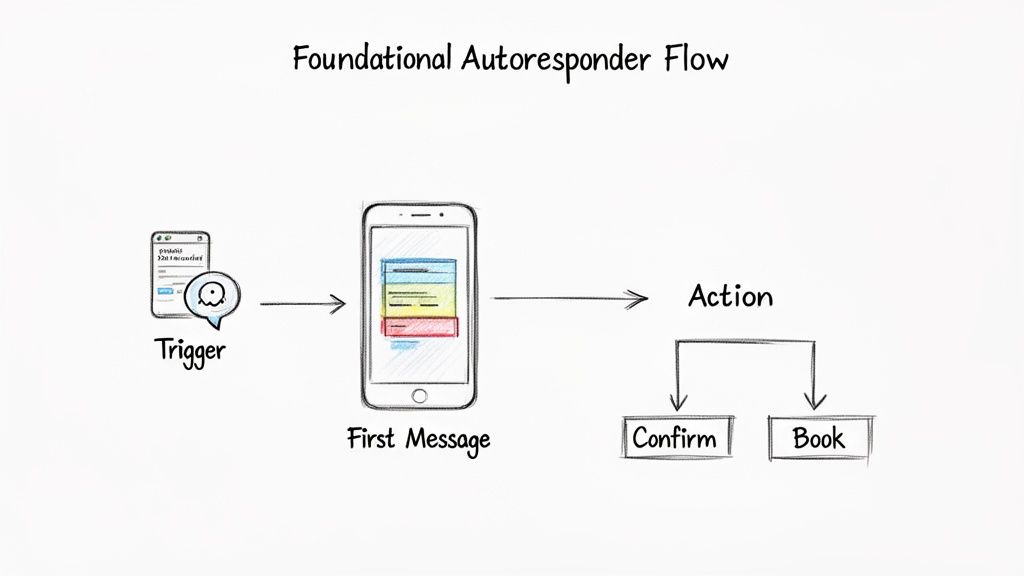
Before you even think about writing, you have to decide what you want this first message to do. What's the one action you want someone to take? A laser-focused goal makes your message direct, valuable, and dead simple for the recipient to act on.
Your objective is the "why" behind your autoresponder. It shapes everything—the content, the tone, and especially the call-to-action.
Most initial campaigns boil down to one of these goals:
Trying to do too much at once is a recipe for a confusing message. A welcome text, for example, should focus on gratitude and confirmation. Don't bombard a new subscriber with three different offers right out of the gate. If you're looking to build out more complex sequences, our guide on building a complete marketing automation workflow is a great next step.
The trigger is what kicks the whole thing off. It’s the "if this, then that" of your automation. Inside your SMS platform, you'll set up your autoresponder to fire based on one of these events.
A few of the most common triggers for an autoresponder text message are:
Pro Tip: For new subscribers, always use a double opt-in. After they text your keyword, your first autoresponder should ask them to reply "YES" to confirm. This is a non-negotiable compliance step that proves you have explicit consent.
Okay, you’ve got your goal and your trigger. Now it's time to write. The best foundational autoresponders are clear, concise, and deliver on their promise immediately. Try to keep your message under 160 characters to make sure it sends as a single SMS.
Here are a few templates you can adapt for your business:
Welcome Message (Retail):Hey [FirstName]! Welcome to the VIP Club. Thanks for joining! Show this text for 15% off your next purchase. Reply STOP to cancel.
Lead Magnet Delivery (Real Estate):Thanks for your interest in 123 Main St! Here's the link to the virtual tour you requested: [Link]. Let me know if you have any questions. Reply STOP to opt out.
Booking Confirmation (Service Business):Your appointment with [BusinessName] is confirmed for [Date] at [Time]. We look forward to seeing you! Reply STOP to cancel.
See the pattern? Each one includes a touch of personalization, delivers the value right away, and includes clear opt-out instructions. These three elements are absolutely critical for building a successful—and compliant—foundational campaign that nails the first impression.
An automated text is worthless if it gets deleted on sight.
The line between an autoresponder that gets results and one that gets ignored is almost always the copy. Is it valuable? Does it sound human? That initial connection is everything, and crafting a message that feels personal—not robotic—is how you make it count.
Your goal is simple: write an autoresponder text message that reads like a one-on-one chat, even though it's sent automatically. It needs to be quick, clear, and sound like you from the very first word.
To avoid sounding like a machine, you have to write like a human. That means dropping the stiff, corporate-speak for a more natural, conversational tone that fits your brand. Just think about how you’d talk to a customer face-to-face and capture that vibe.
Personalization is your secret weapon here. Using merge tags like [FirstName] is a simple move, but it makes a huge difference. "Hi Jessica!" will always beat a generic "Hello." It instantly makes the message feel like it was written just for them.
Links are often the whole point of an autoresponder—sending people to a signup page, a product, or an appointment scheduler. But how you share that link can make or break both the user experience and your deliverability.
Always use a trackable link shortener, ideally the one built into your SMS platform like Call Loop. This does two critical things: it saves precious character space and lets you measure your click-through rate (CTR). Don't use public shorteners like Bitly; mobile carriers can sometimes flag these as spam, killing your delivery before it even starts.
Your autoresponder is the perfect chance to push a contact to the next logical step. Make that step dead simple with a clear, trustworthy link and a great reason to click it.
So, what does this look like in the real world?
Retail Welcome Offer:Hey [FirstName], welcome to the Style Club! So glad you're here. As a thank you, here's 15% off your first order: [Link]. Enjoy! Reply STOP to opt out.
HIPAA-Compliant Appointment Confirmation:Hi [FirstName], this is a reminder of your appointment with Dr. Smith's office on [Date] at [Time]. Please review our check-in policies here: [Link]. Reply STOP to cancel.
Service Business Reminder:Hi [FirstName], just a friendly reminder that your lawn service with GreenScape is scheduled for tomorrow, [Date]. No need to be home! Questions? Call us at 555-1234. Reply STOP to end msgs.
Notice the pattern? Each text is short, personal, and offers immediate value. If you need more ideas, check out these effective text message examples for all sorts of different industries.
Standard SMS is text-only and capped at 160 characters. But MMS (Multimedia Messaging Service) lets you send images, GIFs, and even short videos. For brands that are highly visual, this can be a total game-changer.
A real estate agent could auto-reply to a new lead with a gorgeous photo of the property they just asked about. An e-commerce brand could welcome a new subscriber with a slick GIF showing off their latest products.
But use MMS wisely. It costs more per message and needs a better data connection on the recipient's end. I recommend saving it for high-impact moments where a visual will seriously boost engagement, like that initial welcome message or a big sale announcement. Get the balance right between concise copy, personalization, and smart media, and you'll have an autoresponder that doesn't just get read—it gets results.
A single, instant autoresponder text is a great start, but the real magic happens when you build out a strategic sequence. This is how you shift from a one-off touchpoint to an automated conversation that actually nurtures leads over time. You get to scale your impact without sounding like a robot.
An SMS drip campaign is simply a series of messages mapped out to deliver value at the perfect moments. Instead of blasting a new contact with everything at once, you can set delays—a few hours, a couple of days, or even weeks—to create a journey that feels natural and genuinely helpful.
Your first autoresponder confirms their action. The drip campaign is what builds the relationship.
Think of it as a guided path. What does a new lead need to know right after they sign up? What about two days from now? Or a week later?
A well-planned campaign could look something like this:
This structured flow keeps your brand top-of-mind without overwhelming your contacts. It's not just for marketing, either. Businesses are using similar automated systems for things like sending automated payment reminders to keep cash flow healthy.
The key is timing. An automated message sent at the right time feels like thoughtful follow-up, not a spammy broadcast. Your platform's analytics will help you fine-tune these delays based on engagement.
This process gives you a simple framework for every single message in your sequence.
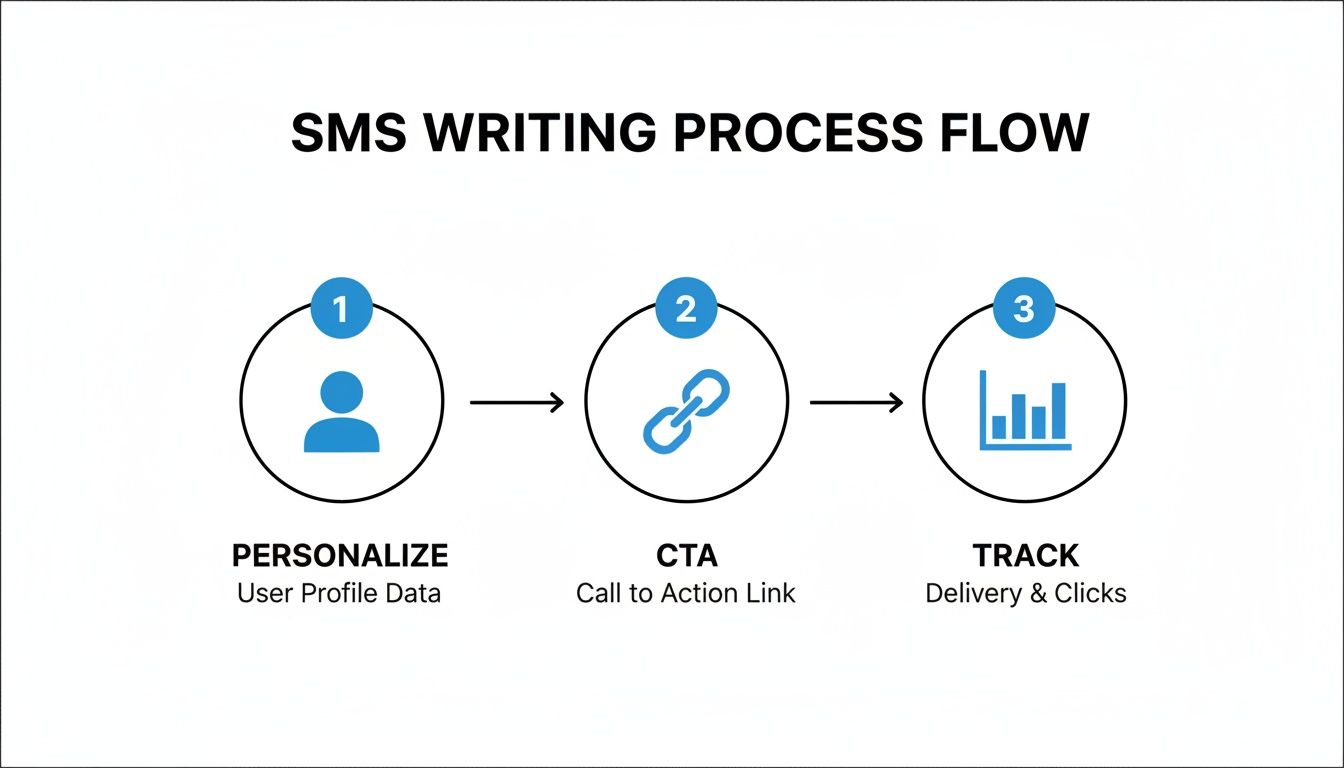
It really comes down to a cycle: personalize the content, drive action with a clear CTA, and then track the results to make the next message even better.
Ready for a pro move? Let’s talk about a multi-channel tactic that can dramatically boost your response rates: weaving ringless voicemail drops into your SMS drip campaign.
A ringless voicemail delivers an audio message straight to a person’s voicemail inbox—their phone never actually rings. It feels incredibly personal, almost like you took the time to call them one-on-one.
Imagine this powerful, automated sequence in action:
This combination of text and voice creates a high-touch experience that is 100% automated. The voicemail adds a human element that text just can't match, making your follow-up feel more authentic and urgent.
Platforms like Call Loop let you orchestrate these multi-channel drips, coordinating SMS and ringless drops with precise timing. If you're new to the idea, our getting started guide to ringless voicemail for business will walk you through all the specifics.
By blending the speed of an autoresponder text with the personal touch of a ringless voicemail, you build a follow-up machine that truly stands out, builds stronger connections, and ultimately drives more conversions.
An automated message is worthless if it never reaches the inbox. Even worse? If it gets you into legal trouble. Let's walk through the essential technical and legal side of your autoresponder text message strategy to make sure your campaigns are both effective and completely above board.
Getting this right isn't just about avoiding massive fines; it’s about building trust from the very first text. When people know you respect their privacy and communicate clearly, they're far more likely to stick around.
Before you even think about sending a promotional message, you absolutely must have express written consent. This is the non-negotiable cornerstone of SMS compliance, laid out by regulations like the Telephone Consumer Protection Act (TCPA). It means a person has to knowingly and explicitly agree to get marketing texts from you.
And it has to be crystal clear. Just grabbing a phone number from a contact form won't cut it. You need proof showing they agreed to receive promotional messages via text.
Think of express consent as a digital handshake. It’s a clear, recorded agreement that protects both you and your subscriber, setting the foundation for a trustworthy relationship.
Beyond consent, every automated message needs a few key elements to keep you compliant and your subscribers happy. These aren't just suggestions; they are hard requirements for running a responsible SMS program.
Your autoresponder must always give people a simple way to opt out. The standard "Reply STOP to cancel" is universally recognized by carriers and is required by law. This mechanism has to work instantly. Ignoring opt-out requests is a fast track to legal trouble and a permanently damaged brand reputation.
Compliance gets your message sent legally; deliverability gets it seen. Mobile carriers use powerful filters to block spam. If your messages look spammy, they’ll end up in a digital black hole, never reaching your audience.
A great first step is to use a dedicated toll-free number for your campaigns. Unlike shared short codes that can get tainted by other users, a toll-free number is tied exclusively to your brand. This helps you build a solid sending reputation with the carriers.
Next up, clean your data. Use a phone number validation service before you send a campaign to slash your bounce rate. Firing off texts to invalid or dead numbers is a huge red flag for carriers and will tank your sender score.
Finally, watch your content. Steer clear of public link shorteners (like Bitly), as they are frequently flagged for spam. Instead, use the tracked link shortener provided by your SMS platform, like the one built into Call Loop. This not only helps with deliverability but also lets you see exactly who is clicking your links. These small technical details are what separate a successful campaign from one that gets lost in the filters.
So, you've launched your autoresponder text message campaign. That's a great first step, but the real work is just beginning. How do you actually know if it’s driving results?
Firing off messages into the void and hoping for the best isn't a strategy. You have to measure what’s working, ditch what isn’t, and constantly tweak your approach based on what the data is telling you. Your SMS platform’s analytics dashboard is your new best friend—it's where the story behind your numbers comes to life.
To get a real sense of your campaign's health, you need to keep a close eye on a few essential metrics. These are the numbers that matter.
Tracking these KPIs is the difference between guessing and knowing. It transforms your autoresponder text message strategy from a simple automated reply into a fine-tuned engine for growth.
Once you’ve got a baseline from tracking your metrics, it's time to start optimizing. A/B testing is just a straightforward way of comparing two versions of a message to see which one gets better results.
The key is to keep it simple. Don't try to test everything at once. Test one single element at a time so you get clean, actionable results.
What to Test:
Think about a local pizza shop. They could A/B test two different welcome texts. Version A offers a free drink with their first order. Version B offers free garlic knots. By tracking the redemption of each unique coupon code, they can see exactly which offer drives more first-time customers through the door. This kind of data-driven approach takes the guesswork out of the equation and is how you consistently improve your campaign's ROI.
Setting up your first automated text message campaign? It's normal to have a few questions pop up. Here are some of the most common ones we hear from businesses just getting started.
Keep it short and sweet—under 160 characters is the magic number.
This isn't just about being concise; it ensures your message goes out as a single, standard SMS. This avoids weird formatting problems or unexpected costs from carriers. Just get straight to the point: state why you're texting, give them the value (like a confirmation), include a clear call-to-action, and don't forget the compliance text like "Reply STOP to cancel." A short, scannable message almost always packs the biggest punch.
Absolutely. In fact, you should be sending links.
Links are your bridge to action, whether you're sending subscribers to your website, a specific product page, or a booking calendar. One pro tip: always use the link shortening tool built into your SMS platform, not a public one like Bitly. It does more than just save space on characters; it’s essential for tracking your click-through rate, which is a critical KPI for seeing what’s actually working.
Here's something we've learned from experience: using your platform's native link shortener is a game-changer for deliverability. Mobile carriers are far less likely to flag these links as spam compared to generic ones, meaning more of your messages actually get to your subscribers.
While both are fantastic automation tools, they play different roles on the team.
An autoresponder text message is exactly what it sounds like: a text that fires off instantly after a trigger. It’s perfect for those immediate confirmations, quick links, and short, timely updates.
Ringless voicemail, on the other hand, drops a pre-recorded audio message straight into someone's voicemail box without making their phone ring. It’s an incredibly powerful way to add a personal, human touch to your follow-ups. Imagine combining an instant SMS with a friendly ringless voicemail a day or two later—you've just created a high-touch, multi-channel experience that feels personal but is completely automated and super effective at boosting engagement.
Ready to build powerful, automated campaigns that bring together SMS, voice, and ringless voicemail? Call Loop makes it dead simple to create high-converting autoresponders and smart drip sequences that actually get results. Start your free trial today and see the difference.
Chris Brisson
Chris is the co-founder and CEO at Call Loop. He is focused on marketing automation, growth hacker strategies, and creating duplicatable systems for growing a remote and bootstrapped company. Chat with him on X at @chrisbrisson


Trusted by over 45,000 people, organizations, and businesses like


