
See a Demo
You're just one step away from seeing Call Loop in action.
Enter your information below to watch a demo right now.

You're just one step away from seeing Call Loop in action.
Enter your information below to watch a demo right now.

If you're shopping for the best bulk text messaging service, you're probably already feeling the pain. Leads come in from different places. Customers need reminders. Your team follows up inconsistently. Some people answer texts, some answer calls, and some ignore everything until you leave a voicemail they can check on their own time.
That's why most businesses outgrow basic texting tools faster than they expect. The primary task isn't sending one message to a lot of people. The primary task is building a repeatable outreach system that handles replies, respects consent, supports compliance, and gives you more than one channel when a text alone isn't enough.
A group text is not a business messaging system. It doesn't give you automation, opt-out handling, reporting, list control, user permissions, or a clean way to coordinate follow-up across SMS, voice, and ringless voicemail.
That distinction matters because SMS is already operating at serious scale. Twilio says its platform sends and receives 167 billion+ messages per year, and its mass texting guidance notes that a reliable bulk SMS platform can send 10,000 SMS at once and that SMS open rates can be as high as 98% through Twilio mass texting guidance. Those numbers explain why businesses treat texting as infrastructure, not an experiment.
Once texting becomes operational, your buying criteria change fast. You stop asking, “Can this send a blast?” and start asking better questions:
For many owners, SMS works best as part of a broader communication stack. A reminder text may do the first job. A ringless voicemail can add a more personal touch without interrupting someone with a live call. Voice broadcasting can work for urgent notices, staffing alerts, schedule changes, or event reminders.
Bulk messaging works when it behaves like a workflow, not a blast.
Small and mid-sized businesses don't need more message volume for its own sake. They need better timing, cleaner lists, and more reliable follow-up. That's also why SMS now sits beside email, paid ads, and local outreach in broader marketing strategies for small businesses, rather than being treated as a standalone tactic.
If you run a clinic, home service company, gym, agency, auto shop, or karate studio, the best bulk text messaging service usually isn't the cheapest SMS sender. It's the platform that helps you reach people consistently, document consent, and shift between text, voice, and ringless voicemail when the moment calls for it.
A low monthly fee can still be expensive if your messages don't land, replies get lost, or compliance problems slow down your campaigns. Price matters, but it belongs near the end of the evaluation, not the beginning.
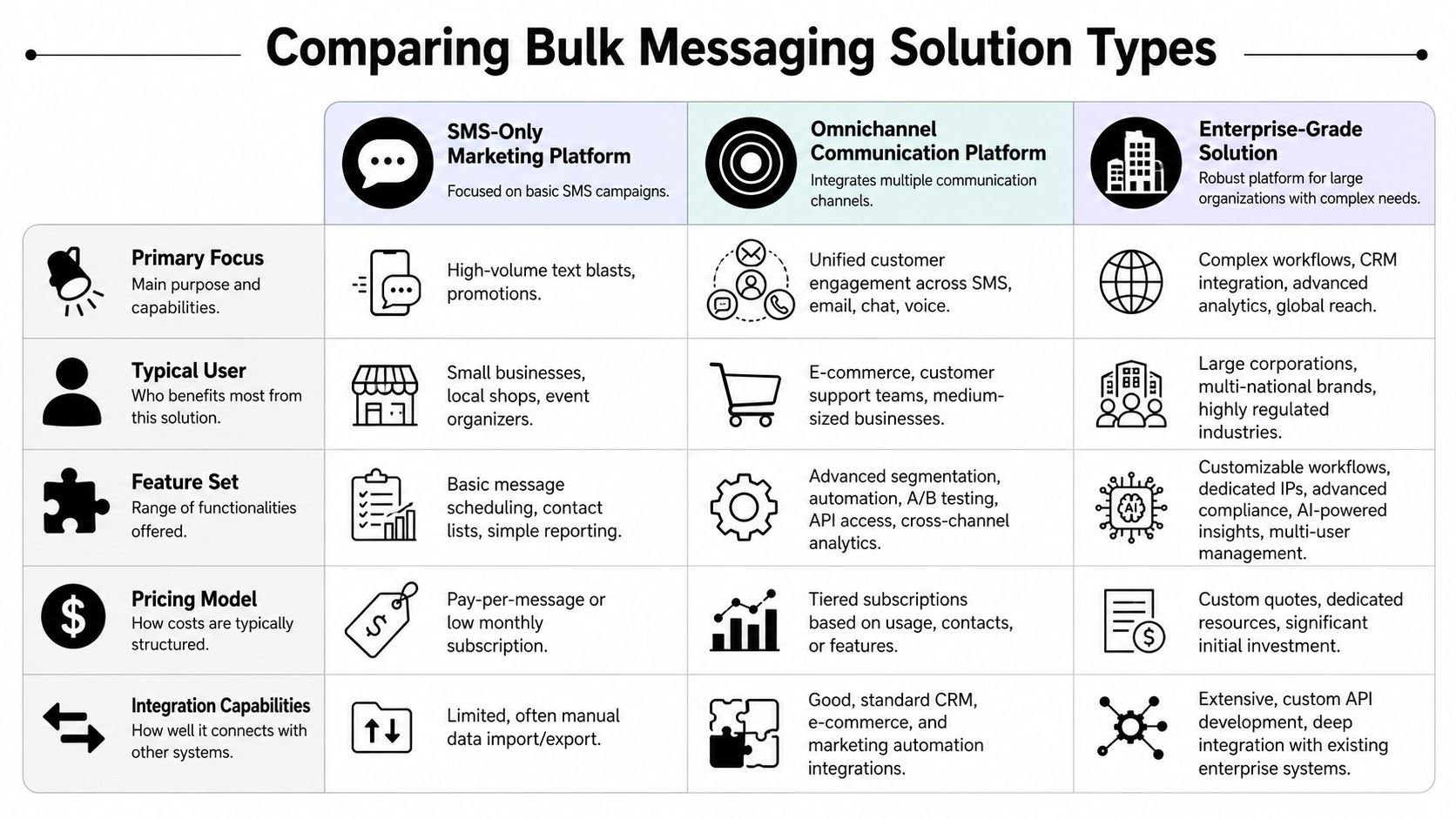
Here's the quick comparison most buyers need first.
| Solution type | Best fit | Main strength | Main limitation | Best when you need |
|---|---|---|---|---|
| SMS-only platform | Small teams running simple campaigns | Fast setup for broadcast texting | Limited channel flexibility | Promotions, reminders, list-based outreach |
| Omnichannel platform | Growing businesses with mixed use cases | SMS, voice, and ringless voicemail in one workflow | More setup choices to manage | Follow-up sequences, reminders, support updates |
| Enterprise-grade platform | Large or regulated organizations | Deep controls, analytics, integrations | Longer implementation cycle | Complex workflows, strict oversight, multi-team use |
Texting is now standard operating practice in many industries. MessageDesk's 2026 review reports that 57% of trades and service-based businesses text customers, while 50% of logistics and support-based businesses do the same in its business texting statistics review. That means your platform choice affects everyday operations, not just occasional campaigns.
This is the first filter. If a provider makes compliance feel like an afterthought, keep moving.
You need a system that handles opt-outs cleanly, supports registration requirements, and gives you confidence that your traffic won't get flagged because someone imported a bad list. In practical terms, compliance protects your ability to keep messaging at all. If you're unfamiliar with carrier registration rules, this overview of 10DLC compliance requirements is worth reviewing before you buy.
Look for:
Many “best bulk text messaging service” lists come up short; they evaluate SMS as if every business is only sending promotions.
Real outreach is messier than that. A customer may ignore a text but listen to a voicemail. A lead may respond better to a short ringless voicemail after two unanswered texts. A patient may need a reminder by text first, then a voice follow-up if the appointment is high value or time-sensitive.
Automation should reduce staff effort without creating obvious spam. Good platforms let you trigger messages from actions, dates, or contact fields.
Useful examples include:
Practical rule: If a platform only supports one-off blasts well, you'll outgrow it as soon as your follow-up process matters.
The platform should fit your existing workflow. CRM integrations, Zapier connections, and calendar or form triggers matter because manual exports create mistakes.
You also need reporting that answers business questions, not vanity questions. Can you see deliveries, replies, click activity, opt-outs, and campaign-level results? Can staff tell which list or workflow produced the conversation?
Support matters more than most buyers expect. Messaging touches compliance, carriers, imports, and timing. When something breaks, you don't want a knowledge base loop. You want help from a team that understands business messaging operations.
Platform categories matter more than brand lists. Most buyers don't need a winner picked for them. They need to know which model fits their workflow.
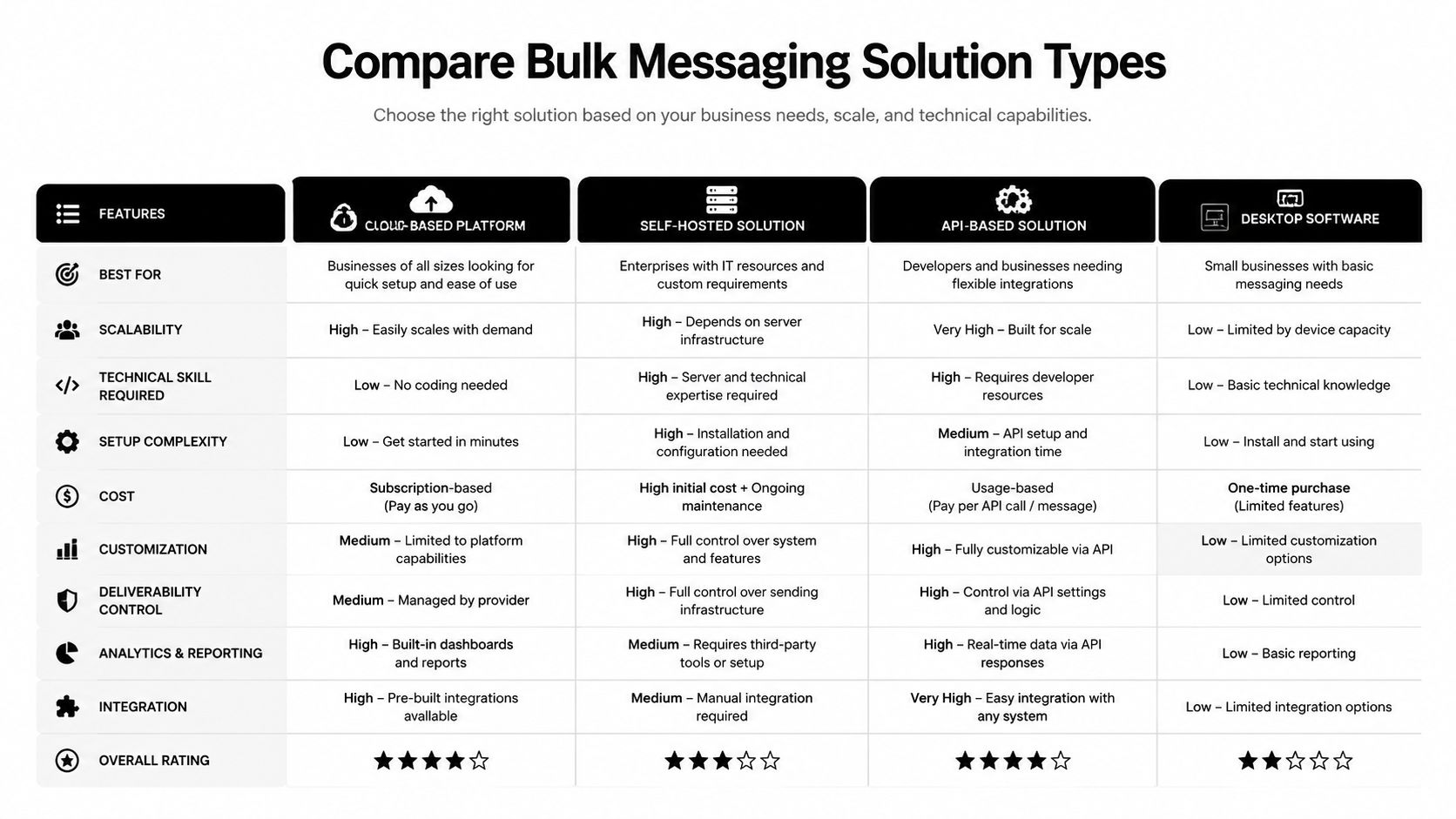
Independent small-business roundups keep coming back to the same practical differentiators: two-way texting, automation, scheduling, MMS support, CRM integrations, and invalid-number detection in this review of small-business text messaging service criteria. That's a better way to compare categories than just counting message volume.
These work for straightforward campaigns. If you mostly send offers, event reminders, or basic announcements, an SMS-only platform can be enough.
They usually make it easy to import contacts, schedule campaigns, and manage simple replies. The downside shows up when your process gets more nuanced. Once you want voice, ringless voicemail, deeper routing, or multi-step follow-up based on behavior, these tools start to feel narrow.
Best fit:
API-first providers are great when your team wants full control and has technical help. They let you build messaging into your app, CRM, support workflow, or custom internal system.
That flexibility comes with trade-offs. Someone has to design the workflow, maintain it, test edge cases, and manage message logic over time. If you have developers and a clear system architecture, that can be worth it. If you don't, setup can drag and ownership gets fuzzy.
If you're comparing custom texting infrastructure versus packaged tools, it helps to understand how A2P texting works for business messaging.
This is the category I usually recommend for businesses that rely on follow-up to make money or keep operations running. These platforms combine SMS with voice and ringless voicemail, often with shared contact records, automation, segmentation, and reporting.
That combination matters because not every message has the same job. A discount offer, a service reminder, and a patient communication all need different delivery logic.
A text gets attention fast. A ringless voicemail adds tone and context. A voice call handles urgency. The best systems let you decide which one belongs at each step.
One example in this category is Call Loop, which supports bulk SMS, voice broadcasting, ringless voicemail, drip campaigns, integrations, and HIPAA-capable workflows. That's a different buying proposition from a pure SMS tool because you're choosing a communication system, not just a texting sender.
The simplest platform is rarely the best long-term choice if your team depends on reply handling, reminders, no-show reduction, patient outreach, staffing notices, or lead follow-up. In those environments, ringless voicemail isn't a gimmick. It's a practical bridge between text and live calling. It gives you a personal voice touch without asking the contact to answer a phone call in the moment.
The best bulk text messaging service depends on what you're trying to make happen after the message lands. Promotions are one use case. Operations are another.
That difference matters because some businesses need campaign reach, while others need reliable response handling and coordinated follow-up. ClickSend's bulk SMS guidance makes that distinction clear around operational messaging needs like reply handling, delivery confirmation, and multi-channel follow-up in its discussion of bulk SMS for business operations.

A plumbing company, salon, contractor, or karate studio usually doesn't need fancy SMS branding. It needs fewer missed appointments and faster confirmations.
A practical sequence looks like this:
That workflow is better than a generic broadcast because it gives the customer an easy path to confirm, ask a question, or change timing. Ringless voicemail helps when the message needs a little more warmth than text can provide.
Sales teams often over-text cold and warm leads. The message cadence becomes repetitive fast, and prospects stop engaging.
A better approach mixes channels. Start with a short introductory text. Follow with a ringless voicemail that explains why you're reaching out and what problem you solve. Then send a final text tied to a clear call to action, such as booking a time or replying with interest level.
If every follow-up looks identical, prospects read it as automation, even when a person wrote it.
Voice and ringless voicemail earn their place. They don't replace SMS. They keep SMS from carrying the entire relationship by itself.
Healthcare is where many buyers discover that marketing-focused SMS tools are the wrong fit. Patient communication needs secure workflows, controlled access, reliable records, and careful message design.
For a clinic or practice, bulk messaging usually includes:
The platform has to support compliant handling, but the workflow also matters. Text for fast visibility. Use voice for urgent notices. Use ringless voicemail when you need a more personal reminder without creating missed-call frustration.
Field teams, logistics groups, support teams, and distributed staff often use bulk messaging for updates, not campaigns. Dispatch changes, shift reminders, weather disruptions, and service alerts all benefit from fast outbound messaging with tracked delivery and replies.
In these use cases, fancy templates matter less than speed, routing, and acknowledgment. That's why the strongest platforms don't just send messages well. They help your team act on what comes back.
The best bulk text messaging service for your business is the one that matches your communication job. Not the one with the longest feature list. Not the one with the prettiest dashboard. Not the one that's cheapest on a pricing page.
Start with important questions.
If most of your outreach is promotional, you may be fine with a focused SMS platform.
If your messages handle reminders, reschedules, support updates, internal alerts, or patient communication, you need more than a promo tool. You need better reply handling, workflow control, and likely more than one channel.
Use this checklist:
If your business sends simple offers and occasional reminders, choose an SMS-first tool with strong scheduling, segmentation, and list hygiene.
If you need custom workflows inside your own systems and have technical resources, an API-first provider may be the right call.
If you rely on follow-up sequences, appointment reminders, patient communication, sales nurturing, or mixed-channel outreach, choose an integrated platform that handles SMS, voice, and ringless voicemail together. That's usually the better long-term fit because it mirrors how real customers respond.
The winning platform is the one your team will use correctly every week, not the one that looks impressive in a demo.
Once you've picked a platform, the first campaign matters more than people think. A messy launch creates bad data, poor deliverability, and internal skepticism fast.

Don't import every number you've ever collected and hope for the best. Start by removing duplicates, separating old leads from active customers, and tagging people by use case.
Your first segments might be:
If your team needs a practical overview of list setup and message sending, this guide on how to send SMS in bulk covers the basics clearly.
Your first message should do one job. Confirm. Remind. Ask for a reply. Offer one clear next step.
Good business texts are short, direct, and easy to act on. Ringless voicemail should be the same. Keep it conversational, identify your business quickly, and give a simple callback or reply path.
Don't stop at opens. For an actual business rollout, better metrics are:
Run a small launch first. Check reply patterns. Review opt-outs. Listen to voicemail recordings before scaling. Tight feedback loops beat big first sends.
Bulk texting isn't going away. But the category is changing. The strongest results now come from coordinated outreach, where SMS, voice, and ringless voicemail work together instead of competing for the same job.
That shift matters because customers don't all respond the same way. Some want a quick text. Some need to hear a human voice. Some will never answer a live call but will listen to a voicemail and reply later. The best bulk text messaging service recognizes that reality and gives you workflow control across channels.
If you're choosing a platform in 2026, think bigger than message volume. Look for systems that help you manage consent, automate follow-up, support compliance, and move naturally between promotional and operational use cases. That's where the greatest value is generated.
If you want one platform for bulk SMS, voice broadcasting, and ringless voicemail, take a look at Call Loop. It's built for multi-channel outreach, supports automation and integrations, and fits businesses that need more than simple text blasts.
Chris Brisson
Chris is the co-founder and CEO at Call Loop. He is focused on marketing automation, growth hacker strategies, and creating duplicatable systems for growing a remote and bootstrapped company. Chat with him on X at @chrisbrisson


Trusted by over 45,000 people, organizations, and businesses like


