
See a Demo
You're just one step away from seeing Call Loop in action.
Enter your information below to watch a demo right now.

You're just one step away from seeing Call Loop in action.
Enter your information below to watch a demo right now.

So you want to send a text blast. It's tempting to just upload a list of numbers, type a message, and hit 'send'. But if you want to see real results—not just annoy people—you need a solid game plan.
A great bulk SMS campaign is so much more than a mass text. It’s about getting the right message to the right person at the right time, all while staying on the right side of the law.
Let's face it, texting is one of the most direct ways to reach your customers. Everyone has a phone, and SMS open rates crush almost every other channel. The secret isn't just reaching them, though. It's about treating each text like a one-on-one conversation that you're having with thousands of people at once.
This isn't just some marketing fad. The market for business SMS is exploding and is expected to hit USD 11.69 billion by 2032. That’s a whole lot of businesses realizing just how powerful direct-to-customer texting can be. To get a piece of that pie, you need a playbook.
Here's a quick visual of what that process looks like from a high level.
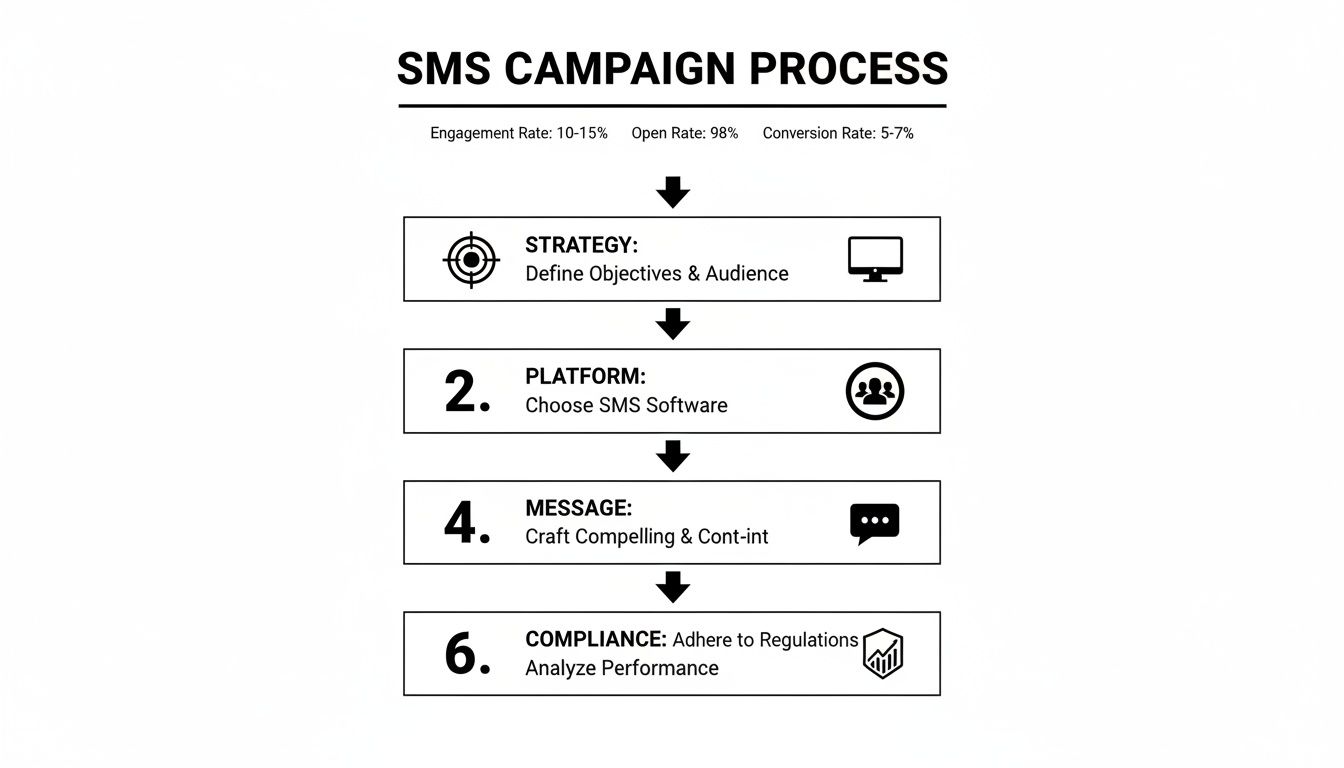
As you can see, compliance and tracking aren't afterthoughts. They’re baked right into the process, creating a loop where you're always improving.
To really get the most out of your texts, you need to think bigger. Your SMS efforts should be part of a larger multi-channel marketing strategy. Texting works wonders when it supports your other channels, like email or social media. Think about how a quick SMS can give a last-minute push to a sale you've been promoting all week.
This guide will walk you through everything you need to know. We'll cover setting clear goals, picking the right platform, building a clean contact list, and writing messages that actually get people to click.
The real power of bulk SMS isn't just in reaching thousands of people at once. It’s in making each of those thousands of people feel like you're speaking directly to them.
Before we dive into the step-by-step, let's break down the core pieces you'll need to assemble for any successful campaign.
This table gives you a quick snapshot of the essential elements. Think of these as your fundamental building blocks.
| Component | Primary Goal |
|---|---|
| Strategy & Goals | Define what success looks like (e.g., 15% coupon redemption). |
| Platform Choice | Select a tool with the features you need (e.g., scheduling, MMS). |
| Contact List | Build and clean a list of opted-in, valid numbers. |
| Message Crafting | Write clear, concise, and compelling copy with a strong call-to-action. |
| Compliance | Adhere to legal rules like TCPA by managing opt-ins and opt-outs. |
| Execution | Schedule and send the campaign at the optimal time. |
| Tracking & Analysis | Measure key metrics like click-through and conversion rates to improve next time. |
Getting these components right from the start is what separates a profitable campaign from a costly mistake.
We'll also touch on some cool complementary tech, like ringless voicemail. Imagine sending a promotional text and, a day later, dropping a personal-sounding audio message directly into their voicemail box—without their phone ever ringing. It's this kind of multi-touch approach that turns a simple text blast into a meaningful customer experience and delivers real, measurable results.
Before you even think about hitting “send” on a bulk SMS campaign, you’ve got to get your foundation right. I’ve seen countless campaigns fall flat right out of the gate, and it almost always comes down to two things: the tools they chose and the quality of their contact list. Get these wrong, and you're just sending expensive spam.
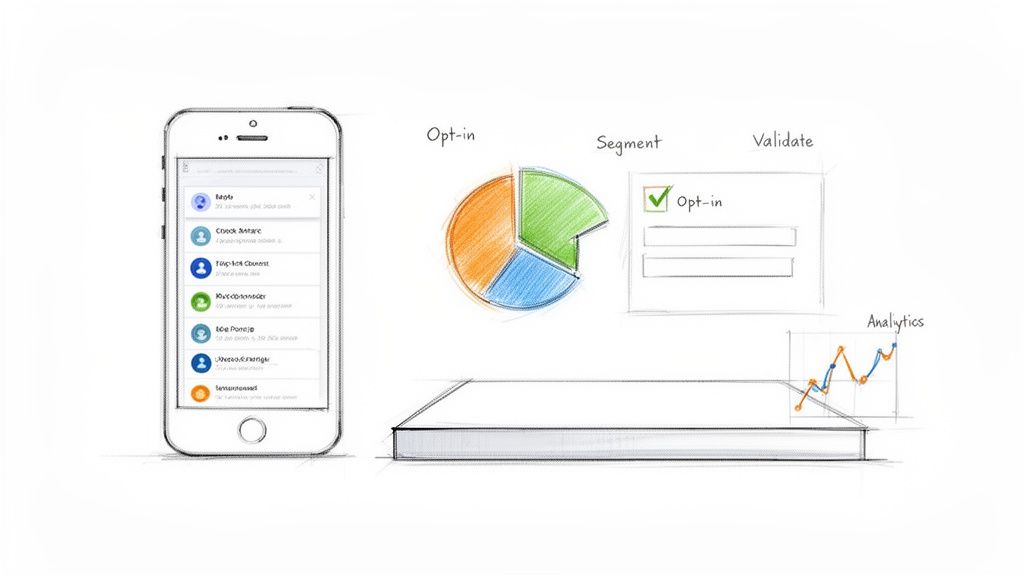
Think of your SMS platform as your campaign's mission control. Sure, a basic service will let you upload a list and blast out a message. But if you want real performance and precision, you need more than the bare minimum.
Don't just shop around for the cheapest price per message. You need to look for the features that actually drive results. Honestly, these are the deal-breakers for any serious campaign:
[FirstName]). A message that starts with a subscriber's name feels personal, not like a generic blast sent to thousands.These are the features that let you run targeted, high-impact campaigns instead of just making a lot of noise.
Your contact list is pure gold, but how you build it matters. A lot. Never, ever buy a list. That’s what scammers do, using data from breaches to run smishing campaigns. Legitimate businesses earn their contacts by getting explicit permission.
The quality of your contact list determines the success of your campaign. A small, engaged list of opted-in subscribers is far more valuable than a massive list of unverified numbers.
Building a list the right way isn’t just about following the rules—it’s about respecting your audience and protecting your sender reputation. If you keep sending messages to bad numbers, carriers will start flagging you, and your deliverability will tank for all future campaigns.
Here are a few proven ways to collect opt-ins ethically:
Now, once you have the numbers, the work isn't done. You have to practice good list hygiene. Routine list validation is a step people often skip, but it's essential. This process scrubs your list of any invalid or deactivated numbers. It saves you money on failed messages and, more importantly, protects your sender reputation.
Think of it as regular maintenance for your most valuable marketing asset. It ensures your texts actually land in front of real, interested people every single time.
Let's be honest: just because you send a text doesn't mean anyone will read it. You're landing in a highly personal space—their message inbox. The difference between a message that makes money and one that gets ignored (or worse, gets you blocked) comes down to the first few seconds.
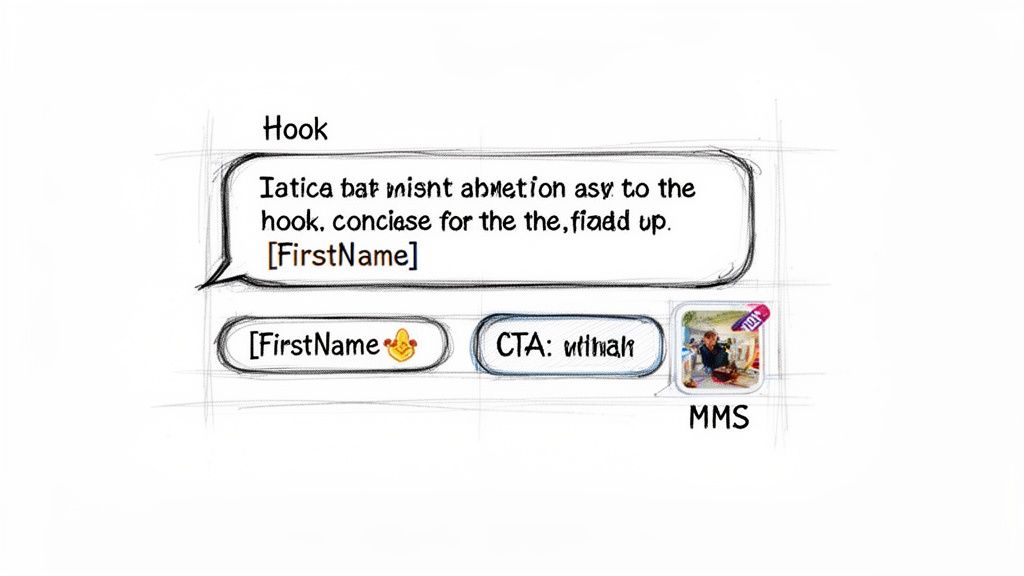
I've seen it time and again: the best texts are brutally simple. They have a killer opening line, a clear "what's in it for me," and a call-to-action (CTA) you can't miss. Your hook has to grab them instantly.
This isn't just theory. The data backs it up. SMS open rates are still insane, hovering between 90-98%. But the real magic is in the clicks. Well-crafted, personalized messages can easily hit 10% click rates, and I've seen top-tier campaigns blow past 16%. If you want to dig deeper, check out these SMS marketing statistics that show just how powerful contextual messaging really is.
Nothing screams "generic ad blast" like a message that isn't personal. It's the fastest way to get your customers to tune out. Personalization is your secret weapon for making a bulk send feel like a one-on-one chat.
At the bare minimum, you need to use merge tags to address people by their first name. Think about it. "Hey [FirstName], we've got a deal for you!" feels worlds apart from a cold, anonymous message.
A simple
[FirstName]tag can transform a cold broadcast into a warm, personal communication. It’s a small detail that signals you see the customer as an individual, not just a number on a list.
The best platforms let you go even further. Using custom fields for things like their city or last purchase can help you create offers so relevant they feel like they were made just for them. That's how you get a response.
Standard SMS is great, but adding pictures with MMS? That's next-level. A picture is literally worth a thousand words when you're capped at 160 characters.
Visuals make your offer feel tangible and more desirable. But remember, the end goal is to get them to act. That’s where your link comes in.
Every single campaign needs to use a built-in link shortener. This is non-negotiable for two big reasons. First, it saves a ton of character space. Second, and this is the crucial part, it lets you track every single click. If you're not tracking clicks, you're flying blind. You have no idea what worked and no way to calculate your ROI.
To get you started, here are a few templates I’ve seen work wonders. Notice how they’re all personalized, have a clear value, and tell the person exactly what to do next.
Flash Sale Alert (E-commerce):
Hey
[FirstName]! Our flash sale is LIVE. Get 30% off all hoodies for the next 4 hours only. Don't miss out! Shop now: [short.link/sale]
Appointment Reminder (Service Business):
Hi
[FirstName], just a friendly reminder about your appointment with us tomorrow at 2:30 PM. To confirm or reschedule, please reply to this text or call us at [Phone Number]. Thanks!
Event Update (Webinar Host):
Hey
[FirstName], we're starting in 15 minutes! Here's your private link to join the webinar on mastering social media ads. See you there: [short.link/webinar]
Each one is tight, personal, and has a clear next step. That focused approach is what turns your bulk SMS sends into a real, reliable revenue driver for your business.
Sending SMS in bulk is a huge opportunity, but it comes with serious legal responsibilities. Getting compliance wrong isn't just a small mistake—it can lead to staggering fines, get your numbers blocked by carriers, and completely torch the trust you've worked hard to build with your customers.
This is a non-negotiable part of the game.
And it’s not just about avoiding penalties. Proper compliance is the bedrock of high deliverability. Mobile carriers and their anti-spam systems are smarter than ever. They actively hunt for signals that a sender is cutting corners, and when they find them, they don't hesitate to filter or block those messages from ever reaching an inbox.
The single most important regulation you need to drill into your brain is the Telephone Consumer Protection Act (TCPA). The law is crystal clear: you must have "express written consent" before sending a single promotional text message.
So, what does that actually mean in practice? It means someone has to take a clear, deliberate action to say, "Yes, I want to receive marketing texts from you." This could be:
Simply having a customer's phone number from a past purchase is not consent. Assuming you can text them because they're a customer is a fast track to a TCPA violation and a damaged brand reputation.
You also have to include standard legal disclaimers. Phrases like "Msg & Data rates may apply" and "Reply STOP to cancel" are mandatory. They ensure your subscribers are fully informed and have a simple, no-questions-asked way to opt out. If you're in a specialized field like healthcare, finding a platform built with HIPAA compliance in mind is critical to keep communications secure.
Once you have a compliant, opted-in list, your next focus is deliverability. You need to make sure your messages actually land in your subscribers' inboxes. Think of mobile carriers as the gatekeepers of their network, and they protect it fiercely.
One of the biggest mistakes we see businesses make is sending too many messages, too quickly, from the wrong kind of number. This is where throttling your send rate becomes absolutely critical. Blasting thousands of texts instantly from one number is a massive red flag for carriers. A good platform will handle this for you, spacing out your sends so they look like natural traffic and don't trigger filters.
The number you use also matters—a lot. For bulk messaging, using a verified toll-free number is the gold standard. These numbers are built for high-volume Application-to-Person (A2P) sending and go through a verification process that builds trust with carriers. To get deeper into this, check out our guide on 10DLC compliance and number registration.
The A2P SMS market is a massive part of the global economy, valued at USD 52.28 billion in 2025. We're seeing a shift in this market, with security and transactional alerts growing faster than traditional marketing messages, largely driven by these evolving regulations. This trend shows just how much carriers and regulators value verified, compliant messaging. You can explore more about these market dynamics and their implications to stay ahead of the curve.
Finally, you have to manage subscriber fatigue. Bombarding your list with daily messages is a surefire way to get a wave of "STOP" replies and kill your engagement. Plan your sending frequency carefully. Provide real value with every message, and you'll keep your audience engaged—and your deliverability high—for every campaign you send in bulk.
Alright, you've done the hard work. Your strategy is sharp, your list is clean, and your message is ready to go. Now for the fun part: launching your campaign and seeing the results roll in.
But hitting "send" isn't the finish line. It's the starting gun. This is where your careful planning meets the real world, and the real learning begins.
First things first, let's talk timing. Sending a text is all about showing up at the right moment. Imagine a local restaurant texting a lunch special at 3:00 PM—not great. But what if that same text landed at 11:30 AM, right when stomachs start to grumble? You'd have a line out the door. Think about your customer's day and aim to be a welcome interruption, not a random one.
There's also a technical piece of the puzzle you can't ignore: send speed throttling. It sounds complicated, but it's simple. Blasting out thousands of texts all at once can make carrier networks think you're a spammer, and they might just block you. A good platform will automatically pace, or "throttle," your sends. This makes your traffic look natural, keeps the carriers happy, and ensures your messages actually get delivered.
Once your messages are out in the wild, your job shifts from creator to analyst. You need to know if you're getting a good return on your investment (ROI), and that means tracking the right numbers. These are the stats that tell the real story of your campaign.
Here are the core metrics I watch like a hawk on every campaign:
Understanding your numbers is what separates the pros from the amateurs. When you know your conversion rate and your campaign cost, you can calculate the exact ROI. That’s how you prove the value of your work and get buy-in for doing more.
Let's be honest: your first campaign will rarely be your best one. And that's okay. The data you get back is pure gold for making the next one even better. This is where A/B testing comes in.
The concept is simple. You create two versions of your message with one small difference, send them to two different segments of your list, and see which one wins.
For example, you could test:
The key is to only change one thing at a time. That way, you know exactly what made the difference. This data-driven cycle of sending, measuring, and refining is how you get really good at this. Each test teaches you something, making every subsequent campaign you send in bulk more effective. To see what's possible, check out our guide on the features that power this kind of outreach with our bulk SMS services.
Sending a bulk SMS blast is a powerful move on its own. But its real potential shines when you start pairing it with other channels. When you weave your SMS campaigns into a bigger, automated strategy, you don’t just send a message—you create a persistent, engaging experience for your customers.
This is where you bring in some complementary tools to really crank things up.
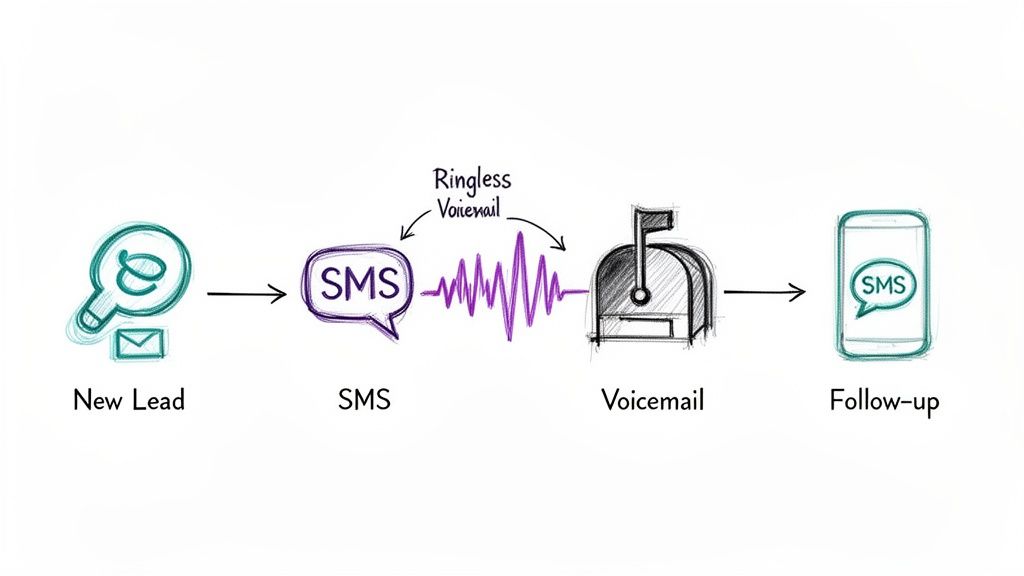
One of the best partners for bulk SMS is ringless voicemail. It's a slick piece of tech that drops a pre-recorded audio message straight into someone’s voicemail box. The best part? Their phone never even rings.
Think of a ringless voicemail as a way to add a human voice to your digital outreach without being pushy. It’s perfect for those follow-ups or big announcements where the tone of a real person's voice makes all the difference.
Unlike a cold call that interrupts someone's day, it respects their time. They can listen to your message whenever it’s convenient for them.
Ringless voicemail gives you the personal feel of a phone call combined with the polite, non-disruptive nature of a text. It's a fantastic way to stand out and make your communication feel more direct and personal.
This tactic is brilliant for adding some real depth to your campaigns. For instance, a real estate agent could text a new listing and then follow up a day later with a ringless voicemail, personally describing the home's best features. If you’re just getting started with this, you can learn more about what ringless voicemail is and how it works with SMS.
Now, this is where the real magic happens. By connecting SMS and ringless voicemail through automation, you can build powerful drip campaigns. These are just sequences of pre-scheduled messages that nurture your leads over time, making sure you’re always following up without lifting a finger.
Imagine this automated workflow for a brand-new lead:
This kind of automated sequence works for you 24/7, guiding potential customers through your funnel and pushing them toward a sale. To really pull this off at scale, it's worth checking out some modern workflow automation software platforms that can seamlessly tie all your messaging efforts together.
Jumping into bulk SMS can feel like navigating a minefield of rules and technical jargon. It’s an incredibly direct way to reach people, but you’ve got to do it right. You probably have a few questions, so let's clear up some of the most common ones we hear from businesses just starting out.
Yes, it's absolutely legal, but you have to play by the rules. The biggest one in the U.S. is the Telephone Consumer Protection Act (TCPA). This law requires you to get "express written consent" before you send a single promotional text.
This means you need a clear, documented record of exactly when and how someone agreed to get texts from you. Every message also needs to have a dead-simple way to opt out, like replying "STOP," and you have to honor those requests immediately. A good SMS platform will handle this part for you, which is a lifesaver.
For sending messages at scale, a text-enabled toll-free number is the gold standard and really your only smart option.
Trying to use a regular 10-digit number (like your personal cell) for mass texting is a surefire way to get your number flagged as spam by the carriers. On the flip side, dedicated short codes are great for deliverability but are way too expensive for most small businesses.
A verified toll-free number is built specifically for high-volume Application-to-Person (A2P) sending. It goes through a carrier verification process that builds trust, which means your messages actually get delivered and your reputation as a sender stays intact.
Using the wrong type of number is one of the most common—and costly—mistakes we see. A verified toll-free number signals to carriers that you're a legitimate business, and that’s critical for any successful campaign.
Your pricing will almost always break down into two parts: a monthly or annual subscription for the platform itself, and a per-message fee. That per-message cost changes based on things like the destination country and whether it's an SMS or MMS. An MMS with a picture or GIF will always cost more than a plain text message.
When you're comparing platforms, look for simple, transparent pricing that grows with you. But don't just look at the cost per text. Think about the value of the features included. For example, a platform with built-in list cleaning can save you a ton of cash by stopping you from texting invalid numbers.
Ready to harness the power of direct, compliant outreach? Call Loop provides a complete multi-channel messaging platform, enabling you to automate and personalize campaigns across SMS, voice, and ringless voicemail. Start your free trial today and see how easy it is to connect with your audience.
Chris Brisson
Chris is the co-founder and CEO at Call Loop. He is focused on marketing automation, growth hacker strategies, and creating duplicatable systems for growing a remote and bootstrapped company. Chat with him on X at @chrisbrisson


Trusted by over 45,000 people, organizations, and businesses like


