
See a Demo
You're just one step away from seeing Call Loop in action.
Enter your information below to watch a demo right now.

You're just one step away from seeing Call Loop in action.
Enter your information below to watch a demo right now.

A salon owner checks the Saturday schedule and sees a familiar problem. Twelve appointments are sitting on the books, but several customers haven't confirmed, and every empty chair will cost the business time it can't recover. A short reminder sent at the right moment can do more than another social post, but only if the owner has built the list, message, timing, and opt-out process correctly.
That's the key opportunity with bulk SMS for small business. It isn't just a way to broadcast discounts. Used well, it becomes an operational channel for reminders, promotions, follow-ups, payment notices, and customer service updates. Used carelessly, it creates filtering problems, angry subscribers, and a compliance record nobody can explain.
The salon owner doesn't need a clever campaign on Saturday morning. She needs customers to confirm, reschedule, or show up. SMS fits that job because the message lands on a device customers already use, without an app download or a social feed to monitor. A concise reminder can give the customer one clear action, such as confirming the appointment or calling the front desk.
Industry summaries place SMS open rates in the 90% to 98% range, with around 80% of messages read within five minutes. They also commonly cite average response rates around 45% for SMS compared with roughly 6% for email, while reported conversion rates for well-optimized programs fall in the 21% to 30% range. These benchmarks come from SMS marketing performance data for 2025 and 2026, and they explain why owners use texting for time-sensitive communication rather than treating it as another newsletter channel.
Email can still carry longer explanations, receipts, and educational content. Social advertising can introduce a business to new people. Voicemail can handle a richer spoken message, but many recipients skip unfamiliar calls or never listen to the recording. SMS earns its place when the business needs a customer to act soon.
Operator's rule: Use SMS when delay costs you something. Use email when context matters more than speed.
Adoption reflects that practical value. One widely cited survey found that 55% of businesses used SMS marketing in 2022, rising to 80% in 2024, a 25-point increase, while nearly 70% of businesses increased their SMS marketing budgets in 2024. The industry survey summary describes a channel moving from experimentation into regular outreach.
| Channel | Open Rate | Median Response Time | Typical CTR | Best Use Case |
|---|---|---|---|---|
| SMS | 90% to 98% | Fast | 8% to 12% typical | Reminders, urgent updates, limited offers |
| Lower than SMS benchmarks | Slower | Around 6% response benchmark | Detailed education and longer promotions | |
| Ringless voicemail | Varies by list and device | Varies | Track through a paired link or callback | Spoken context and callback campaigns |
| Paid social | Intermittent reach | Varies | Depends on placement and audience | Discovery and broader awareness |
The takeaway is simple. A Friday afternoon text can still help fill a Saturday schedule, confirm an appointment, or move a time-sensitive offer. Give SMS its own process and budget rather than burying it inside a generic software stack.
A low advertised message price tells you very little. The vendor has to support the way your business communicates, including replies, opt-outs, media, segmentation, reporting, and carrier requirements. I'd score every platform against the same operational checklist before comparing plans.
Start with U.S. carrier coverage and sender reliability. Ask whether the platform supports registered 10DLC campaigns, toll-free messaging, and short-code workflows where appropriate. Then check whether it supports MMS, two-way conversations, automated keyword joins, custom fields, scheduling, and source-level list segmentation.
Ringless voicemail deserves a separate line on the scorecard. If your campaign may use SMS for a short prompt and voicemail for a more detailed spoken explanation, a disconnected workflow creates duplicate records and messy opt-outs. Look for a platform that can coordinate the channels while preserving consent and suppression data.
As a worked example, Call Loop combines SMS, MMS, and ringless voicemail workflows, with features such as keywords, merge fields, segmentation, scheduling, link tracking, and number validation. That makes it useful for evaluating a multi-channel setup, not just a text broadcast. You can also use this bulk text messaging service evaluation guide as a checklist, then compare the same requirements against a pure-play SMS provider and an all-in-one CRM with SMS added as a secondary feature.
Don't optimize for a tiny per-message difference while ignoring list quality. A $0.01 price gap can disappear quickly if poor capture tools cause a 3% opt-out spike, but those figures should be verified against your own account data and campaign economics.
Before signing, ask sales three questions:
A phone number isn't permission. Treat consent as a documented funnel, beginning with a clear reason for someone to subscribe and ending with a record your team can retrieve later.
Your strongest entry points are usually tied to an immediate customer action. A checkout form can ask for SMS permission with an unchecked consent box. A register sign can invite customers to text a keyword for an offer. Receipts can carry a QR code, and a text-to-win promotion can collect subscribers who understand what they're joining. Imported customer records are different. Use them only when you can document prior consent for the relevant messages.
The supplied benchmark data shows how sharply capture rates can vary by surface. Checkout capture is cited around 35% to 55%, gamified popups around 8% to 12%, dedicated SMS popups around 4% to 7%, keyword text-ins around 2% to 4%, and passive footer forms around 0.5% to 1.5%, as reported in these Shopify SMS marketing benchmarks. Treat those figures as directional benchmarks, not promises for your business.
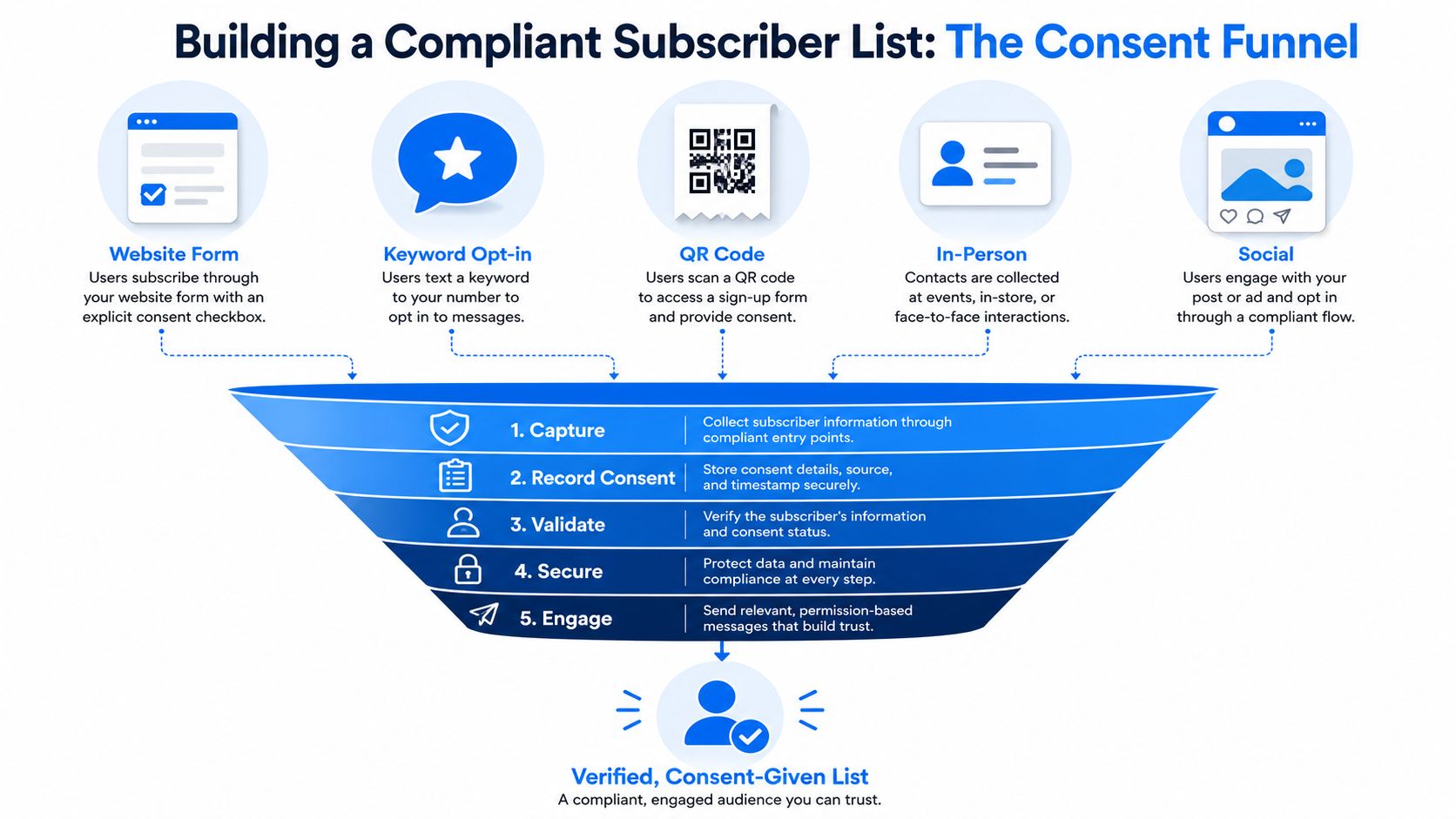
At the point of capture, show the brand name, message purpose, expected frequency where relevant, terms, privacy notice, and opt-out instructions. Store the phone number, source, wording shown to the subscriber, timestamp, campaign identity, and confirmation event together.
A double opt-in flow adds a useful verification step. After the initial sign-up, send a confirmation message and require a reply within the stated window, such as 24 hours, before activating promotional sends. A keyword join should also produce a clear confirmation reply, not a silent enrollment.
Use this text subscription workflow as a practical reference for connecting keywords, confirmation replies, and subscriber records. Source-tag every contact so you can distinguish a checkout subscriber from a contest entrant or an in-person sign-up. That distinction matters when you decide what to send and how often.
List buying remains tempting because it looks faster than building demand. It's also a poor fit for permission-based messaging. Unwanted marketing texts can expose the sender to claims involving $500 to $1,500 per message, a penalty range discussed in the FCC revocation-rule commentary at JD Supra. A smaller, clearly documented list is more valuable than a large list you can't defend.
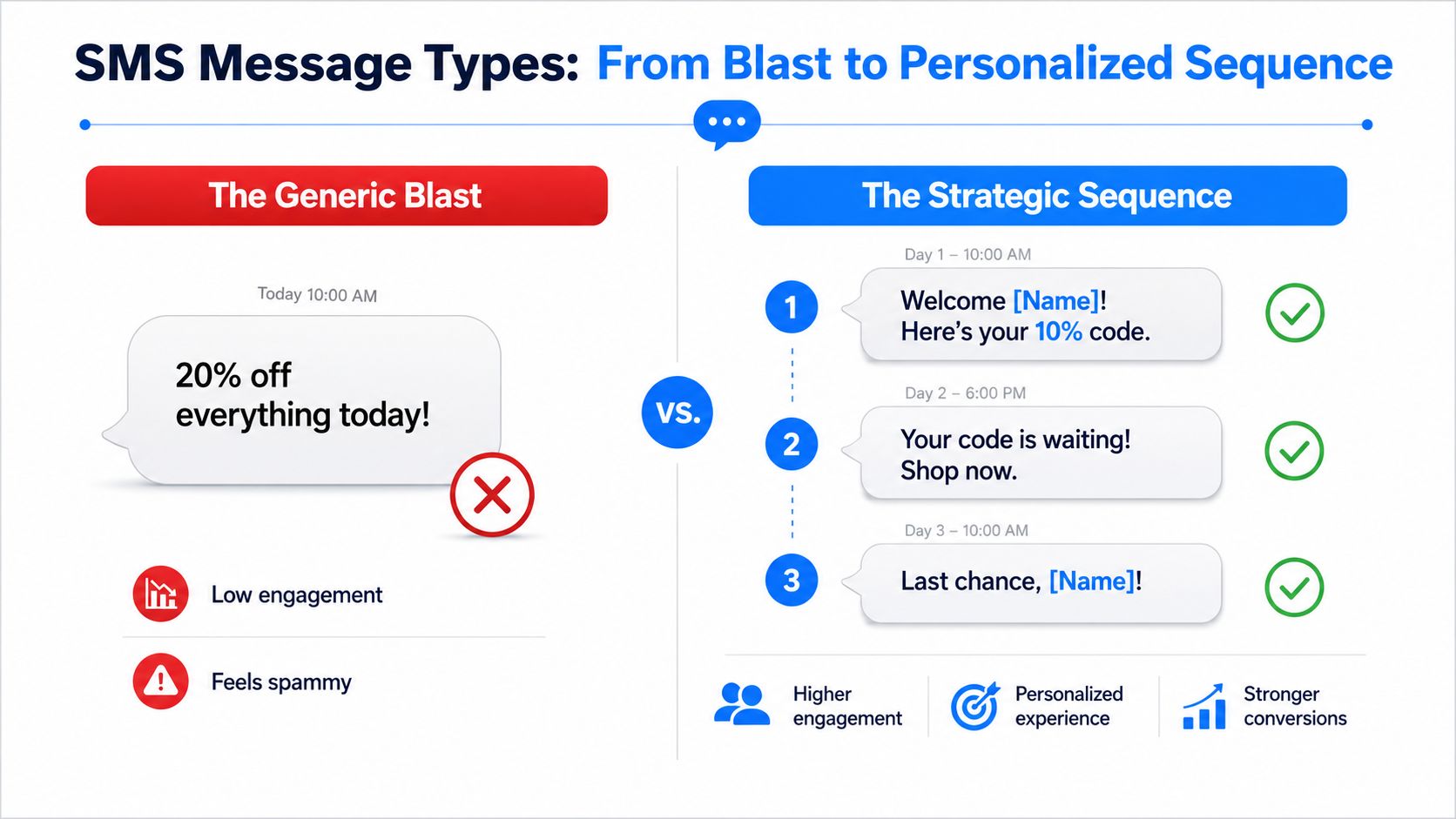
Most weak SMS campaigns fail before the send button. They try to make one message relevant to everyone, cram in several instructions, and rely on a discount to overcome poor timing. A better campaign treats each text as one slot in a short sequence.
Keep the copy compact. Aim for under 160 characters when possible, and keep the message under 306 characters to reduce splitting concerns. Those are practical copy limits, not performance guarantees. Use one emoji when it adds meaning, perhaps two if the message still reads naturally. Decorative emoji consume space and make a service reminder look like a flyer.
Short links help, but don't hide the destination. Use a branded or recognizable path where possible, add UTM tags for analytics, and send the click to a mobile page with one action. Personalization should support relevance, not create the unsettling effect of exposing information the customer didn't expect you to use.
A list of 2,000 contacts shouldn't automatically receive one broadcast. Divide it into useful cohorts by:
Three or four meaningful groups usually produce a cleaner test than one noisy bucket. Keep frequency caps at the segment level, and suppress people who have already converted or asked for a follow-up through another channel.
Send by the recipient's local time, not the time zone of the owner or headquarters. Morning reminders suit scheduled appointments, while promotional sends should arrive when the audience can act without feeling interrupted. Suppress a message when the customer has already replied, booked, paid, or opted out.
Choose SMS for a concise action, MMS when an image materially helps the offer, and a paired ringless voicemail drop when the message needs spoken context or the audience includes many landlines. For full-width mobile imagery, Salesforce recommends a 1080 by 1920 pixel image with a 9:16 aspect ratio in its MMS image guidance.
The old “add STOP and move on” approach is no longer enough. The FCC's revocation rule took effect in April 2025 and requires businesses to honor opt-out requests expressed in any reasonable manner. The operational question is whether your system can recognize, log, and suppress that request across related workflows, including SMS and ringless voicemail from the same sender.
For marketing texts, the safer operating standard is prior express written consent that clearly identifies the seller or brand and authorizes automated marketing messages. The TCPA SMS consent explanation describes that written-agreement requirement. Your messages should identify the business, include a workable opt-out path, and respect local quiet-hour requirements, including the commonly applied window before 8 a.m. and after 9 p.m. local time.
Compliance test: If a customer says “Please stop sending me these,” your system should suppress future comparable outreach even if the customer didn't type STOP.
The penalty exposure is not theoretical paperwork. Commentary on the FCC rule identifies potential liability of $500 to $1,500 per message, which makes logging, vendor oversight, and staff training part of the campaign budget.
| Requirement | SMS, TCPA | Ringless Voicemail |
|---|---|---|
| Consent | Obtain appropriate prior express written consent for marketing | Obtain consent before delivery |
| Sender identity | Identify the business or seller | Identify the business in the message |
| Revocation | Honor reasonable opt-out requests, not only STOP | Apply the same suppression logic to comparable outreach |
| Records | Store consent, timestamps, source, and message history | Store consent, drop history, and suppression events |
| Quiet hours | Use the recipient's local time | Schedule conservatively in the recipient's local time |
Healthcare businesses need an extra layer. Standard SMS isn't automatically suitable for protected health information, so clinics and covered-service businesses should avoid placing sensitive patient details in ordinary texts. Use a compliant patient communication system, limit the message to a non-sensitive notification, or direct the recipient to an authenticated portal.
Ringless voicemail isn't a loophole. In its November 21, 2022 Declaratory Ruling and Order, the FCC concluded that ringless voicemail sent to wireless phones is a “call” under the TCPA because it uses an artificial or prerecorded voice, so consumer consent is required. The FCC ruling on ringless voicemail is the primary reference, while legal commentary notes a federal-court split and the safer course of treating the channel as regulated outbound communication. Use opt-in language that explicitly covers automated SMS, MMS, and prerecorded or ringless voicemail where those channels are part of the plan. A focused SMS compliance checklist can help staff apply the same rule consistently.
Open rates are useful context, but delivery comes first. A message that isn't delivered can't be opened, clicked, or redeemed. Registered U.S. 10DLC campaigns have stabilized around 96.8% average delivery, while compliant programs commonly benchmark at 95% to 99% and top-tier sender setups can approach 99%, according to bulk SMS deliverability benchmarks.
That means a clean campaign can still lose roughly 3 to 4 messages out of every 100 before the customer sees anything. Monitor carrier-filtered traffic separately from ordinary failures. Non-compliant traffic can be suppressed by 20% to 40% in some benchmark reports, so raw send volume is a poor success metric.
Use this hierarchy:
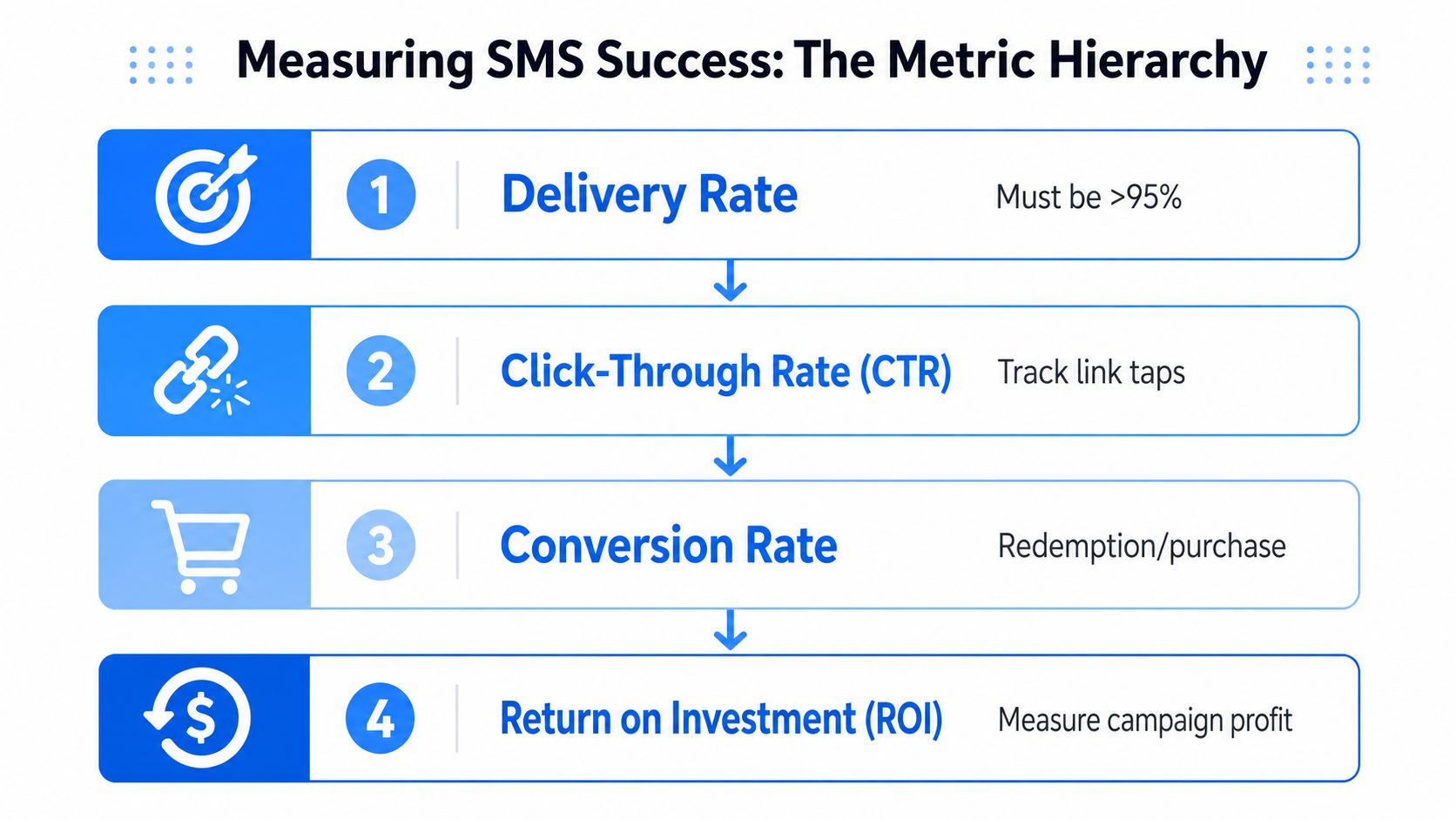
First, inspect delivery and filtering by segment. If one source performs badly, pause that source rather than changing every campaign. Next, read the three weakest messages and identify whether the problem was offer, audience, timing, link, or unclear action.
Run one controlled A/B test. Change one variable only, such as the opening line, send time, call to action, or landing page. Then prune contacts who remain unengaged according to a documented policy, while preserving the consent and suppression record.
Use unique coupon codes, dedicated landing pages, and click timestamps to connect texts with purchases or bookings. For a campaign that combines SMS with ringless voicemail, give each channel a distinct tracking path or callback instruction. Suppress a customer after conversion, and move a contact to voicemail only when the spoken format adds value. Don't burn another text credit just because the automation makes it easy.
A rollout works best when the owner starts with one reliable workflow instead of trying to automate the entire business. The first quarter should produce a documented system that another staff member can run without guessing.
Choose the vendor using the operational scorecard, then create the account and sender setup. Draft the privacy notice, terms, and opt-in disclosure before collecting new subscribers. Import only seed contacts with documented consent, and preserve their source and timestamps.
Pin a one-page register checklist beside the workstation:
Put one keyword-to-join campaign on the busiest customer-facing surface. Send the welcome message immediately after confirmation, then run one broadcast to a 500-contact segment rather than the whole database. Review replies manually and fix confusing copy before expanding.
Add segmentation by location, recency, purchase history, and engagement. Automate a birthday flow and an abandoned-cart flow where the business has the consent and data required to support them. Test one ringless voicemail drop alongside its SMS counterpart, using distinct tracking so you can compare pickups, callbacks, clicks, and opt-outs.
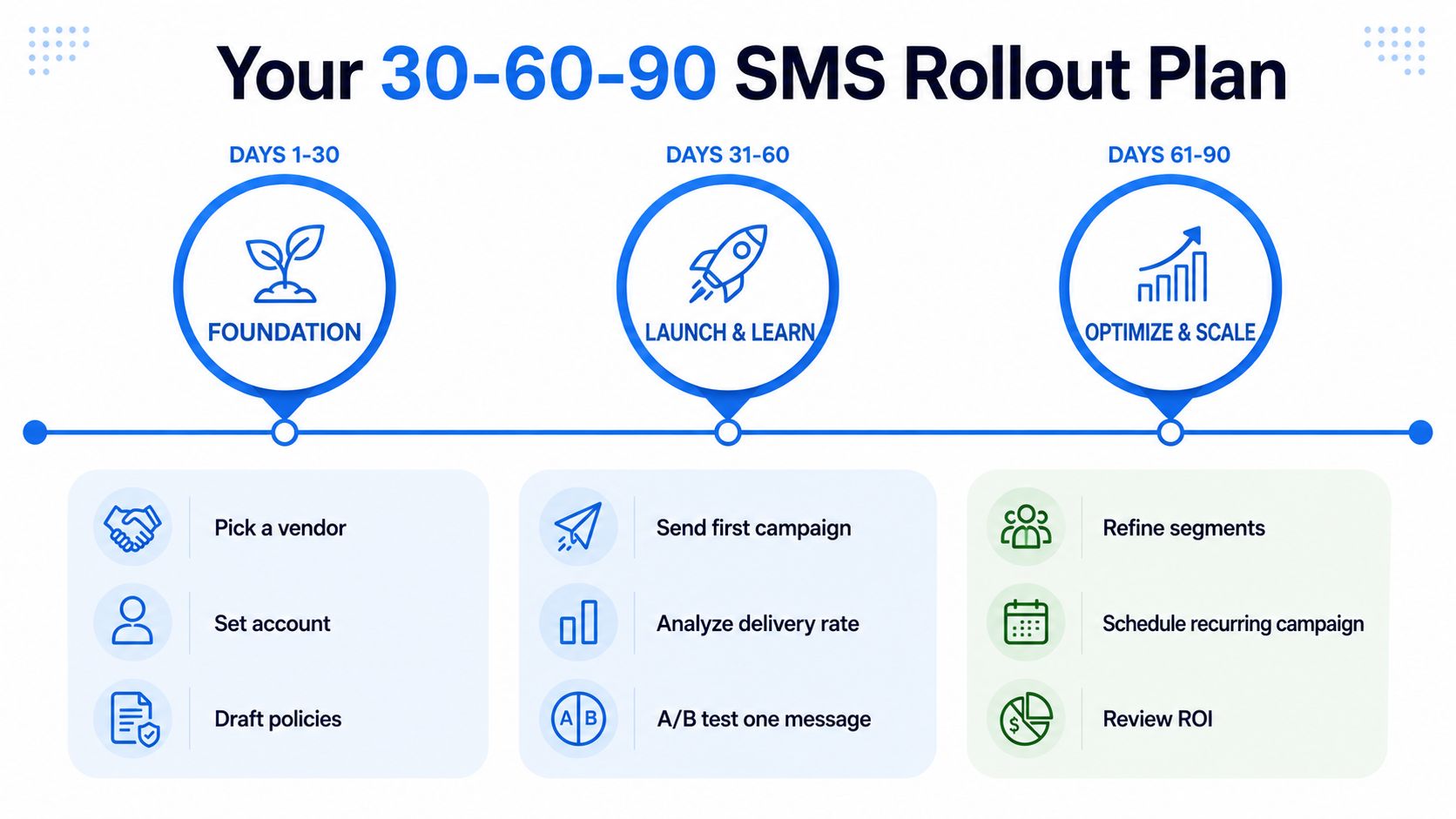
Review delivery, CTR, conversion, and ROI. Remove weak templates, refine the segments, and scale toward two campaigns per week only if the list remains healthy and customers continue to find the messages useful. Document the winning sequence, consent process, suppression workflow, and weekly review so a part-time hire can operate it safely.
The first win isn't a huge list. It's a dependable loop: permission, relevant message, measurable action, clean suppression, and a review process that improves the next send.
Call Loop offers coordinated bulk SMS, MMS, voice, and ringless voicemail workflows with keywords, segmentation, scheduling, tracking, and opt-in controls for small-business outreach. Visit Call Loop to evaluate whether its multi-channel workflow fits your consent, follow-up, and measurement process.
Chris Brisson
Chris is the co-founder and CEO at Call Loop. He is focused on marketing automation, growth hacker strategies, and creating duplicatable systems for growing a remote and bootstrapped company. Chat with him on X at @chrisbrisson


Trusted by over 45,000 people, organizations, and businesses like


