
See a Demo
You're just one step away from seeing Call Loop in action.
Enter your information below to watch a demo right now.

You're just one step away from seeing Call Loop in action.
Enter your information below to watch a demo right now.

“Send more texts” is still the most common advice in bulk SMS marketing USA. It's also the fastest way to turn a valuable channel into a list of complaints, opt-outs, filtering problems, and legal exposure. The operators who sustain results treat SMS as a permission-based conversation, not a louder megaphone. They control consent, cadence, sender identity, quiet hours, and channel fit before they worry about sending another promotion.
That shift matters because the U.S. SMS marketing market is estimated at USD 9.99 billion in 2025 and projected to reach USD 28.19 billion by 2030, implying a 23.05% CAGR from 2025 to 2030, according to market context on SMS marketing laws. Growth at that scale attracts more brands, but it also raises the cost of careless execution. A sustainable program earns attention repeatedly, rather than extracting one short-term response from an exhausted list.
More messages don't automatically produce more revenue. They can create more opportunities, but only when recipients understand why they're receiving a text and can control what happens next.
Bulk SMS marketing in the USA has moved beyond experimental use into a mature paid messaging category. Customers now recognize promotional texts, appointment reminders, event alerts, and service updates as distinct communications. That recognition creates an advantage for relevant messages, but it makes irrelevant or excessive messages easier to identify and reject.
A useful operating model has three parts:
The first part is legal infrastructure. The second and third parts determine whether the relationship lasts.
A phone number in a CRM isn't proof of SMS permission. A customer may have provided a number for shipping, billing, support, or an appointment without agreeing to promotional texts. Your team needs to know what the person consented to, when they consented, how the disclosure appeared, and which sender or brand was identified.
That's why a documented express written consent process belongs in campaign planning, not as an afterthought during a complaint. Consent records also help marketing, sales, support, and compliance teams work from the same source of truth.
The channel's strength is immediacy, but immediacy doesn't mean every message deserves priority treatment. A product launch, a time-sensitive appointment change, and a routine newsletter promotion shouldn't all compete for the same attention. Strong operators reserve SMS for moments where a direct message is more useful than a passive impression.
Operator rule: If you can't explain why this recipient should receive this message today, the campaign probably needs better segmentation.
The old “spray and pray” playbook fails for a simple reason. It treats the list as a one-way distribution asset, while recipients experience every send as a decision about whether to keep trusting the brand. In 2026, permission architecture and fatigue management aren't administrative details. They're the foundation of repeatable reach.
U.S. bulk SMS compliance is an operating system, not a dashboard setting. It combines federal law, industry guidance, carrier controls, and state requirements. The Telephone Consumer Protection Act, enacted in 1991, remains the central federal law for telephone solicitation and covers SMS campaigns sent with automatic dialing systems, as explained in this summary of SMS marketing laws.
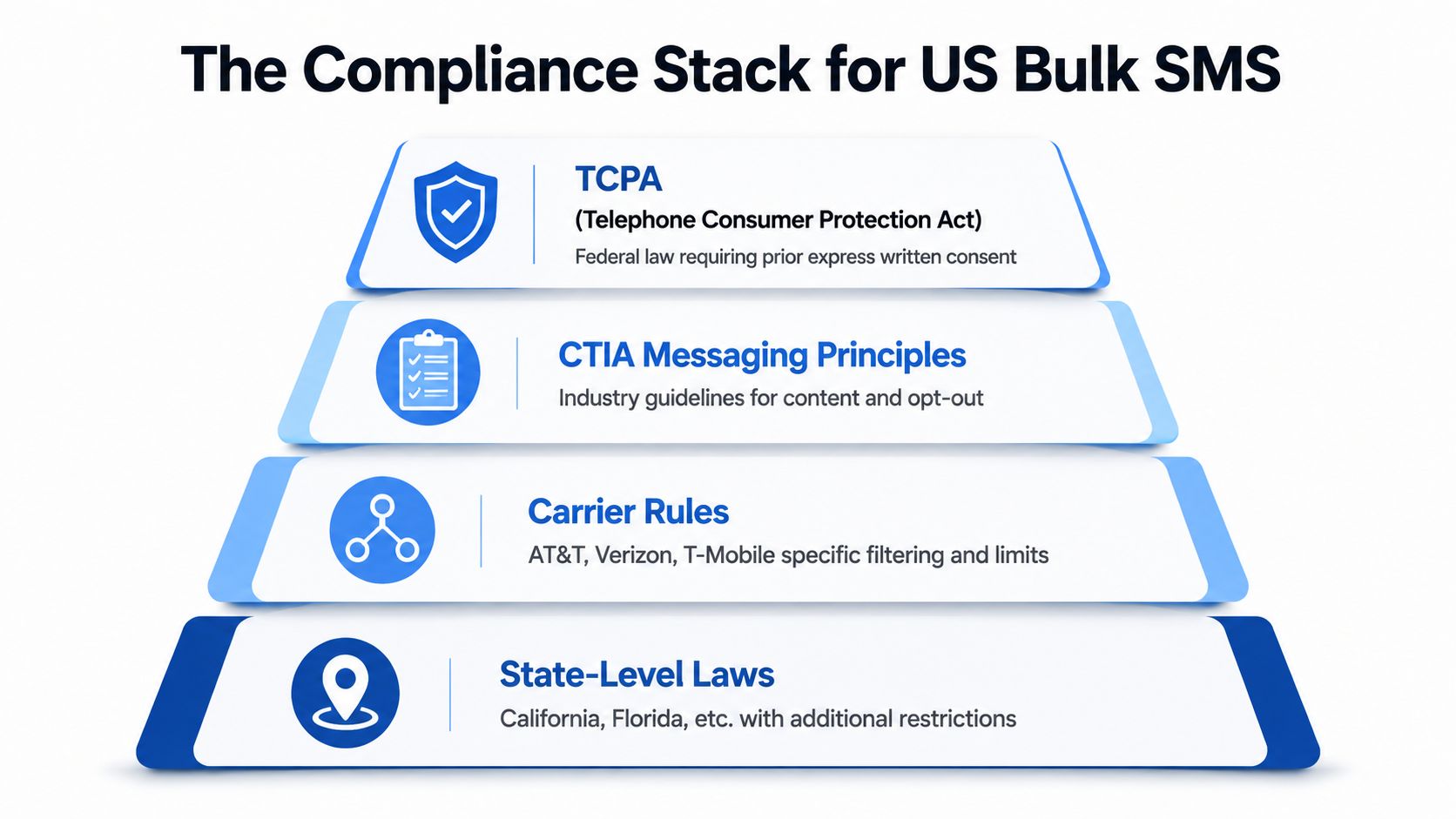
Marketing texts generally require prior express written consent, particularly when automated delivery systems are used. The disclosure should identify the sender, describe the message program clearly, and avoid treating a general contact form as permission for promotional texts.
Record the evidence at collection. Store the form or keyword flow, disclosure language, timestamp, source, phone number, and campaign context. Agencies should separate consent by brand, since permission for one client does not automatically extend to another.
Federal violations can expose businesses to statutory damages of USD 500 to USD 1,500 per violation, according to this SMS marketing compliance overview. List acquisition, consent storage, and access controls therefore belong in campaign operations, not a later paperwork review.
Every message must make the sender recognizable. Recipients should know which company is contacting them, even when campaigns use multiple numbers, locations, or client brands.
Configure the platform and train staff to process STOP and HELP requests immediately. The CTIA Messaging Principles and Best Practices sets guidance for application-to-person messaging across wireless networks. Its practical controls include retaining opt-in records, identifying the sender, honoring opt-outs, and providing assistance.
Marketing texts also face a local-time window of 8 a.m. to 9 p.m., as summarized in the SMS marketing law guidance. Scheduling should use the recipient's time zone automatically, rather than depending on manual checks.
Carriers assess content, sending patterns, sender reputation, registration, and recipient feedback. State laws may add requirements beyond the federal baseline, so a campaign approved for one audience can require another review before nationwide deployment.
Use this preflight checklist:
Ringless voicemail belongs in the same compliance review. Skipping the ring does not create a legal loophole. Treat SMS, voice, and ringless voicemail as separate delivery paths with documented permission, clear identity, and suppression rules. That structure limits complaint risk while giving cadence decisions a defensible foundation.
Permission gives you a starting point. It does not guarantee carrier delivery or sustained engagement. In USA bulk SMS marketing, deliverability reflects list quality, sender consistency, message patterns, and what happens after a recipient replies. A campaign can satisfy consent requirements and still lose reach when fatigue, complaints, or poor data accumulate.
Start with list hygiene. Remove invalid numbers, suppress previous opt-outs, isolate contacts with disputed consent, and verify the origin of imported files. A clean list also supports useful segmentation because campaigns are based on current customer states rather than stale records.
Message construction affects filtering and response quality. Use short, specific copy with one clear action. Repeated links, unclear sender identity, unexplained urgency, and wording that resembles unwanted traffic reduce trust and can weaken delivery.
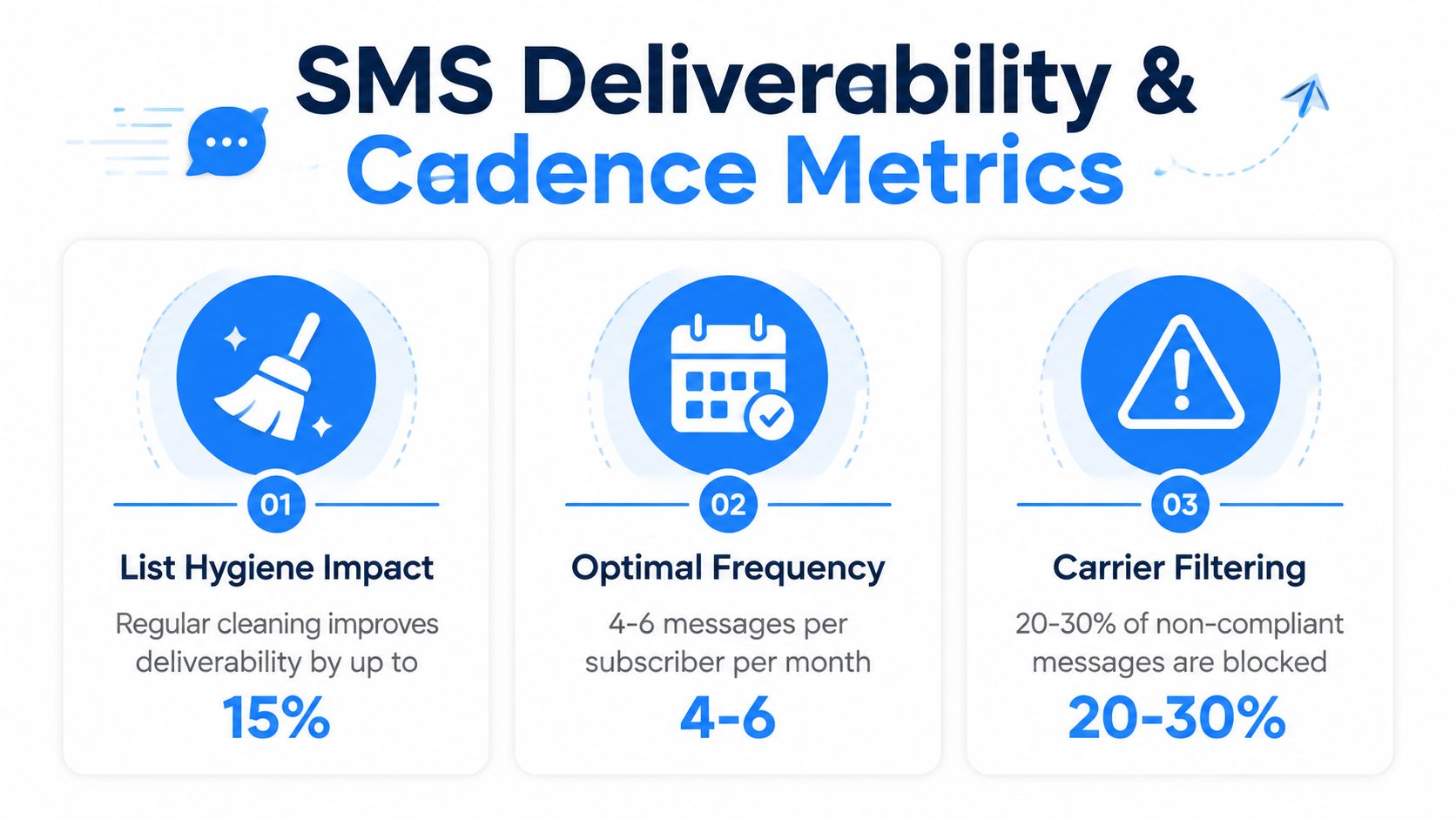
A universal frequency rule creates avoidable fatigue. Ecommerce customers may accept more promotional messages than buyers of a complex B2B service. Restaurant guests may act on timely offers, while healthcare patients generally place greater value on reminders and service updates than recurring promotions.
One independent guide suggests 4 to 8 messages per month for ecommerce, 2 to 4 for restaurants, and 1 to 2 for B2B services, with opt-out thresholds under 3%, 2%, and 1%, respectively, in its discussion of SMS laws and frequency. Use those figures as planning benchmarks, not guarantees. Your audience's replies, conversions, complaints, and opt-outs should determine the actual ceiling.
Separate the calendar by intent:
Cadence test: Hold the offer constant while changing the interval. If response quality stays stable but opt-outs increase, frequency is probably the problem.
A benchmark based on more than 1 billion texts found that 94% of responses were neutral-to-positive and fewer than 1% were negative, according to the SMS marketing analysis. The result supports relevance and restraint, but it cannot establish the right cadence for every audience.
Track reply sentiment, not clicks alone. A useful question can matter more than a silent click, while repeated STOP requests expose fatigue that a conversion report may miss. Ringless voicemail can extend a sequence without adding another text, but it still needs a clear role, permission, identity, and suppression path. Campaign registration and the sending practices covered in 10DLC compliance guidance belong beside frequency controls in the operating calendar.
The right platform lowers operational risk without forcing every team into an enterprise workflow. A small business may need dependable broadcasts, scheduling, replies, and basic segmentation. An agency needs client separation, user permissions, reusable templates, reporting, and workflow controls. A healthcare organization needs secure handling, access controls, documented procedures, and careful review of any HIPAA-related claims.
As noted in the CTIA principles above, consent, opt-out handling, and sender identification should shape the evaluation. Check how each platform records permission, processes STOP and HELP requests, identifies the sender, and suppresses contacts across campaigns. Compare design polish and artificial intelligence features only after those controls work reliably.
| Feature | Why It Matters | Priority for SMBs | Priority for Agencies | Priority for Healthcare |
|---|---|---|---|---|
| Consent records and double opt-in | Preserves evidence and improves list quality | Essential | Essential | Essential |
| STOP and HELP automation | Protects compliance and recipient experience | Essential | Essential | Essential |
| Number validation | Reduces failed sends and stale contacts | High | High | High |
| Segmentation and custom fields | Makes relevance possible at scale | High | Essential | High |
| Scheduling and quiet hours | Prevents poorly timed messages | Essential | Essential | Essential |
| Link tracking | Connects messages to actions | High | Essential | Selective |
| MMS support | Adds images or richer campaign context | Useful | High | Selective |
| Two-way inbox | Lets staff handle replies | High | Essential | Essential |
| Voice broadcasting and ringless voicemail | Adds channels when SMS fatigue is a concern | Selective | High | Selective |
| Integrations and API access | Connects campaigns to CRM and operations | High | Essential | High |
| HIPAA-related controls and documentation | Supports healthcare review and governance | Not applicable for many SMBs | Client-dependent | Essential |
A simple mass-texting tool can suit one team sending occasional announcements and handling replies manually. Choose a workflow platform when campaigns rely on triggers, appointments, multiple segments, or coordinated SMS, voice, and ringless voicemail. More features only help when the team can configure and govern them.
Manufacturing teams often address separate audiences, including distributors, field representatives, buyers, and service contacts. A practical comparison of SMS marketing platforms for manufacturers helps frame those requirements without assuming an ecommerce-focused tool will fit industrial workflows.
Run a live test before buying. Import a small consented list, trigger an opt-out, reply with HELP, schedule messages across time zones, inspect reporting, and confirm that staff can identify the correct client or department in the inbox. Test suppression across every channel as well. A contact who opts out of SMS should not remain active in a linked outreach sequence. If the workflow fails in testing, more volume will multiply the problem.
Review the bulk SMS service considerations alongside your consent records, staffing capacity, integration needs, and suppression rules. Call Loop is one option for teams seeking bulk SMS and MMS, segmentation, scheduling, custom fields, link tracking, number validation, double opt-in, voice broadcasting, ringless voicemail, and coordinated drip campaigns in one outbound workflow. The selection should follow the operating model, not the feature count.
The strongest multi-channel programs don't send the same message everywhere. They assign each channel a job and use timing to prevent one channel from overwhelming the recipient.
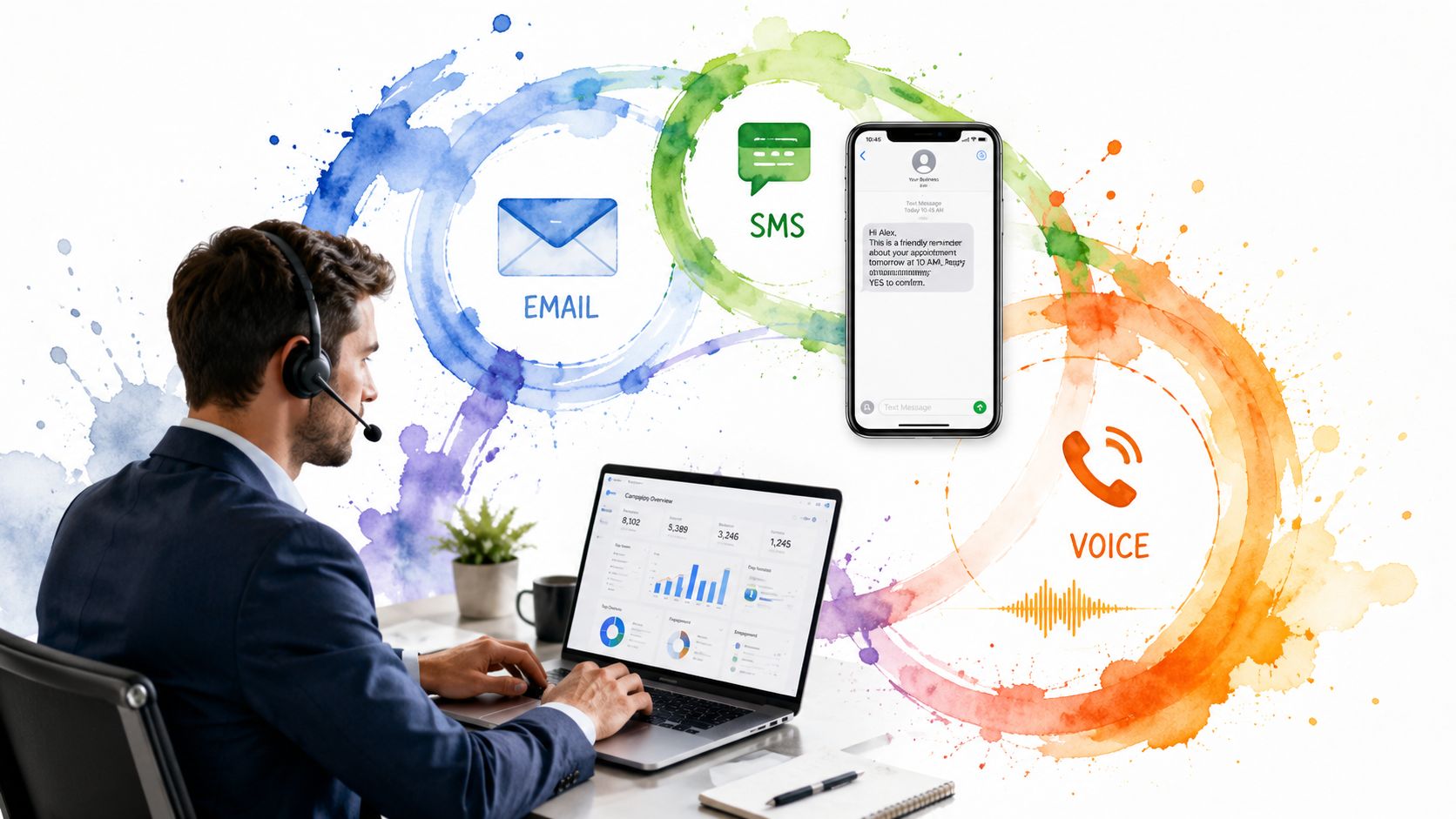
An ecommerce brand might use SMS for a concise product alert to subscribers who explicitly joined promotional messaging. The message should identify the brand, explain the offer, provide one action, and include the opt-out path. A follow-up can go to engaged recipients, while people who don't interact remain untouched rather than entering an automatic barrage.
Voice can help when a promotion needs a human-sounding explanation, but it shouldn't duplicate every text. A recorded message may suit a loyalty audience that has previously accepted voice communications, while SMS handles the link and purchase action.
Appointment reminders are a different use case from promotional campaigns. A clinic or service business may send a confirmation, a preparation instruction, or a rescheduling prompt tied to a known appointment. The message should disclose only the information necessary for the recipient to take the next step, with internal review for privacy and secure handling.
A voice reminder can support people who don't respond to text, provided the organization has the appropriate consent and operational controls. Ringless voicemail may fit a consented audience that prefers an audio message delivered directly to voicemail, but it shouldn't be treated as consent-free outreach.
Event organizers can use SMS for registration confirmation, arrival instructions, schedule changes, and last-minute logistical alerts. Voice broadcasting may support a more detailed update when a short text can't carry the context. An agency managing several clients needs separate lists, sender identities, consent records, templates, and reporting so one client's campaign never leaks into another's workflow.
The FCC ruled on November 21, 2022 that ringless voicemail to wireless phones is a “call” made using an artificial or prerecorded voice and is covered by the TCPA. The FCC ruling on ringless voicemail specifically applies to messages delivered directly to voicemail without first making the phone ring.
Channel principle: Use SMS for concise action, voice for richer explanation, and ringless voicemail only where the consent, audience preference, and message purpose support it.
A drip sequence should have an exit condition. Once the recipient registers, confirms an appointment, replies with a question, or opts out, the workflow must stop or change state. Automation is useful only when it respects the recipient's latest action.
A small team can launch responsibly without a large program. Start with clean consent records, clear ownership, tested workflows, and a limited first send. The goal is to expose compliance gaps and recipient fatigue before they affect the full list.
Configure STOP and HELP handling, recipient-local scheduling, segmentation, number validation, and reporting. Test the full journey with internal numbers. Include an opt-out, an inbound question, an invalid number, and a delayed reply. Confirm that each outcome changes the contact's status correctly.
Marketing texts sent with an autodialer or artificial or prerecorded voice generally require prior express written consent. Document that consent and retain the disclosure presented at collection, as summarized in SMS TCPA compliance guidance. Have counsel review the language and campaign types where state rules or healthcare privacy obligations may apply.
Create a focused template library: one welcome message, one promotional message, one reminder, one service update, one HELP response, and one opt-out confirmation. Keep every template tied to one action, identify the sender, and remove artificial urgency.
Build segments around behavior and relationship rather than demographics alone. A recent purchaser, dormant subscriber, and appointment holder should receive different copy and cadence. Set frequency limits before the pilot, not after complaints begin.
Run a limited pilot with a defined audience and one objective. Review delivery outcomes, replies, opt-outs, complaints, link activity, and staff workload before expanding. A voice or ringless voicemail touch belongs in the pilot only when its consent record, audience preference, and purpose are clear.
Document every change after the pilot. The launch record should include the audience, consent source, message version, send time, channel, suppression results, and follow-up decision. That record becomes the operating baseline for future campaigns and helps prevent silent list fatigue.
Open rates alone don't tell you whether a bulk SMS program is healthy. Measure consent quality, opt-outs by segment, reply sentiment, conversion per message, revenue attribution, delivery outcomes, and staff response time. For voice and ringless voicemail, track successful connections or drops, callbacks, action completion, and channel-specific opt-outs.
Run controlled tests, not simultaneous creative chaos. Hold the offer constant while testing cadence, message length, send window, segment definition, or whether a voice touch should replace a follow-up text. Review results by audience and channel because an aggregate report can hide fatigue in one segment.
A practical review rhythm is simple:
The best SMS programs become more selective over time. They send fewer unnecessary messages, route more replies to the right team, and reserve voice or ringless voicemail for situations where those channels add useful context. That discipline turns bulk SMS from a one-off blast tool into a durable customer communication system.
Call Loop supports compliant outbound workflows across bulk SMS, MMS, voice broadcasting, and ringless voicemail, with segmentation, scheduling, opt-out controls, tracking, and drip campaign orchestration. If you're ready to build a permission-based outreach engine instead of sending another indiscriminate blast, visit Call Loop and evaluate the workflow against your consent, cadence, and channel requirements.
Chris Brisson
Chris is the co-founder and CEO at Call Loop. He is focused on marketing automation, growth hacker strategies, and creating duplicatable systems for growing a remote and bootstrapped company. Chat with him on X at @chrisbrisson


Trusted by over 45,000 people, organizations, and businesses like


