
See a Demo
You're just one step away from seeing Call Loop in action.
Enter your information below to watch a demo right now.

You're just one step away from seeing Call Loop in action.
Enter your information below to watch a demo right now.

Yes, you absolutely can text a landline. It might sound strange, but it’s a surprisingly common and effective way to reach people.
When you send an SMS to a landline number, the carrier’s network automatically converts your text into a voice call. The recipient’s phone rings, and when they answer, a computer-generated voice reads your message out loud.
Ever hit "send" on a text and wondered if it was going to a mobile phone or a landline? The good news is, you don't have to worry about it. Modern communication systems are smart enough to figure that out for you.
Think of it like a translator working behind the scenes. This technology acts as a bridge, making sure your message gets delivered no matter what kind of phone the other person has.
The process is pretty slick. When you send your text, the carrier's network instantly checks the destination number. If it sees it’s a landline, it doesn’t even try to deliver it as a standard text message. Instead, it reroutes the message through a special gateway. This is where the magic happens.
This gateway uses what’s called Text-to-Speech (TTS) technology to turn your written words into a natural-sounding audio file.
Once that audio file is created, the system places a regular voice call to the landline. When the person picks up, instead of a dial tone or a person on the other end, they hear the audio version of your text message being read to them.
This whole process is automated and ensures that important messages, like appointment reminders or delivery alerts, don’t get lost in the shuffle just because a customer still has a home phone. It's a fantastic way to make sure your communication strategy includes everyone, especially demographics that have held onto their landlines.
Key Takeaway: The system automatically figures out if a number is a landline and turns your text into a voice call. You don't have to do anything differently, making it simple to reach every single contact on your list.
Let's break down the journey of a text message to a mobile phone versus a landline. While the end result is similar—the message gets delivered—the path it takes is quite different.
Here’s a quick comparison of the two delivery methods:
As you can see, the core difference lies in that conversion step. For mobile, it's a straight shot. For landlines, there's a clever detour that turns your typed words into spoken ones, guaranteeing your message is heard.
So, you hit "send" on a text to a landline number. What happens next? It’s not magic, but it’s a pretty clever workaround that acts as a universal translator between two totally different types of phone systems.
The journey from your mobile screen to an old-school landline receiver involves a few key steps. It all starts the moment your message leaves your phone.
When you send that SMS, it doesn’t go straight to the landline. First, it hits a specialized SMS gateway. Think of this gateway as a smart traffic cop. Its first job is to look at the destination number and figure out what kind of phone it is.
If it detects a mobile number, it sends the text along like normal. But if it sees a landline, it knows a standard SMS won't work. That’s when it reroutes your message for a special conversion process.
This is where the core technology, known as Text-to-Speech (TTS), jumps in. Your text message is handed off to a TTS engine, which is basically software that reads written words and turns them into a natural-sounding audio file. It’s like having a digital narrator read your message out loud.
Once that audio file is ready, the system places an automated voice call to the landline. When the person on the other end picks up, they don't hear a human voice—they hear the audio recording of your text message.
This quick diagram breaks down the process:
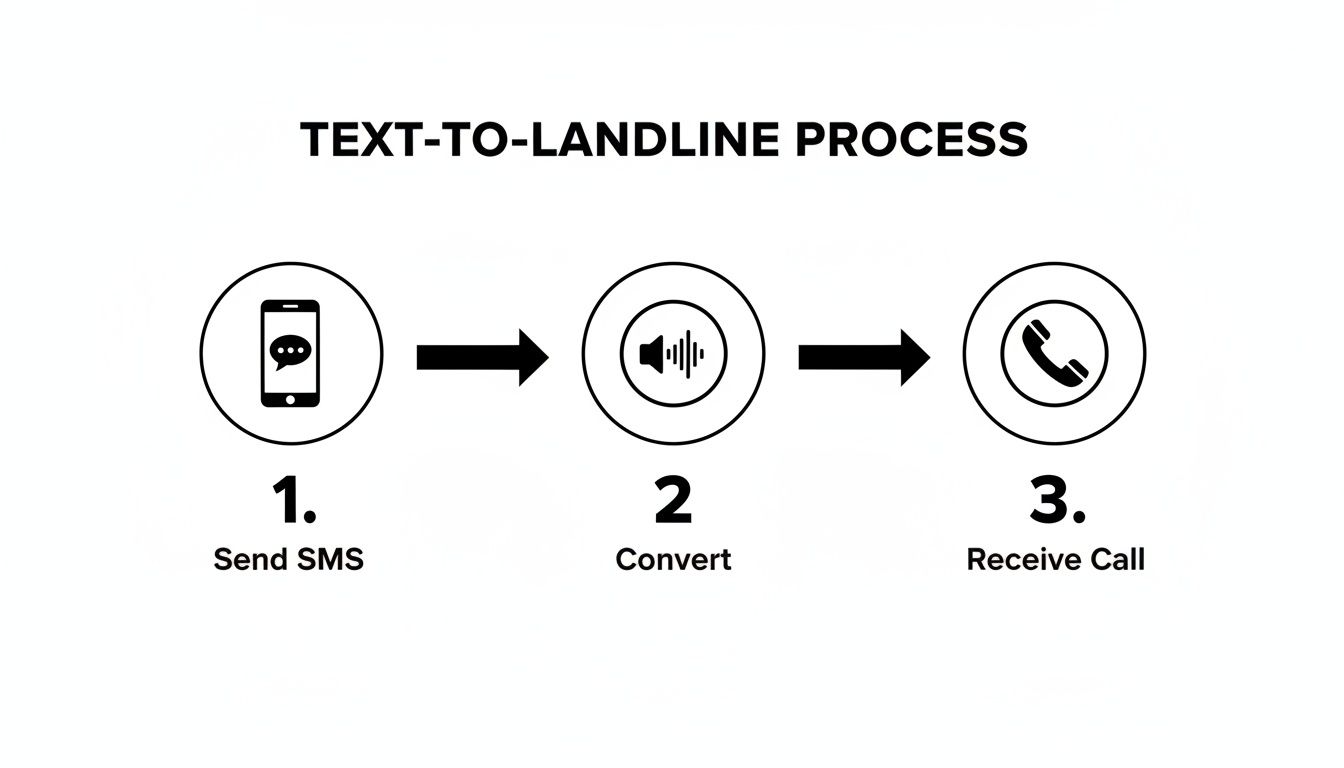
It’s really just a three-step dance: send the SMS, convert it to audio, and deliver it as a voice call. Simple, but effective.
While this technology is incredibly useful, it’s not without its limits. Since the whole system relies on turning text into audio, anything that isn't plain text gets left behind.
Key Insight: At its core, text-to-landline is built for simple, text-only communication. If you need to send richer media, you’ll have to stick to other channels. If you're curious about other ways to bridge messaging gaps, you can learn more about how to convert an email to an SMS message.
But it's not all one-way. Many modern services have added interactive features to make this more useful. For example, a recipient might hear your message and then a prompt like, "To confirm your appointment, press 1." This simple addition turns a basic alert into a functional, two-way exchange, making it a fantastic tool for automated reminders, alerts, and confirmations.
In a world buzzing with mobile notifications, it's tempting to write off the good old landline as a dinosaur. But here's the thing: completely ignoring this channel means you’re leaving a surprisingly large chunk of your customer base in the dark. Smart businesses know that real customer connection isn't about chasing the newest trend; it's about meeting people where they are.
For a lot of folks, the landline is still the go-to, trusted way to connect. This is especially true for certain groups, like older customers, and in industries where a stable, reliable line is non-negotiable. Think about healthcare facilities, businesses in rural areas, and government offices—they often rely on landlines for their sheer dependability.
When you can't reach these customers, it has a real impact. It can lead to more no-show appointments, service alerts that go unseen, or missed chances to connect with loyal clients who simply don't live on their mobile phones.
The numbers might surprise you. Even as smartphones seem to be everywhere, landlines are holding their ground. In developed markets like the US, landline usage still hovers around 30-40%. Now, consider that about 5.4 billion people globally use SMS. That's a huge communication blind spot for businesses that want to reach everyone.
There's a massive opportunity waiting for businesses that can figure out how to bridge this gap. Think about services that can drop a ringless voicemail directly into a landline's inbox. You deliver the message without ever making the phone ring, guaranteeing it gets heard.
This isn't just about padding your numbers; it's about creating a communication strategy that’s more inclusive and, frankly, more effective. For any business serious about growth, understanding all your communication channels is just as critical as exploring different B2B lead generation tactics.
Bringing landlines back into your communication plan isn't just a nice gesture. It's a strategic move that delivers real, measurable results. When you make sure every customer gets the message—whether on a smartphone or a home phone—you're directly helping your bottom line.
Just look at the practical benefits:
At the end of the day, acknowledging the role of landlines proves you value every customer relationship. It makes sure no one gets left behind, which builds incredible loyalty and shows your business is serious about clear, reliable communication for everyone.
Beyond the text-to-voice option, there's a much quieter, more direct way to get your message to customers with landlines: Ringless Voicemail (RVM).
This cool piece of tech lets you slide a pre-recorded audio message straight into someone's voicemail box without their phone ever making a peep. It’s a total game-changer for communicating without being intrusive.
This method is perfect for messages that don't demand an immediate reply, like marketing updates or a gentle follow-up. Instead of blowing up someone's phone and interrupting their day, you're leaving a personal, recorded message they can listen to whenever it’s convenient for them. It's a small shift, but it shows you respect their time and can seriously boost how they respond.
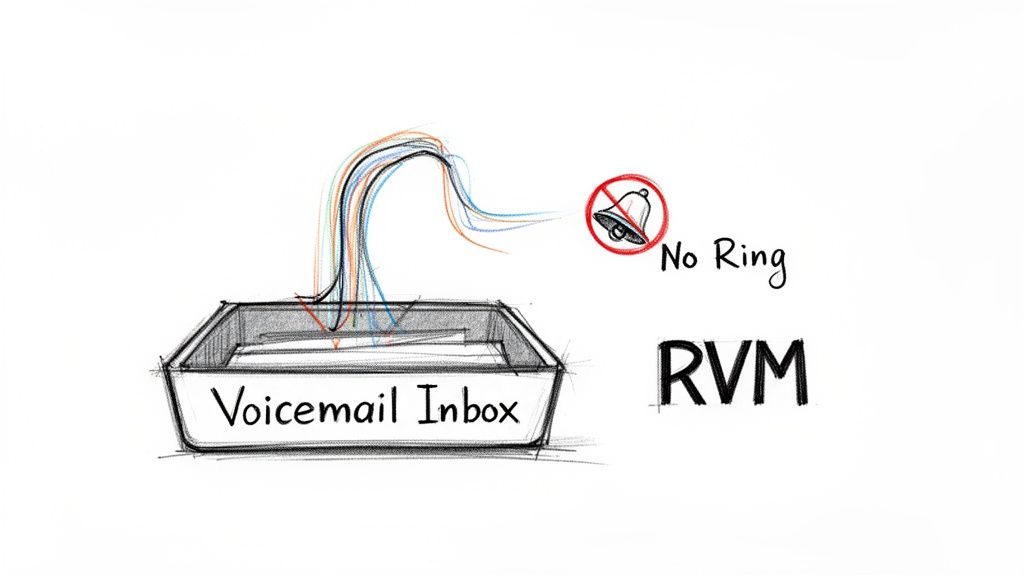
Using RVM for landline numbers brings some powerful benefits to the table. For one, it cuts right through the noise. So many people are hardwired to ignore calls from unknown numbers, but almost everyone checks a voicemail notification sooner or later.
The cost is another huge plus. Most RVM services run on a per-drop pricing model, which means you only pay for the voicemails that actually get delivered successfully. This keeps your budget predictable and makes it a smart tool for large-scale campaigns.
The Human Touch: Maybe the biggest win here is the ability to send a message with real emotion and personality. A human voice is way more powerful than a robotic text-to-speech message, letting you build a much stronger connection with your audience.
Think about how fast communication has changed. Back in 2003, Europe was already seeing an average of 16 billion SMS messages sent every month, and that was when landlines were still king in most households.
Fast forward to today, 83.32% of people own smartphones, and while the tech has shifted, SMS is still a top channel for businesses. In fact, 66% of consumers globally use it to engage with brands. Ringless voicemail to landlines is the bridge that connects old and new technology, making sure no customer gets left behind.
For businesses, this means you can hit contacts on both their mobile and landline numbers within the same campaign. You can even use AI to create text-to-speech recordings or set up press-1 transfer options that connect interested listeners directly to a live agent. It's an awesome solution for everything from HIPAA-secure healthcare reminders to sales follow-ups.
If you want to dive deeper into this technology, check out our guide on what ringless voicemail is and how it all works.
Tapping into landlines with text-to-voice or ringless voicemail can be a game-changer for customer outreach. But before you dive in, you need to know the rules of the road. The big one here is the Telephone Consumer Protection Act (TCPA).
Now, this isn't legal advice, but getting the gist of the TCPA is absolutely essential for any business. These rules are in place to shield consumers from unwanted calls and messages, and they definitely apply to automated or prerecorded messages sent to landline numbers. Following them isn't just about staying out of hot water; it's about building real trust with your audience.
At its core, the TCPA is all about consent. For simple, informational messages—think appointment reminders or shipping updates—consent is usually considered implied when a customer gives you their number. But for anything marketing-related? The bar is much higher. You’ll typically need express written consent before sending any automated promotional content their way.
To stay on the right side of the law, every business needs a solid compliance game plan. This goes beyond just how you send messages; it’s about how you manage your contact lists and handle customer requests from start to finish. It's really about building a system that respects your audience's choices.
Three practices should be at the absolute heart of your strategy:
Important Takeaway: Think of the TCPA less as a rulebook to fear and more as a guide to respectful communication. When you put consent and transparency first, you're showing customers you value their privacy and time. That's the foundation for any strong, lasting relationship. To dig deeper into setting up compliant outreach, check out our guide to using an automated calling system.
To make this even clearer, here’s a quick checklist to help you stay on track.
| Quick Compliance Checklist for Landline Messaging |
| :--- | :--- |
| Compliance Area | Key Requirement or Best Practice |
| Consent for Marketing | Obtain express written consent before sending any automated promotional messages. |
| Consent for Info Messages | Implied consent is often sufficient for non-promotional alerts (e.g., appointment reminders). |
| Business Identification | Clearly state your business name at the beginning of every message. |
| Internal DNC List | Maintain and regularly update an internal Do-Not-Call list for your specific company. |
| Opt-Out Mechanism | Provide a clear, simple, and immediate way for consumers to opt out of future messages. |
| Calling Time Restrictions | Only call between 8 a.m. and 9 p.m. in the recipient's local time zone. |
| Record Keeping | Keep detailed records of consent, opt-out requests, and your DNC list. |
Following these guidelines is the best way to ensure your outreach is both effective and responsible.
Once your compliance foundation is solid, it's time to focus on what you're actually saying. The most effective messages are the ones that deliver clear value without being intrusive. When you can text a landline phone, never forget your message will be heard, not read. Clarity is everything.
Keep your messages short and sweet. A long, rambling audio recording is a one-way ticket to getting ignored. Get straight to the point and include a simple, obvious call-to-action. For example, a direct message like, "This is a reminder from your dentist about your appointment tomorrow at 10 AM," is way more effective—and appreciated—than a drawn-out sales pitch.

Knowing you can text a landline is one thing, but the real magic happens when you weave that power into a bigger communication plan. A unified strategy doesn't just send messages; it combines standard SMS, text-to-landline, and even ringless voicemail into a single, automated workflow that just works.
Instead of manually checking who gets a text and who needs a call, a smart system does the heavy lifting for you. This approach makes sure you connect with 100% of your audience without burning through time or money. It's all about creating a seamless experience on both ends.
Let's say you're sending out appointment reminders. A unified system can automatically look at your contact list and segment it by phone number type, all in the background.
Here’s a simple breakdown of how that automated workflow plays out:
This multi-channel approach guarantees every single customer gets their reminder in the right format for their device. That kind of automation is a game-changer for efficiency and can drastically slash your no-show rates.
By integrating different communication methods into one cohesive strategy, you move from simply sending messages to creating intelligent, responsive outreach campaigns that adapt to your audience. This ensures maximum reach and impact.
Going beyond basic automation, you can start segmenting your audience by how they prefer to be contacted. This is where you can unlock even better results.
For example, you might find that your customers with landlines respond really well to the personal touch of a pre-recorded ringless voicemail, while your mobile users just want the quick hit of an SMS.
By tailoring your approach, you're showing customers you get them, which builds trust and boosts response rates. A unified strategy lets you create these different communication journeys without making your daily tasks more complicated. It’s a professional, adaptable approach that meets every customer where they are, making sure your message always gets through loud and clear.
Once you discover you can actually text a landline, a few practical questions usually pop up right away. Let's tackle some of the most common ones that businesses run into when exploring this technology.
Here's the interesting part: while they can't fire back a text message from their old-school phone, they can absolutely respond. It’s not a one-way street.
Most text-to-landline services are built to be interactive. After the voice message plays, a simple prompt can ask them to "Press 1 to connect to our team" or "Press 2 to confirm your appointment." This opens up an immediate, live conversation right when you have their attention.
For less time-sensitive messages, like a ringless voicemail, you can just include your callback number in the recording. This gives them the freedom to get back to you whenever it's convenient for them.
The costs can be a bit different, and it's good to know why. A text-to-landline message has a few extra steps—it needs to be converted from text to speech and then delivered as a voice call, which can be priced differently than a standard SMS. Similarly, ringless voicemails are often priced per successful drop.
But don't let that scare you off. Most modern communication platforms, like us here at Call Loop, wrap everything into simple, bundled pricing. This makes it incredibly cost-effective to add landline messaging into your strategy, so you can reach everyone without getting bogged down by a complicated bill.
You definitely don't have to play a guessing game. Manually sorting a list of phone numbers would be a nightmare.
This is where technology does the heavy lifting for you. Today's messaging platforms have number validation built right in. When you upload your contact list, the system automatically checks the carrier data for every single number, instantly identifying it as a mobile, landline, or even a VoIP line.
From there, it intelligently routes your message the right way—SMS for mobile numbers and text-to-speech or ringless voicemail for the landlines. This automation is seamless and ensures every message gets delivered correctly, every single time. It's the simple answer to the "can you text a landline phone" question.
Ready to reach every customer, whether they're on a mobile phone or a landline? Call Loop provides a unified platform for SMS, text-to-landline, and ringless voicemail to ensure your message always gets delivered. Automate your outreach and connect with your entire audience today. Learn more at https://www.callloop.com.
Chris Brisson
Chris is the co-founder and CEO at Call Loop. He is focused on marketing automation, growth hacker strategies, and creating duplicatable systems for growing a remote and bootstrapped company. Chat with him on X at @chrisbrisson


Trusted by over 45,000 people, organizations, and businesses like


