
See a Demo
You're just one step away from seeing Call Loop in action.
Enter your information below to watch a demo right now.

You're just one step away from seeing Call Loop in action.
Enter your information below to watch a demo right now.

Your pipeline looks healthy on paper. Leads come in, demos get booked, proposals go out, and then deals stall.
Sales says prospects went quiet. Marketing says the campaigns generated interest. Customer success only hears about the account after the contract is signed, if it gets signed at all. Meanwhile, the buyer is still moving, just not in a way your team can see clearly.
That’s why customer journey b2b work matters so much now. Not as a slide for a quarterly meeting, but as an operating tool. If you sell to other businesses, especially with longer cycles, multiple stakeholders, or regulated workflows, you need a practical map of how buyers move, where they hesitate, and which touchpoints push the deal forward.
Most guides stop at inbound content, email nurture, and retargeting. That leaves a big gap. Real B2B deals often move because someone followed up at the right moment with a text, a call, or a ringless voicemail that got heard when the inbox didn’t.
A common scenario looks like this. A prospect fills out a form, attends a demo, asks for pricing, then disappears for three weeks. After that, someone else from the same company downloads a comparison sheet. A decision-maker replies to an old email chain. Procurement reopens the conversation. Legal slows it down. Then the original champion asks for a fresh walkthrough because the internal team changed.
That isn’t a broken process. That’s modern B2B buying.
According to Gartner, 77% of B2B buyers describe their purchasing process as very complicated and time-consuming, and the average journey spans 272 days from first touch to revenue according to the statistics summarized by Intelligent CIO in its roundup of B2B customer experience research: B2B buying complexity and journey length.
Many small businesses still manage this journey as if it were linear.
They assume the prospect moves from ad to form to demo to close. They build reporting around first-touch attribution or last-click conversion. Then they wonder why the buying motion feels unpredictable.
The better approach is to map every meaningful interaction, including overlooked ones like follow-up calls, reminder texts, voicemail touches, handoffs between sales and onboarding, and support questions that surface before the deal is signed. A useful starting point is auditing your existing customers touch points and identifying which ones create momentum versus which ones create delay.
A B2B journey map gives your team a shared version of reality.
It shows where buyers loop back. It shows where one stakeholder needs education while another needs reassurance. It also shows where outbound communication can reduce friction instead of adding noise.
Buyers rarely feel stalled for no reason. They usually feel stalled because your team hasn’t matched the next message to the next decision.
If your team can't explain what happens between first interest and signed agreement, you don't have a pipeline problem. You have a visibility problem.
The classic funnel still helps as a shorthand, but it doesn’t describe how businesses buy. Modern B2B journeys are layered, non-linear, and shaped by a buying group instead of one decision-maker.
The practical model is simpler than most diagrams suggest. There are still core stages. The difference is that buyers move back and forth between them.
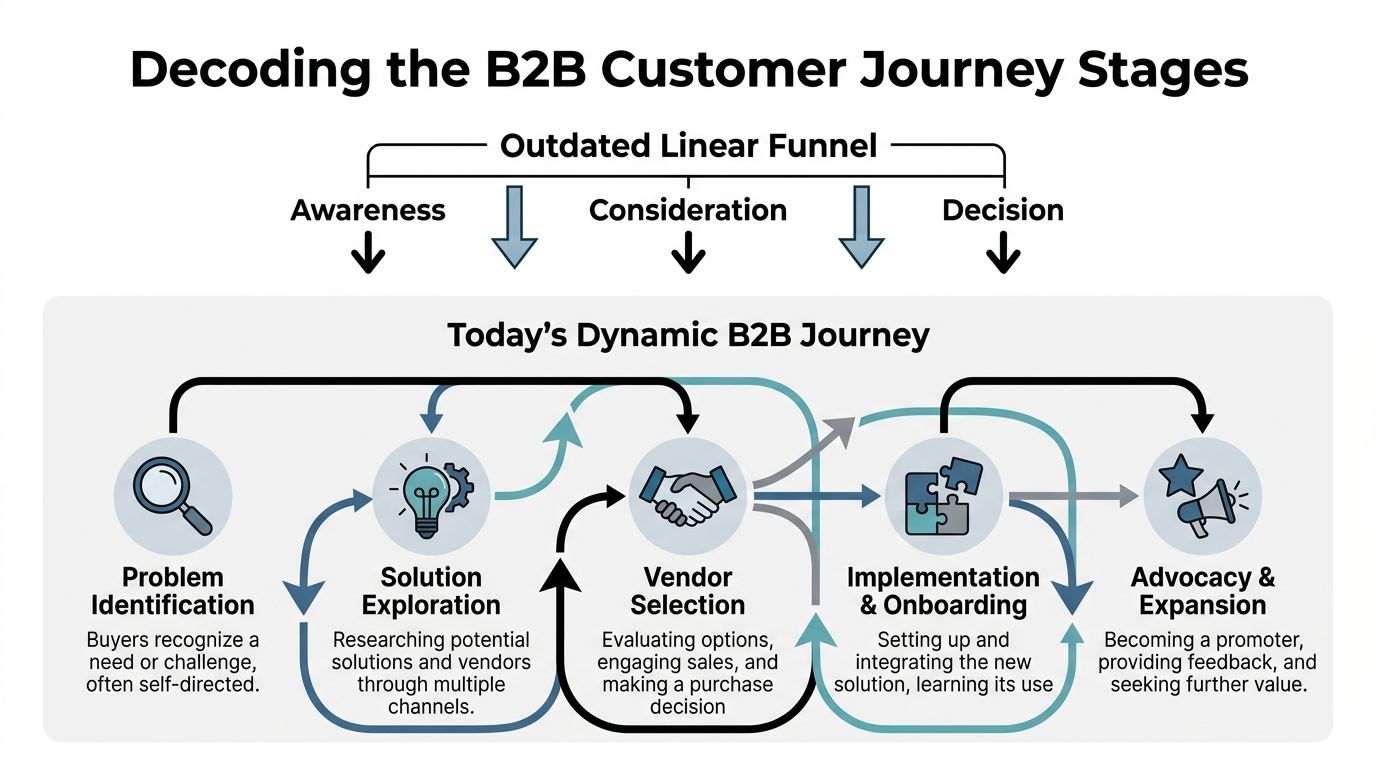
A useful way to think about the stages is this: each one changes the buyer’s main question.
At this point, the buyer is trying to name the problem clearly.
They may not be looking for your product category yet. They’re looking for language, benchmarks, examples, and signs that the issue is worth fixing now instead of later.
Generic promotional messaging usually fails in this stage. Buyers respond better to material that helps them frame the problem internally.
Now the buyer knows the problem exists and starts comparing approaches.
They’re evaluating categories, methods, pricing models, implementation effort, and risk. Internal disagreement begins to surface here. One stakeholder wants speed. Another wants compliance. Another wants lower cost.
That’s why a customer journey b2b strategy has to support the whole buying group. The modern B2B buying process involves an average of 6-10 stakeholders, with a 19.8% increase in required touchpoints to close a deal, according to HockeyStack’s analysis of B2B customer journey touchpoints: B2B touchpoint complexity and buying groups.
At this stage, deals don’t move on persuasion alone.
They move on responsiveness, clarity, and confidence. Buyers want fast answers about contract terms, onboarding, timing, internal rollout, and support. Delays here often get misread as lost intent when they’re really unresolved operational questions.
Practical rule: If a prospect asks an implementation question during the sales process, treat it as a buying signal, not a support issue.
Many teams treat this as post-sale. That’s a mistake.
Implementation is where the buyer tests whether your promises survive contact with reality. If setup is confusing, stakeholders immediately revisit the purchase decision in their heads. A good journey map carries momentum into onboarding with clear reminders, handoff messages, and milestone updates.
A customer who adopts your solution well is more likely to renew, expand, refer, and participate in proof assets.
This stage is often ignored in B2B journey planning because teams stop mapping at the signed deal. That creates blind spots. Expansion usually starts when the customer sees progress and feels supported, not when your sales rep sends an upsell email months later.
Automation should support movement between stages, not replace judgment.
Drip systems work best when they’re stage-specific. A generic nurture sequence can’t do the same job as a targeted workflow tied to a proposal review, a no-show demo, or a stalled onboarding milestone. If you’re building timed follow-up logic, it helps to ground the plan in a clear drip marketing campaign structure instead of one broad sequence for every lead.
A useful journey map doesn’t start in a design tool. It starts with evidence from the people who already touch the customer.
Sales hears objections. Support hears confusion. Operations hears what slows implementation. Your job is to convert that information into a map your team can act on.

Many small businesses create one ideal customer profile and stop there.
That’s too shallow for B2B. You need to map the buying committee, even if your market is small. In practice, that means listing who influences the deal, what each person cares about, and what would block approval.
Use a simple worksheet like this:
| Role | What they want | What they fear | What they need from you |
|---|---|---|---|
| Economic buyer | Clear return and low risk | Wasted budget | Pricing clarity and business case |
| Day-to-day user | Ease of use | Workflow disruption | Real examples and setup details |
| Operations or compliance lead | Control and documentation | Exposure and mistakes | Process detail and proof of reliability |
This step usually exposes the first big issue. The message that wins over one person often creates friction with another.
Don’t build the map from your intended process. Build it from your current one.
That means collecting every meaningful touchpoint across the journey, including:
If a buyer experiences it, it belongs on the map.
Most journey maps either become useful or become theater at this point.
Ask your team and recent customers questions that produce specifics. Not “How was the buying experience?” Ask, “What nearly stopped the deal?” Ask, “What had to be explained twice?” Ask, “When did the buyer go quiet, and what reopened the conversation?”
The map gets stronger when you document hesitation, not just progression.
Capture three things at each stage:
You don’t need a polished mural. A spreadsheet, whiteboard, or shared doc is enough if the fields are right.
A practical map should include:
That last field matters. It turns the map from analysis into execution.
For example, if no-shows cluster around demos, add a timed reminder workflow. If proposals sit untouched, add a short outbound sequence that combines text, voicemail, and a rep follow-up task. If onboarding slows after kickoff, trigger milestone reminders automatically.
To operationalize this, many teams connect CRM status changes, form activity, and follow-up logic inside a broader marketing automation workflow so the journey map becomes something the business runs, not just reviews.
A static map becomes stale fast.
Review it when deals slip, when onboarding complaints repeat, or when one market segment starts behaving differently from another. Healthcare buyers won’t move like agencies. Local service businesses won’t evaluate like software teams. The framework stays the same. The triggers and messages change.
A strong map tells you where buyers get stuck. A strong channel strategy tells you what to do about it.
Many B2B teams underperform in this area. They create decent content, then rely too heavily on email and hope the buyer keeps moving. That works sometimes. It breaks down when timing matters, when multiple stakeholders need nudging, or when the buyer is busy enough to miss inbox messages that matter.
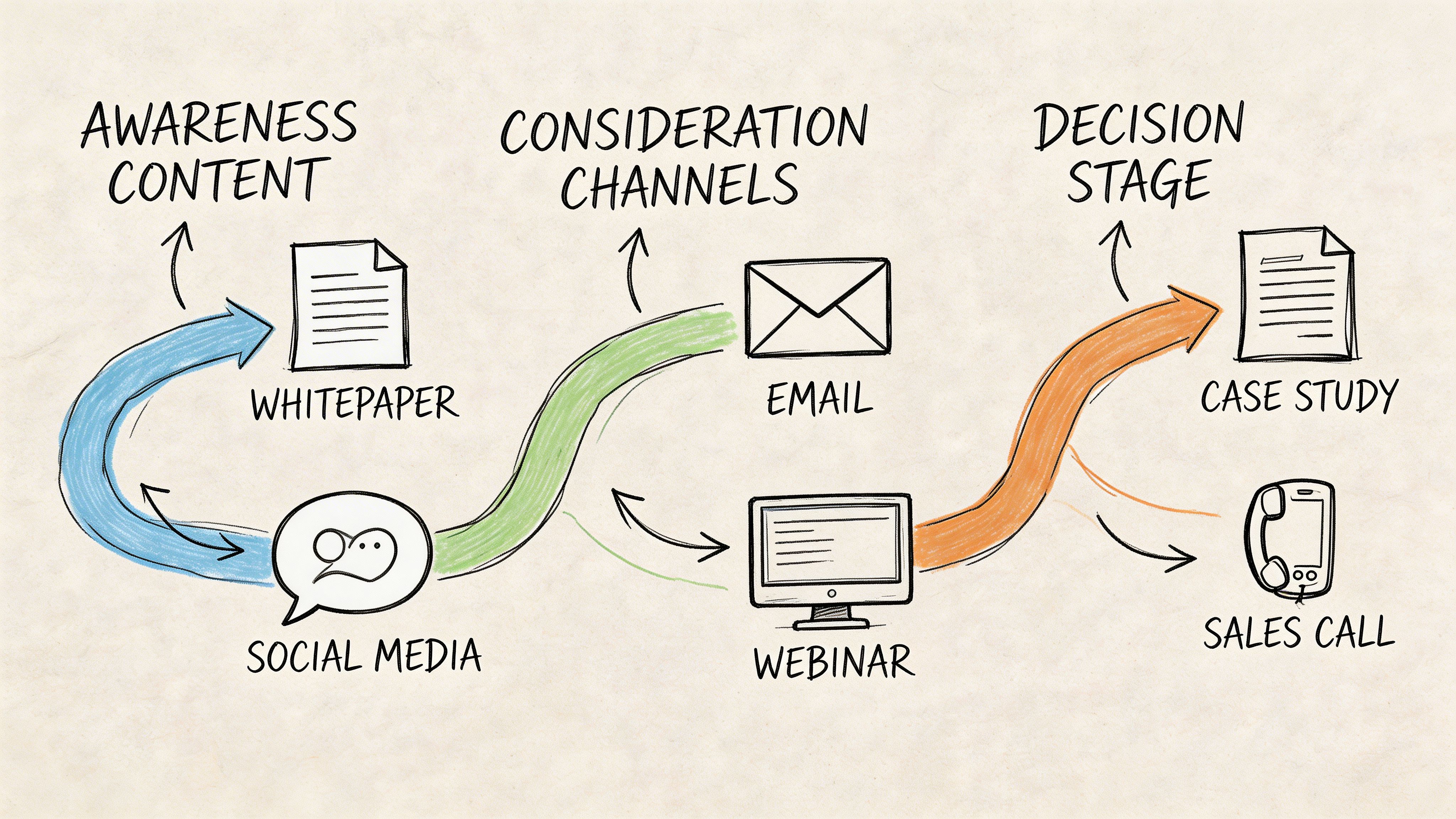
A better model matches content format and outbound channel to the buyer’s immediate job.
| Journey Stage | Buyer Goal | Recommended Content | Outbound Channel Strategy (Call Loop) |
|---|---|---|---|
| Awareness | Understand the problem and possible approaches | Educational blog posts, short explainers, industry FAQs, checklists | Short SMS follow-up after content opt-in, light-touch voice invite to webinar, segmented outreach for high-intent inquiries |
| Consideration | Compare options and build internal consensus | Buyer guides, comparison sheets, demo invites, objection-handling assets | SMS reminders for demo booking, ringless voicemail to re-engage warm leads, scheduled voice touch for complex accounts |
| Decision | Reduce risk and gain approval | Proposal summary, implementation outline, pricing recap, stakeholder-specific answers | Post-demo SMS, ringless voicemail after proposal delivery, voice follow-up when multiple stakeholders stall the deal |
| Implementation | Get set up correctly and fast | Kickoff checklist, onboarding steps, training reminders, support contact guide | Automated reminders, milestone alerts, appointment confirmations, compliance-sensitive voice or SMS sequences |
| Expansion | Prove value and uncover next opportunities | Review prompts, referral requests, feature education, renewal prep | Timed follow-ups, account check-in sequences, event invites, targeted outreach to re-engage dormant accounts |
Early-stage prospects usually don’t want a hard close. They want relevance.
If someone downloads a practical guide or registers for a webinar, a short text reminder often works better than another long email. The point isn’t to pressure them. It’s to reduce the chance they forget the next step.
For teams managing multi-channel prospecting, it also helps to align customer records with social signals and outreach history. If you’re evaluating systems that bring those views together, this roundup of social CRM platforms for B2B outreach is useful because it frames the tooling question around outbound coordination, not just lead storage.
Inbox fatigue becomes expensive at this stage.
A prospect requested details, maybe attended a demo, maybe involved another teammate, and now the thread goes cold. Email alone can’t always restart momentum. A ringless voicemail can.
Why? Because it feels more direct than email without demanding the buyer pick up the phone. That makes it well suited for warm follow-up after a demo, a quote request, or a stalled conversation.
Use ringless voicemail when:
A key gap in most B2B strategies is the lack of guidance for integrating automated outbound messaging into complex journeys. With 74% of decisions hinging on interaction quality, using tools for post-demo follow-ups or HIPAA-compliant reminders can directly address the “moments of truth” that determine a deal’s success, as noted in Crescentia’s discussion of B2B journey mapping challenges: interaction quality and outbound automation gaps.
That matters because late-stage buyers don’t need more generic nurture. They need fewer unanswered questions.
A practical decision-stage sequence might look like this:
Good outbound follow-up doesn’t “check in.” It removes one specific obstacle.
Regulated industries stand out in this context. Healthcare teams, for example, often need reminders, confirmations, and secure communications tied to appointments, onboarding tasks, or follow-up actions. A clean operational message is more useful than polished brand copy.
The same principle applies outside healthcare. Agencies, trainers, consultants, and local service businesses all benefit when onboarding messages are short, timed, and tied to a real milestone.
Many upsell opportunities appear after proof of value, not before.
That means your outbound sequence should reflect customer progress. Invite reviews after a visible win. Ask for referrals after a solved problem. Promote additional services when the customer has enough context to care.
The right channel at the right stage doesn’t feel intrusive. It feels like good timing.
If you can’t tell which touchpoints move deals forward, your journey map is still incomplete.
Many SMBs track opens, clicks, and booked calls, but those aren’t enough on their own. The goal is to connect activity to movement. Which touches shorten delay? Which stages leak? Which messages create adoption after the sale?
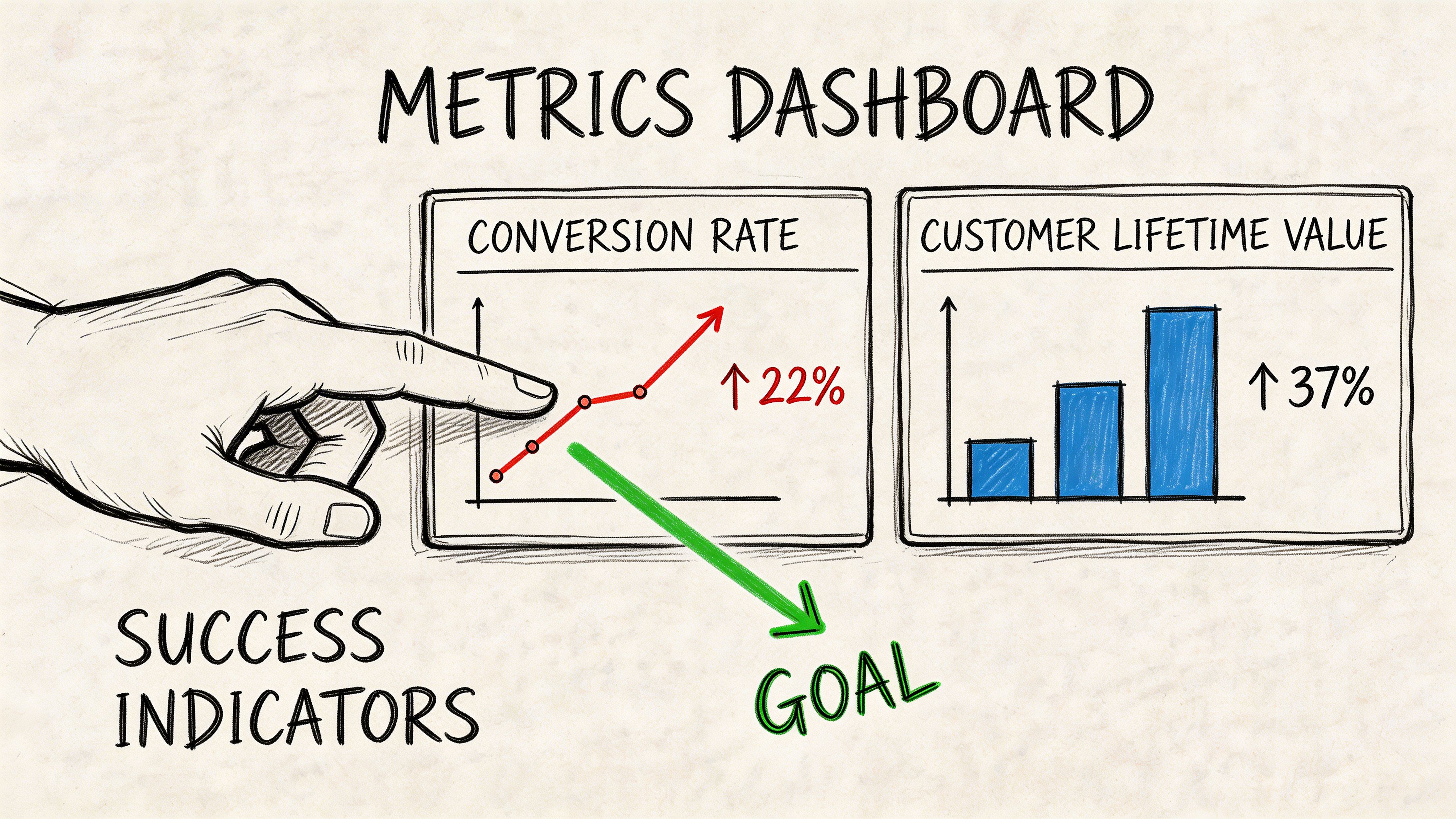
The first metrics to watch are the ones tied directly to progress.
Look at:
You don’t need advanced attribution software to start. A disciplined CRM, clear stage definitions, and consistent activity logging will get you farther than many teams expect.
Channel-level reporting is usually too broad.
Email may look strong overall while your best-performing sequence is a text reminder followed by a voicemail touch and then a rep call. You want to know which combinations create movement, especially at high-friction moments like proposal review or onboarding setup.
A simple review question helps: What happened immediately before the buyer advanced?
That’s not perfect attribution, but it’s far more useful than counting top-line engagement.
Many teams lose visibility here. Marketing data sits in one system. Sales notes live in another. Customer success sees a third version of the account.
Organizations that implement a unified data strategy connecting marketing, sales, and customer success teams achieve 50% higher revenue growth, according to Trilliad’s analysis of GTM data strategy: unified journey data and revenue growth. In practice, that matters because you can quantify touchpoint ROI and personalize follow-up based on what the buyer already did.
Use a simple monthly scorecard for each major segment.
| Metric | What it tells you | What to do if it slips |
|---|---|---|
| Sales cycle length | Whether deals are slowing overall | Review stalled-stage messaging and approval bottlenecks |
| Stage conversion | Where the journey leaks | Rewrite offers, tighten handoffs, improve follow-up timing |
| Touchpoint contribution | Which channels help deals advance | Reallocate effort to higher-impact sequences |
| Onboarding completion | Whether buyers reach early value | Add reminders, simplify setup, improve handoff communication |
| Expansion signals | Whether customers are ready for more | Trigger review, referral, or renewal outreach based on usage or milestone completion |
If your reporting only measures activity volume, you’ll optimize for busyness. Measure progression instead.
Many businesses don’t need a bigger customer journey b2b project. They need a version they can build this week and improve next month.
The easiest way to do that is to focus on the few moments that decide whether the relationship moves forward or drifts. While detailed maps are useful, data suggests obsessing over the 5-7 most critical moments in the journey drives 80% of the decision-making process, especially for SMBs, according to SPP’s discussion of B2B journey mapping: critical moments in B2B journeys.
Use this as a copy-paste checklist for the first pass.
You can build the first version in a spreadsheet with these columns:
| Stage | Stakeholder | Buyer goal | Buyer concern | Current touchpoint | Gap | Best next action | Owner |
|---|
Keep the entries short. One row per meaningful moment.
Examples:
Don’t over-map everything equally.
Many teams get more value by spotting the few points where emotion rises. In B2B, that emotion often looks like uncertainty, skepticism, fear of making a bad recommendation, or frustration with internal approval.
Watch for moments like:
A good map doesn’t try to track every possible behavior. It highlights the points where one well-timed touch changes the outcome.
Start with repetitive, high-value actions.
Good first candidates include appointment confirmations, no-show recovery, post-demo follow-ups, onboarding reminders, document prompts, and renewal check-ins. Leave delicate negotiation, pricing exceptions, and sensitive objections to humans.
That balance is what makes automation useful. It handles consistency without flattening the relationship.
A lot of B2B teams still act like the journey is something to observe. It’s not. It’s something to shape.
The businesses that win don’t necessarily have the fanciest diagrams or the biggest content libraries. They know where buyers hesitate, which stakeholder needs what, and which touchpoint should happen next. Then they execute with discipline.
That’s the shift. Stop thinking of the journey as a funnel you hope people move through. Start treating it like a series of decisions you can support with better timing, clearer messaging, and stronger coordination across channels.
For small businesses, this matters even more. You don’t have the luxury of wasted touches, vague follow-up, or handoff confusion. Every reminder, voicemail drop, text message, proposal recap, and onboarding prompt should do a job.
The most effective customer journey b2b strategy is usually not the most complicated one. It’s the one that ties outreach to real buying behavior. It respects how modern buyers move. It gives sales, marketing, and service a shared operating model. And it uses outbound communication where it helps most, especially when email alone isn’t enough.
If your current process depends on buyers keeping themselves organized, the journey is running you.
Build the map. Mark the friction. Automate the routine parts. Personalize the moments that matter. Use SMS, voice, and ringless voicemail where they reduce delay and improve interaction quality.
That’s how you stop reacting to stalled deals and start orchestrating movement.
If you want to put this into practice with automated SMS, voice broadcasting, and ringless voicemail in one place, Call Loop gives SMBs, agencies, sales teams, and healthcare organizations a practical way to run timely follow-up, reminders, and multi-step outreach without adding manual work.
Chris Brisson
Chris is the co-founder and CEO at Call Loop. He is focused on marketing automation, growth hacker strategies, and creating duplicatable systems for growing a remote and bootstrapped company. Chat with him on X at @chrisbrisson


Trusted by over 45,000 people, organizations, and businesses like


