
See a Demo
You're just one step away from seeing Call Loop in action.
Enter your information below to watch a demo right now.

You're just one step away from seeing Call Loop in action.
Enter your information below to watch a demo right now.

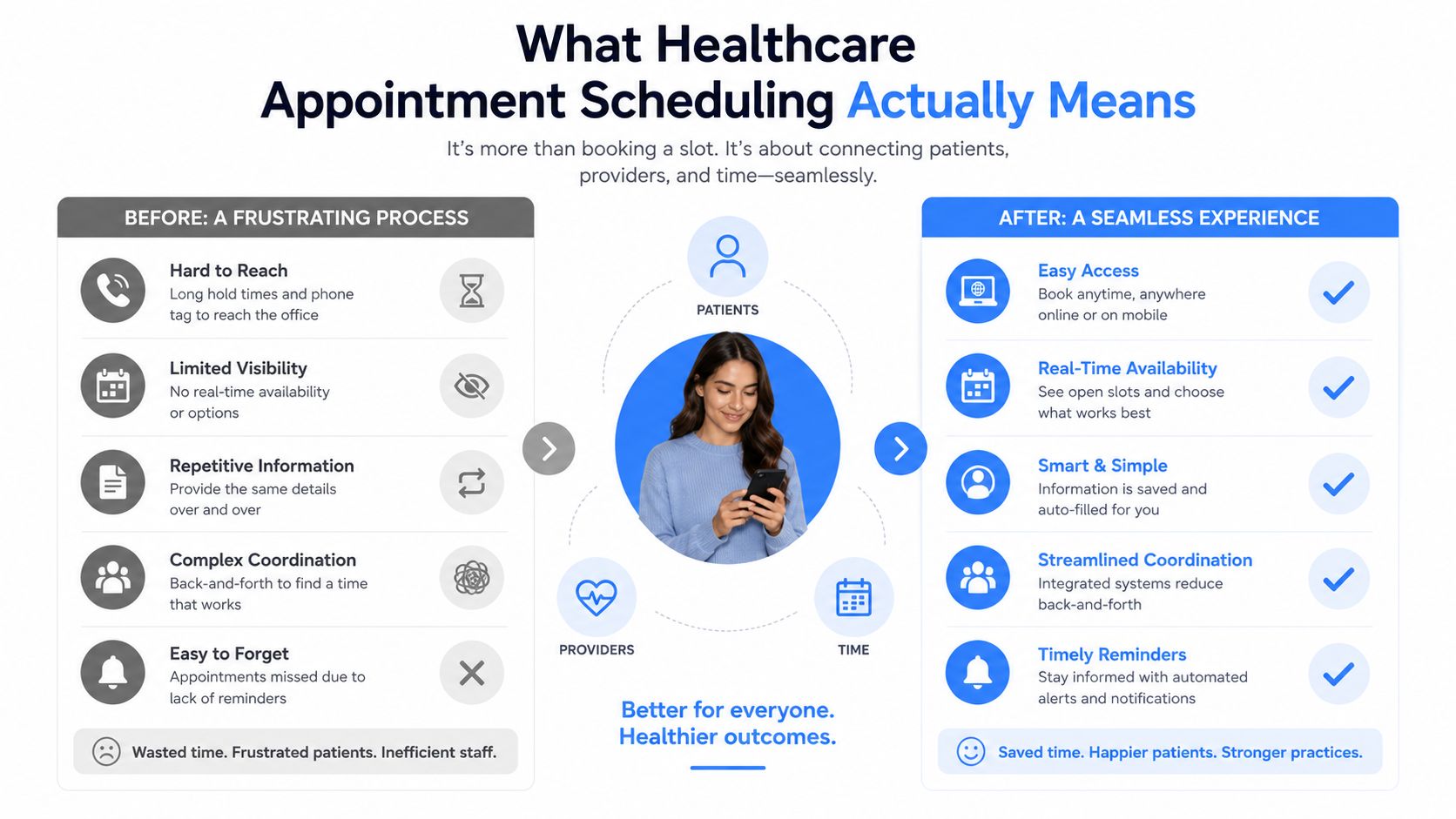
Monday starts with the schedule already under pressure. Two front-desk phones ring while a patient waits at the desk, a 9:15 follow-up doesn't arrive, another patient asks for an earlier opening, and the EHR queue refuses to sync. The staff member who should be helping patients is instead checking calendars, calling people back, and trying to decide whether an empty slot can safely be filled.
That scene is common because healthcare appointment scheduling isn't just calendar management. It connects patient demand with provider time, communication, compliance, and the likelihood that a booked visit will happen. A systematic review found an average appointment no-show rate of about 23%, with substantial regional variation, including 43.0% in Africa and 13.2% in Oceania (systematic literature review).
A practical scheduling system reduces uncertainty before it reaches the front desk. It makes booking easier, confirms the right details, reminds patients through suitable channels, and treats cancellations or no-shows as opportunities to rebook. It also respects HIPAA and FCC limits, especially when a clinic uses SMS, voice calls, or ringless voicemail.
At 9:20, an empty exam room can look harmless. The provider, medical assistant, and room remain available, but the practice has lost the chance to use that capacity. Filling the opening manually creates another workload. Staff must find patients who want an earlier visit, check whether the appointment type matches the provider's template, and reach someone before the slot loses its value.
The economic effect extends beyond one missed visit. A 2021 review of missed appointments in general practice reported a mean missed-appointment rate of 15.2% and a median of 12.9%, with rates ranging from 3.3% to 48.1% across studies (review of missed appointments). In England, the paper noted that more than 15 million appointments are missed annually, including about 7.2 million GP appointments, at an estimated cost of £216 million per year to NHS England.
A weak scheduling layer puts pressure on several parts of the practice:
Scheduling design should also determine how staff handle appointment risk. If a patient books far in advance or has missed visits before, the workflow can assign earlier confirmation, a clearer cancellation route, or a follow-up task for staff. The 2018 review identified high lead time and prior no-show history as the most common significant predictors of missed appointments. Use those findings to set rules in the scheduler, rather than relying on every coordinator to remember them.
A stronger Monday has automatic confirmations, reply-based rescheduling, and a compliant reminder sequence. Ringless voicemail can reach patients who rarely respond to text, but it works as one channel in that sequence, alongside consent checks, SMS or voice reminders, and clear opt-out handling under FCC and HIPAA requirements. It is not a substitute for sound booking logic.
The front desk should see exceptions instead of chasing every patient.
Practical rule: Treat every appointment as a workflow with an owner, a confirmation path, and a recovery action if the patient cancels or does not arrive.
On Monday morning, review the unconfirmed queue, assign replacement tasks, and check that reminder rules match each appointment type. That small operating routine connects available capacity with patient communication, compliance, and the cost of unused visits.
Healthcare appointment scheduling combines booking rules, patient communication, and reminders to turn provider availability into visits that are confirmed and attended. The calendar is only the visible layer. A usable slot also requires a defined visit type, accurate patient details, a response path, and a plan for changes or missed visits. Those choices affect no-show costs, because an unfilled slot still consumes staff time and provider capacity.
Start by matching the model to the clinic's work.
In a manual model, front-desk staff handle calls, portal requests, paper notes, and calendar entries. An experienced coordinator can ask follow-up questions and resolve unusual cases, but the process depends on memory and attention. During busy periods, duplicate entry, missed callbacks, and incorrect templates become more likely.
A 2-provider family practice may manage this approach well when visit types are simple and one coordinator knows both clinicians' preferences. Coverage becomes harder when that person is absent or the phone queue grows.
Self-service scheduling allows patients to book through a website, portal, SMS conversation, or interactive voice response system. The software should apply current rules for provider availability, visit length, location, and appointment type. Without a dependable EHR connection, patients may select a slot that has changed, leaving staff to correct calendar conflicts.
A 12-clinician specialty group could offer self-service booking for routine follow-ups while sending procedures, new diagnoses, and multi-provider visits to staff review. This division keeps simple requests moving while reserving human judgment for higher-risk bookings.
Predictive scheduling uses administrative data to estimate which appointments are more likely to be missed. It can support calibrated overbooking or targeted outreach, but it depends on accurate records and staff oversight. A model should guide reminder intensity and capacity decisions, not make them without review.
In a rural healthcare system, one predictive no-show model achieved an AUC of 0.84 in training and 0.83 in testing, with 0.71 sensitivity at a 0.4 cutoff. Appointments booked more than 60 days ahead had a 7.7% no-show rate, compared with a 6.0% overall rate, and the model recommended one overbook for every six at-risk appointments per provider per day. A busy urban dental office might use that output to protect high-demand slots while keeping staff in control of exceptions.
Reminder design must also respect FCC consent and HIPAA safeguards. Ringless voicemail belongs in a compliant reminder stack with consent checks, text or voice options, and clear opt-out handling. It supports attendance; it does not replace accurate booking logic.
Pregnancy care requires a sequence of visits, not one isolated transaction. Patients can use resources such as plan your pregnancy checkups to understand why timing and follow-up appointments matter.
A dependable scheduling workflow connects four stages: request, confirm, remind, and rebook. Each stage should create a usable result for the next. An unclear request can produce the wrong visit type. A confirmation without a response route leaves the patient unable to correct an error. A slow rebooking process turns an open slot into lost capacity, which can also increase the financial effect of no-shows.
The request stage records patient intent from a phone call, portal, website, SMS, IVR, or walk-in visit. The scheduling record should name the appointment type, provider or specialty, location, duration, and preparation requirements. “Needs follow-up soon” is too vague. Staff would still need to interpret it, and that interpretation can lead to an unsuitable slot.
Template mismatch is a frequent failure. A patient may ask for a routine follow-up, while the selected appointment is too short, assigned to the wrong provider, or unavailable under the patient's insurance plan. Set up self-service scheduling to write directly to the scheduling system. If the request is uncertain, route it to a staff queue with the missing details clearly marked.
Confirmation reserves the visit and gives the patient enough information to act. Include the provider or practice name, date, time, location, and a simple way to confirm or request a change. “Reply YES” works only when the practice monitors replies and has a defined rescheduling process.
Delivery status matters as much as the EHR status. A message sent to a landline, an outdated mobile number, or an inbox the patient rarely checks can make an appointment appear confirmed when the patient never received the details. On Monday morning, review failed deliveries and unverified contact information before relying on confirmation counts.
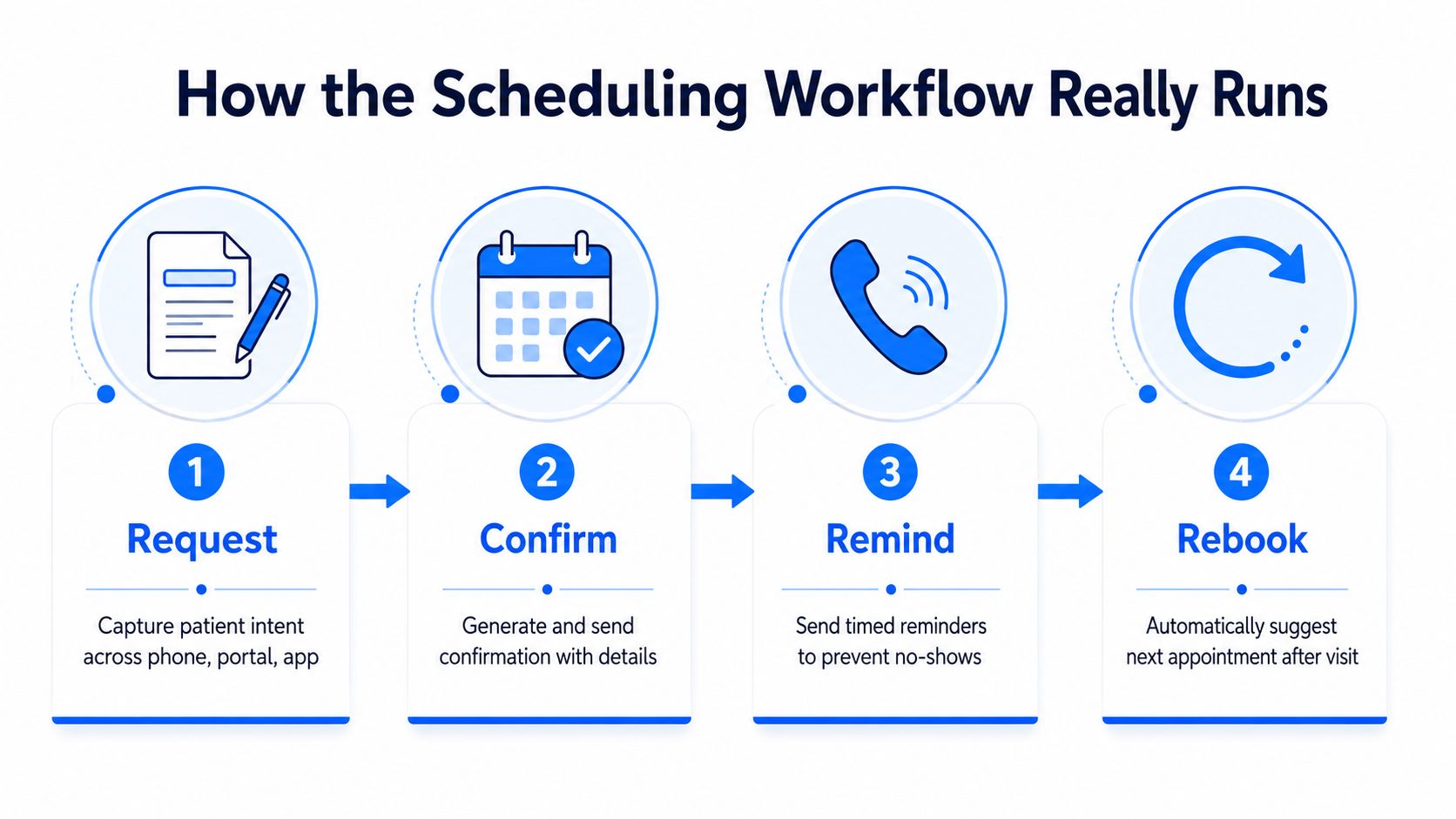
Reminder timing should match the clinic's operating model, appointment type, and patient segment. SMS suits short messages and two-way replies. Voice calls help patients who need spoken instructions or do not use portal messaging. Ringless voicemail delivers a recorded reminder to a mobile voicemail inbox without making the phone ring, giving the patient time to listen later (ringless voicemail in healthcare).
The channel belongs in a consent-based reminder stack, not as a separate marketing tactic. Keep consent records, permitted contact methods, and opt-out handling connected to the scheduling workflow so FCC requirements and HIPAA safeguards shape the outreach.
Reminder fatigue creates another operational problem. Repeated messages without a useful response option can cause patients to mute the channel or ignore later notices. Each reminder should make the next action clear, whether that action is confirming, changing the time, or contacting staff.
Rebooking starts after a cancellation, missing confirmation, or missed visit. Offer the next suitable appointment, add the patient to an appropriate waitlist, and document the result. A quick response matters because interest in rescheduling can fade while the open slot remains unused.
A missed appointment is a workflow event, not a closed record.
Separate routine missed visits from clinically urgent cases, then send unclear situations to staff for review. Make open slots visible to suitable waitlist patients instead of requiring each coordinator to search manually. This connects daily scheduling work to no-show economics: faster recovery gives the practice more chances to fill capacity that would otherwise disappear.
Each reminder channel has a different job. SMS is efficient for confirmations and quick replies, voice calls help when the patient needs a conversation or spoken instructions, and ringless voicemail provides a lower-interruption option for recorded messages. The practice should combine them deliberately rather than sending every channel to every patient.
SMS is usually the first choice for a short appointment confirmation. It supports two-way communication, so a patient can confirm, cancel, or ask for a new time without waiting on hold. Voice remains useful for older patients, complex preparation instructions, and households that prefer spoken communication. Ringless voicemail sits between the two. A pre-recorded message is delivered to the voicemail inbox without ringing the phone, allowing the patient to listen on their own time.
A workable reminder arc might look like this:
The exact cadence should come from the practice's patient preferences, consent records, appointment types, and operational capacity. One 2025 patient-access survey summary reported that 80% of patients want to schedule anytime from home or mobile, while a separate summary reported 96.3% faster booking and a 50.7% drop in no-shows when predictive scheduling was combined with operational systems (patient scheduling statistics). Those figures come from different contexts, so a clinic shouldn't treat them as guaranteed results. They do support a broader design principle: convenient booking and coordinated follow-up work together.
| Channel | Best use case | Avg. cost / send | Confirm-rate lift | Compliance complexity |
|---|---|---|---|---|
| SMS | Short confirmations and two-way replies | Varies by provider | Measure locally | Consent, opt-out, content controls |
| Voice call | Spoken instructions and patients who prefer calls | Varies by provider | Measure locally | Consent, caller identification, DNC controls |
| Ringless voicemail | Low-interruption recorded reminders | Varies by provider | Measure locally | Treat as a regulated communication and verify consent |
Don't blast all channels at once. Let patients select a primary channel, then use another channel as a fallback when the first one fails or receives no response. Practices comparing message workflows can review appointment reminder texts, but they should evaluate every tool against their consent, integration, and response-handling requirements.
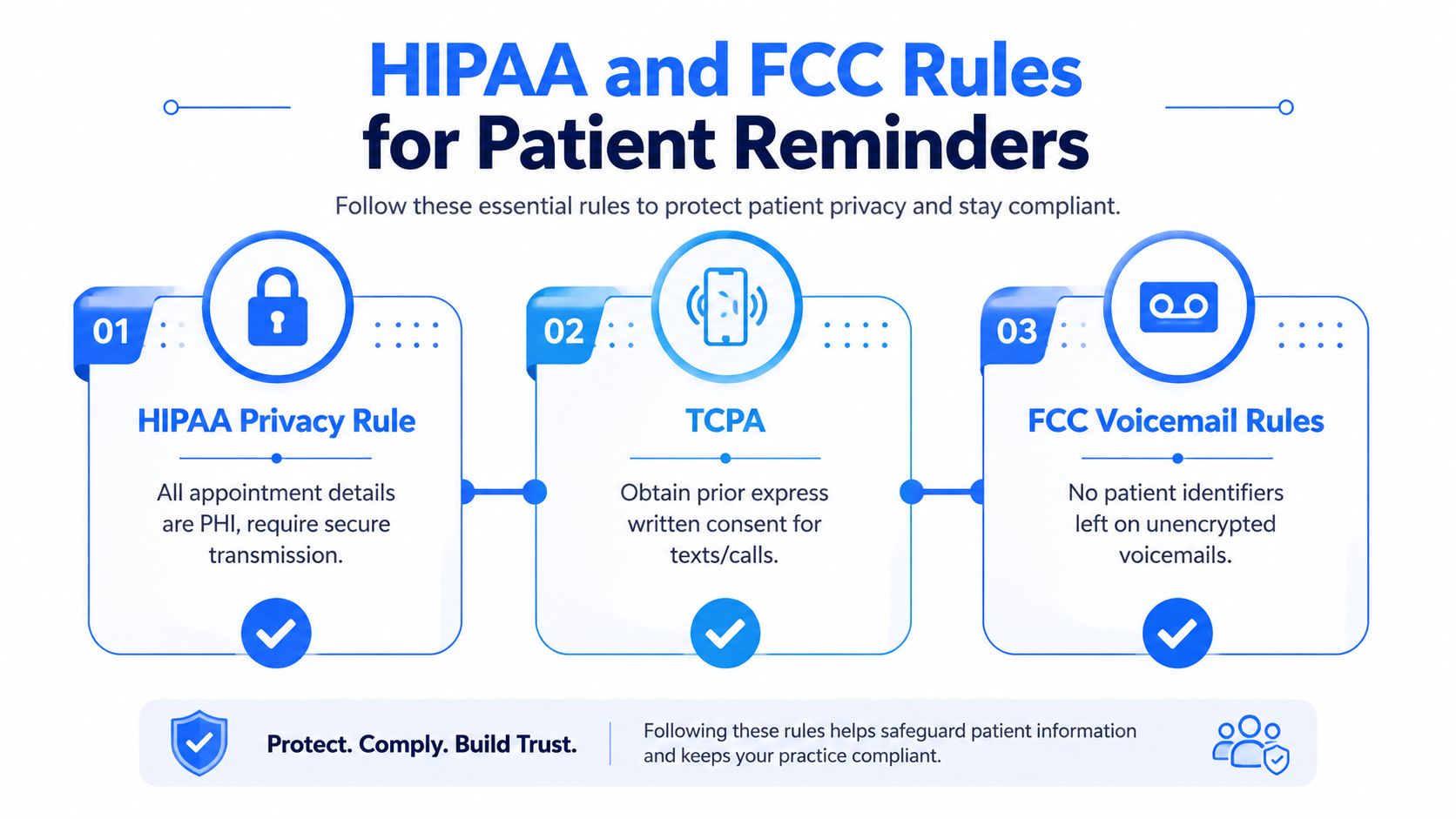
A patient books an appointment, gives a mobile number, and later receives a reminder meant to prevent a missed visit. If the number is wrong, the message reveals too much, or the channel lacks proper consent, a scheduling improvement can become a privacy or communications problem. HIPAA and FCC requirements therefore belong in the workflow design, alongside no-show economics.
Appointment reminders can generally be sent without separate authorization when they support treatment under HIPAA. Keep voicemail content short: identify the practice, provide a callback number, and give a neutral reminder. Leave out diagnoses, test results, medication names, and financial details, as outlined in this HIPAA voice reminder guidance.
Confirm that the patient supplied the contact information and record the preferred channel. A voicemail still exposes information to whoever answers or checks the mailbox, so an unanswered call does not make it private.
FCC rules provide a narrow consent exemption for wireless healthcare appointment reminders. The number must be a patient-provided wireless number, the message must identify the provider, and the content must stay related to the appointment. The cadence is limited to one message per day and no more than three voice calls or texts combined per week, according to these FCC healthcare message rules.
Ringless voicemail belongs in the same compliance review as other automated voice outreach. It may avoid a ringing phone, but the practice still needs to verify the communication's legal treatment, consent status, provider identification, and opt-out process. Use it as one layer in a reminder stack, not as a shortcut around consent or content controls.
Before turning on automated reminders, check:
Voicemail reminders are legally permissible for healthcare providers. A 2013 Omnibus Rule change removed the former requirement to state in the Notice of Privacy Practices that the practice might leave appointment reminders on voicemail. Following the minimum-necessary standard keeps voicemail available as a compliance option (voicemail reminder compliance).
For setup details, follow a documented HIPAA-compliant appointment reminders guide, then ask the practice's privacy or legal adviser to review the final workflow. On Monday morning, start with the number source, consent record, message template, fallback channel, and audit trail.
A dashboard should help a manager decide what to change, not just display activity. Start with the no-show rate, calculated as missed appointments divided by total scheduled appointments. Separate new patients, established patients, and telehealth visits because those groups can behave differently.
Track the following measures each week:
Don't import a universal target band without checking local conditions. The evidence base shows wide variation, including an average no-show rate of about 23% in one systematic review and a mean of 15.2% in a general-practice review (systematic review, general-practice review). A local baseline gives the manager a more reliable starting point than a generic benchmark.
A useful Monday review asks one question for each metric: what operational action will this number trigger? If the answer is nothing, remove the metric or redesign it.
Rollout should start with the current workflow, not the software demo. On Monday morning, pull the practice's recent no-show data, document when reminders go out, and note which messages receive responses. Then map request, confirmation, reminder, and rebooking against actual staff hours.
A four-provider primary care practice provides a useful planning example. Suppose its internal baseline is an 18% no-show rate, and the team pilots automated SMS confirmations 7 days before visits, a ringless voicemail drop 24 hours before, and a same-day two-way text window. Over one quarter, the practice reports reducing no-shows to roughly 11% and recovering an estimated $42,000 in monthly visit revenue, without adding front-desk headcount.
Those figures belong to the example's stated scenario, not a promise for every clinic. The manager should validate the result by comparing appointment types, patient segments, provider utilization, and actual collected revenue. A controlled pilot also reveals whether the workflow creates new problems, such as duplicate reminders, unmonitored replies, or patients choosing the wrong appointment type.
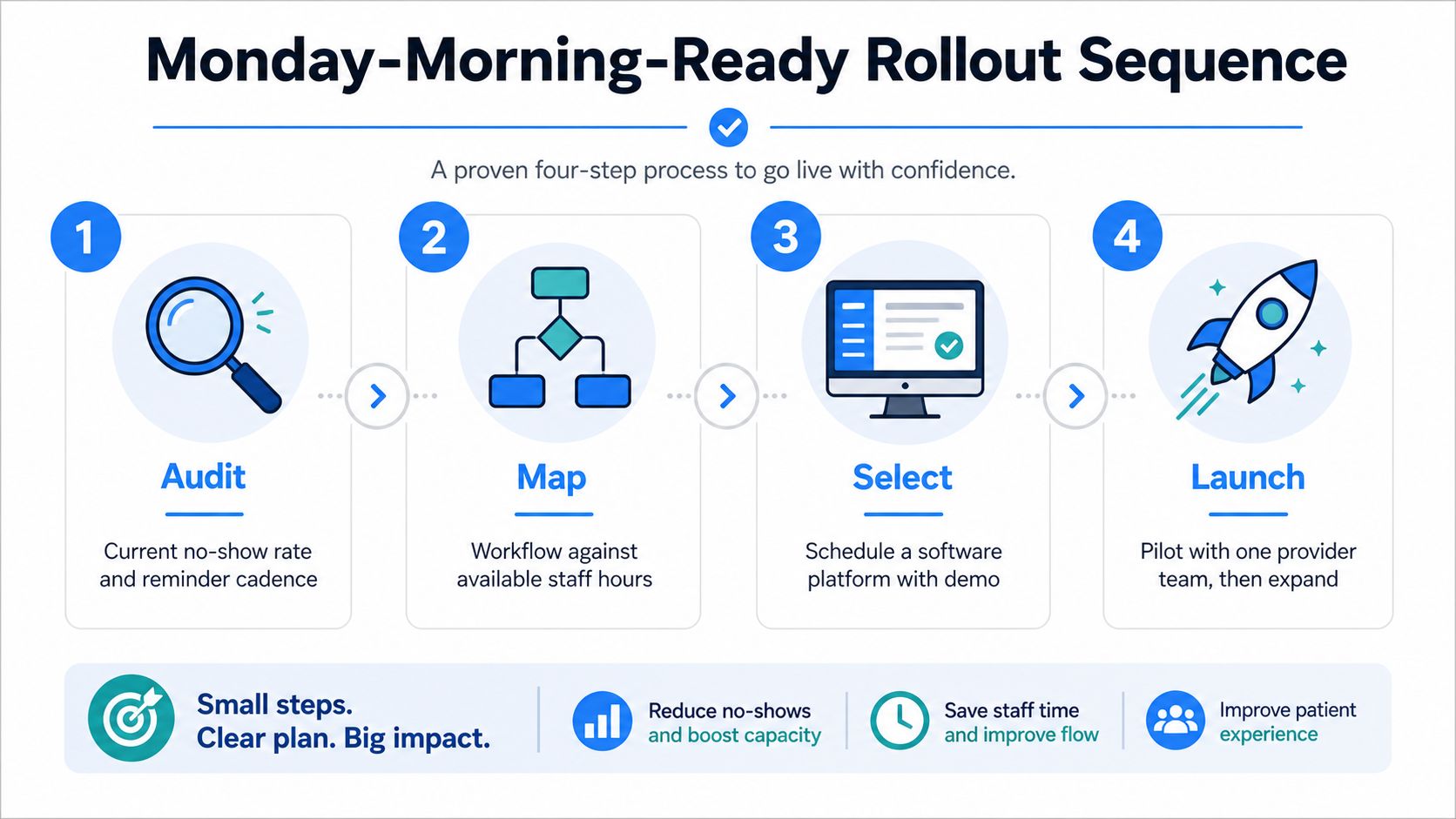
For additional ideas on recovering missed visits, review this guide to reduce patient no-shows. A manager can then build one small test, monitor responses, and expand only after the staff can support the communication volume.
Call Loop offers automated SMS, voice broadcasting, and ringless voicemail workflows for appointment reminders, including scheduling, segmentation, opt-out controls, and analytics. If your clinic needs a coordinated reminder and rebooking layer, visit Call Loop to evaluate how it can fit your healthcare appointment scheduling process.
Chris Brisson
Chris is the co-founder and CEO at Call Loop. He is focused on marketing automation, growth hacker strategies, and creating duplicatable systems for growing a remote and bootstrapped company. Chat with him on X at @chrisbrisson


Trusted by over 45,000 people, organizations, and businesses like


