
See a Demo
You're just one step away from seeing Call Loop in action.
Enter your information below to watch a demo right now.

You're just one step away from seeing Call Loop in action.
Enter your information below to watch a demo right now.

Think of healthcare patient engagement solutions as the digital front door to your practice. They're specialized tools designed to build a real, ongoing relationship between you and your patients, extending care far beyond the four walls of your clinic. This whole approach is about shifting from reactive, "see you when you're sick" healthcare to something far more proactive.
The result? Better health outcomes for patients and a more efficient practice for you.
Imagine having a dedicated digital concierge for every single patient.
This concierge doesn't sleep. It proactively checks in, sends friendly appointment reminders, delivers critical pre-op instructions, and shares helpful educational videos right when they're needed most. That’s the real job of a modern patient engagement platform.

These platforms solve a huge, long-standing problem in healthcare: the communication dead zone between appointments. Traditionally, interaction is crammed into a 15-minute office visit, leaving patients to figure out the rest on their own. Engagement solutions close that gap by automating key communications and empowering patients with timely information.
This move away from appointment-only interaction is picking up serious steam. The global market for these solutions is exploding, projected to jump from USD 32.59 billion in 2026 to USD 61.64 billion by 2031. This isn't just hype; it's driven by a real demand for tools that help patients manage their own health, with 72% of healthcare organizations planning to invest more in this tech. You can dig deeper into patient engagement market trends to see how providers are adapting.
At its core, patient engagement technology is all about freeing up your staff from the repetitive, manual tasks that burn them out. The goal is to let them focus on what they do best—delivering outstanding patient care.
A great engagement platform doesn't just add another piece of software to your stack. It multiplies your team's effectiveness by automating the routine stuff and personalizing the crucial interactions. It turns administrative headaches into chances to build real connections.
By automating things like reminders, follow-ups, and pre-visit instructions, these platforms hit the most common pain points in practice management head-on.
It's helpful to see the direct line between a healthcare goal, the common challenge that gets in the way, and the specific feature designed to solve it.
When you look at it this way, it’s clear that these aren't just "nice-to-have" features. They are targeted solutions built to solve the everyday operational hurdles that prevent a practice from running smoothly and growing effectively.
When you're looking for a platform, it’s easy to get lost in a sea of features. But let's cut through the noise. The truly non-negotiable features aren't just bells and whistles; they're the engine that powers a secure, efficient, and genuinely connected patient journey.
First and foremost, let's talk security. Any platform you even consider must be built on a rock-solid foundation of HIPAA compliance. This isn't just a checkbox; it's a legal and ethical line in the sand that protects your practice and your patients' most sensitive information.
This means your vendor absolutely must be willing to sign a Business Associate Agreement (BAA). They also need to provide communication channels that are secure and fully auditable. Without this, you're not just risking massive fines—you're risking a breach of patient trust that is almost impossible to get back.
A smart outreach strategy meets patients right where they are, using the communication channels they already prefer. A modern platform has to give you a whole suite of secure messaging options, including SMS, voice calls, and the increasingly popular ringless voicemail.
Each one has its own job to do:
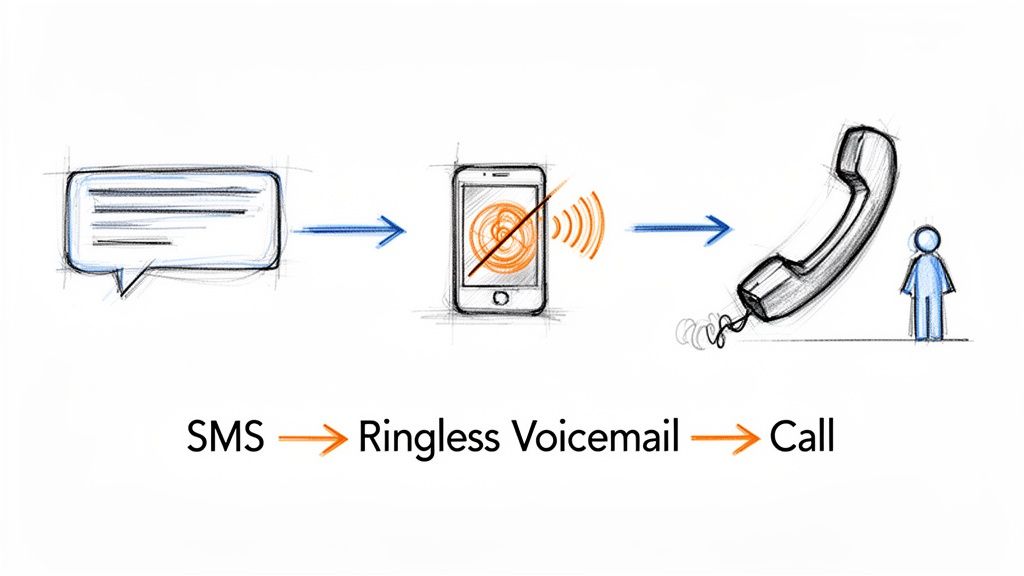
The real magic happens when you use these channels together. Imagine a patient gets an SMS reminder with a link to reschedule. If they don't respond, a gentle ringless voicemail follows up a day later. This kind of layered approach crushes no-show rates and cuts down on all that manual follow-up from your staff.
Let’s be real: manually sending every single reminder and follow-up just isn't going to happen. That’s why powerful automation is a cornerstone of any good platform. It lets you build "drip campaigns"—a series of pre-scheduled messages that automatically guide patients through their care journey without anyone on your team having to lift a finger.
Automation turns your patient communication from a bunch of one-off tasks into a continuous, supportive conversation. It makes sure nobody falls through the cracks, whether they need pre-op instructions, post-procedure check-ins, or tips for managing a chronic condition.
For instance, a patient scheduled for a minor procedure could automatically get this sequence:
That entire sequence runs on autopilot, giving the patient consistent, timely support and freeing up your team for more important work.
You can't improve what you don't measure. Solid analytics and reporting are vital for seeing the actual impact of your outreach. A great platform will give you clean, easy-to-read dashboards showing you key metrics like message delivery rates, click-throughs on your links, and patient response rates. This is how you prove your campaigns are improving patient outcomes and making your practice more efficient.
Finally, the platform has to play nice with your existing systems, like your EHR or practice management software. When it integrates smoothly, you get a unified workflow that kills manual data entry and keeps patient info up-to-date everywhere. Many modern platforms also come loaded with patient education resources or can even connect to external libraries that offer diverse comprehensive patient guides. This creates a single, seamless system that supports your staff and empowers your patients.
In healthcare, a one-size-fits-all communication plan just doesn't cut it. Patients have their own preferences, comfort levels with technology, and the urgency of the message should absolutely dictate the channel you use. True patient engagement isn't about blasting the same message everywhere; it's about strategically picking the right tool for the right job.
This approach ensures your messages are not only received but also acted upon. By meeting patients where they are—whether that's a quick text, a direct call, or a non-intrusive voicemail—you build a more respectful and effective dialogue. The best healthcare patient engagement solutions are built on this multi-channel foundation.
SMS messaging is the real workhorse of patient communication. With an open rate hovering around 98%, it’s the most reliable way to deliver quick, time-sensitive info that needs to be seen almost instantly.
This channel is perfect for:
The secret to great SMS outreach is to keep it short and actionable. Always include a clear call to action, like "Reply C to Confirm" or a direct link to reschedule. For a deeper dive, check out our complete guide on using SMS for healthcare communications.
When a critical message needs to reach a large group of patients fast, a voice broadcast is unmatched. An SMS can be missed, but an incoming phone call commands attention. This makes it the perfect tool for urgent, practice-wide announcements.
Think of it as your digital megaphone for situations like:
For even more punch, you can add interactive elements. A "press-1 transfer" option lets a patient connect with your front desk immediately if they have questions, turning a one-way announcement into a two-way conversation.
Sometimes, a message is important but not urgent, or it contains sensitive information that a patient might not want popping up on their phone screen. This is where ringless voicemail really shines. It delivers a recorded message straight to a patient's voicemail inbox without their phone ever ringing.
Ringless voicemail is the digital equivalent of leaving a discreet, personal note. It respects the patient's privacy and time, letting them listen to the message when it's convenient, without the interruption of a live call.
This makes it an excellent choice for:
Because the delivery is so subtle and non-intrusive, it feels more personal and less automated, which goes a long way in building patient trust.
The real power of multi-channel communication kicks in when you orchestrate these tools into a smart sequence. For example, a campaign to cut down no-shows could start with an SMS reminder. If you don't get a response, you can follow up with a gentle ringless voicemail drop a day later, and finally, a direct automated call for anyone still unconfirmed. This layered approach makes sure your message gets through, significantly boosting patient accountability and your practice's efficiency.
Picking the right vendor for your patient engagement solution is a massive decision, and its effects will ripple through your entire practice. This isn't just about buying a piece of software; you're starting a partnership that will directly shape how you communicate with patients, impact your staff's daily workload, and ultimately affect your bottom line.
A flashy feature list is one thing, but you need a partner who truly gets the unique challenges of healthcare. The right one becomes an extension of your team, giving you tools that actually solve problems instead of creating new ones.
One of the first big questions you'll face is whether to go with custom software vs. off-the-shelf solutions. Each path has huge implications for your budget, how quickly you can get started, and how the system grows with you, so it's a critical fork in the road to consider early on.
To make a smart choice, you need a solid framework. This checklist covers the absolute must-haves for any potential partner. Think of it as your guide to separating the real healthcare communication experts from the generic messaging platforms.
Once you've got a shortlist, it's time to dig in. The answers to these questions will tell you everything you need to know about a vendor's technical chops and their commitment to your success.
A vendor’s answers should show you not just what their platform does, but how it solves healthcare-specific problems. They should speak your language, understanding terms like no-show rates, medication adherence, and patient satisfaction scores.
The good news is that the market for these solutions is mature and competitive. North America is the biggest player, commanding a 45.8% market share. This growth is being driven by deep EHR integrations and the fact that 61% of U.S. healthcare organizations are making patient engagement a top priority. As you choose a partner, you’re plugging into a well-established ecosystem designed to meet these exact needs.
Putting a new patient engagement solution in place feels like a step in the right direction, but how do you actually prove it’s working? It's one thing to feel like you're improving things; it's another to have the numbers to back it up.
The real power of these platforms isn’t just in sending messages—it’s in producing measurable results that directly impact your practice's health and efficiency. To see the true value, you need to track specific Key Performance Indicators (KPIs) that connect your engagement efforts directly to patient well-being and your bottom line.
To build a compelling case for your strategy, you need to focus on data that tells a clear story of return on investment. These are the numbers that shift your platform from a "cost center" to a "revenue driver."
Here are the essential KPIs to keep an eye on:
This infographic paints a clear picture of just how critical—and widespread—patient engagement has become.

The data speaks for itself. With North America holding a 45.8% market share and 72% of organizations planning to pump more money into these solutions, patient engagement is no longer a "nice-to-have." It’s a core strategic priority.
Connecting specific features to real results is how you demonstrate true value. It’s not abstract; it’s about seeing how a simple text campaign can deliver a powerful outcome.
"A dental practice cut no-shows by 35% using a three-step SMS and ringless voicemail campaign for appointment reminders."
Think about how that works. A patient gets an initial SMS reminder. If they don't confirm, a non-intrusive ringless voicemail drop follows up. This layered approach gets their attention without being annoying, leading directly to fewer empty chairs and more recovered revenue.
Another great example comes from managing ongoing care.
"A physical therapy clinic boosted home exercise plan adherence by 20% with automated, encouraging SMS tips and check-ins."
In this case, scheduled messages provide a little nudge of motivation between visits, helping patients stay on track with their recovery. This doesn't just improve their clinical outcomes; it reinforces the clinic's value and builds incredible long-term loyalty.
The explosion of Remote Patient Monitoring (RPM) drives this point home, with some programs seeing engagement rates over 75%, resulting in fewer ER trips and lower readmission rates. You can dive deeper into insights on the power of patient engagement technology to see just how big its role is becoming in chronic care. These examples make it clear: a smart strategy delivers a real, measurable impact.
A powerful tool is only as good as its execution. Rolling out new healthcare patient engagement solutions isn't about just flipping a switch; it's about following a thoughtful plan to get it right from the start. This roadmap will help your team adopt the new tech smoothly so you can see a real impact from day one.
The first step is always getting your staff on board. You have to frame the new platform not as another complicated tool to learn, but as a system designed to make their lives easier. Show them how automated reminders and two-way messaging will finally put an end to endless phone tag, freeing them up for more meaningful patient interactions.
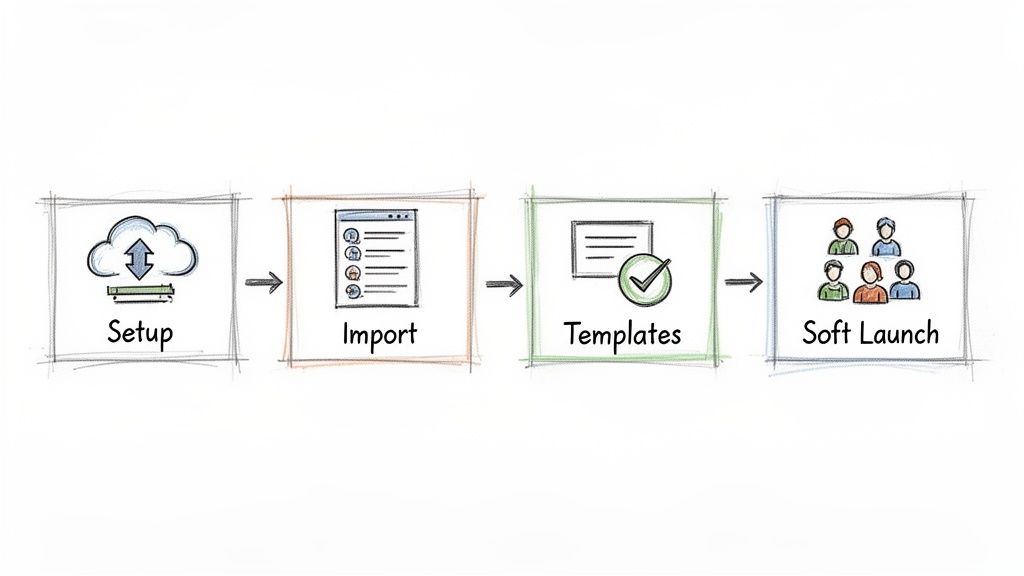
Moving to a new system should feel organized, not overwhelming. A clear checklist takes the guesswork out of the process and ensures a seamless launch. It’s all about making sure every foundational piece is in place before you go live.
Here’s a simple, four-step guide to get you up and running:
Before you unleash the platform on your entire patient base, start with a "soft launch." What does that mean? It means activating your new communication workflows for a small, controlled group of patients first. This strategy is your secret weapon for a flawless full-scale rollout.
A soft launch is your real-world testing ground. It allows you to work out any kinks, refine your message timing, and gather direct feedback from both patients and staff in a low-stakes environment.
By starting small, you can keep a close eye on everything. Are patients actually responding? Is your staff handling incoming texts efficiently? Does the timing of your ringless voicemail drop feel right? Use the feedback from this initial group to make small tweaks and perfect your approach.
Once you’ve validated your workflows and your team is feeling good about the process, you can start expanding the rollout to the rest of your practice. This measured approach minimizes disruption and maximizes the chances of a successful, long-term adoption. As you grow, exploring different patient engagement strategies for healthcare can give you even more ideas for creating effective campaigns.
It’s only natural to have a few questions when you’re looking at bringing new tech into your practice. You’ve got to think about compliance, the setup process, and how it’ll play nice with the systems you already use every day. Let's tackle some of the most common questions we hear from providers.
This is the big one, and the short answer is: yes, but it takes two to tango. HIPAA compliance is a shared responsibility between you and your platform provider. Any vendor worth their salt will sign a Business Associate Agreement (BAA), which is your guarantee that they have all the necessary security, like data encryption, buttoned up on their end.
Your part is all about what you put in the messages. It's perfectly fine—and incredibly effective—to use SMS and ringless voicemail for things like appointment reminders, scheduling links, or a heads-up about a new service. The key is to avoid sending detailed Protected Health Information (PHI) through these channels. Think of them as tools for logistics and gentle nudges, not for discussing a diagnosis.
This is where people are usually pleasantly surprised. Getting a modern, cloud-based platform up and running is often way faster than you’d think—in many cases, you can be live in under an hour. We're not talking about some massive, complex software installation that takes days.
The main steps are pretty simple:
Because these platforms are built to be intuitive, your team can start reaping the benefits—like a quieter phone and fewer no-shows—almost right away.
While a direct, built-in integration depends on your specific EHR, modern platforms are designed for flexibility. Many of the best healthcare patient engagement solutions connect to other tools using a connector service like Zapier.
Zapier is like a universal adapter for your software. It lets your engagement platform talk to thousands of other apps, including tons of popular CRMs and practice management systems, without needing a developer to build a custom connection.
For example, you could set up a "Zap" that automatically adds a patient to a post-op follow-up sequence the second their appointment is marked complete in your EHR. This is what turns a simple messaging tool into a core part of your practice's operations, saving your team from hours of manual data entry.
Ready to see how seamless communication can transform your practice? Call Loop provides HIPAA-compliant SMS, voice, and ringless voicemail solutions designed to automate your outreach, reduce no-shows, and free up your staff. Discover a smarter way to connect with patients at https://www.callloop.com.
Chris Brisson
Chris is the co-founder and CEO at Call Loop. He is focused on marketing automation, growth hacker strategies, and creating duplicatable systems for growing a remote and bootstrapped company. Chat with him on X at @chrisbrisson


Trusted by over 45,000 people, organizations, and businesses like


