
See a Demo
You're just one step away from seeing Call Loop in action.
Enter your information below to watch a demo right now.

You're just one step away from seeing Call Loop in action.
Enter your information below to watch a demo right now.

Tackling your customer acquisition cost isn't about slashing your budget. It’s about working smarter.
The game plan is simple, really. You calculate where you stand, find the channels that are eating your budget with little return, and then use automation to make your outreach far more efficient. It’s all about putting your money into high-impact channels and letting smart tools handle the lead nurturing.
In any competitive market, keeping a close eye on your Customer Acquisition Cost (CAC) is non-negotiable for long-term growth. Put simply, CAC is the total bill for all your sales and marketing efforts just to land one new customer. If that number creeps too high, it eats into your profits, no matter how much revenue you’re bringing in.
This one metric tells you a lot about the health of your marketing. It’s the key to answering some crucial questions:
With ad costs constantly on the rise, a high CAC can become a serious cash drain. Businesses that ignore it are basically just throwing money at strategies that don't work, killing their ability to scale.
Figuring out your CAC doesn't require a Ph.D. in mathematics. The core formula is pretty straightforward.
(Total Cost of Sales + Total Cost of Marketing) / Number of New Customers Acquired = Customer Acquisition Cost
Let's say in one quarter you spent $7,000 on marketing and $3,000 on sales salaries, which brought in 100 new customers. Your CAC would be $100. Knowing this baseline number is the absolute first step. From there, you can start digging into the details by measuring marketing campaign effectiveness to see what's really driving those results.
The entire process boils down to a clear, three-part strategy: figure out your baseline, find the weak spots, and bring in automation to do the heavy lifting.

This roadmap shows that it all starts with data and ends with a scalable system that works for you.
Here’s a snapshot of the core strategies we'll explore to help you lower customer acquisition costs.
This table gives you a quick look, but we're about to dive deep into each one.
Throughout this guide, we'll walk through real, actionable tactics you can use right away. We’ll show you exactly how any business—from an e-commerce brand to a local healthcare clinic—can use multi-channel tools like SMS, ringless voicemail, and voice broadcasts to connect with people more effectively and bring those acquisition costs way down.
Okay, you’ve got your baseline Customer Acquisition Cost (CAC) calculated. Now the real work begins: figuring out exactly where that money is going.
I’ve seen it a thousand times—not all marketing channels are created equal. Some are your workhorses, bringing in customers efficiently day after day. Others are just budget black holes, sucking up cash and inflating your CAC without pulling their weight. It's time to do a channel audit.
You have to slice up your data to see who the real culprits are. Forget looking at your overall CAC for a minute. You need to calculate it for each channel individually: paid social, search ads, email marketing, content—everything. This is the only way to get a granular view and make smart, data-backed decisions about where to double down and where to pull the plug.
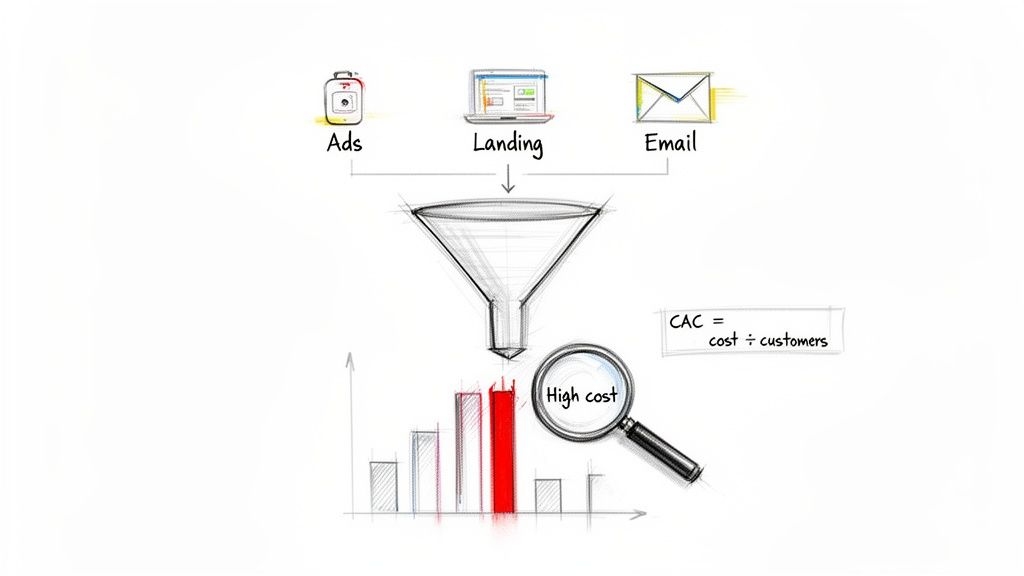
Here’s a common mistake: seeing a high CAC on a channel and immediately writing it off as "bad." The channel itself isn't always the problem. More often than not, it’s pointing to a leak somewhere in your funnel. Is your ad creative missing the mark? Is your landing page just confusing people? Is your signup process a pain?
To find out, you need to trace the customer’s journey for each channel. Pay close attention to a few key metrics:
Let's say an e-commerce store is running ads on both Facebook and Google. The Google Ads have a higher cost-per-click, but they might also deliver a 7% conversion rate by capturing people with high-intent searches. Meanwhile, the Facebook ads have a cheap cost-per-click but only convert at 1.5%, which ends up jacking up the final cost per customer. That insight tells the store owner to either get much smarter with their Facebook targeting or move that budget over to Google where it's working better.
Once you've found a weak spot, it's time to start testing. Guesswork is expensive; data is cheap. A/B testing is your absolute best friend for methodically improving campaigns and chipping away at acquisition costs.
And don't just test the big, obvious stuff. I've seen tiny tweaks produce major results. Here are a few elements you should be testing constantly:
The real goal of A/B testing isn't just to find one "winner." It's about building a continuous feedback loop. You're constantly learning what your audience wants and refining your message. This iterative process is the secret to sustainably lowering your customer acquisition cost over the long haul.
Your landing page is the moment of truth. It's where a prospect decides whether to take the next step or hit the back button. A poorly optimized page will absolutely demolish your conversion rates and make your CAC go through the roof.
Make sure your landing pages are built to convert. Here are the non-negotiables:
For instance, a local service business might find out its landing page has a high bounce rate. The fix could be as simple as swapping a generic stock photo for a real picture of their team and adding a few glowing customer testimonials. I’ve seen changes like that boost form submissions by 30%, which directly slashes the CAC for every single lead from that page. It's all about making the most of the traffic you're already paying for.
If you're still blasting the same generic message to every lead, you're not just being ineffective—you're burning money and inflating your customer acquisition cost. Prospects expect a personal touch, and a one-size-fits-all campaign is a fast track to being ignored.
The real key to smarter outreach is using automation to deliver hyper-personalized conversations at scale. It's about turning those repetitive, manual tasks into genuine opportunities for engagement. This is where you stop chasing every single lead and start building intelligent systems that nurture them for you.
By weaving together channels like SMS, voice broadcasts, and the subtle power of ringless voicemail, you can create a communication sequence that feels both personal and timely, which is a game-changer for your response rates.
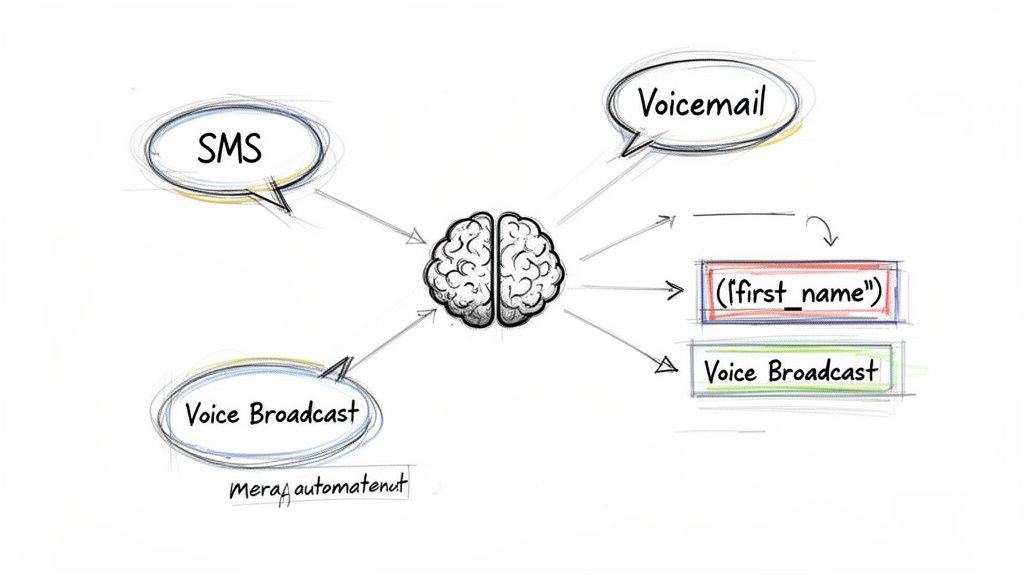
An automated drip campaign is your secret weapon for nurturing leads efficiently. It’s a pre-built sequence of messages that guides prospects through their journey without you having to lift a finger for every step. The real magic happens when you make these campaigns multi-channel.
Imagine a new lead fills out a form on your site. Instead of just firing off an email that gets buried in a crowded inbox, your system can do this:
This automated sequence keeps you top-of-mind by delivering the right message at just the right time. For a deeper look at putting these together, check out our guide on creating a marketing automation workflow.
Automation doesn't have to sound robotic. This is where features like merge tags and segmentation come in, making each recipient feel like you're talking directly to them.
[FirstName] or [City] that automatically pull customer data into your message. "Hey [FirstName]" is worlds more effective than a generic "Hello."A local karate studio, for instance, could segment its list into "Beginners" and "Advanced Students." They could use a text-to-join keyword like JOIN for new sign-ups to automatically trigger a welcome series for beginners. At the same time, a separate campaign for advanced students might promote a new weapons class. This targeted approach is fundamental to lowering your CAC because it makes every message count.
The goal is simple: automate the tasks, but personalize the experience. By delivering messages that are relevant and timely, you build trust and guide prospects toward a purchase with far less friction and cost.
The applications here are massive and can be tweaked for almost any industry to directly slash acquisition costs.
A healthcare clinic can use automated SMS and ringless voicemail drops to remind patients about appointments. This simple action crushes no-show rates, which are a huge hidden cost for clinics. The same system can re-engage past patients with follow-up care tips or reminders for annual check-ups.
For a busy sales team, automation is a true force multiplier. Instead of dialing hundreds of manual calls, they can launch a voice broadcast to a list of warm leads. The message can prompt interested prospects to "press 1" and be instantly connected with a live sales rep. This press-1 transfer feature filters out the noise and hands off only high-intent leads, focusing your sales team's energy where it matters most.
Recent reports show just how powerful this is. Companies using AI and marketing automation have cut acquisition costs by 30-50%. By integrating AI-driven personalization into multi-channel outreach, they can target high-intent prospects with incredible precision and eliminate wasted ad spend.
This is especially true with SMS, where open rates often top 90%. Imagine a sales team using drip sequences with precise timers to scale their follow-ups—they could see conversion lifts of 25%, directly compressing their CAC. By automating your outreach, you're not just saving time; you're building a more efficient and cost-effective engine for growth.
Imagine if your happiest customers were also your best salespeople. That’s the simple idea behind referral marketing, and it's one of the most powerful ways to slash your customer acquisition cost.
Instead of just pumping more cash into ads, you can build a self-sustaining engine that brings you high-quality leads for a tiny fraction of the cost. Why does it work so well? Trust. A recommendation from a friend carries way more weight than any ad ever will.
These new customers show up already believing in what you do. That means they convert faster, often spend more, and tend to stick around longer. It’s a powerful cycle that crushes CAC while building an army of loyal fans.

The secret to a great referral engine? Make it ridiculously easy for customers to share. This is where automation is your best friend. By plugging simple tools into your existing customer journey, you can ask for and manage referrals without lifting a finger.
You can use automated messages to hit them up at the perfect time.
By automating the "ask," you give every happy customer a clear and simple way to become an advocate for your brand.
For a referral program to really catch fire, everyone needs to win. A one-sided reward system usually falls flat. The best programs are a win-win-win: for your current customer, the new customer, and of course, your business.
Think about a double-sided incentive. For example, a marketing agency could give a current client one free month of service for a successful referral. At the same time, the new client they brought in gets 10% off their first three months. This gives your current client a huge reason to act and the new prospect a compelling nudge to sign up.
The real power of a referral isn't just the lower acquisition cost; it's the quality of the customer it brings. Referred customers already have a positive impression of your brand, making them more likely to become loyal, high-value clients themselves.
The rewards don't always have to be about cash. You could also offer:
The right incentive really depends on your audience. An e-commerce store might get the best results with discounts, while a SaaS business might see more action by offering an extra month of service.
When you get this right, you create a growth loop that frees you from the roller coaster of expensive ad channels. Every new customer you get from a referral is another potential advocate, creating a compounding effect that fuels your business organically.
The numbers don't lie. A good referral program can bring in customers at a 20-40% lower CAC than other channels. On top of that, referred users tend to spend 25% more and have an 18% lower churn rate. For businesses like marketing agencies, event hosts, and e-commerce stores, this is a massive opportunity.
Think about it: a $20 cost to acquire a customer through a referral versus a blended CAC of $239 from other channels is over 90% savings per acquisition. By using smart drip campaigns that mix SMS and ringless voicemail, you can nurture your referrers and track everything, pouring fuel on the fire. You can find more insights on lowering customer acquisition costs on enable3.io.
This isn't just about a short-term win. When you focus on creating an experience worth talking about, you automatically improve customer lifetime value (LTV). As your LTV climbs and your CAC drops, your business becomes healthier and far more scalable. You stop "renting" customers with ads and start "owning" a powerful, word-of-mouth machine.
Well-crafted SMS campaigns are a must, but if you're serious about slashing your customer acquisition cost, you need to explore channels your competitors are ignoring. It's time to think beyond just the SMS inbox and get creative with voice strategies that grab attention without being annoying.
This is where something like ringless voicemail comes in.
Instead of a cold call that interrupts someone's day, this technology drops an audio message straight into their voicemail. Their phone never rings. They just get a personal, timely message they can check out when it's convenient for them. For re-engaging cold leads or confirming appointments, this non-intrusive approach is a huge win.
One of the best things about ringless voicemail drops is how you pay for them. You aren't charged for calls that fail or go to a dead number. You're on a pay-per-drop model, meaning you only pay for voicemails that actually get delivered.
This ensures every single dollar of your ad budget is spent on a message that reached its target, which is exactly what you want when you’re trying to lower CAC. It cuts out all the waste from traditional cold calling, where your team spends hours dialing numbers that go nowhere. We get into all the specifics in our guide explaining what ringless voicemail is and how it works.
Beyond just ringless drops, a few other voice tools can make your outreach incredibly efficient.
Voice Broadcasts with Press-1 Transfers: Picture sending a recorded message to your webinar list. The message can tell anyone interested to "press 1" to register. When they do, they're automatically sent to your registration page or a live agent. This filters for high-intent leads on autopilot, saving your team from endless manual follow-ups.
AI Text-to-Speech: Recording personalized audio for hundreds of people used to be impossible. Not anymore. With text-to-speech, you can use merge tags like [FirstName] in a script, and the system generates natural-sounding audio for each person. It’s a personal touch that’s tough to replicate with text alone.
Let's look at how this plays out in the real world.
Take a real estate agent with a new listing. Instead of spending a full day cold-calling potential buyers, they can record one great message and use a ringless voicemail drop to send it to hundreds of people in just a few minutes. The people who call back are your warm leads, self-segmented and ready to talk.
Or, an event promoter with low ticket sales a week before the show. They can blast out a voice message with a press-1 transfer offering a last-minute discount. Anyone who presses "1" gets sent straight to the ticketing page. This creates urgency and turns interest into immediate sales, filling seats that would have stayed empty.
By combining these advanced voice and ringless strategies, you shift from a high-effort, low-yield outreach model to a low-effort, high-impact one. The cost savings come from cutting out wasted manual labor and focusing your team only on leads who have already raised their hand.
For instance, a business with a referral program can use these tools to put it on steroids. After a customer buys something, send an automated ringless voicemail with a "thank you" and a quick mention of the referral bonus. That personal touch makes them feel valued and much more likely to share. If you want to build a real referral engine, check out some of these High Leverage Referral Program Examples.
The whole idea is to automate the top of your funnel—the initial outreach and qualification. By using these less conventional channels, you get more efficient, create better touchpoints, and slash the costs tied to manual prospecting. You connect with more people in less time, which directly lowers your customer acquisition cost.
Trying to get a handle on customer acquisition costs can feel like a moving target. It’s normal to have a ton of questions when you start digging in. Here are some quick, real-world answers to the questions we hear most often.
There's no magic number here. A "good" CAC depends entirely on your business model, your industry, and—most importantly—your Customer Lifetime Value (LTV).
The benchmark we always aim for is an LTV-to-CAC ratio of at least 3:1. For every dollar you put into getting a new customer, you should be making at least three dollars back over time.
A recurring-revenue SaaS business can afford a much higher CAC than an ecommerce shop with razor-thin margins. The real goal isn't hitting some universal number; it's about constantly improving your own ratio.
This isn't about slashing your budget. It's about spending it smarter. You have to get surgical with your targeting instead of just making broad cuts.
Start by getting crystal clear on your ideal customer profile. Once you know exactly who you're talking to, you can pour your ad spend into the channels where they actually hang out.
True cost reduction comes from efficiency, not just less spending. When you sharpen your targeting and personalize your outreach, you're only paying to reach prospects who are genuinely a good fit. This naturally brings down your CAC and boosts the quality of your leads at the same time.
Use hyper-specific audience segments and negative keywords to weed out the wrong traffic before you even pay for the click. From there, you can nurture those high-quality leads with personalized follow-ups like a quick SMS or even a non-intrusive ringless voicemail to build a real connection.
It really depends on what you're doing. Some fixes are fast. You can see results in just a few weeks by making tactical tweaks—like pausing an ad that's burning cash or improving the conversion rate on a key landing page. Small changes can make a big difference, fast.
Bigger, more strategic plays take time. If you're building out a content engine for SEO or rolling out a solid customer referral program, you're looking at more like 3 to 6 months to see a major impact on your CAC.
The best approach is to mix short-term wins with a long-term game plan. Just make sure you're tracking your CAC every month so you know what’s working and can confidently put more fuel on the fire.
Absolutely. We see it every day. Using a multi-channel approach with automation is a game-changer for high CAC because it tackles the problem from a few different angles.
First off, it slashes the labor costs that come with manual follow-up. Think about all the time your team spends chasing leads with calls and emails. Automation frees them up to focus on what they do best: closing deals.
Second, it boosts your conversion rates. An automated, multi-channel sequence delivers the right message at the right time. A lead might ignore your email but respond instantly to a text or a personal-sounding ringless voicemail drop. This ensures no one falls through the cracks, letting you get the absolute maximum value from every lead you generate.
Ready to put these cost-saving strategies into action? Call Loop provides the multi-channel tools you need to automate your outreach with SMS, voice broadcasts, and ringless voicemail. Start connecting with customers more effectively and lower your CAC today. Learn more and get started.
Chris Brisson
Chris is the co-founder and CEO at Call Loop. He is focused on marketing automation, growth hacker strategies, and creating duplicatable systems for growing a remote and bootstrapped company. Chat with him on X at @chrisbrisson


Trusted by over 45,000 people, organizations, and businesses like


