
See a Demo
You're just one step away from seeing Call Loop in action.
Enter your information below to watch a demo right now.

You're just one step away from seeing Call Loop in action.
Enter your information below to watch a demo right now.

If you want to stop customers from leaving, you have to get ahead of the problem. It’s time to move from a reactive to a proactive communication strategy.
Instead of waiting for a complaint or a cancellation notice, you need to be reaching out with personalized, timely messages. Channels like SMS, voice broadcasts, and non-intrusive ringless voicemail are perfect for this—they let you reinforce the value you provide and build genuine loyalty. This simple shift stops the quiet bleed of customers and directly strengthens your bottom line.
Customer churn rarely announces itself. It’s a silent killer, slowly draining your revenue without a single loud complaint.
Think about a local karate studio that starts noticing fewer familiar faces in class, or an e-commerce store that sees its repeat purchase rate slowly dipping. This isn’t just a small drip; it's a major leak in your revenue bucket, and it’s a critical threat to your business.
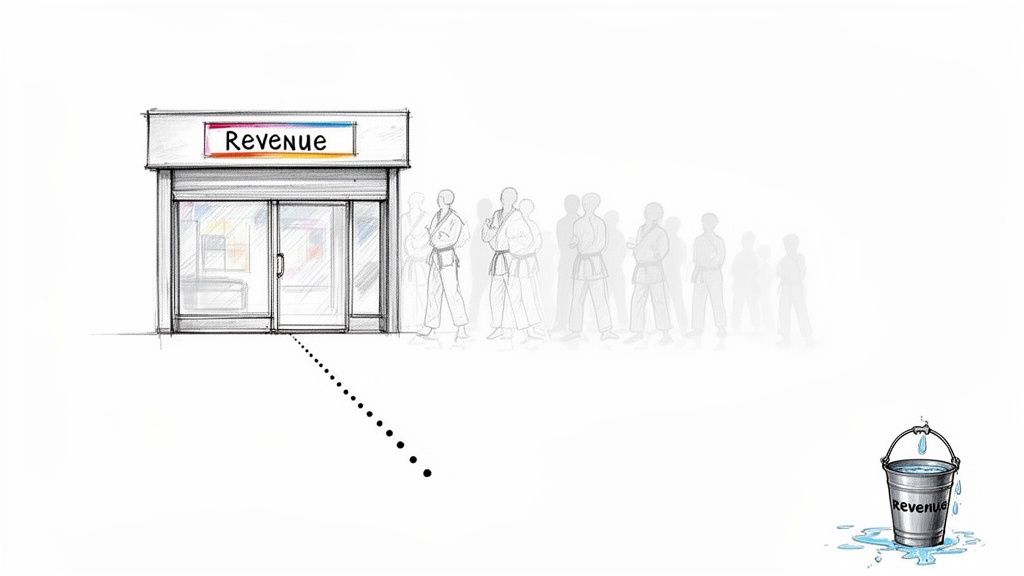
The good news? You don't need expensive, over-the-top gestures to fix it. It's all about smart, proactive communication using tools you can easily manage.
So many businesses pour all their energy into chasing new customers, completely overlooking the goldmine they're already sitting on. It's always easier and cheaper to sell to your existing customers, but they won't stick around if they feel ignored or taken for granted.
This neglect is usually unintentional—just a side effect of being busy running the day-to-day. The financial hit, however, is very real. For small and mid-sized businesses where every single customer relationship counts, losing someone means losing predictable revenue and hamstringing your future growth.
Key Takeaway: The most dangerous churn is the one you don't see coming. It's the slow drift of customers who don't complain—they just stop showing up, stop buying, and quietly switch to a competitor who makes them feel more valued.
One of the most eye-opening stats out there is that a whopping 67% of customers ditch businesses because of a poor service experience, usually stemming from long wait times or unresolved issues. That's a massive revenue drain. U.S. companies lose an estimated $168 billion annually from churn directly tied to bad service.
But here’s the flip side: businesses that get proactive with personalized outreach see dramatic improvements. The numbers don't lie—reducing churn by just 5% can boost profits anywhere from 25% to 95%. You can learn more about what really drives customer churn from this detailed guide.
This guide is designed to show you exactly how to use powerful yet simple tools to re-engage customers before they even think about leaving. We'll walk through a practical playbook for building a retention strategy that actually works, focusing on:
We're moving beyond theory to give you actionable steps to stop revenue leakage and build a more resilient, loyal customer base.
The absolute best way to crush churn? Stop it before it even starts.
This means you need to become a bit of a churn detective, learning to spot the subtle red flags that pop up long before a cancellation email ever hits your inbox. If you're waiting for customers to tell you they're unhappy, you're already behind the eight ball. The real magic is in identifying their silent signals.
A lot of businesses think they need a data science team and complex algorithms to predict churn. That’s just not true. You can start tracking the most important indicators right now, probably with the tools you already use. By keeping an eye on shifts in customer behavior, you can pinpoint at-risk accounts and step in with a timely, personal touch that makes all the difference.
Quantitative signals are the hard, measurable actions—or lack thereof—from your customers. These are the cold, hard numbers that paint a clear picture of their engagement. One of the most reliable predictors of churn is a sudden drop in activity.
Think of it like a gym membership. If a member who religiously showed up three times a week hasn't swiped their card in a month, they're a massive flight risk. The same logic applies to any business.
Here are a few key quantitative signals to have on your radar:
Tracking these metrics lets you create simple but powerful "at-risk" segments. For a deeper dive, check out our guide on practical customer segmentation examples. This is the first step to targeting them with specific, automated re-engagement campaigns.
While the numbers tell you what is happening, the qualitative clues give you the why. These signals are all about the tone and feel of your interactions. They often reveal the underlying frustration that data alone can't quite capture.
For instance, think about a customer who was once your biggest fan, always leaving positive feedback. Suddenly, their emails become short, curt, or they just stop responding altogether. That shift in communication is a major warning sign that their satisfaction is tanking.
Other qualitative clues to watch for include:
When you marry quantitative data with these qualitative insights, you get a much sharper picture of customer health. You're not just seeing that a customer is pulling away; you're starting to understand why. And that's the secret to building a retention strategy that actually sticks.
What signals trouble for a SaaS company won't be the same for a local hair salon. Recognizing these nuances is critical if you want your retention efforts to hit the mark instead of falling flat.
To help you out, I’ve put together a quick breakdown of common churn indicators for different business models. Use this to zero in on the red flags most relevant to your world.
Here are some of the most common red flags that signal a customer might be about to leave, categorized by business model to make it easy to see what applies to you.
By keeping an eye on these specific indicators, you can get ahead of the problem.
For example, you could automatically trigger a non-intrusive ringless voicemail to a service client who hasn't booked in 60 days, offering them a special "we miss you" discount. This kind of smart, proactive outreach, based on actual behavior, is how you stop churn in its tracks.
Spotting at-risk customers is a great start, but insight without action is just trivia. Now it's time to go from simply seeing the warning signs to actively preventing churn. This is where you build a proactive retention engine—an automated, multi-channel machine designed to keep customers engaged long before they ever think about leaving.
The goal isn’t to blast everyone with generic messages. It's about sending timely, personal outreach that feels like a real conversation. By setting up smart triggers based on the behaviors you're already tracking, you can deliver the right message on the right channel at the exact moment it'll have the biggest impact. This turns retention from a manual chore into a system that works for you 24/7.
Here’s the basic flow for spotting and acting on those churn signals.
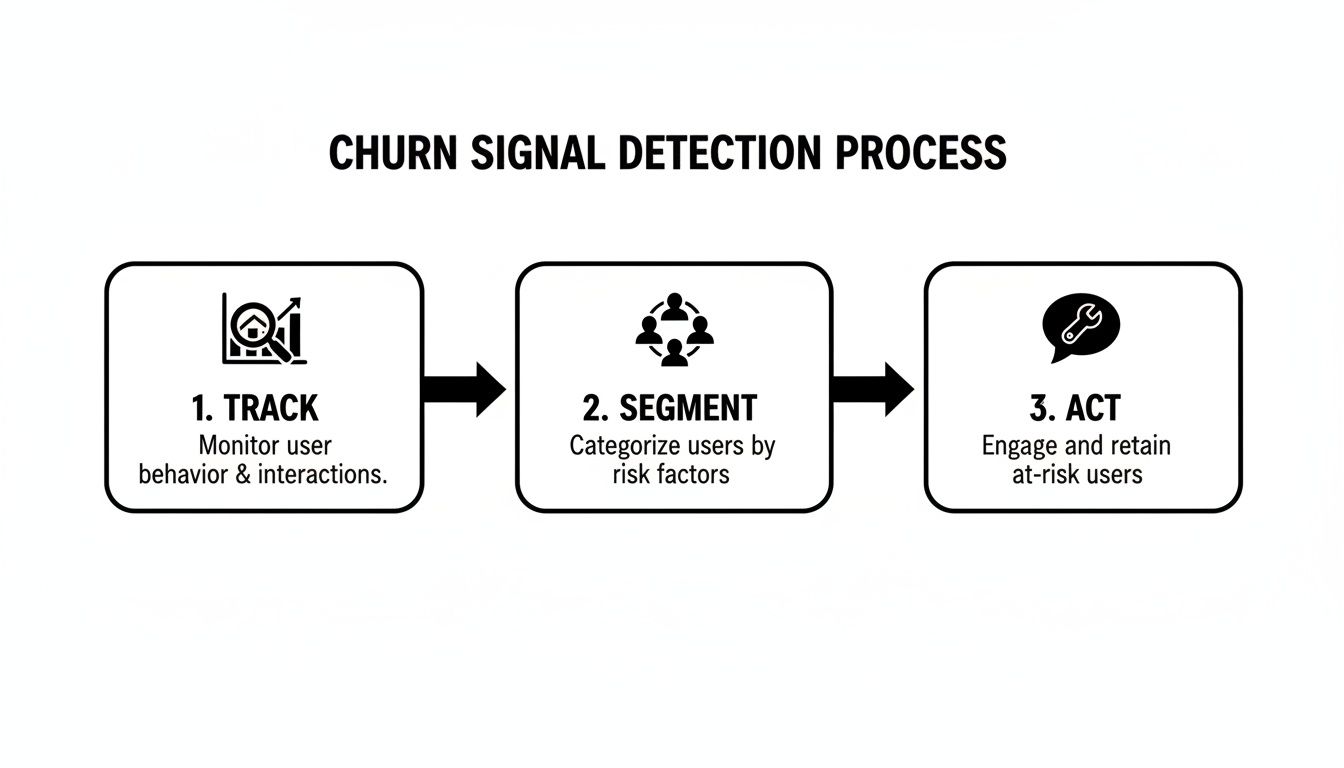
This simple three-step model—Track, Segment, Act—is the foundation. It makes sure every action you take is backed by real customer data.
A truly effective retention engine never puts all its eggs in one basket. It combines the unique strengths of SMS, voice broadcasts, and ringless voicemail into a seamless sequence. Each channel has a different job, letting you tweak the intensity and personality of your outreach based on the situation.
Think of it like this: SMS is perfect for quick, immediate check-ins. A voice broadcast is great for urgent, wide-reaching news. And a ringless voicemail? That delivers a personal touch without being intrusive, making it perfect for those more delicate re-engagement moments.
Here’s how you could string them together:
By orchestrating these channels, you create a layered communication strategy that keeps your brand top-of-mind and shows you're actually paying attention.
Automation can feel cold and robotic if you're not careful. The secret to making it feel human is deep personalization. This goes way beyond just using a customer's first name. With merge tags and custom fields, you can drop specific details into your messages that make them hyper-relevant.
For instance, a message could reference their last purchase date, the exact product they bought, or the last feature they used. That level of detail shows you see them as an individual, not just another contact in your database.
Pro Tip: Your outreach should always feel like a helpful nudge, not a sales pitch. Frame your messages around offering value—whether it's a useful tip, an exclusive offer based on their past behavior, or a simple check-in to see if they need a hand.
While 33% of customers cite budget constraints as the top reason for churning, this often hides deeper issues like product frustration or low usage. This is a huge opportunity. For a SaaS platform, a drip campaign combining SMS, voice, and ringless voicemail can re-engage users before they hit "cancel." For an e-commerce store, knowing that returning customers spend 67% more makes automated follow-ups like "Loved your last order? Here's 10% off the next one" a no-brainer.
A monthly churn rate of just 5% might not sound like much, but it compounds to a staggering 46% loss over a year. A multi-channel reminder strategy can often drop that rate to under 3%.
For small businesses, this approach is a game-changer. You don't need a huge team. By using the right tools, you can build sophisticated retention sequences that run on autopilot, freeing you up to focus on growing your business while your retention engine works quietly in the background. If you're looking for more ideas, check out our guide on other powerful customer retention strategies for small business.
Even with a killer retention strategy, some customers will inevitably walk away. But don't write them off just yet. A churned customer isn't a lost cause—it's an opportunity. This is where a smart, empathetic win-back campaign can turn a departure into a renewed relationship.
The trick is to move beyond the generic, desperate-feeling discount offers. Instead, you need to focus on why they left in the first place. A great win-back campaign acknowledges what went wrong, shows you've made things better, and gives them a compelling reason to come back. It's less about begging and more about showing you were listening.
Before you write a single message, get inside the head of a churned customer. They left for a reason—maybe your price was too high, the product was confusing, or they had a bad service experience. Your campaign has to hit that reason head-on.
The most effective win-back strategies are built on empathy. They prove you value the customer's feedback and actually did something about it. Think about it: only 1 in 26 unhappy customers ever complain; the rest just disappear. That makes your win-back message a critical, and often final, chance to get that feedback.
Your goal here is to completely change their perception. You want to stop being "the company they left" and become "the company that listened and got better." This reframes the entire conversation from "please come back" to "look what you're missing now."
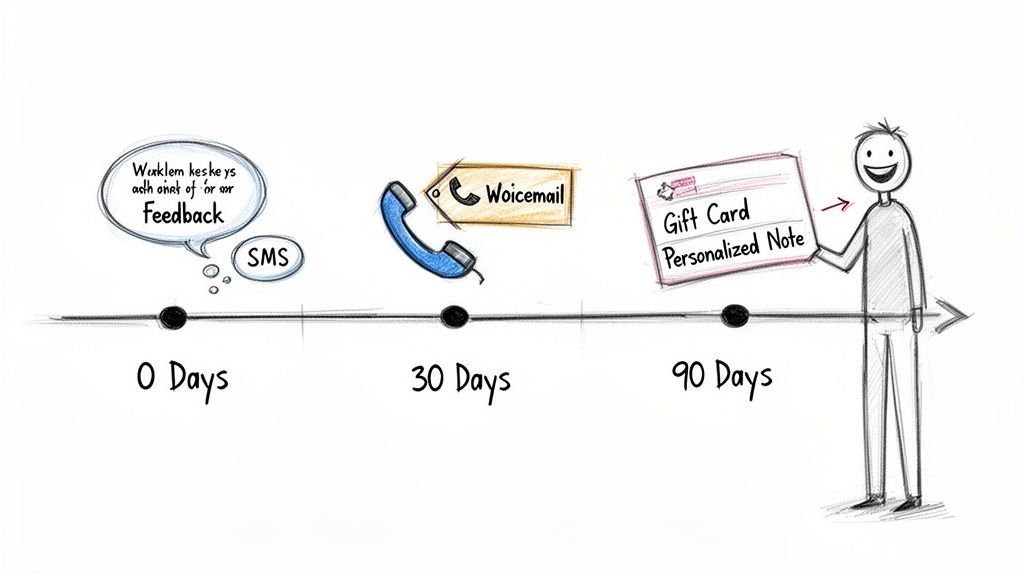
Timing and the channel you use are everything. A single "we miss you" email sent 90 days late is easy to ignore. A strategic sequence, on the other hand, builds momentum and dramatically increases your chances of getting them back.
Here’s a proven 90-day flow that combines the instant punch of SMS with the personal touch of a ringless voicemail.
Day 1: The Feedback Request (SMS): The moment a customer cancels, send an SMS. Don't lead with an offer. Just ask for feedback. This simple act shows you care more about their experience than their money. The goal here is pure information gathering while leaving the door open for a future conversation.
Day 30: The 'Welcome Back' Offer (Ringless Voicemail): Now it’s time to get personal. Drop a ringless voicemail directly into their inbox. Hearing a human voice conveys a sincerity that plain text just can't match. In the message, mention their feedback (if they gave it) and present an exclusive, compelling offer to return.
Day 90: The Final Nudge (SMS): If they still haven't come back, send one last personalized SMS. This message should have a slightly more urgent, "last chance" feel. You could highlight a brand-new feature or a final, enhanced offer to seal the deal.
Key Takeaway: A win-back campaign isn't a single event; it's a carefully timed conversation. Using different channels at different stages creates multiple opportunities to re-engage the customer on their terms. This makes your outreach feel thoughtful, not just automated.
Generic messages get deleted. Specific, empathetic messages get responses. Here are a few copy-and-paste examples you can tweak for your own campaigns.
This message is short, direct, and focused on learning, not selling.
Hi [FirstName], this is [YourName] from [Company]. We're sorry to see you go. To help us improve, could you share the main reason you decided to cancel? Your feedback is incredibly valuable. Thank you.
This script should sound warm, genuine, and unscripted. I highly recommend recording it yourself for maximum impact.
"Hey [FirstName], it's [YourName] again from [Company]. We really miss having you as a customer and took your feedback seriously. We've actually just [mention a specific improvement or new feature relevant to their reason for leaving, if possible]. I've put a special 'welcome back' offer on your account—25% off your first three months if you decide to give us another try. No pressure at all, but we'd love to win you back. Thanks for everything."
Using a ringless voicemail drop is the secret sauce here. It lets you deliver that personal message without actually interrupting their day. It’s a powerful way to stand out from a noisy email inbox, respecting their time while making a real emotional connection. Combine these tools, and you'll build a win-back strategy that doesn't just ask customers to return—it gives them a compelling reason to.
Launching your retention and win-back campaigns is a fantastic first step. But it’s only half the job.
How do you know if any of it is actually working? This is where you close the loop. You have to focus on measurement and constant improvement, turning your best guesses into a process driven by real data.
You can't fix what you don't measure. By tracking the right numbers, you get way beyond a simple churn rate. You start to see the real impact of your SMS check-ins, ringless voicemail offers, and win-back sequences. This is the insight that transforms churn reduction from a one-off project into a core part of your business that gets smarter over time.
Your overall churn rate is like the check engine light in your car—it tells you something’s up, but not what. To get the full story on your retention health and see how your campaigns are performing, you need to look under the hood a bit.
Focusing on these key performance indicators (KPIs) will show you exactly what’s clicking and where you need to make some tweaks.
When you keep a close eye on these numbers, you can draw a straight line from your retention activities to your bottom line.
Modern messaging platforms give you all the analytics you need to see what’s landing with your audience. You don't need to be a data scientist; you just need to know what to look for. Things like link click tracking and response rates are your new best friends.
For instance, say you send two different win-back offers via SMS. Just use a unique shortened link in each message. The one that gets more clicks is your winner. It's a dead-simple A/B test that gives you immediate, actionable feedback. You can dive deeper into this in our guide on measuring marketing campaign effectiveness.
By consistently testing different messages, channels, and offers, you get into an iterative mindset. You're no longer just guessing; you're using real data to refine your strategy with every single campaign.
One of the most powerful—but often overlooked—tools for understanding retention is retention cohort analysis. It sounds more complex than it is. Basically, you group customers together based on when they signed up (e.g., everyone who joined in January) and then track what percentage of them are still active over time.
This kind of analysis helps you spot trends that a simple, high-level churn rate would completely miss.
Here's a real-world scenario:
Imagine in March you launched a new, more personal onboarding flow. It included a welcome SMS and a follow-up ringless voicemail from you, the founder.
By looking at the "March cohort" and comparing it to the "February cohort," you might see that a higher percentage of the March folks are still active customers three months down the line. Boom. That's strong evidence that your new onboarding is working and directly boosting long-term retention. This is exactly how you prove the ROI of your efforts and make smarter decisions for the future.
When you start digging into churn reduction, a lot of practical questions pop up. It's one thing to understand the theory, but another to actually put these ideas into practice. Let's tackle some of the most common ones I hear from businesses just like yours.
Think of this as your quick-start guide to clearing up any confusion so you can get your retention and win-back campaigns rolling with confidence.
This is the golden question, and the honest answer is: it depends. There's no magic number that works for everyone. The real goal is to be helpful, not annoying.
For a subscription business, a quick monthly SMS check-in or a quarterly ringless voicemail dropping some value (like a new feature update) works wonders. If you're in e-commerce, your timing should sync up with the buying cycle. A text a week after delivery to see how they're loving their purchase is a great touch. If they go dark for 60-90 days, that’s your cue to send a re-engagement offer.
The secret is to let customer behavior drive your outreach. Use automated triggers based on inactivity or other signals, not just a rigid calendar. That way, every message feels relevant and lands at just the right moment.
Great question. They sound similar, but they're used for totally different things.
A voice broadcast is an active call. It rings the user's phone, and if they pick up, they hear your message. This is your go-to for urgent, time-sensitive stuff—think appointment reminders or flash sale announcements where you need to get the word out to everyone, fast.
A ringless voicemail, on the other hand, is completely non-intrusive. It slips your recorded message straight into their voicemail inbox without the phone ever ringing. This is perfect for more personal, less urgent follow-ups, like a thank you message or a special offer. It has a surprisingly high listening rate because you’re delivering a personal touch without interrupting their day.
Yes, absolutely. In fact, that's what modern multi-channel platforms are built for. These tools are designed to give small and mid-sized businesses the power of automation without needing a team of marketers or developers.
You can set up your customer lists, write your SMS templates, record a few voice messages, and build out entire automated campaigns that just run in the background. It's the definition of "set it and forget it" retention.
Plus, with integrations into tools like HubSpot, ActiveCampaign, or pretty much anything else through Zapier, you can plug this directly into your existing customer data. It becomes a seamless part of your workflow, no big team required.
Don't choose one—use both! The best win-back campaigns layer them together, playing to each channel's unique strengths.
Here's a simple, effective sequence:
By using both channels in the right order, you dramatically increase your chances of bringing that customer back into the fold.
Ready to stop churn and build a proactive retention engine that runs on autopilot? Call Loop gives you all the tools you need to automate personalized outreach across SMS, voice, and ringless voicemail. See how over 45,000 businesses are building stronger customer relationships and start your free trial today.
Chris Brisson
Chris is the co-founder and CEO at Call Loop. He is focused on marketing automation, growth hacker strategies, and creating duplicatable systems for growing a remote and bootstrapped company. Chat with him on X at @chrisbrisson


Trusted by over 45,000 people, organizations, and businesses like


