
See a Demo
You're just one step away from seeing Call Loop in action.
Enter your information below to watch a demo right now.

You're just one step away from seeing Call Loop in action.
Enter your information below to watch a demo right now.

Trying to cut costs without a plan is like navigating blindfolded. You might trim some fat, but you're just as likely to cut into muscle and bone, hurting your business in the long run.
The smart approach isn’t about randomly slashing budgets. It’s about becoming a detective inside your own company—finding where the money is really going so you can make strategic, informed cuts.
Before you touch a single line item on your budget, you need a clear, honest picture of your spending. Most businesses are leaking money in places they don't even think to look—forgotten subscriptions, clunky old processes, and workflows that waste precious time.
Your first move is to map out your core business processes. Don't get bogged down in complex software; just grab a whiteboard or a piece of paper. Trace the journey from a new lead's first contact all the way through to the final sale and any follow-up.
Where are the manual steps? How much time is your team really spending on repetitive stuff like data entry or chasing down leads? Every single manual touchpoint is a blinking sign that points to a potential cost saving.
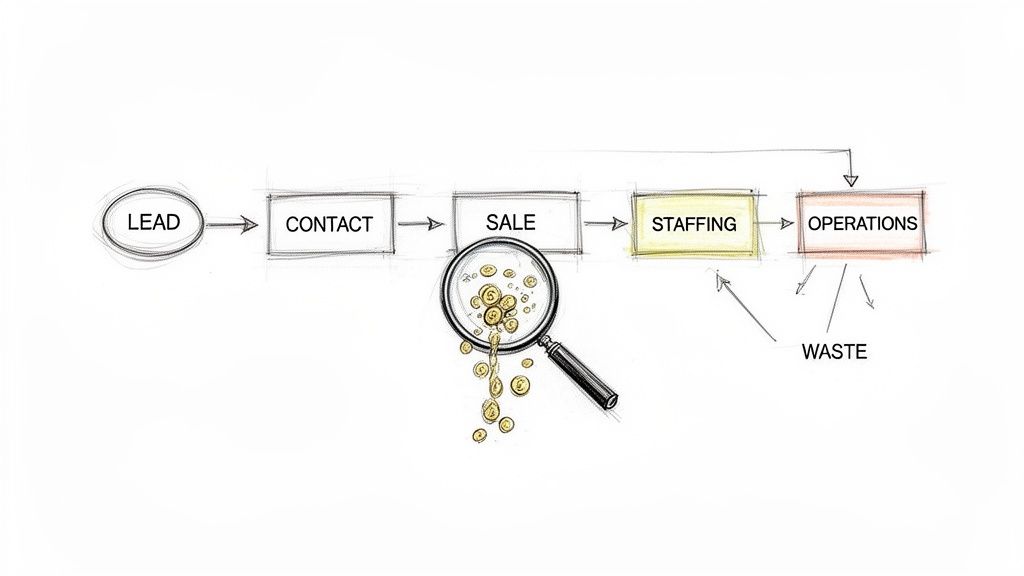
Once you've got your processes mapped, it's time to categorize every single expense. Group them into big buckets so you can see where your money is flowing.
Not sure where to focus first? Some costs have a much bigger potential for savings than others. This table can help you quickly sort your high-impact opportunities from the small wins.
Focusing on the high-impact categories first gives you the biggest bang for your buck and frees up cash flow faster.
The real goal here is to move from random budget cuts to smart cost optimization. It’s about shifting money away from low-impact expenses and into high-growth activities, making sure every dollar is working for you.
Beyond the obvious overhead, hidden costs often hide in plain sight within outdated processes. For example, putting solid IT Asset Management best practices in place can slash what you spend on tech by flagging underused or obsolete hardware before it becomes a money pit.
This initial deep dive is the most important part of your cost-cutting mission. It gives you the hard data you need to make intelligent decisions instead of just guessing. Once you know exactly where the financial leaks are, you can build a targeted plan that cuts waste without killing growth.
Let's be honest: repetitive manual tasks are payroll killers. Think about how many hours your team sinks into dialing leads, sending appointment reminders, or typing out the same follow-up emails week after week. This is exactly where you can slash operational costs by letting smart automation do the heavy lifting for you.
Research shows that businesses can automate at least 30% of the tasks in 60% of occupations. When you target those repetitive activities, you’re not just saving a few minutes—you’re reclaiming thousands of hours and cutting right into your labor expenses. This isn't about replacing your team. It's about freeing them up to focus on the high-value work that actually grows the business.
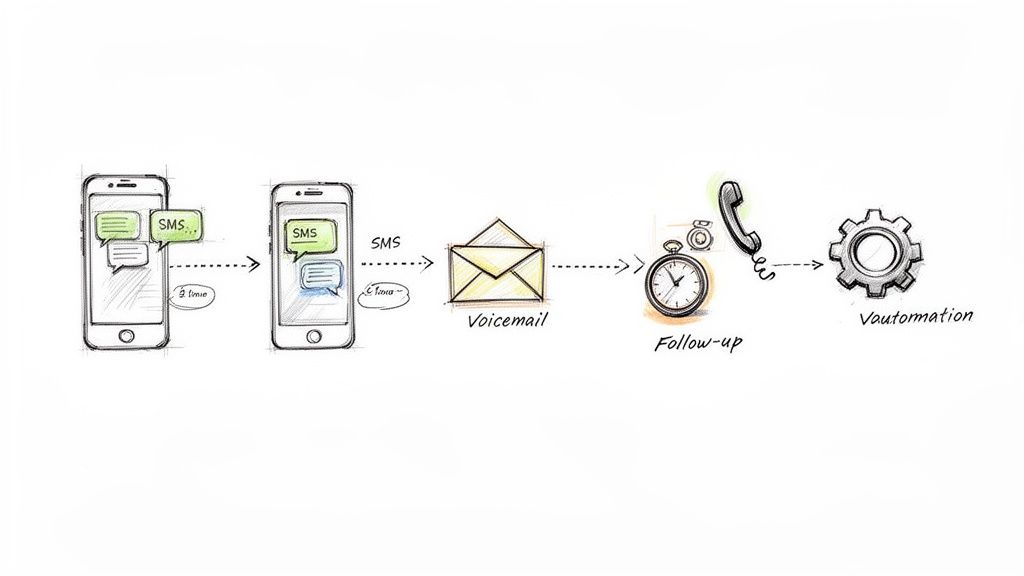
One of the most powerful ways to cut costs is by setting up automated communication workflows. These sequences can handle everything from lead nurturing to customer follow-ups and reminders without anyone on your team lifting a finger. This lets you scale your outreach without having to scale your headcount.
Imagine a new lead fills out a form on your website. Instead of an employee having to drop everything to make a call, an automated sequence kicks in right away:
This whole process runs silently in the background. No lead ever falls through the cracks, and your team is freed up to talk to warm, responsive prospects who are ready to engage.
The real magic of automation is its ability to run perfectly timed, multi-channel outreach at scale. You're basically creating a tireless digital assistant that works 24/7, guaranteeing consistent communication while your team focuses on closing deals and delighting customers.
The uses for communication automation are practically endless and can be adapted to almost any industry. By automating these routine interactions, you directly lower your cost to acquire a customer and give your retention rates a serious boost.
For example, a marketing agency could use an SMS drip campaign to nurture new leads over several weeks. This keeps the brand top-of-mind by delivering helpful tips and resources, warming up prospects for a sales call without anyone having to spend hours on manual follow-ups. If you want to see how this works, check out our guide on building an automated marketing workflow.
A healthcare clinic is another perfect example. Missed appointments are a massive drain on revenue. Instead of staff spending their entire day on the phone, an automated system can take over:
This simple workflow has a huge impact. It drastically cuts down on no-shows, protects your revenue, and lets your front-desk staff focus on the patients who are actually in the office. It's a clear, direct way to reduce operational costs while making the patient experience even better.
Let’s talk about the biggest line item on your P&L statement: labor. While you absolutely need to optimize your team's output, a huge, often-missed opportunity for cost savings comes from rethinking where and how they get their work done.
Embracing flexible and remote work isn't just a trendy perk anymore. It’s a serious financial strategy.
The most obvious win is cutting the overhead that comes with a physical office. When you let employees work from home, you can slash—or even totally eliminate—costs for rent, utilities, insurance, and daily upkeep. Those expenses bleed cash that you could be pouring back into growing your business.
Going remote isn't as simple as handing everyone a laptop and wishing them well. A successful transition means being intentional. You need to set clear ground rules and give your team the right tools to stay connected and productive, wherever they are.
Here's what a smart transition looks like:
This model also opens up your hiring pool to the entire world. You're no longer stuck hiring only people who live within a 30-mile radius. This gives you access to incredible talent at competitive rates, letting you scale your team without the crushing costs of a central HQ.
To make this all seamless, you'll need the right tech. Exploring flexible Hosted PBX solutions is a great starting point, as it empowers your staff to work effectively from anywhere with a solid phone system.
Don't forget, going remote isn't just a cost-cutting play. It often gives you a huge boost in employee productivity and retention. Happier people who have more control over their day are far less likely to leave, which cuts your recruiting and training budget way down.
The numbers don't lie. When you look at how to reduce operational costs, remote work for traditionally office-based roles like call center agents offers some of the most dramatic savings.
Think about it. A traditional call center for a medium-sized business can easily run you $5,000 to $10,000 per month just for the building, lights, and internet. A fully remote model wipes that entire expense off your books.
That move alone can lead to savings of over $2,000 per agent annually before you even touch equipment and maintenance costs. You can see a complete call center cost breakdowns to get a feel for the full picture.
By changing your mindset about where work gets done, you can build a business that's not only more cost-effective but also more resilient and productive.
Let’s be real—how much of your team's day gets eaten up by phone calls that go straight to voicemail? That endless cycle of dialing, waiting, and never connecting with a real person is a massive time-suck and a quiet killer of your operational budget.
But what if you could skip the ringing altogether and just deliver your message? That's exactly what ringless voicemail does.
This tech is a game-changer. It drops a pre-recorded audio message right into someone’s voicemail box without their phone ever making a peep. Your team is instantly free from hours of mind-numbing dialing, and your contacts are never interrupted. They can listen to your message whenever it’s convenient for them, which usually means they’re in a much better headspace to hear what you have to say.
One of the best parts about ringless voicemail is how it’s priced. With old-school dialing, you’re paying for every single minute your team is on the phone, whether they connect with someone or not. With ringless voicemail, you only pay for successfully delivered messages.
Think about that. You’re not burning cash on calls that hit a busy signal, a disconnected number, or just ring endlessly. Every single penny of your budget is going toward actually getting your message heard. For any business trying to cut down on operational costs, this pay-per-delivery model gives you predictable spending with a clear line to your ROI.
Ringless voicemail turns one of your biggest time-wasters—manual dialing—into a lean, low-cost communication machine. You stop paying for effort and start paying only for results.
The beauty of ringless voicemail is that it works for just about any business that needs to get a message out efficiently. You can get a deeper look into what is ringless voicemail and how it works in our full guide.
Here are just a few ways we’ve seen it used effectively:
In every one of these cases, the business gets its message across quickly and for a tiny fraction of what it would have cost to do it the old-fashioned way. By replacing all that manual work with smart technology, you can make a serious dent in your daily operational expenses.
Ideas are great, but turning them into actual savings requires a plan. A simple 90-day sprint is the perfect way to get from audit to implementation, ensuring you see a real impact on your bottom line within a single quarter. This isn't about vague goals; it's a roadmap for taking decisive action.
The first 30 days are all about analysis and strategy. This is where you take the data from your cost audit and decide where to strike first. Your goal is to pinpoint your top three cost-saving initiatives. Is it unused software bleeding you dry? Manual customer reminders eating up staff hours? A vendor contract that needs a tough renegotiation? Focus on the actions that will deliver the biggest bang for your buck with the least amount of chaos.
Once you know what you're doing, you need to define what success looks like. "Save money" is not a target. You need concrete Key Performance Indicators (KPIs) for every single initiative.
With your priorities and KPIs locked in, days 31-60 are for piloting your ideas. Never, ever roll out a massive change across the whole company at once. That’s a recipe for disaster.
Instead, run a small-scale test. For example, if you want to use automated ringless voicemail for appointment reminders, try it with a small, specific group of customers first. This lets you iron out the wrinkles and get real feedback before you go all-in.
The process for something like ringless voicemail is incredibly straightforward and non-intrusive.
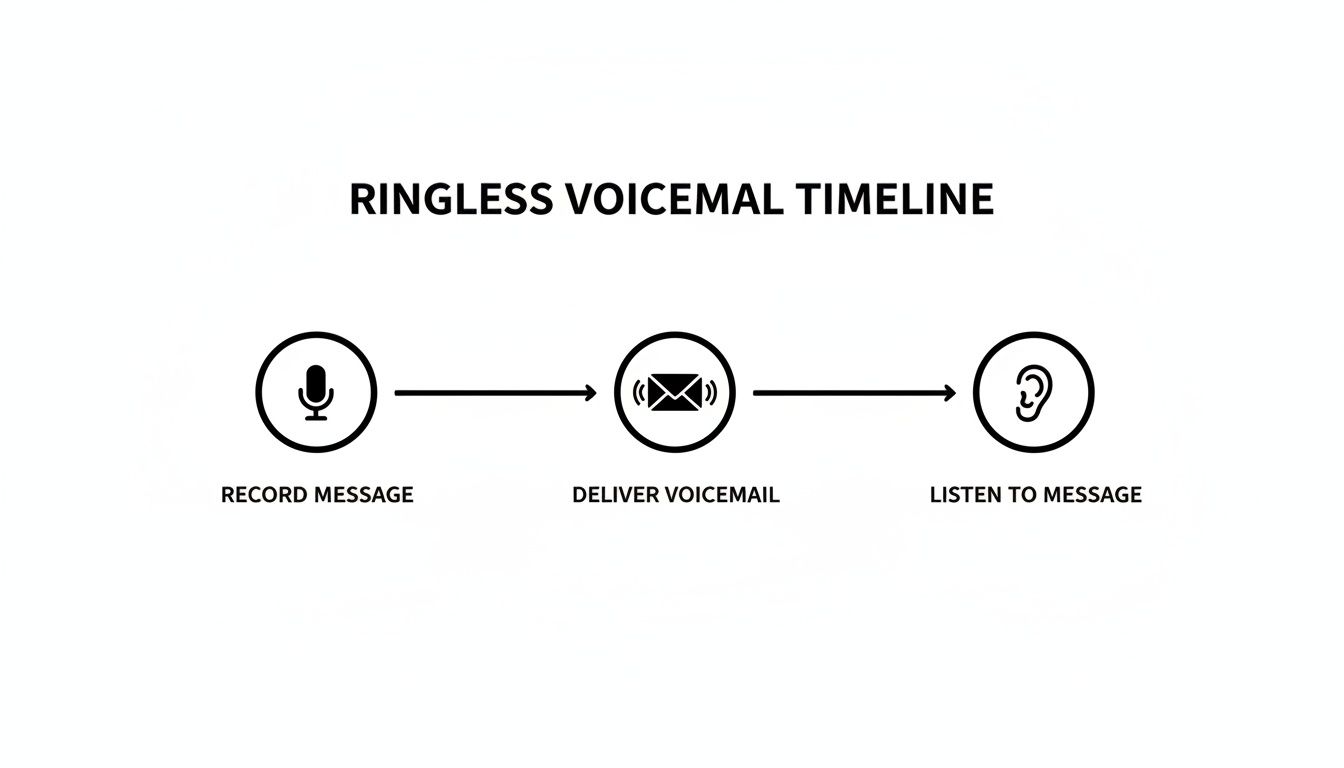
You can record a message, deliver it straight to someone's voicemail without their phone ever ringing, and they can listen when it's convenient. It’s a classic tactic for winning back productivity without annoying your customers.
The pilot phase is your safety net. It’s where you prove an idea actually works in the real world before you bet the farm on it. This minimizes your risk and dramatically increases your chances of a big win.
Finally, days 61-90 are for rolling it out and measuring the results. Once your pilot proves successful, it's time to go wide. Document the new process and get your team trained up so everyone is on the same page from day one.
At the 90-day mark, it’s time to circle back to your original KPIs. Did you hit your targets? This last step is non-negotiable. It proves the ROI of your work and builds the momentum you need to start the next round of optimizations.
It's one thing to decide you need to trim your operational costs. It's another thing entirely to actually do it without kneecapping your growth.
Whenever you start looking under the hood for savings, a bunch of questions inevitably pop up. Let's get into some of the most common ones I hear from business owners trying to cut expenses the smart way.
First, you need to know where your money is actually going. Pull up your expenses from the last six months and start sorting them into two simple buckets: 'essential' and 'non-essential'. You'll be surprised what you find—forgotten software subscriptions, manual tasks that eat up hours, or utility bills that have crept up over time.
The goal here isn't to slash and burn. It's about finding the fat. A great place to start is your communication workflow. Think about it: automating follow-ups with a quick SMS or a ringless voicemail can instantly free up payroll hours without your customer ever feeling a negative impact. This is all about working smarter, not just cheaper.
The key is to find expenses that don't directly contribute to revenue or a great customer experience. Ditching a redundant software license is a clear win. Gutting your customer support team is a huge gamble you don't want to take.
Automation’s biggest gift is giving you back your team’s time. Instead of paying someone to dial through a list of appointment reminders—a tedious and costly task—an automated system can fire off SMS or voice messages for a tiny fraction of the cost.
Suddenly, that team member is free to handle a complex customer issue, nurture a high-value lead, or close a sale. Beyond the time savings, automation also stamps out human error. Every mistake, whether it's a missed appointment or a wrong number, has a price tag attached, either in rework or lost business.
Absolutely. Ringless voicemail is a powerhouse because it delivers your message without ever interrupting someone's day. Their phone doesn't ring, but your message lands right in their voicemail inbox, ready for them to listen when it's convenient. That polite, non-intrusive approach means people are far more receptive to what you have to say.
We've seen it work wonders for everything from lead nurturing and sales follow-ups to quick event announcements. Plus, since you generally only pay for voicemail drops that are successfully delivered, the ROI is fantastic. It’s a lean, high-impact tool for any business serious about reducing operational costs in their outreach.
Ready to see how smart automation can dramatically cut your operational expenses? With Call Loop, you can build powerful SMS, voice, and ringless voicemail campaigns that save time and money. Start automating your outreach today.
Chris Brisson
Chris is the co-founder and CEO at Call Loop. He is focused on marketing automation, growth hacker strategies, and creating duplicatable systems for growing a remote and bootstrapped company. Chat with him on X at @chrisbrisson


Trusted by over 45,000 people, organizations, and businesses like


