
See a Demo
You're just one step away from seeing Call Loop in action.
Enter your information below to watch a demo right now.

You're just one step away from seeing Call Loop in action.
Enter your information below to watch a demo right now.

At its core, sending an automatic text message is about using a smart platform to schedule and fire off messages based on specific triggers or a set timeline. For businesses, that means picking the right service, building a permission-based contact list, and then letting the automation run with things like appointment reminders or welcome messages.
Before we get into the nuts and bolts of how to do it, it’s worth spending a minute on the why. Smart businesses are leaning into automated SMS because it’s the most direct way to cut through the digital clutter and talk to customers. This isn't just another tech trend; it's a strategic move that saves a ton of time, drives revenue, and builds real customer loyalty.
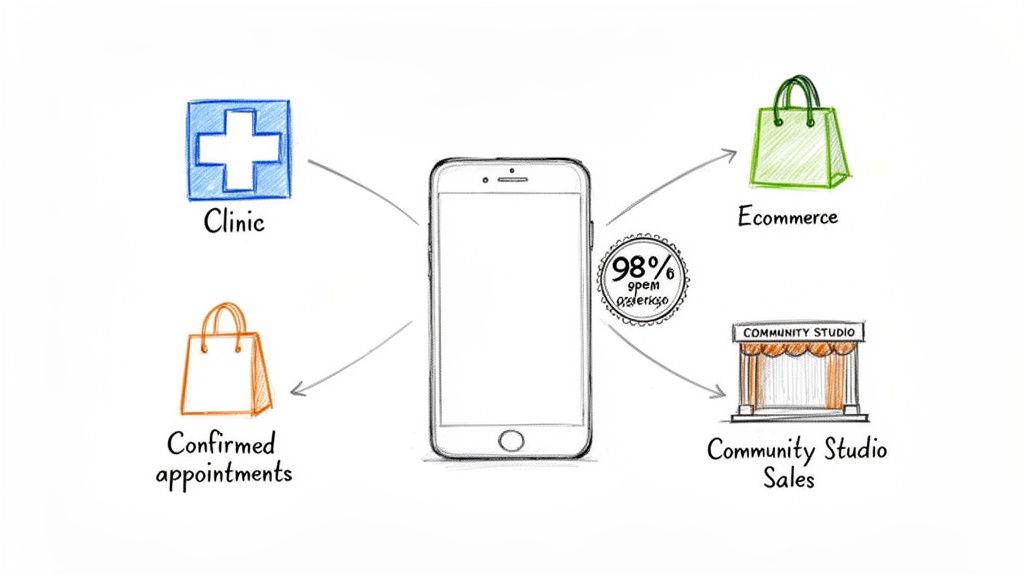
Think about it: an email can sit unread for days in a crowded inbox. A text message, on the other hand, lands in a personal, immediate space. This direct line to the customer pays off big time—more kept appointments for a clinic, bigger sales for an online store, and packed classes for a local studio.
In a world where everyone is fighting for attention, a simple text message almost always gets seen. We're talking an incredible 98% open rate, with most of those—about 90%—being read within just three minutes of landing on someone's phone.
Let's put that in perspective.
When you look at the numbers side-by-side, it’s obvious why SMS is the go-to for messages that absolutely need to be seen now. This isn't just theory; digging into the benefits of marketing automation shows how this immediacy translates to real efficiency gains.
The real magic of SMS is in its simplicity and directness. It's the most reliable way to make sure your message doesn't just get delivered but actually gets read.
This isn't a small deal. In fact, that immediacy has become a game-changer for critical communications. Public-sector agencies have even seen a 67% boost in transfer production and slashed transfer times by 40% just by adding automated texts to their workflow.
While SMS is a powerhouse on its own, a modern communication strategy often weaves in complementary channels to reach people effectively. Tools that pair perfectly with SMS automation can amplify your message and add a personal touch.
By strategically combining automated texts, ringless voicemail, and voice broadcasts, you can create multi-layered campaigns that connect with your audience on multiple levels, ensuring your message always gets through.
Before a single automated text goes out the door, you've got to build a solid foundation. This isn't just about ticking off a few technical boxes. It's about making smart choices right from the get-go that guarantee your messages are effective, legal, and actually wanted by your audience.
First things first: your phone number. You've got a couple of options here, like a standard 10-digit long code (10DLC) which gives you that local, familiar vibe. Or, you could go with a toll-free number, which works great for national campaigns or customer support lines. Think about your brand—a local gym would probably feel more personal with a 10DLC, right? Your number is part of your identity, so choose wisely.
With your number sorted, the next—and most critical—piece is building a clean, consented contact list. You absolutely cannot just upload a random list of phone numbers. You need clear, explicit permission from every single person on that list. This isn't just a good idea; it's the law.
Getting people to opt-in comes down to one thing: offering real value. One of the most effective ways to do this is with a text-to-join keyword. For instance, a retail shop could run a promo like, "Text DEALS to 55555 for 20% off your next purchase!" It gives the customer an immediate win and gets them on your list seamlessly.
Here's what a solid, compliant opt-in flow should look like. It's all about getting that permission locked in.

As the image shows, securing consent is the bedrock of any SMS strategy that's both successful and legal. It’s about protecting your business and your subscribers.
Web forms on your site are another goldmine for list growth. A simple checkbox on your contact or checkout page saying, "Sign me up for text alerts and special offers," can capture leads when they're already engaging with you. It's a natural fit.
I've seen it time and time again: the quality of your list is infinitely more important than the quantity. A small, engaged list of people who want to hear from you will blow a massive, unconsented list out of the water every single time.
Let's be clear: compliance isn't optional. Two concepts you need to burn into your brain are double opt-in and clear opt-out instructions.
Double Opt-In: After someone subscribes, whether by keyword or web form, fire off an immediate automated reply to confirm. Something like, "Thanks for joining! Reply YES to confirm you want texts from us. Msg&data rates may apply." This two-step dance gives you bulletproof proof of consent. To really dig into the details, make sure you understand what goes into obtaining express written consent.
Clear Opt-Out: Every single message you send must have an easy way for people to say "no more." The industry standard is simple: "Reply STOP to unsubscribe." Make sure it's clear and that you honor it instantly.
By getting these fundamentals right—the right number, a consented list, and airtight compliance—you're building a system based on trust. And that's the only way to make your automation truly powerful.
An automatic text is pointless if it doesn't create a real connection. Let's be honest, anyone can blast out a generic message. The real magic of automated SMS is moving beyond that.
The secret isn't just about keeping messages short; it's about making them feel personal, even when they're going out to hundreds or thousands of people at once.
This is where personalization tools like merge tags become your absolute best friend. Instead of a bland "Your appointment is tomorrow," you can send something like, "Hi {{FirstName}}, just a friendly reminder of your appointment tomorrow at {{AppointmentTime}}." See the difference? That small tweak transforms a cold notification into a helpful, one-to-one interaction. It shows you see the recipient as an individual, not just another number on a contact list.
The gap between a message that gets ignored and one that gets a reply is often just a few small details. A little personalization goes a surprisingly long way.
Let’s look at a simple before-and-after for a dental clinic:
Reminder: You have a dental appt tomorrow.Hi Alex, this is a reminder from Smile Bright Dental about your appointment with Dr. Chen tomorrow, June 15th at 10 AM. Reply C to confirm or call us to reschedule. Reply STOP to opt out.The "After" version is leagues better. It's personal, it gives them all the info they need, and it includes clear, compliant instructions. This is exactly how you slash no-show rates and make your automated messages start pulling their weight.
For more ideas on crafting effective messages, check out our guide on how to set up an auto text reply that actually gets people to engage.
While the text itself is crucial, don't sleep on the power of visuals. Using MMS (Multimedia Messaging Service) lets you toss in images, GIFs, or even short videos.
An e-commerce store, for instance, could send a promo text that includes a picture of the product on sale. Suddenly, that offer feels much more real and appealing.
I've found that a well-placed image in an MMS campaign can boost click-through rates by as much as 52% compared to a standard SMS. People are visual creatures, and a picture makes your offer tangible.
To figure out what's actually working, your platform needs to have built-in link shortening and click tracking. This is non-negotiable. It lets you see exactly who is engaging with your messages and which links they're clicking. This data is pure gold. It tells you what your audience responds to, allowing you to fine-tune your approach and get better results over time.
By creating reusable templates with these elements baked right in, you can scale up your most effective messaging without having to reinvent the wheel for every single campaign.
Alright, this is where the magic really happens. You’ve got your foundation set up and your message templates are ready to go. Now it's time to build the workflows that will do all the heavy lifting for you.
We’re going to dig into two core campaign types that are the bread and butter of almost any solid SMS strategy: trigger-based automations and scheduled drip sequences.
Trigger-based automations are all about instant gratification. They fire off a message in direct response to something a customer does, delivering the perfect message at the most relevant moment. That real-time engagement feels personal and shows your customers you're paying attention.
A classic example is the welcome text. The second someone opts in with a keyword or fills out a form, a pre-written message should hit their phone. This confirms their subscription, delivers that discount code you promised, and sets the tone for everything that follows. That one text can make a huge difference in engagement right from the start.
Another one I love is the abandoned cart reminder. For any e-commerce store, this is a must-have. When a shopper leaves items in their cart, sending an automated text an hour later is incredibly powerful. A simple, friendly nudge like, "Hey {{FirstName}}, you left something behind! Complete your order now for free shipping," can easily recover sales you would have otherwise lost.
While triggers are reactive, drip sequences are all about being proactive. Think of them as a series of pre-scheduled messages sent over a specific period, designed to nurture a relationship or guide someone through a process. It’s perfect for situations where you need to send multiple touchpoints without lifting a finger.
Let’s walk through a real-world scenario for a webinar host. This is a sequence I’ve seen work wonders.
This multi-step approach keeps the event top-of-mind and makes it dead simple for attendees to join, which dramatically boosts participation rates. The best part? You build this sequence once, and it just runs in the background for every new person who signs up, saving the host a ton of time.
A great workflow is a mix of smart personalization, clear visuals, and solid tracking. It's a simple process, but nailing each part is key.
This just hammers home the point that effective messaging is more than just words. It's about personalizing the content, using visuals where you can, and tracking every single interaction so you can learn and get better.
Don't think your SMS automation has to live on an island. For high-value leads or really critical communications, you can layer in other channels to make your campaigns even more powerful.
Try triggering a ringless voicemail drop two days after sending an initial promotional text to your VIP customers. This adds a personal, human element that a text message just can't match, making your follow-up feel more like a friendly check-in than an automated blast.
This strategy uses the speed of text for the first touch and the personal feel of a voice message for a stronger follow-up. By scheduling messages for the best delivery times and having a plan to manage replies, you create a seamless and highly effective campaign that actually drives results.
Launching your automated SMS campaign is just the starting line. The real work—and the real payoff—begins when you start digging into the data to see what’s working, what isn’t, and how you can squeeze more value out of every single text. This is how you turn a simple communication tool into a serious growth engine.
Your campaign reports are your roadmap. Start by looking at the core metrics, because they tell a story. A low delivery rate, for instance, is a huge red flag that your contact list is stale and needs a good cleaning. What about a low click-through rate (CTR)? That usually points to a weak call-to-action or sending messages when your audience is least likely to engage.
To get a true picture of performance, you have to look past simple open rates. These are the metrics I live by:
These numbers give you the hard data you need to stop guessing and start making informed decisions. For a much deeper look at this, we've put together a guide on measuring marketing campaign effectiveness.
Let's get down to brass tacks: ROI. The numbers behind automated SMS are pretty staggering. It's not uncommon to see a return between $21 to $71 for every dollar you spend. Plus, with average click-through rates hovering around 28%, it absolutely blows email's typical 2.5% out of the water. This isn't just a fun statistic; it's the reason SMS has become non-negotiable for anyone serious about engagement. You can learn more about the power of SMS marketing.
The goal isn't just to send texts; it's to start conversations that lead to conversions. Use your data to identify your most engaged subscribers and double down on what resonates with them.
It's all about listening to what the data tells you. For example, if you notice a specific discount code is driving a ton of clicks, that’s your cue to create more offers like it. Or maybe you see that one audience segment really responds to MMS messages with images. Great—start sending them more visual content.
This cycle of analyzing and tweaking is what separates the campaigns that thrive from the ones that fall flat. It's how you ensure every single text you send is working as hard as possible for your business.
Of course. Here is the rewritten section, crafted to sound like an experienced human expert and match the provided examples.
As you dive into the world of automated SMS, a few common questions always seem to pop up. Let's tackle them head-on, so you can move forward with confidence and build campaigns that actually work.
Think of ringless voicemail as a stealthy way to leave a pre-recorded message directly in someone's voicemail box. Their phone never rings, but a few minutes later, they see a notification for a new voicemail. It's a clever, non-intrusive way to deliver a personal-sounding message without interrupting their day.
So, where does it fit with SMS? It’s a killer combo for multi-channel drip campaigns.
Imagine you send out an SMS with a great offer. If a contact doesn't click the link within 24 hours, your automation could trigger a ringless voicemail. This follow-up could be a friendly, human voice saying, "Hey, just wanted to make sure you saw our text about the sale..." This strategy pairs the massive open rates of SMS with the personal touch of a voice message.
Yes, they can be HIPAA compliant, but this is a big one you can’t afford to get wrong. You absolutely must use a platform built specifically for healthcare communications. Your standard SMS tool just won't cut it.
Achieving HIPAA compliance isn't a simple checkbox; it requires serious safeguards. Any platform you consider must provide:
With a compliant platform in place, healthcare providers can confidently automate things like appointment reminders and pre-op instructions. This slashes no-show rates while keeping protected health information (PHI) completely secure.
Here's the bottom line: standard SMS is not secure. A true HIPAA-compliant platform adds the layers of security and legal agreements needed to make it a safe tool for patient communication. Don't take chances here.
Getting that initial opt-in is the bedrock of any good SMS strategy. If you get this wrong, nothing else matters. The secret is to offer clear, immediate value in exchange for permission to text them.
Some of the most effective opt-in strategies I’ve seen are pretty straightforward:
Just be transparent. Tell them what you'll be sending ("exclusive offers," "appointment reminders") and how often. No surprises.
Absolutely—and you should. This is precisely what makes modern SMS platforms so powerful. It’s all about scaling your communication without sounding like a robot.
You can blast a single campaign to thousands of contacts while making each message feel like it was written just for them using merge tags.
For example, a template can look like this: "Hi {{FirstName}}, just a quick reminder about your appointment on {{AppointmentDate}}." The system does the heavy lifting, plugging in the right name and date for every single person. This blend of scale and personalization is what turns automated texting from a neat tool into a total game-changer for a business.
Ready to put the power of automated SMS, voice, and ringless voicemail to work for your business? With Call Loop, you can build powerful, compliant, and multi-channel campaigns that drive real results. Explore our features and start your free trial today!
Chris Brisson
Chris is the co-founder and CEO at Call Loop. He is focused on marketing automation, growth hacker strategies, and creating duplicatable systems for growing a remote and bootstrapped company. Chat with him on X at @chrisbrisson


Trusted by over 45,000 people, organizations, and businesses like


