
See a Demo
You're just one step away from seeing Call Loop in action.
Enter your information below to watch a demo right now.

You're just one step away from seeing Call Loop in action.
Enter your information below to watch a demo right now.

Standard SMS is not HIPAA compliant by default because it lacks the controls HIPAA expects, but it can be used compliantly when it sits inside a secured workflow with the right vendor and patient-consent process. The practical question isn't whether texting exists in healthcare, it's whether your practice has the safeguards that make it safe to use.
You've probably seen this play out already. Front-desk staff want to send appointment reminders, nurses want to answer simple follow-ups quickly, and patients expect texts instead of voicemail. The problem is that a normal text thread is built for convenience, not protected health information, so the main risk sits in the workflow around the message, not just the app on the phone.

A front-desk team wants to send an appointment reminder, a nurse wants to confirm a medication follow-up, and the patient expects a text instead of a voicemail. That workflow looks simple on the surface, but SMS becomes a compliance issue the moment protected health information can be seen, stored, or forwarded outside your control. Standard SMS is not HIPAA-compliant by default because it usually lacks end-to-end encryption, access controls, audit logs, and message recall, and HIPAA compliance depends on the secured workflow, not the SMS protocol itself (Linear Health).
Practices often make the mistake of treating texting as a pure technology choice. It is really a process choice. HIPAA was enacted in 1996, and texting became a more visible compliance question as mobile communication expanded and regulators clarified that texting can be used with safeguards (Healthcare IT News). CMS later stated that texting patient information and orders requires data security and encryption, and must comply with HIPAA, the Conditions of Participation, and the HITECH Act (Healthcare IT News).
Practical rule: If the message contains PHI, the question is not just “Can we text?” It is “Can we control who sees it, where it is stored, and how we prove we handled it correctly?”
The consent piece matters just as much. HHS and OCR guidance allows patient texting when the patient has requested it or has been warned about the risks, which makes consent handling part of the compliance workflow, not a form you collect and forget (Linear Health). A practice that skips the vendor review, ignores message storage, or leaves staff to improvise with patients may still be using a phone, but it is not running a defensible SMS process. If the workflow cannot be explained clearly to your team, it will be hard to defend to an auditor. For a closer look at why the channel itself still carries risk, see how SMS encryption works.
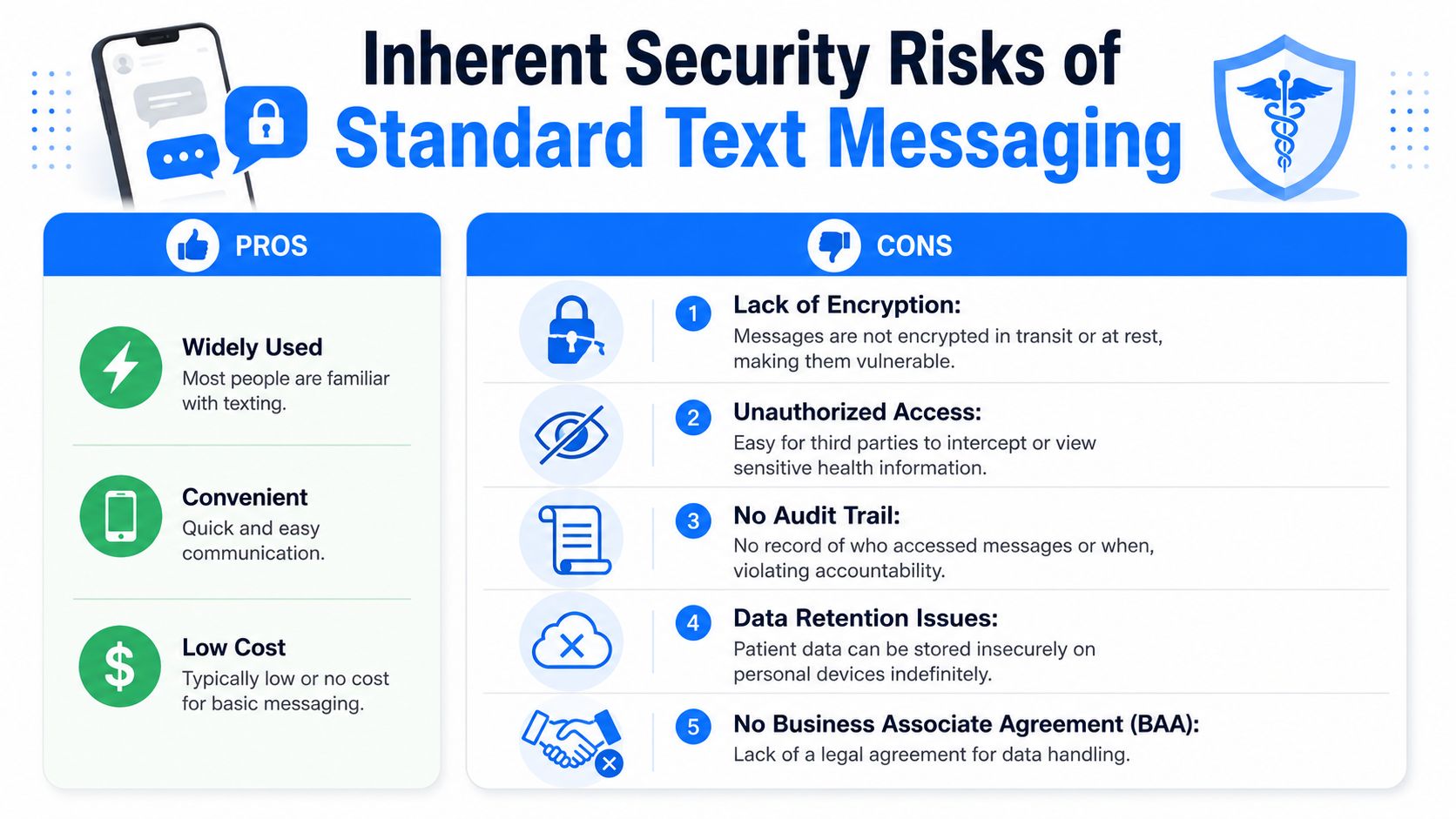
A standard text message behaves more like a postcard than a sealed envelope. The content can move through carrier systems and other intermediaries, and it is not end-to-end encrypted in the way a secure healthcare messaging system should be. That is why standard carrier SMS is generally not HIPAA-compliant by default, and why message content may transit and be stored by wireless carriers or other intermediaries (Holland & Hart).
The risk starts before anyone even reads the message. If the channel is not encrypted end to end, you are relying on a consumer transport system to protect healthcare data it was never designed to handle. HIPAA can permit text-based PHI only when the covered entity uses reasonable safeguards and the patient has been warned that the channel is insecure or has requested that method of communication.
That warning changes the workflow, not just the consent form. If a patient asks for texts, the practice still has to decide what kind of content belongs in a text, whether the number is verified, and where the message is stored afterward. A wrong-number reminder or a message that reveals too much can create problems even if the text was sent with good intentions.
HIPAA compliance is not just about whether a message can travel. It is also about whether your team can prove who sent it, who accessed it, and when it was viewed. Standard SMS usually gives you little to no access control, no meaningful audit trail, and no reliable message recall.
A secure system should leave a trail a compliance officer can follow. A personal phone with consumer texting often leaves a gap instead.
For healthcare teams, that gap shows up in everyday mistakes. A receptionist uses the wrong contact, a provider sends too much detail, or a clinician's phone keeps messages longer than it should. For a closer technical comparison of message transport, see whether SMS is encrypted alongside your internal policy.
The core issue is simple. SMS was built to move short messages fast, not to protect PHI with healthcare-grade controls. A compliant setup has to add protections around the message body, the sender identity, the receiving number, and the records that surround the exchange.
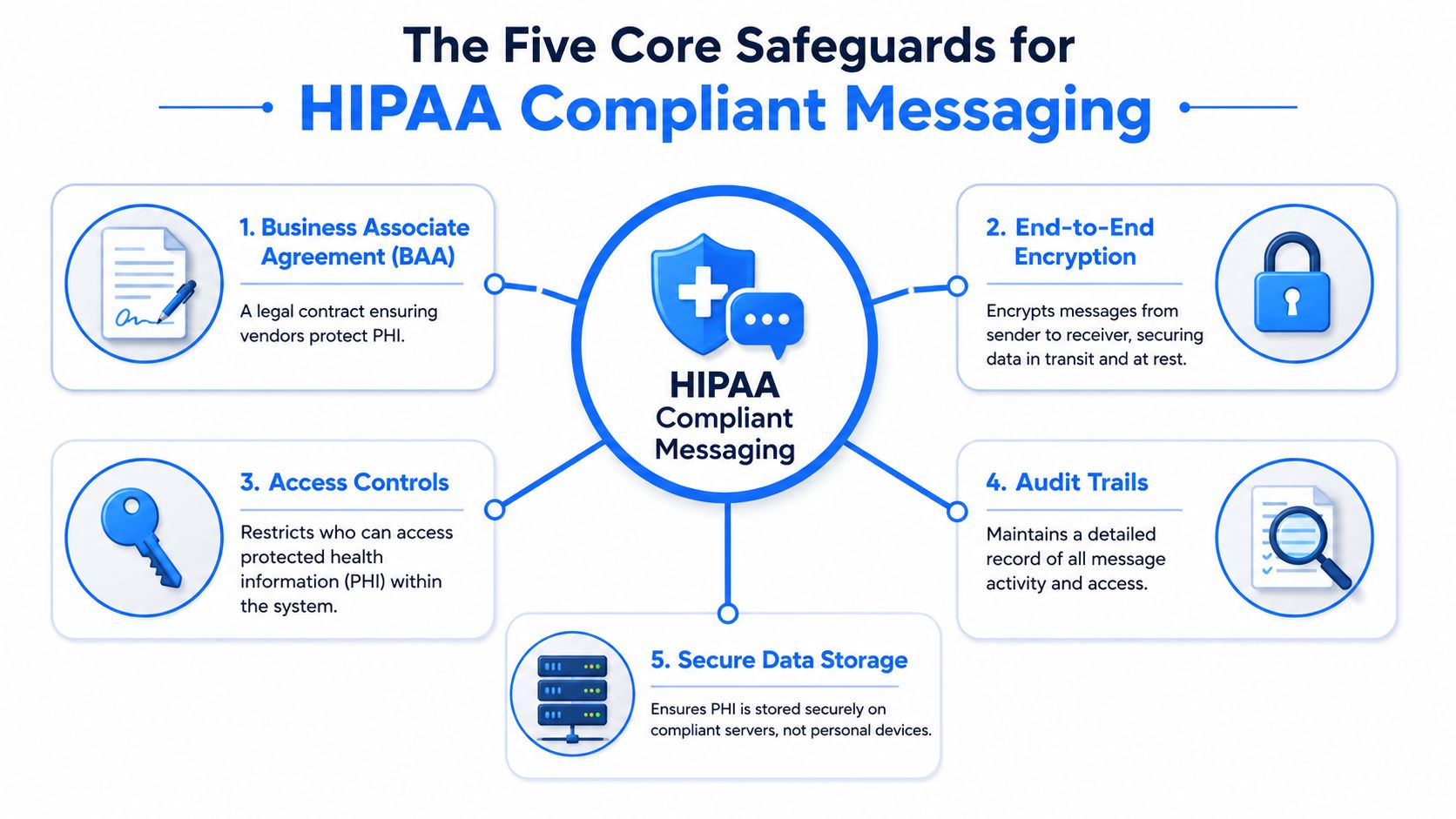
HIPAA's encryption standard is an addressable safeguard, not an automatic mandate in every case. The Security Rule still expects covered entities and their vendors to use mechanisms that can encrypt and decrypt ePHI, and to encrypt ePHI in transit when appropriate. In practice, that usually means a compliant texting workflow needs a secure messaging layer, not ordinary SMS by itself (HIPAAJournal).
A BAA is the first gate. If a vendor handles PHI on your behalf, you need a written agreement that explains how it protects that data and what each party is responsible for. Without that agreement, the platform may still work for general outreach, but it is not the right setup for protected messaging.
A compliant workflow should protect the message while it moves and while it is stored. HIPAA does not require every system to use the same mechanism in every situation, but encryption is the baseline control most healthcare teams should expect when they evaluate a vendor. A good starting point is a HIPAA SMS compliance checklist that ties the technical setup to your internal policies.
Your messaging system should limit who can see PHI, who can send it, and who can manage the account. That includes unique logins, role-based permissions, and identity checks. If everyone can see everything, you do not have a compliance workflow, you have a shared inbox with better branding.
If there is no audit log, there is no clean way to trace the message lifecycle. A real healthcare platform should record message activity and access events so your team can review what happened during a privacy incident or an internal audit. That record matters when you need to answer who sent a text, who opened it, and whether anyone touched the message afterward.
Storage is where a lot of teams get sloppy. HIPAA-compliant messaging should keep PHI off personal devices whenever possible and store it on compliant systems with policy-based retention. That matters because secure transmission alone does not fix weak storage practices, and a message that lands in the wrong place can still become a reportable problem.
A useful way to judge the workflow is simple. If the platform cannot protect the message before, during, and after delivery, it is only solving part of the problem. The whole process has to hold together, from vendor agreement to storage and access control.
The mistake many practices make is shopping for “HIPAA-compliant SMS” as if it were a product label. It's better to think in terms of a complete stack, because compliance depends on the BAA, encryption in transit and at rest, access controls, audit logs, identity and number verification, and data-minimization rules (HIPAAVault). The biggest operational risks are usually wrong-number delivery and over-sharing in reminders.
Start with use cases. Appointment reminders, referral follow-ups, billing nudges, and portal prompts don't all need the same level of detail. A reminder that says “Your visit is tomorrow at 9 a.m.” is very different from one that spells out a diagnosis or test result.
Good practice: Keep texts short enough that a mistaken recipient learns as little as possible.
If you want a structured rollout, use a formal checklist such as this HIPAA SMS compliance guide and adapt it to your own policies. Staff training matters here because the safest platform still fails if people send the wrong content or skip verification.
A compliant message should tell the patient enough to act, not enough to expose the chart. For example, “Your appointment is scheduled for Tuesday at 2 p.m. Reply C to confirm” is better than “Your cardiology follow-up for abnormal stress test results is Tuesday at 2 p.m.” The second version gives away far more than the reminder requires.
| Step | Action Required | Why It Matters |
|---|---|---|
| Vendor review | Confirm the provider will sign a BAA | PHI handling needs a legal framework |
| Security review | Verify encryption, access controls, and audit logs | These controls reduce exposure and support accountability |
| Patient setup | Document consent, warnings, and communication preferences | HIPAA may allow texting when the patient requests it or is warned about the risks |
| Message design | Use minimum necessary content | Limits what a wrong recipient can see |
| Number verification | Confirm the correct mobile number before sending | Reduces wrong-number delivery risk |
| Staff training | Teach allowed use cases and prohibited content | Human error is often the weakest link |
| Recordkeeping | Keep logs and review exceptions | Supports incident response and internal oversight |
A real vendor conversation should feel like a compliance interview, not a sales demo. If the company can't answer basic security questions clearly, you already know the answer. A platform that's serious about healthcare should be able to explain its BAA process, access model, storage approach, and audit capabilities without hand-waving.
The vendor should also fit the way your team communicates. Some healthcare groups need secure SMS for reminders, while others want a broader outreach system that also supports ringless voicemail and voice messaging for patients who don't respond to text. The point isn't to add channels for novelty, it's to make sure each one is governed by the same compliance discipline.
For teams evaluating broader outreach tools, the features described in Call Loop's HIPAA-compliant communication platform overview are a useful benchmark for what to ask any vendor, even if you choose a different system.
It can be, but not because voicemail is automatically safer than SMS. The same logic applies, the channel must sit inside a controlled workflow with the right permissions, vendor terms, and content limits. If a voicemail mentions PHI, you still need to think about who can hear it, how it's stored, and whether the patient wants that channel.
That changes the context, but it doesn't erase your responsibilities. HIPAA may allow texting when the patient initiates contact or requests SMS, provided the patient is warned about the risks and that warning is documented (HIPAAJournal). You still need to respond with minimum necessary content and route the conversation into a controlled workflow if the discussion gets sensitive.
Yes, if the reminder content is limited and your workflow is set up correctly. The cleaner the message, the safer the process usually is. A date, time, and contact number is much easier to defend than a message that hints at a diagnosis or procedure.
Patient communication consent
I understand that text messages and other electronic messages may not be fully secure. I authorize this practice to send me appointment reminders, follow-up notices, and other administrative messages by SMS at the phone number I provide. I understand I can withdraw this permission at any time, and I agree to notify the practice if my number changes.
That language works because it does three things at once. It warns the patient about the risk, it documents permission, and it creates a clean opt-out path. If your practice uses text-based outreach, that documentation should live where staff can find it.
If your team is still sending patient messages from personal phones or a consumer app, this is the point to tighten the workflow. Review your current texting process, ask every vendor whether they'll sign a BAA, and make sure your staff knows exactly what belongs in a message and what doesn't. If you want to see how a multi-channel outreach platform handles SMS, voice broadcasting, and ringless voicemail in a single system, visit Call Loop and compare it against your current patient communication setup.
Chris Brisson
Chris is the co-founder and CEO at Call Loop. He is focused on marketing automation, growth hacker strategies, and creating duplicatable systems for growing a remote and bootstrapped company. Chat with him on X at @chrisbrisson


Trusted by over 45,000 people, organizations, and businesses like


