
See a Demo
You're just one step away from seeing Call Loop in action.
Enter your information below to watch a demo right now.

You're just one step away from seeing Call Loop in action.
Enter your information below to watch a demo right now.

You’re probably dealing with this right now. A list comes in from your CRM, your team wants to launch a promotion or reminder campaign, and the first operational question sounds simple: should we target landlines, mobiles, or both?
That choice affects more than channel preference. It changes what you can send, how reliably it lands, what compliance checks you need, how many retries you burn through, and whether your workflow holds up in regulated settings like healthcare. In outbound work, landline vs mobile isn’t a branding debate. It’s a routing decision with real consequences.
Businesses that treat every phone number the same usually create avoidable problems. They send SMS to numbers that can’t receive it. They push voice drops to segments better suited for text. They miss response opportunities on mobile and ignore the reliability advantages of landline delivery for certain notices and voicemail campaigns. They also create unnecessary compliance risk when consent and contact rules vary by number type and campaign type.
A better approach is straightforward. Identify the number type first. Then match the channel to the number, the goal, and the compliance standard.
It's often assumed mobile won the argument years ago. For reach, that’s broadly true. Global mobile adoption has outpaced fixed-line infrastructure, with a projected 5.8 billion mobile users by 2025 and 82% of people aged 10 and older worldwide owning a mobile phone, according to GeoPoll’s summary of ITU mobile penetration data.
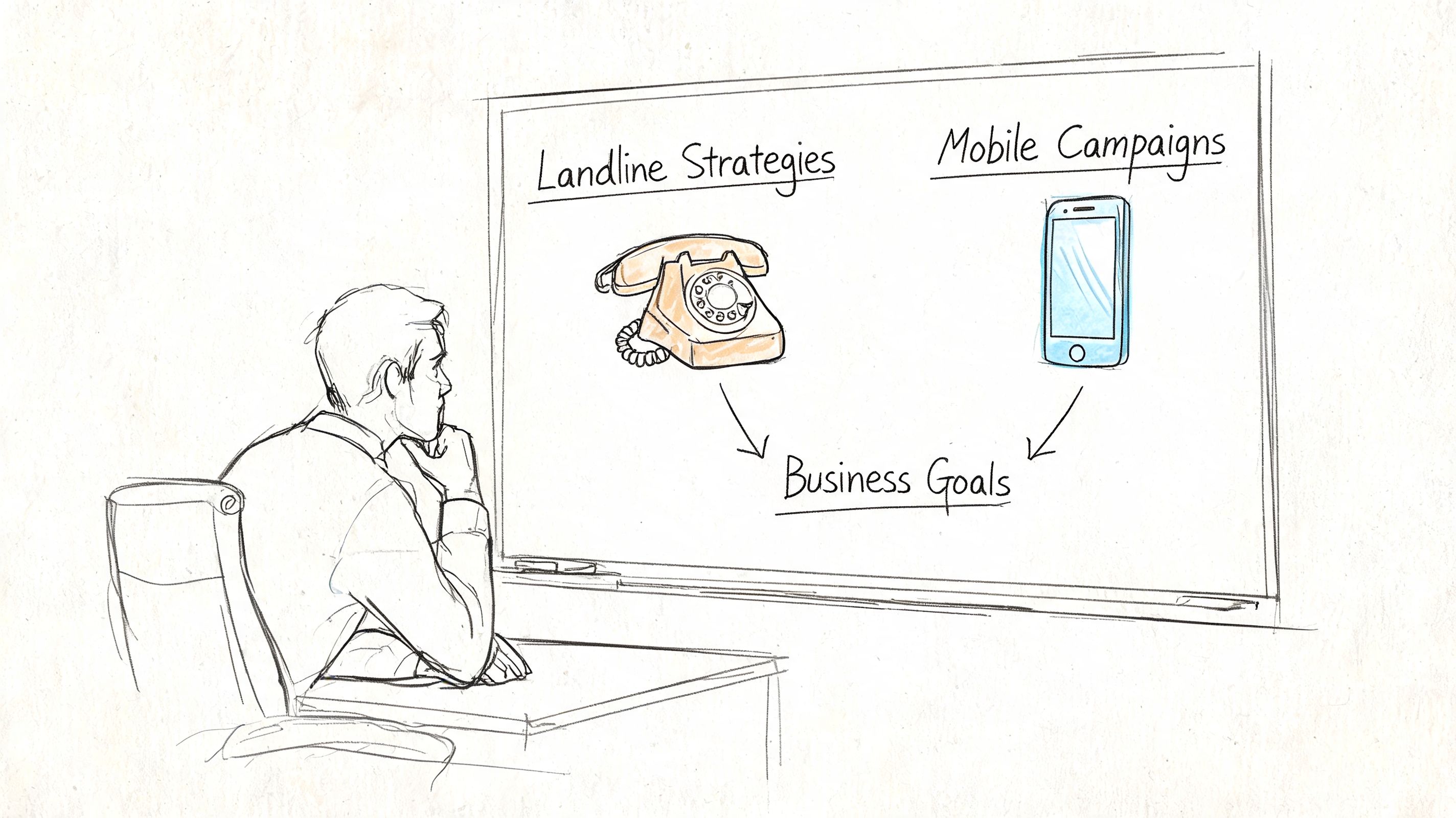
That doesn’t make landlines irrelevant. It means mobiles dominate reach, while landlines still matter for reliability, voice behavior, and certain operational environments. If you run appointment reminders, collections follow-up, school alerts, patient communications, dealership outreach, or local service campaigns, number type still changes results.
Here’s how to view it practically:
| Campaign question | Landline | Mobile |
|---|---|---|
| Best for voice reliability | Strong | Variable |
| Best for SMS and MMS | Limited without special setup | Strong |
| Best for broad personal reach | Narrower | Strong |
| Best for ringless voicemail stability | Often stronger | Good, but network-dependent |
| Best for time-sensitive response | Moderate | Strong |
| Best for backup communications | Strong | Depends on coverage and device state |
The issue is message-channel fit. If your list contains both landlines and mobiles, one campaign won’t behave the same across both segments.
A few common mistakes show up over and over:
For teams handling mixed lists, landline text messaging strategies are useful to understand, but the larger lesson is simpler: don’t guess what a number can receive.
Practical rule: Before you write copy, decide which number types are in the audience and which channels each segment should get.
That one step improves deliverability, lowers wasted spend, and keeps compliance decisions tied to the actual contact method instead of assumptions.
Landlines and mobiles don’t just look different in a contact database. They behave differently because the underlying networks work differently.
A landline call rides on a circuit-switched path. A mobile call rides on packet-switched radio over shared spectrum. The easiest analogy is this: landlines use a reserved lane for the duration of the call, while mobile traffic moves through a busy road system where conditions change constantly.
That network design shows up in campaign performance. Landlines use a circuit-switched architecture with near-zero packet loss and latency under 20ms in optimal conditions, while mobiles use packet-switched radio and see average call drop rates of 1% to 2% in urban areas versus under 0.1% for landlines, according to Revoical’s breakdown of VoIP, landline, and mobile delivery behavior.
For outbound teams, that matters in two places:
If your campaign depends on clean audio for an offer, reminder, or escalation message, landlines usually create fewer surprises. If your list leans mobile, you get access to text and richer personal reach, but the voice side is more exposed to network variation.
Ringless voicemail campaigns make the difference more obvious. Revoical notes that landline targeting can yield 98% to 99% successful drops compared with 85% to 92% on mobiles. That doesn’t mean mobiles are a bad target. It means mobile voicemail delivery is more sensitive to handset state, network handoffs, and other variables outside your script.
That’s why experienced teams usually avoid a one-channel mindset. They don’t assume a voice drop to mobile will behave exactly like a landline voicemail drop.
If the message must land cleanly, segment first. Use mobile for text-driven response and landline for voice reliability where the list supports it.
The technical difference is only useful if your data can act on it. If your database doesn’t identify number type, your campaign logic is blind. You can’t confidently decide whether to send SMS, place a voice broadcast, or schedule a ringless voicemail.
A number identification step fixes that. Tools that classify contacts by landline, mobile, or VoIP make the rest of your workflow workable. If you need that split before building a campaign, PhoneCheckr phone lookup for landline, mobile, and VoIP identification is the kind of workflow layer that prevents channel mismatch.
Use the network differences to guide the campaign, not to argue for one format universally.
Teams get in trouble when they treat number type as a minor field. It’s not minor. It determines channel eligibility, expected delivery behavior, and how much cleanup you’ll need after launch.
The fastest way to make sense of landline vs mobile is to compare them by campaign outcome, not by nostalgia or device preference.
In the U.S., mobile ownership is near saturation at 98% for cellphones and 91% for smartphones among adults in 2025, and mobile also accounts for 55.94% of worldwide web traffic versus 44.06% for desktop, according to Pew’s mobile fact sheet. That tells you where attention lives. It doesn’t erase the practical strengths of landlines for voice reliability.
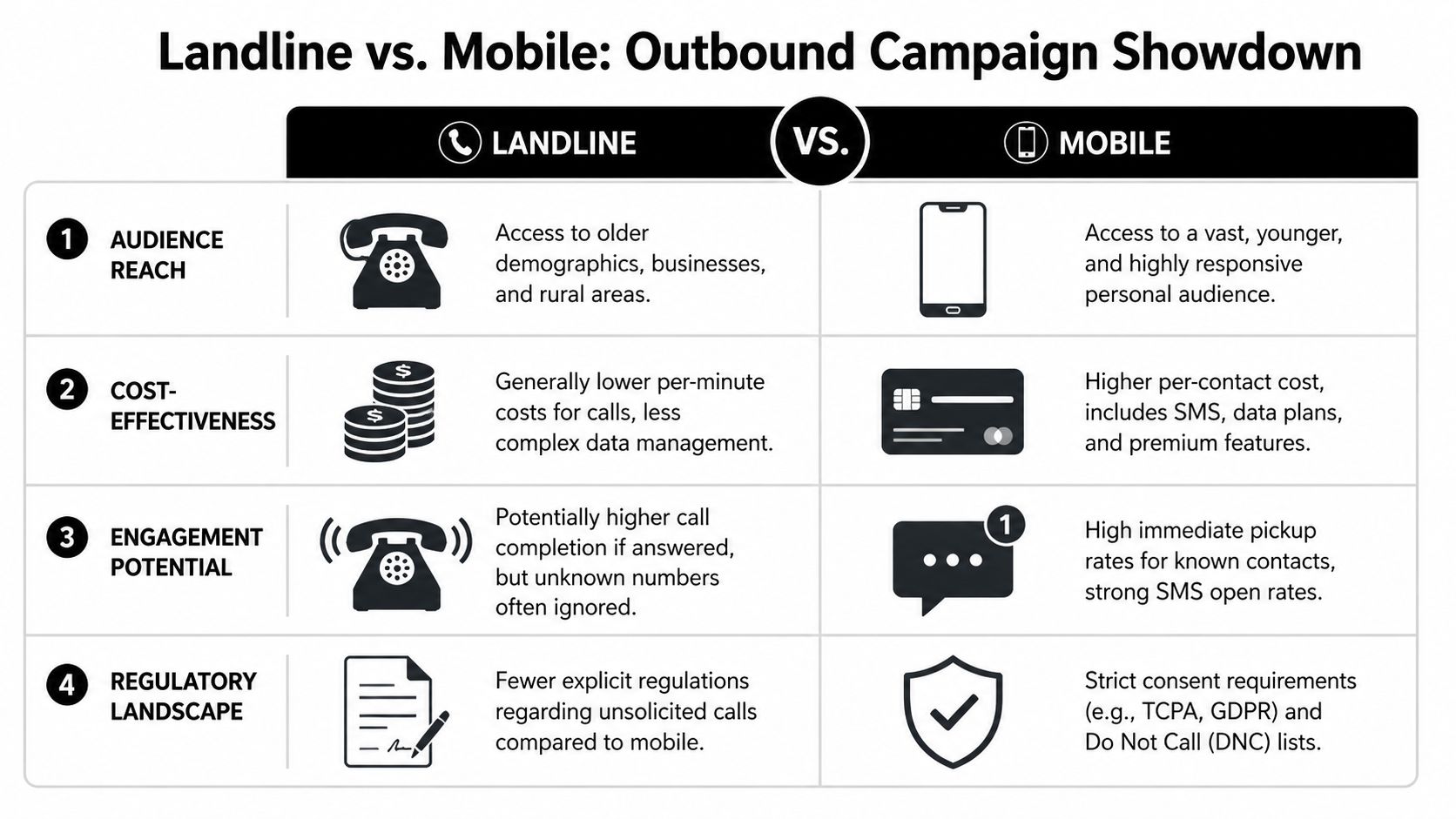
| Criteria | Landline | Mobile |
|---|---|---|
| Reach | More limited consumer reach, but still relevant in homes, offices, and some rural or regulated settings | Broad personal reach and everyday accessibility |
| Voice quality | More stable for live calls and voicemail delivery | More variable based on device, coverage, and congestion |
| SMS and MMS fit | Usually not the default path for standard texting workflows | Native fit for SMS, MMS, and short-response campaigns |
| Response behavior | Better for formal notices, office answering, and voicemail workflows | Better for immediate action, link clicks, confirmations, and replies |
| Compliance sensitivity | Still needs rules and suppression management | Usually stricter in practice because marketing texts and mobile dialing create more exposure |
| Best campaign roles | Backup channel, voice alerts, ringless voicemail, critical notices | Promotions, reminders, confirmations, conversations |
Mobile wins on scale. That matters if your campaign goal is broad consumer contact, especially for direct response.
Landline reach is more selective. That’s not always a disadvantage. For some businesses, selective is exactly what you want. Offices, front desks, certain household segments, and emergency continuity workflows still make landline data useful.
Decision lens: If the goal is immediate customer action, start by asking how much of your audience can respond fastest on mobile.
Landlines still have the cleaner voice profile. If you’ve ever listened to campaign recordings from mixed number types, you can hear the difference. Stable audio matters more than teams think, especially for healthcare reminders, payment prompts, and community notices where clarity affects action.
Mobile quality is often fine, but “fine” and “predictable” aren’t the same. Campaign managers care about predictability.
Mobile clearly expands what you can do. SMS and MMS give you a lightweight path to confirmations, links, quick replies, and follow-up sequences. If your campaign includes a click, a one-word reply, or a time-sensitive offer, mobile gives you more room to work.
Landlines can still play a role in messaging strategies, but not as a default substitute for mobile texting. Their value in outbound tends to be stronger on the voice side.
This is one of the most overlooked differences in landline vs mobile campaigns.
A mobile number is personal. That’s good when the contact trusts you and expects the message. It’s less helpful when the contact doesn’t recognize the sender. Mobile users also manage notifications, silent mode, and Do Not Disturb behavior in ways that can reduce immediate response.
Landline numbers often connect to a household or business environment with different answering habits. For ringless voicemail and certain voice campaigns, that can create a more dependable delivery path.
A number can be reachable without being equally usable. Mobile gives access. Landline can give cleaner voice execution.
The primary cost issue isn’t just platform pricing. It’s wasted actions.
If you send SMS to non-mobile numbers, you’re wasting list volume. If you push voice to a segment that would have converted faster by text, you add time and friction. If you fail to suppress the wrong segment for the wrong channel, your reporting gets distorted and your team starts optimizing bad assumptions.
A good campaign manager asks:
That’s a better cost model than comparing channels in the abstract.
The practical answer for many businesses isn’t landline or mobile. It’s landline and mobile with different jobs.
Use mobile where speed, replies, and link-driven action matter. Use landline where voice reliability, voicemail completion, and continuity matter. Build the workflow so each number type gets the channel it can support.
Compliance problems usually start before launch. A team imports a list, writes one message, and applies one automation rule to every number. That’s how landline vs mobile turns into legal risk.
The safer approach is to treat compliance as a routing problem. Different number types and different message types create different obligations, and your campaign logic should reflect that from the start.
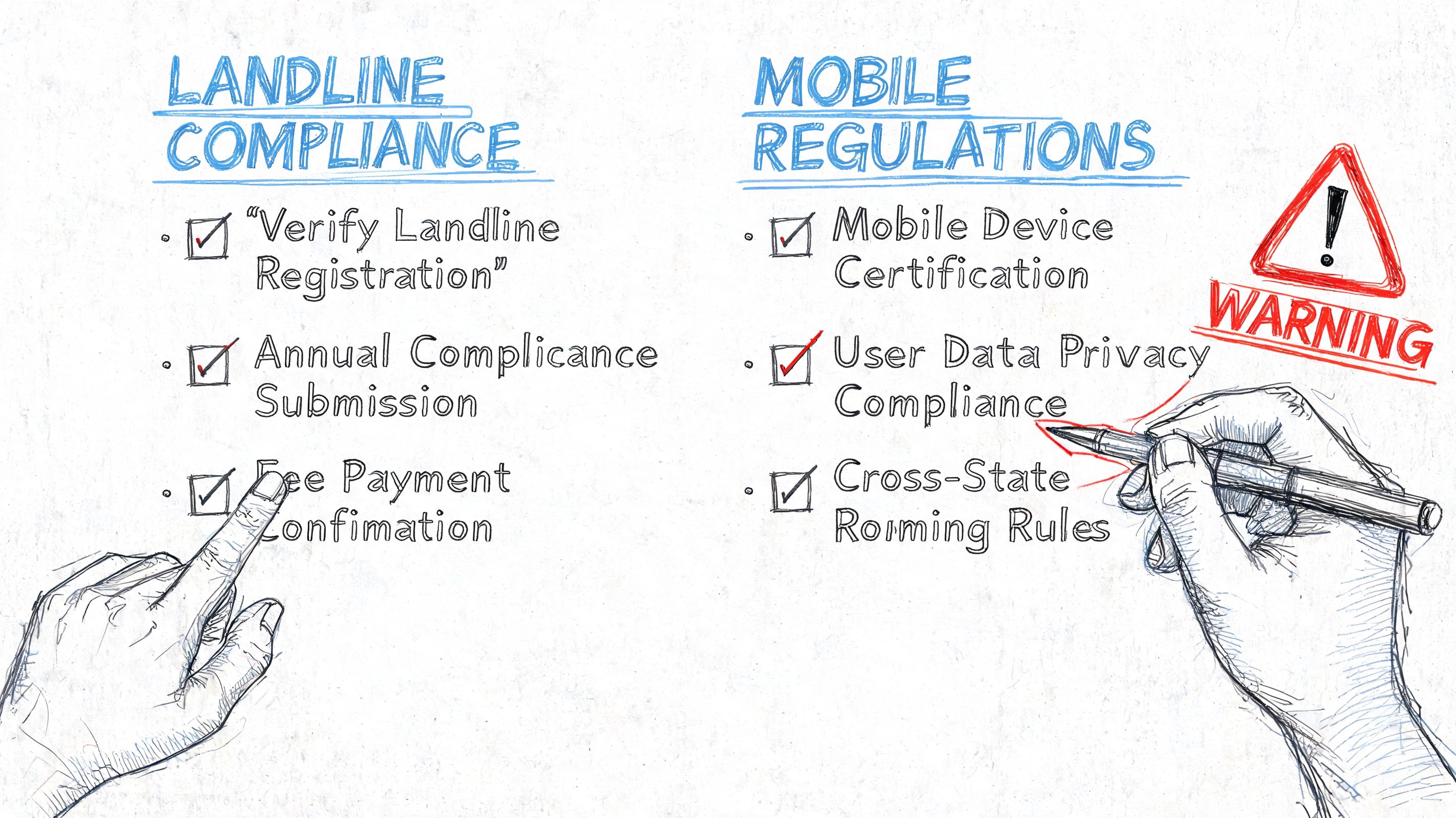
For outbound work, two habits matter regardless of channel:
That sounds obvious, but a lot of teams still separate compliance from operations. They let legal draft policies while the campaign team builds workflows. In practice, those two functions have to meet inside the list itself.
At minimum, your process should define:
A mobile campaign often carries more practical exposure because it can involve SMS, personal device contact, and tighter consent expectations around automated outreach. A landline campaign can still create risk, especially if you ignore do-not-call controls or contact people without a valid basis, but the operational rule set usually differs by channel and use case.
That’s why one of the biggest mistakes is writing a “phone outreach policy” that ignores number type. You need a channel-specific contact policy tied to the actual destination and message format.
Compliance habit: If the workflow can’t tell the difference between a mobile and a landline, it’s not ready to automate.
Healthcare makes the trade-off sharper. Reliability matters, and so does continuity during disruption. Traditional landlines provide precise location data to 911 operators and can continue working during power outages. Lively’s summary citing recent FCC data notes that 15% of U.S. rural healthcare facilities still rely on landlines for this reason.
That matters beyond emergency response. It affects how a clinic, home health provider, or rural practice plans patient outreach when mobile coverage is inconsistent or infrastructure is stressed. If you only design for mobile convenience, you may create a communications gap in the exact moments when message reliability matters most.
For most organizations, this is the cleanest model:
The point isn’t to make outreach slower. It’s to keep your team from improvising compliance in the middle of a campaign.
Simple rules work better than long policy memos. If the campaign is promotional, use the stricter standard. If the message contains sensitive context, reduce content exposure and use the approved workflow. If the number type is unknown, pause it until it’s classified.
That discipline matters more than clever automation. Good outbound teams don’t just ask, “Can we send this?” They ask, “Should this number receive this message in this format at all?”
The best landline vs mobile decision depends on what you’re trying to accomplish. Not every campaign needs the same mix, and trying to force one template onto every use case usually hurts response quality.
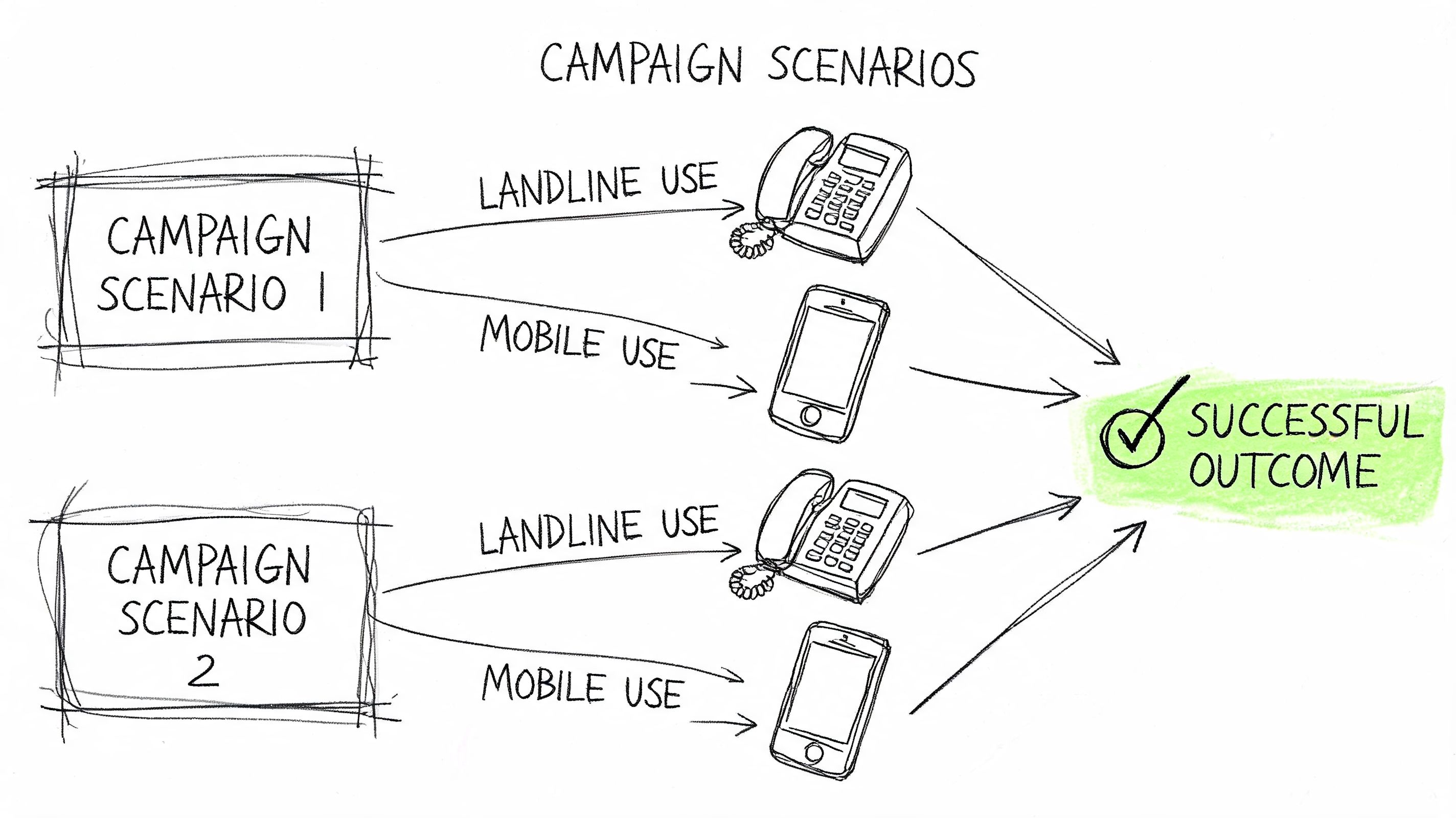
If you’re running ecommerce, retail, or event-driven promotions, mobile should carry the front end of the campaign.
SMS fits this use case because the contact can see the message fast, tap a link, and act immediately. A mobile-first workflow also gives your team a cleaner way to handle short responses, coupon reminders, and last-call nudges.
Landlines still have a role, but not as the lead channel. Use them as a secondary voice path if you’re contacting high-value segments that have historically responded to voicemail or live reminder calls.
A practical setup looks like this:
Under these circumstances, hybrid strategy tends to work best.
For a clinic, dental office, specialist practice, or service business with scheduled appointments, mobile is strong for confirmations and short reminders. But voice still matters, especially when a reminder needs to be heard by a household, front desk, caregiver, or shared contact point.
Ringless voicemail is useful here because it can deliver a reminder without forcing the recipient to answer in the moment. That lowers friction while preserving a clear spoken message.
For reminders, use text for speed and voicemail for coverage. Don’t force one channel to do both jobs.
If the environment is regulated, keep the message lean and operational. Focus on the appointment, callback action, or scheduling prompt. Avoid adding sensitive detail that doesn’t need to travel in the outbound message.
Schools, municipalities, property managers, churches, associations, and field-service teams often need broad notification capacity with minimal delay. In these campaigns, landlines regain importance because the message may need to hit homes, offices, and fixed locations reliably.
Voice broadcasting and ringless voicemail both fit this scenario better than a pure SMS approach, especially when the message needs a human voice and broad household reach. Mobile still matters for personal awareness, but relying only on text can leave gaps.
Good use cases include:
For sales teams, number type should shape the sequence.
Mobile is usually the better first move when the contact has opted in to text or has an active conversational workflow. It supports fast back-and-forth, simple qualification, and quick rescheduling.
Landline fits better when your team is working office contacts, business switchboards, or follow-up that benefits from a voicemail trail. Ringless voicemail can keep follow-up moving without requiring a live pickup.
These campaigns work best when the message is clear, polite, and easy to act on. Mobile can handle the reminder and payment link. Landline can backstop the sequence with a voice message that clarifies urgency and gives a callback path.
What usually fails is overloading the contact with too many touches from the same channel. If a customer ignores one text, sending three more texts may not fix it. A short voicemail or ringless drop can change the pattern and get attention without creating the same type of fatigue.
Across use cases, the pattern is consistent:
That’s the practical center of landline vs mobile. Different number types support different campaign jobs. Treat them that way and your outbound programs become easier to run and easier to defend.
A good strategy only works if the setup is clean. Mixed-number outreach fails when teams dump every contact into one path and try to fix the results later. The better approach is to build the routing logic before the first message goes out.
If you’re using a platform with number validation, drip sequencing, voice broadcasting, ringless voicemail, and suppression controls, the workflow is straightforward. The key is to separate number classification, channel assignment, and compliance gating instead of blending them together.
Start with the phone field, not the message.
Run your imported contacts through a number identification step so each record is labeled as landline, mobile, or VoIP where available. That single field should drive almost everything else in the campaign. Without it, your SMS routing, voicemail decisions, and compliance logic will all be weaker than they need to be.
For implementation ideas, multi-channel communication strategy examples are useful because they show how one audience can branch into different paths without turning the campaign into a manual mess.
Your list should end up with segments like:
Teams often overcomplicate things. You don’t need every channel doing everything.
Set a primary purpose for each:
That division keeps copy tighter and reporting clearer. If you treat SMS like email, voice like SMS, and voicemail like a replacement for live outreach, the sequence gets muddy fast.
Build campaigns so each channel does one thing well. That’s easier to optimize than a sequence where every touch tries to carry the full message.
Once the segments are clean, route them differently.
A simple hybrid workflow might look like this:
This setup matters because landline and mobile users don’t interact with outreach in the same way. If your workflow respects that, the campaign feels intentional. If it doesn’t, your team spends the week troubleshooting edge cases.
A lot of outbound campaigns underperform because the same script gets pasted into every channel.
SMS copy should be short, direct, and easy to act on. It should answer one question fast: what should the recipient do next?
Voice copy, including ringless voicemail, needs to sound natural when heard once. That means shorter sentences, clear identification, one main action, and a callback or next-step instruction that can be understood without replaying the message several times.
A useful structure is:
For healthcare, appointment reminders, and sensitive accounts, keep the language operational and minimal. If the contact needs more detail, move that detail into the secure or live follow-up path.
Good sequencing is about spacing, not volume.
For example, a reminder workflow might send a mobile text first because it allows a quick confirmation. A landline segment might receive a voicemail instead at roughly the same stage. If there’s no response, the next touch should add a different contact mode or a clearer action, not just repeat the first message louder.
Useful timing principles include:
If your campaign uses press-1 transfers or call routing, don’t attach that option to every message by default. It works best when the offer or request benefits from real-time conversation.
Examples where transfer logic makes sense:
When it doesn’t fit, skip it. A campaign gets stronger when the response path matches the recipient’s likely intent.
Suppression should never be a manual afterthought. If someone opts out, lands on a DNC list, or is marked ineligible for a specific type of outreach, that status needs to apply automatically to future sends.
A platform like Call Loop is useful in a factual, operational sense. It supports SMS, voice broadcasting, ringless voicemail, drip campaigns, number validation, DNC management, live and machine answer detection, and HIPAA-compliant workflows, which makes it possible to route landline and mobile contacts differently without rebuilding the process in separate tools.
A blended campaign can look average overall while one branch is performing well and another is wasting effort. That’s why reporting should stay segmented by number type and by channel.
Review results separately for:
That view gives you something actionable. Maybe the mobile path needs shorter copy. Maybe the landline voicemail path is carrying more than expected. Maybe one segment should stop receiving a second touch entirely.
The main point is simple. Landline vs mobile is not a cosmetic field in your CRM. It’s the control switch for campaign routing. Once you build around that fact, your outreach gets cleaner, your compliance posture improves, and your team stops wasting sends on the wrong channel.
If you want one platform to handle that routing logic, Call Loop gives teams a way to validate numbers, segment landline and mobile contacts, and automate SMS, voice broadcasting, and ringless voicemail in the same workflow. That setup is especially useful when you need compliant outreach, clearer reporting by channel, and a practical way to run hybrid campaigns without stitching together separate tools.
Chris Brisson
Chris is the co-founder and CEO at Call Loop. He is focused on marketing automation, growth hacker strategies, and creating duplicatable systems for growing a remote and bootstrapped company. Chat with him on X at @chrisbrisson


Trusted by over 45,000 people, organizations, and businesses like


