
See a Demo
You're just one step away from seeing Call Loop in action.
Enter your information below to watch a demo right now.

You're just one step away from seeing Call Loop in action.
Enter your information below to watch a demo right now.


You know mobile marketing matters. The hard part isn't understanding the channels. It's turning vague ideas into campaigns that people respond to without creating a compliance mess, a timing problem, or a reporting blind spot.
Professionals don't need more theory. They need a mobile marketing strategy example they can adapt this week. They need to know when SMS should carry the message, when voice should take over, when ringless voicemail makes more sense than a live call, and how to connect those touches into one sequence that feels coordinated instead of repetitive.
That's where most advice falls short. It explains SMS, push, and geotargeting as separate tactics, but real campaigns rarely work in isolation. The better approach is orchestration: one message, matched to the right channel, sent at the right moment, with clear measurement and opt-out handling built in from the start.
If you're trying to simplify your customer journey across devices and touchpoints, the same discipline applies in adjacent channels too, including ecommerce listing performance. That's why teams often tighten both campaign execution and conversion surfaces at the same time, whether that means outbound messaging or fixing storefront pages with services like fix my Amazon listings.
Below are eight practical playbooks built for action, not theory.

SMS is still one of the clearest mobile marketing strategy example starting points because it's direct, permission-based, and built for action. Industry guidance notes that SMS is typically capped at 160 characters per message and supports targeted, behavior-based offers sent directly to a customer's phone in a measurable way, with marketers commonly tracking click-through rate, conversion rate, and ROI while using analytics and A/B testing to refine message, timing, and audience in GroundTruth's mobile marketing guidance.
That matters because mobile commerce breaks when there's friction. If the text is relevant but the checkout experience is clunky, performance drops fast. If the message and payment flow are both streamlined, the path from tap to purchase feels natural.
A karate studio can text former trial students a limited enrollment offer with a tracked link to a mobile signup page. A Shopify store can send an abandoned cart reminder with a direct product link. An event brand can text last-minute ticket availability with a checkout link that doesn't force extra steps.
Use the mechanics that reduce hesitation:
Practical rule: Don't send a strong SMS campaign into a weak checkout flow.
GroundTruth also points to brands like Express using SMS for personalized promotions, event notices, and rewards reminders, which is a useful model for smaller teams. You don't need a massive program. You need relevance, timing, and a clean mobile payment path.
What works is concise copy, first-party data, and a checkout experience that respects mobile behavior. What usually fails is generic messaging, too many links, or product pages that still feel designed for desktop.
If you want one reliable pattern, use SMS to create urgency and use your store or landing page to remove friction.
The simplest mistake in automation is treating every lead the same. A prospect who downloaded a guide shouldn't get the same cadence as a customer who booked an appointment yesterday. Good drip campaigns respond to timing and behavior, not just list membership.
Multi-step outreach proves its worth. Instead of one isolated text, build a short sequence that follows a trigger such as signup date, appointment date, missed call, purchase date, or form abandonment.
For a webinar, the sequence might look like this:
For healthcare or service appointments, the pattern changes. A reminder sequence tied to the calendar usually beats a generic promotional drip because the customer already has context. The content can stay short and useful.
A lot of teams overbuild these automations. They create too many branches, too many delays, and too many exceptions. Keep the first version simple, then refine it using unsubscribe trends, replies, click patterns, and missed conversions. Call Loop's own guidance on drip campaign best practices is useful here, especially if you're sequencing SMS, voice, and reminders together.
One good sequence usually outperforms five half-finished automations.
The biggest failure points are message fatigue and poor exit logic. If someone books, buys, replies, or asks to stop, they shouldn't keep receiving the same automated nudges.
Use a clear end condition for every sequence. Remove contacts when they convert. Branch them when they respond. Slow the cadence when the message is informational rather than urgent.
If you want outside inspiration for structure, Ascendly Marketing's drip campaign guide offers examples from the email side that translate well into mobile journeys when adapted for shorter, faster interactions.
A customer misses your text reminder, ignores your email, and still needs to confirm an appointment today. Voice is often the better tool in that moment because it carries urgency, gives context fast, and can collect a response inside the call.
That makes voice broadcasting and IVR useful for operational campaigns, not just promotions. Use it for appointment confirmations, school alerts, payment reminders, schedule changes, outage notices, and event support. If the goal is immediate action or guided routing, voice often outperforms a message that asks the recipient to stop and read.
Voice works best when the next step can happen during the call. Press-1 confirmation, live transfer, keypress routing, and simple menu choices reduce drop-off because the recipient does not need to switch channels to act.
A few practical examples:
This is the key advantage. Voice should sit inside a sequence, not operate alone.
Write the script for listening speed. The recipient should understand the caller, the purpose, and the action within the first few seconds.
Use this pattern:
Caller ID matters too. A recognizable number or branded caller name improves answer rates and reduces confusion.
The strongest playbooks combine channels based on urgency and friction.
A practical sequence looks like this:
Teams building these flows should pay attention to timing, consent, and suppression across channels. Call Loop's guide to ringless voicemail marketing workflows is useful if you are coordinating voice, SMS, and voicemail in one campaign process.
Do not judge voice by pickups alone.
Track the outcome that matches the campaign goal:
A campaign with modest answer rates can still perform well if the people who do answer complete the intended action.
Voice is a strong fit for older audiences, regulated service categories, urgent reminders, and any campaign where guided action matters more than reading details on screen.
It is a weaker fit for product discovery, visual offers, or messages that require comparison shopping. In those cases, SMS or email should carry the offer, and voice should only support follow-up if the timing justifies the interruption.
Ringless voicemail fills a useful middle ground. It's less disruptive than a live call and often more noticeable than an email. When the message is important but not urgent enough to interrupt someone, it can be the right move.
That makes it a practical mobile marketing strategy example for reminders, payment notices, account alerts, service follow-ups, and re-engagement campaigns. Medical offices, property managers, loan servicers, and local service businesses can all use it to deliver a clear message without asking the recipient to answer in real time.
The strongest ringless voicemail messages sound natural, not theatrical. Use a warm voice, identify the business quickly, state the reason for the message, and give one simple next step. If the callback number or action step is hard to catch, repeat it once.
A useful pattern looks like this:
For teams using this channel regularly, Call Loop's overview of ringless voicemail marketing is relevant because the operational details matter as much as the script. Delivery tracking, scheduling, segmentation, and suppression rules are what turn ringless voicemail from a one-off tactic into a repeatable system.
Ringless voicemail works best when it supports another touch, not when it tries to do the whole job alone.
The cleanest sequence is usually SMS plus ringless voicemail. Send the voicemail for context and the text for the clickable action. For example, a dental office can leave a voicemail reminder and follow with an SMS confirmation link. A collections team can leave a voicemail and send a secure payment text separately.
What doesn't work is dropping a voicemail with too many details and no easy next step. Let voice create recognition. Let SMS handle the tap.
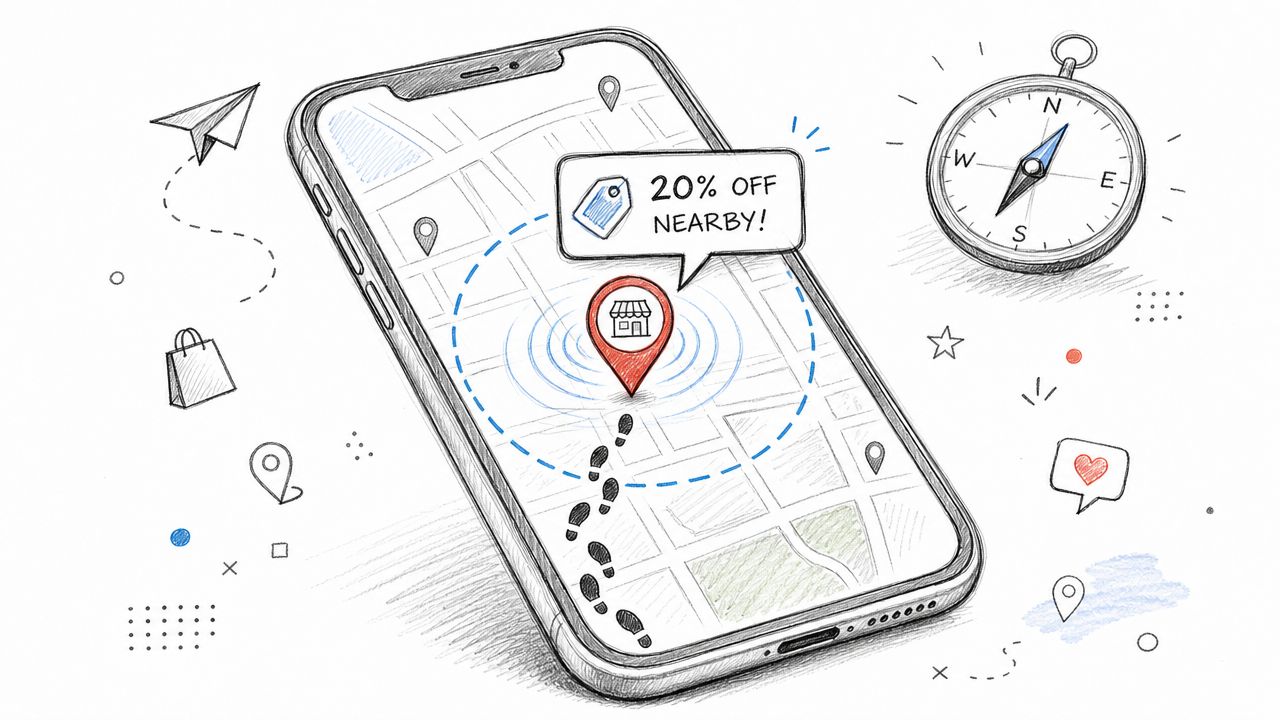
Location-based marketing sounds complex, but the core idea is simple. Deliver a message when place changes intent. If someone is near your store, entering an event venue, arriving at a hotel, or passing a studio they considered before, relevance increases immediately.
The problem is that many campaigns stop at geography. They trigger by location but ignore who the person is, what they've done before, and whether the timing makes sense. That's where geotargeting turns from smart to noisy.
Use location as one signal, not the whole strategy. A restaurant near office parks can promote lunch differently than dinner. A movie theater can send concession offers only to loyalty members who've already opted in. A karate studio can remind a nearby prospect about beginner class times, but only if that person previously expressed interest.
Customer.io's guidance on mobile strategy stresses relevance, timing, segmentation, and omnichannel consistency, while pointing out the practical gap many teams face: deciding which mobile channel fits which segment and trigger in its mobile marketing strategy article. That's the right frame for geotargeting too.
Geo-targeting is strongest for foot traffic, arrivals, local events, and time-sensitive in-person offers. It's weaker when the value proposition needs more explanation or when location doesn't change the customer's likelihood to act.
If the message would feel just as relevant from anywhere, location probably shouldn't trigger it.
A customer taps your SMS reminder, opens the follow-up email on their phone, and gets a wall of tiny text, a clipped subject line, and a CTA button they can barely hit. That journey breaks even if the offer was right.
Mobile-first email fixes that handoff. In a multi-channel program, SMS gets the open, voice can reinforce urgency, and email carries the detail that does not fit in a text or voicemail. If the email is hard to read on a phone, the whole sequence loses momentum.
Start with the constraints of a small screen:
The format changes by use case. A karate studio newsletter should keep class updates, promotions, and one registration link above the fold. A healthcare follow-up should put appointment instructions first, not under a banner image. An ecommerce email should avoid dense product grids that force scrolling and zooming.
Personalization also needs restraint. Use first-party behavior such as past purchases, browsed categories, or prior clicks to decide what content block appears first. Do not cram every known detail into one send. On mobile, relevance beats volume.
If readers need to zoom in or search for the CTA, the email is not ready to send.
Email does the heavier lifting. It is the right place for onboarding steps, prep instructions, product comparisons, event details, receipts, and policy updates.
SMS, voice, and ringless voicemail support it:
That sequencing matters. A short text can drive the open. A clear email can close the gap between interest and action. Platforms like Call Loop are useful here because the job is not just sending messages. It is coordinating channels, timing, and stop rules so customers do not get the same prompt three times in three formats.
One more point. Mobile-first design is not only a creative decision. It affects compliance and deliverability too. Clear sender identity, obvious unsubscribe options, and readable formatting reduce confusion and lower the chance that recipients mark the message as spam.
Broadcasting gets attention. Conversation gets commitment.
Two-way SMS works because it lets the customer respond in the same channel where they received the message. That sounds obvious, but many brands still send one-way texts that force people to call, click, or start over somewhere else. In healthcare, events, education, and service businesses, that extra step creates drop-off.
A patient can text to confirm or reschedule. A parent can reply to a karate class reminder with an attendance update. A customer can ask whether a product is available in another size. An event registrant can send dietary restrictions without filling out another form.
The strongest setups combine automation with clear human takeover rules:
Measurement becomes more nuanced. Opens and clicks matter less than reply quality, completed actions, and whether the conversation resolves the issue. That's one of the gaps in a lot of mobile marketing advice. Nextiva's discussion of mobile marketing trends and tactics highlights how channel complexity is increasing while compliance, deliverability, and deeper measurement are often undercovered in its mobile marketing examples article.
The biggest mistake is inviting replies without staffing for them. If your team can't handle inbound questions, don't pretend the program is conversational. Start with controlled use cases like confirmations, basic support prompts, or lead qualification, then expand once you have routing and response ownership in place.
Most strong campaigns aren't channel-specific. They're sequence-specific. The channel matters, but the order matters just as much.
A healthcare reminder campaign is a good example. SMS handles immediacy. Email delivers prep details. Ringless voicemail adds a human reminder without demanding an answer. Together, the campaign feels coordinated. Sent separately without logic, it feels repetitive.
Use channel roles instead of treating every touch the same:
One of the clearest real-world examples of mobile-first conversion design comes from Legal Brand Marketing. After redesigning its funnel with a mobile-optimized landing page, a mobile-friendly form, click-to-call capability, call extensions in ads, and Google call forwarding for call-time and call-length tracking, the campaign produced an 89% increase in click-through rate and reduced cost per lead by more than 50%, according to Econsultancy's case study roundup. The takeaway is bigger than one campaign. Mobile performance improves when the entire funnel, including phone attribution, is designed for mobile behavior.
A multi-channel program fails when teams duplicate the same message everywhere. The customer doesn't need four reminders that say the same thing in the same tone. They need one coherent journey where each touch adds something.
That means shared suppression rules, a unified contact record, and a clear idea of what each channel is supposed to do. If you're building that framework, Call Loop's post on multi-channel marketing strategy is relevant because orchestration is mostly operational discipline, not creative flair.
| Strategy | Implementation complexity | Resource requirements | Expected outcomes | Ideal use cases | Key advantages |
|---|---|---|---|---|---|
| SMS Marketing & Mobile Commerce Integration | Medium | SMS platform, ecommerce/payment integration, segmentation tools, creative assets | Immediate engagement; high conversion and direct attribution; strong ROI potential | Flash sales, abandoned carts, promotions, DTC ecommerce | Extremely high open rates; one-click checkout; direct tracking |
| Drip Campaigns & Marketing Automation Sequences | Medium to High | Marketing automation/CRM, sequence design, testing resources, analytics | Improved lead nurturing, higher customer LTV, consistent follow-up | Lead nurturing, onboarding, webinars, appointment reminders | Scalable nurturing; saves time; detailed performance insights |
| Voice Broadcasting & IVR Campaigns | Medium to High | Voice/IVR platform, recordings or TTS, compliance/DNC management, agent routing | High engagement for urgent messages; immediate interaction opportunities | Urgent notifications, appointment reminders, political outreach, press‑1 sales | Personal voice builds trust; enables live transfers; good for time‑sensitive outreach |
| Ringless Voicemail Delivery | Medium | Ringless provider, quality recordings, carrier compatibility checks, per‑drop budget | Non‑intrusive delivery with higher listen rates than traditional voicemail; cost per successful drop | Appointment reminders, collections, account alerts, non‑intrusive outreach | No ringing; asynchronous delivery; pay‑for‑success model |
| Location-Based Mobile Marketing & Geo‑Targeting | High | Geofencing/beacons or GPS, app/SDK or permissioned access, location analytics, privacy controls | Contextual, moment‑based engagement that drives foot traffic and local conversions | Retail, QSR, events, competitor targeting, in‑store offers | Perfect‑moment relevance; drives store visits; location insights |
| Mobile‑First Email & Responsive Design | Low to Medium | Email platform, responsive templates, design/testing tools, image optimization | Better mobile engagement and CTR; lower cost per send than SMS; improved UX | Newsletters, product recommendations, detailed content, loyalty updates | Cost‑effective at scale; suited for longer content; complements SMS |
| Two‑Way SMS Conversational Marketing | Medium to High | Two‑way SMS platform, chatbot/AI or staffed agents, CRM integration, escalation rules | Real‑time conversations, faster issue resolution, richer customer data | Customer support, appointment confirmations, surveys, order queries | Builds relationships; collects zero‑party data; scalable with automation |
| Multi‑Channel Campaign Orchestration (SMS + Voice + Email) | High | Integrated platforms, unified CRM, cross‑channel content, analytics and governance | Maximized reach and conversions; improved attribution; reduced channel fatigue when well managed | Complex journeys in healthcare, enterprise sales, large ecommerce campaigns | Omnichannel consistency; multi‑touch lift; unified customer view |
The best mobile marketing strategy example isn't a single text blast, one push campaign, or a one-off voicemail drop. It's a system. Each channel has a job, each trigger has a reason, and each message moves the customer one step closer to a clear action.
That's why SMS, voice, ringless voicemail, and email work better together than alone. SMS is strong when speed matters. Email carries detail better. Voice helps when tone, clarity, or response routing matters. Ringless voicemail gives you a lower-friction way to deliver important follow-up without demanding a live answer. When you sequence them well, the customer experiences one coordinated conversation instead of disconnected outreach.
Start smaller than you think. Pick one use case with obvious stakes, such as appointment reminders, abandoned carts, lead follow-up, or event attendance. Build the sequence around the customer's decision path, not around the channels you happen to have available. Then measure what matters. Did they click, reply, confirm, call back, show up, or buy?
You should also be realistic about trade-offs. More channels don't automatically mean better results. They can create overlap, fatigue, and messy attribution if you don't control frequency and suppression carefully. Compliance matters too, especially when your outreach includes SMS, voice, and ringless voicemail at scale. Consent, opt-out handling, number quality, and accurate tracking aren't side tasks. They're part of campaign design.
As your program matures, move from isolated tactics to channel roles. Let SMS handle urgency. Let ringless voicemail reinforce important reminders. Let voice carry the interactions that need a human feel or IVR routing. Let email hold the details people may need to reference later. That structure makes campaign planning simpler and reporting cleaner.
If you want one platform to coordinate those moving parts, Call Loop is one relevant option for businesses running outbound messaging across SMS, voice broadcasting, and ringless voicemail. The main advantage of working this way is operational. One system makes it easier to manage sequencing, personalization, scheduling, and measurement without stitching together disconnected tools.
The long-term win is consistency. Start with one practical workflow, prove it, and expand. That's how mobile marketing becomes reliable instead of experimental. For teams focused on broader pipeline growth as well as outbound execution, this kind of disciplined orchestration fits naturally into a wider 2026 lead generation strategy.
If you're ready to turn these playbooks into live campaigns, Call Loop gives you a practical way to run SMS, voice broadcasting, ringless voicemail, and automated sequences from one platform. Start with one workflow, track every response path, and build a mobile outreach system your team can manage.
Chris Brisson
Chris is the co-founder and CEO at Call Loop. He is focused on marketing automation, growth hacker strategies, and creating duplicatable systems for growing a remote and bootstrapped company. Chat with him on X at @chrisbrisson


Trusted by over 45,000 people, organizations, and businesses like


