
See a Demo
You're just one step away from seeing Call Loop in action.
Enter your information below to watch a demo right now.

You're just one step away from seeing Call Loop in action.
Enter your information below to watch a demo right now.

Shoppers used to rely on about two touchpoints before buying. In 2025, they use nearly six on average, and roughly half of consumers now use more than four touchpoints regularly, compared with only 7% about 15 years ago (Uniform Market retail statistics). That shift changes the job description for marketing, sales, and service, because the buyer no longer moves in a straight line.
A multi-channel customer journey is now the default reality for SMBs. Buyers research online, compare on mobile, and still check out in physical environments, so the brand that wins is often the one that stays coherent across the whole path. One practical implication is simple, if your channels don't coordinate, your customer experience fragments and your follow-up loses momentum.
The strongest operators don't try to be everywhere. They choose the few channels that fit the journey, then orchestrate them tightly enough that each touchpoint feels like a continuation of the last one. That's where real lift comes from, not from piling on more noisy sends.
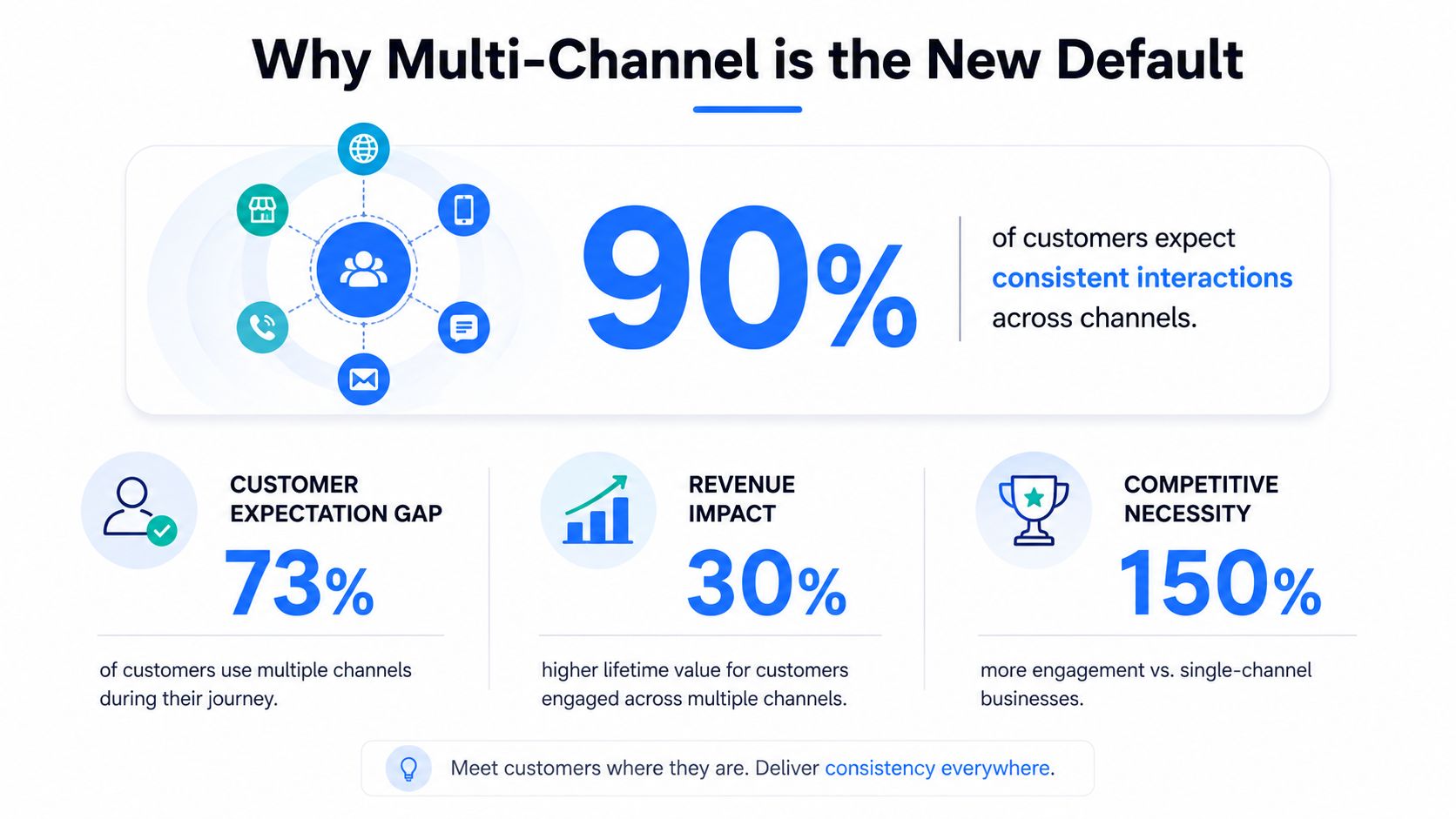
A retail survey found that 73% of shoppers engage across multiple channels during their buying journey, 83% start product research online before visiting a store, and 72% use smartphones in-store to compare prices or read reviews (Uniform Market retail statistics). Those numbers matter because they show how little value there is in treating digital and physical as separate worlds. For SMBs, the customer path is already multi-channel, whether the team planned it that way or not.
Single-channel planning assumes the customer's attention stays in one place. That breaks the moment someone checks reviews on a phone, asks a question by email, then buys in person or returns through a remarketing flow later. If your team tracks each channel in isolation, you can stay busy without moving the buyer toward a decision.
Practical rule: if one channel cannot explain why the next touch happened, you are managing campaigns, not a customer journey.
The business case is just as clear. Research compiled in 2025 reports that omnichannel retailers generate 179% faster revenue growth than retailers without integrated strategies, and that omnichannel consumers account for about 27% of retail sales (marketingltb omnichannel statistics). The same source says omnichannel brands retain 89% of customers, versus 33% for less integrated omnichannel brands, and that omnichannel shoppers deliver 30% higher lifetime value than single-channel shoppers.
For smaller teams, the lesson is operational, not theoretical. A retail store that keeps in-store behavior aligned with email, SMS, and stock availability can avoid dead-end promotions, especially when inventory is tight. That is why omnichannel stock management from Shopstar matters. Messaging and inventory need to stay in sync if the customer is moving between channels.
The same pattern shows up in services, events, and ecommerce. Customers do not think in terms of channel ownership, they think in terms of whether the brand remembered them and responded in time. When that happens, conversion gets easier.
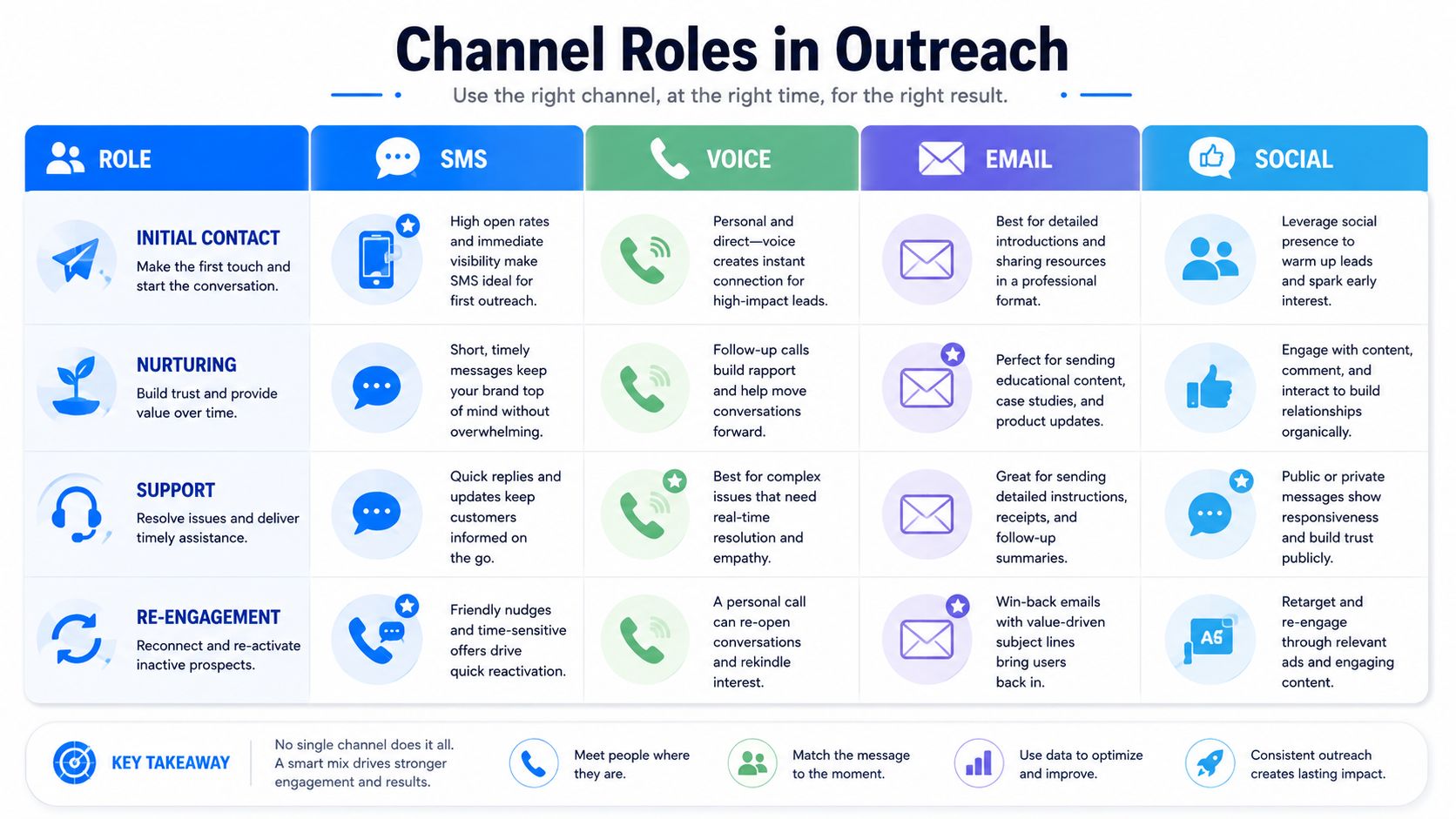
SMS, email, voice, and ringless voicemail don't do the same job well. The common mistake is treating them as interchangeable delivery pipes instead of assigning each one a role inside the journey. A strong sequence gives each channel one clear purpose, then lets the next channel pick up the conversation.
SMS works best when the message is short, timely, and action-oriented. It's the right fit for appointment reminders, payment nudges, limited-time offers, and status updates, because the customer can read it fast and respond fast. It's not the best place for a long explanation or a complicated narrative.
Email is better for context. It can carry product details, follow-up education, receipts, post-purchase care, and longer nurture paths without feeling cramped. If the buyer needs comparison, reassurance, or a structured recap, email usually does the job better than a text message.
Voice broadcasting fits high-importance announcements, especially when live answer detection or machine detection changes the next step. It works when the call itself matters, not just the message content, because the format can prompt immediate attention in a way a passive channel won't.
Ringless voicemail has a different logic. Call Loop describes it as delivery directly into the voicemail inbox without ringing the handset, with scheduling flexibility and delivery to both mobile and landline numbers. That makes it useful for non-intrusive follow-up when you want presence without interruption.
A channel is only useful if its job is clear. If it can't be named in one sentence, it's probably doing too much.
Use social for discovery and reinforcement, not for operational follow-up. Use the web for conversion points where the customer can self-serve, compare, or complete a form. Use SMS or voice when timing matters more than depth. Use ringless voicemail when you want the contact attempt on record without forcing a live interruption.
That's the key benefit of a multi-channel customer journey. Channels stop competing for attention and start covering different moments in the same decision path. A contact doesn't need to hear from you everywhere, they need to hear from you in the right place, at the right intensity, with the right next step.
A useful journey map is not a wall chart. It is a set of routing rules that tell the team who enters, who exits, what message goes out, and what happens if the customer responds or stays silent. Pedowitz Group's five-step design process, Discover, Map, Design, Orchestrate, Measure, Optimize, is a practical operating sequence because it pushes teams from idea to execution in order (Pedowitz Group).
Define exactly what qualifies someone for a journey. A new lead, a missed appointment, an abandoned cart, a quote request, or a lapsed customer each needs a different route. Then define the exit. If the customer converts, books, replies, or opts out, the workflow should stop or hand off cleanly instead of continuing to send messages.
Ownership matters just as much as logic. Marketing often owns the trigger and initial sequence, sales may own response follow-up, and customer success may own post-purchase or renewal steps. If those handoffs are not explicit, messages collide and customers get duplicate outreach.
A practical way to surface weak points is to map customer journey touchpoints before you build the automation, so you can see where attention starts, where it drops, and where a handoff needs to happen (CallLoop customer journey touchpoints).
Before you automate, write the ordered path on paper. Journey analytics gets better when you review ordered sequences for converted users, rank the top paths by volume, and optimize the highest-frequency path first (Girard Media touchpoint analysis). Keep that link in one place and use the same analysis to decide where pressure should go, because not every touchpoint deserves the same intensity.
The practical takeaway is simple. If the first path performs well, refine it before you branch into lower-signal routes. A practitioner guide notes that the top conversion paths can represent a large share of all conversions, which is a strong reminder not to spread effort across weak paths too early (Girard Media touchpoint analysis).
Use timers and routing logic with restraint. A reminder sent too early feels pushy, while one sent too late becomes irrelevant. Calendar triggers, custom-date triggers, and behavior-based branches work because they tie the next message to a real customer moment instead of a generic cadence.
The weak point in most journeys is not the message copy. It is the transition from one channel to the next. If an SMS says to expect an email, the email has to arrive, and if a ringless voicemail follows a missed call, the timing has to make sense. Without that continuity, the customer sees the machinery behind the campaign instead of the usefulness of the offer.
The cleanest test is simple, run the path end to end as a customer would experience it. Check whether the journey routes properly when someone opens, clicks, replies, ignores, books, or converts. If the logic breaks at any point, fix the handoff before you scale volume.
More channels do not automatically create better journeys. They often create more noise, more overlap, and more operational debt. McKinsey's guidance is useful here, because it argues that companies should prioritize journeys by customers' propensity to use multiple channels and the importance of the journey, not by the size of the channel list (McKinsey). That matches what I see in SMB campaigns. A tighter channel mix usually wins because each touch carries more weight, gets cleaner routing, and is easier to manage.
Start with usage, resolution, and satisfaction. Channel overload makes journeys worse, and the right first step is to audit channels against actual usage, resolution rates, and satisfaction before adding anything new. For SMBs, that sequence matters because the cheapest channel to add is often the most expensive one to maintain badly.
A simple internal audit should answer three questions.
Some sequences deserve full orchestration across SMS, voice, voicemail, and email. Others should stay single-channel so the customer does not get fragmented by unnecessary repetition. The better question is direct. Will another channel reduce friction, or will it just add another step?
That becomes more obvious in high-stakes moments. A payment reminder, an appointment confirmation, or a sensitive service update should be designed around urgency and emotional intensity, not around the temptation to use every tool in the stack. Recent academic work on personalised omnichannel customer journeys argues that the scope and intensity of personalization should be understood from both expert and consumer perspectives, which lines up with the practical reality that some journeys need deeper orchestration than others (Taylor & Francis).
A tighter channel mix usually performs better because it is easier to monitor, easier to comply with, and easier to improve. It also makes message timing sharper, which matters when urgency needs to feel real instead of manufactured. The practical test is simple. Keep the channels that change customer behavior, and cut the ones that only add motion. For teams looking for a practical reference point, multi-channel marketing campaign examples are useful because they show how different channel choices shape response, follow-up, and handoff.
Healthcare, events, and ecommerce all follow the same core logic, but the trigger and timing change the experience completely. The channel sequence has to match the stakes of the moment. A missed appointment calls for a different cadence than a cart recovery email, and an event RSVP sequence should feel different from a post-service reminder.
A healthcare journey usually starts with an appointment booked or an appointment missed. The first touch can be an SMS reminder, because it lands fast and is easy to act on. If the patient still does not confirm, a ringless voicemail can follow without interrupting their day, which gives the organization persistence without forcing a live call.
The strongest healthcare workflows stay careful with tone and timing. If the visit is sensitive or the patient has a history of missed appointments, a voicemail follow-up can reinforce the reminder without sounding aggressive. The goal is not to saturate the patient. It is to reduce no-shows while keeping the experience respectful.
Event organizers usually start with an invitation email, then use SMS as the RSVP deadline gets closer. If the attendee has not confirmed, a voice or voicemail touch can add urgency where the email has not. The sequence works because the channels mirror the level of commitment required at each step.
For webinars, classes, or live events, timing matters. Early outreach can explain the value of attending, while later touches should narrow to logistics, reminders, and the next action. If the same message keeps repeating across every channel, the experience feels careless. High-performing teams keep one message thread, then change the channel and the pressure level as the deadline approaches.
Cart recovery begins when the shopper leaves without purchasing. The first message should usually reflect the exact item or category left behind, then the sequence can escalate based on behavior. If the shopper opens but does not buy, email often stays useful. If the basket is time-sensitive or the offer is narrow, SMS can create a faster response path.
One practical mistake is sending the same offer everywhere at once. That creates channel fatigue and lowers the value of each touch. A cleaner sequence uses the first channel to remind, the second to reinforce, and the third, if needed, to create urgency or reopen the conversation.
For teams looking for campaign patterns, multi-channel marketing campaign examples from Call Loop can ground the structure in real outreach use cases without forcing every business into the same sequence.
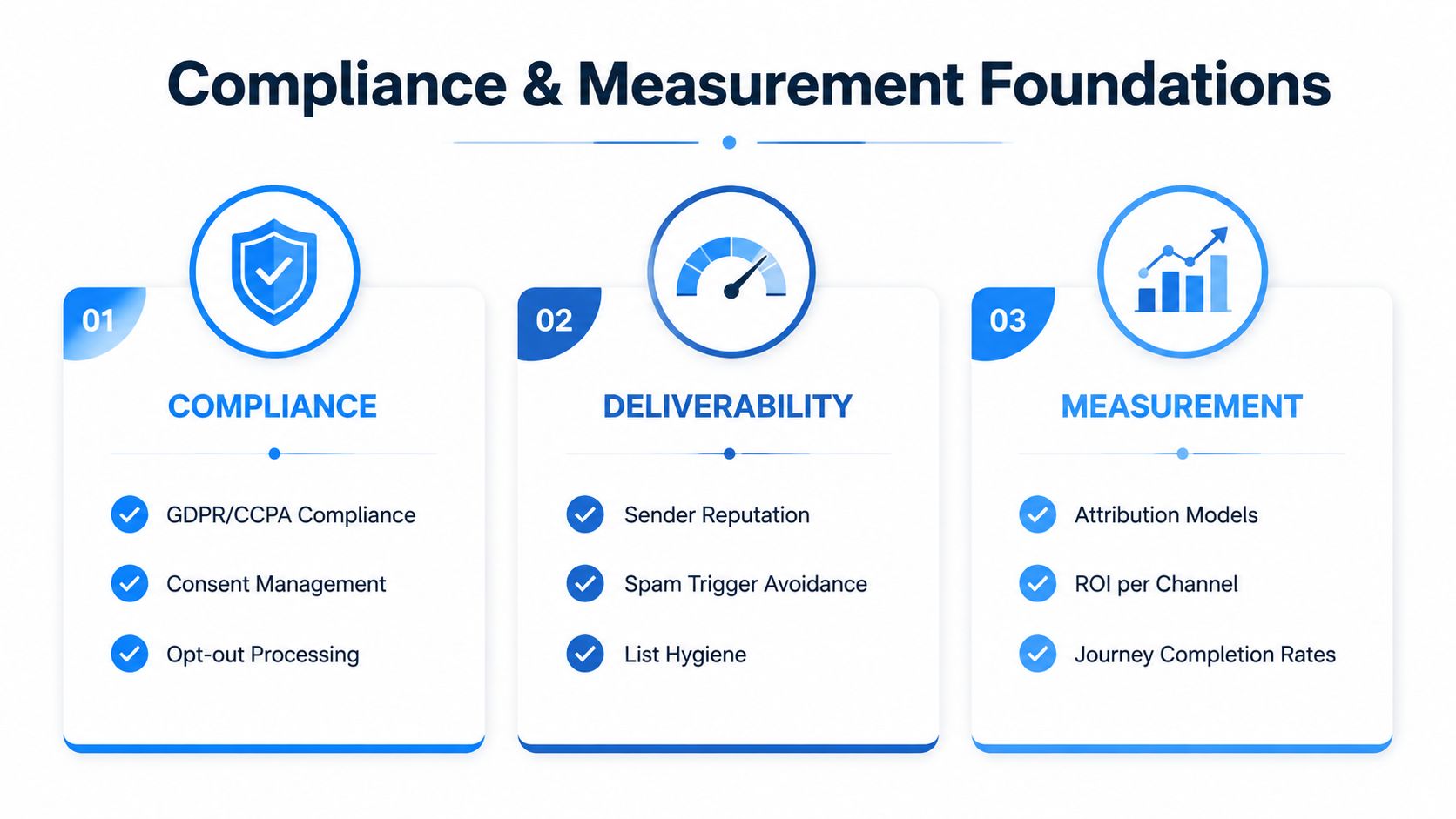
A multi-channel customer journey breaks quickly when the data is messy or the consent layer is weak. The technical base has to connect every channel to the same customer record, the same timing logic, and the same delivery rules. Without that, reporting turns into guesswork, and automation adds noise instead of clarity.
Journey analytics depends on identity resolution across data sources. Website, email, CRM, support, and sales interactions need to join through stable keys and a shared customer master table. Tracking identifiers like email, phone, cookie ID, and device ID helps keep attribution windows from getting distorted by delayed events, as outlined in Improvado omnichannel analytics.
That same guide notes that B2C journeys commonly convert in 7 to 21 days while B2B journeys often take 45 to 180 days. That context matters when you set attribution windows and review sequence performance, because short windows can make slower journeys look weaker than they are.
Consent management is required. Double opt-in, DNC management, toll-free verification, and opt-out handling all shape whether a message should be sent in the first place. If you work in healthcare, HIPAA adds another layer of caution, especially when outreach includes reminders or patient-facing notifications.
For practical setup, document the consent source, the channel allowed, and the suppression rules in one place. If a number opts out of SMS, that status should be reflected before the next send. If a contact should not be called, the voice workflow needs to know it immediately.
For a practical calling and texting checklist, Call Loop's TCPA compliance checklist is a useful operational reference.
Channel-by-channel reporting hides how the journey works. Sequence analysis shows which ordered paths drive conversions, where friction appears, and which handoffs need repair. The best next step is to rank the paths by volume, then improve the most common converted sequence before you touch the fringe cases.
That approach keeps measurement practical. It shows whether message order helps or hurts, whether the response window is too short, and whether one channel is carrying too much of the load. If the customer keeps disappearing between touches, the problem is usually sequence design, not channel choice.
Start with a channel audit and a journey audit. List every place customers currently enter, pause, reply, convert, or drop off, then pick one high-impact journey to fix first. A missed appointment, a cart recovery path, or a payment reminder is usually a better starting point than a broad brand nurture flow.
Build the sequence in this order. Define the trigger, assign the first channel, set the follow-up rule, decide what stops the flow, and confirm who owns each handoff. Then verify consent, suppression, and tracking before launch so the first send doesn't expose a compliance or routing gap.
Track the baseline before you scale. Measure response timing, completion rates, and the quality of the handoff, then watch whether the sequence becomes smoother over time. The goal isn't to launch everywhere at once, it's to create one clean path that can be reused with discipline.
If you need a platform for SMS, voice broadcasting, and ringless voicemail in one workflow, Call Loop supports automated multi-channel outreach, sequencing, scheduling, and deliverability controls that fit this kind of journey design. It's a practical place to turn a mapped sequence into a live campaign without losing the handoff logic that makes the journey work.
Chris Brisson
Chris is the co-founder and CEO at Call Loop. He is focused on marketing automation, growth hacker strategies, and creating duplicatable systems for growing a remote and bootstrapped company. Chat with him on X at @chrisbrisson


Trusted by over 45,000 people, organizations, and businesses like


