
See a Demo
You're just one step away from seeing Call Loop in action.
Enter your information below to watch a demo right now.

You're just one step away from seeing Call Loop in action.
Enter your information below to watch a demo right now.

A multichannel communication strategy isn't about just blasting your message across every platform you can find. It's about strategically using several channels—like SMS, voice, and ringless voicemail—to connect with people where they actually are, on their preferred terms. This integrated approach is what makes your message cut through the noise, creating a far more resilient and effective way to reach your audience.
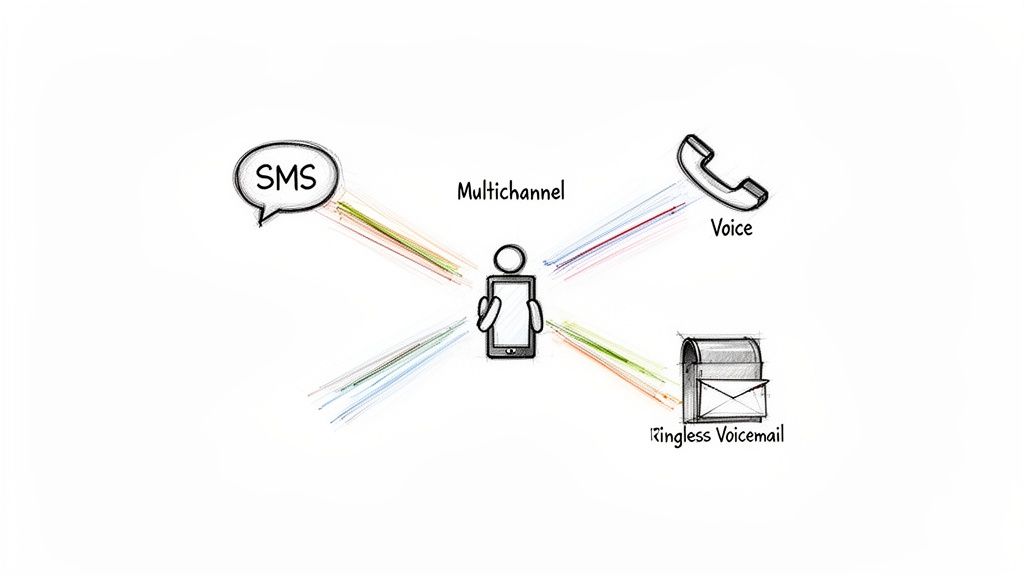
Relying on a single communication channel is like fishing with only one line. Sure, you might catch something eventually, but you're missing out on a whole lot of opportunity just below the surface. A smart multichannel strategy casts a wider, more intelligent net by meeting customers where they already live.
It's about more than just using multiple platforms; it’s about making them work together in a coordinated way to create a better, more human experience.
Think about a local gym trying to reduce no-shows and keep members engaged. They could send an automated SMS reminder 24 hours before a personal training session. But what if a member's credit card is about to expire? Instead of a cold email, a friendly, non-intrusive ringless voicemail can deliver a personal reminder to update their payment details. This avoids service interruptions and saves everyone from an awkward conversation.
The real magic of this approach is its direct impact on customer engagement and, ultimately, your bottom line. When you give people more ways to connect with you, they're simply more likely to respond. This isn't just a hunch; the data backs it up loud and clear.
Campaigns that bring in three or more channels see a staggering 287% higher purchase rate compared to single-channel efforts. That’s a massive lift in performance, making a powerful case for diversifying how you reach out.
To see just how big of a difference this makes, let's put the numbers side-by-side.
The data clearly shows that layering channels doesn't just add to your reach—it multiplies your results. An integrated strategy consistently outperforms a siloed one across the board.
As you can see, customers who engage across multiple channels are not only more likely to buy but also to stick around and spend more over their lifetime. This is the power of a cohesive strategy in action.
A true multichannel strategy ensures that every channel supports a common goal. Your SMS messages, voice calls, and voicemail drops should never feel like random, disconnected interactions. Instead, they should build on each other to feel like one continuous, helpful conversation.
This cohesive experience builds incredible trust and loyalty. Customers appreciate the convenience of interacting on their own terms, which strengthens their relationship with your brand.
Key benefits I’ve seen firsthand include:
By orchestrating a symphony of touchpoints, you ensure your message is not just sent, but heard, understood, and acted upon. It's the difference between shouting into the void and having a meaningful dialogue.
Ultimately, adopting a multichannel strategy is about building a more flexible and robust system for connecting with people. To dive deeper into how to integrate these platforms effectively, I recommend exploring a comprehensive multi-channel marketing approach. This will prepare your business to not only survive but thrive by building stronger, more profitable customer relationships.
Before you send a single message, you need a solid game plan. Jumping the gun on this is like building a house on sand—it might look okay for a minute, but it'll crumble under the slightest pressure. A little thoughtful prep work upfront ensures your messages are clear, compliant, and actually hit the right mark with the right people.
This all starts with a simple question: What are you trying to accomplish? Are you looking to drum up new leads, slash your no-show rates for appointments, or maybe win back customers who've gone quiet? If your goals are fuzzy, your results will be too. Get crystal clear on what a win looks like for every campaign.
Every single text, call, or voicemail you send needs a purpose. If it doesn't have one, you're just adding to the noise. This one goal will dictate everything else—the people you target, the channels you use, and the words you write.
Most campaigns boil down to a few common goals:
Let's make this real. A dental office might set a goal to cut no-shows by 15%. A local boutique could aim to boost weekend foot traffic by 10% with a targeted sale. See? These goals are specific and measurable—the perfect bedrock for a killer strategy.
Pro-tip: Stick to a single, primary objective for each campaign. It keeps your messaging laser-focused and makes it a heck of a lot easier to see what's working. Don't try to do five things with one text; just focus on one clear call to action.
You wouldn't talk to a brand new customer the same way you talk to a loyal regular, right? So why would you send them the same message? That's where audience segmentation comes in. It's just a fancy way of saying you're dividing your contact list into smaller, more specific groups based on what they have in common. Do this, and your messages will land with a much bigger punch.
Don't just stop at the basics like age or location. The real magic happens when you segment based on behavior and how they like to be contacted.
For instance, you could create segments for:
Imagine a karate studio. They could segment their list into "Beginner Students" and "Advanced Students" to send out class-specific info. Everyone gets relevant updates, which keeps them engaged and less likely to hit that "unsubscribe" button. As you start laying this groundwork, digging into some proven multi channel marketing strategies can give you a serious leg up for what's coming in 2026.
Your contact list is gold, but only if it's clean. A list cluttered with bad numbers is a recipe for terrible delivery rates, wasted money, and analytics that don't mean a thing. Keeping your list tidy isn't a one-and-done chore; it’s an ongoing process.
A great first step is to use a number validation tool to scrub your list. It'll weed out any dead or wonky phone numbers, and you'll see your SMS and voice campaign delivery rates shoot up almost instantly.
But even more important is getting explicit consent (an opt-in) from every single person before you hit send on any marketing message. This isn't just good manners—it's the law. It builds trust right from the start. And always, always make it ridiculously easy for people to unsubscribe. That way, you know the people on your list actually want to hear from you.
Alright, you've done the foundational work. Your goals are crystal clear, and your audience list is clean and segmented. Now it's time to shift from planning to doing—choosing your channels and, more importantly, making them work together.
A winning multichannel strategy isn't about blasting messages on every platform you can find. It's about picking the right tool for the right job, at the right time. Think of it as being a communication strategist, not just a marketer.
The three core channels we'll focus on are SMS, voice broadcasting, and ringless voicemail. Each one has a unique superpower. Understanding when to deploy them individually—and how to sequence them—is what separates a disjointed, noisy campaign from a brilliant one.
The way we communicate is getting more complicated by the day. It’s pretty wild that 76% of professionals are using more communication channels at work than they did last year, yet 86% of failures are still chalked up to poor collaboration. In the US alone, this kind of inefficiency leads to a mind-blowing $2 trillion annual loss. You can dig into more of these stats over at pumble.com.
Choosing the right channels for your outreach is the first step to fixing this problem, both inside your company and with your customers.
Let's break down the unique strengths of our three main players:
Think of it like this: you wouldn't use a sledgehammer to hang a picture, right? The same logic applies here. Match the tool to the task.
Generic advice is useless, so let's get practical. Here are some real-world situations where each channel absolutely crushes it.
When to Fire Off an SMS:
When to Use a Voice Broadcast:
When to Drop a Ringless Voicemail:
The core principle is simple: match the urgency and tone of your message to the inherent nature of the channel. SMS is for speed, voice is for reach and humanity, and a ringless voicemail drop is for a personal, non-disruptive touch.
This is where the magic happens. By sequencing your channels, you create a cohesive conversation that guides your audience toward action, instead of just shouting at them from different directions.
Let's walk through a real-life sequence.
Scenario: A Dental Office Cutting Down No-Shows and Providing Aftercare
This simple three-step sequence does so much. It locks in the appointment (bye-bye, no-shows), gives the patient helpful info, and wraps up the experience with a personal touch that builds real loyalty. All of it is automated and completely non-intrusive.
That's the power of a smart channel mix.
Let's be real: manually sending every follow-up text, reminder call, and welcome message just isn't going to work as you scale. You’ll burn out your team and drop the ball on promising leads. This is where automation becomes your secret weapon, letting you expand your outreach without losing that personal touch that actually builds relationships.
Smart campaigns, often called drip campaigns, are the engine that powers a modern multichannel communication strategy.
Think of them as intelligent, automated sequences that guide customers through a seamless journey. They run on autopilot, using triggers, timers, and smart logic to deliver the right message to the right person at exactly the right moment. It feels responsive and personal to them, but it's completely hands-off for you.
This diagram shows a simple but incredibly effective flow, layering SMS, voice, and voicemail to create a complete communication journey.
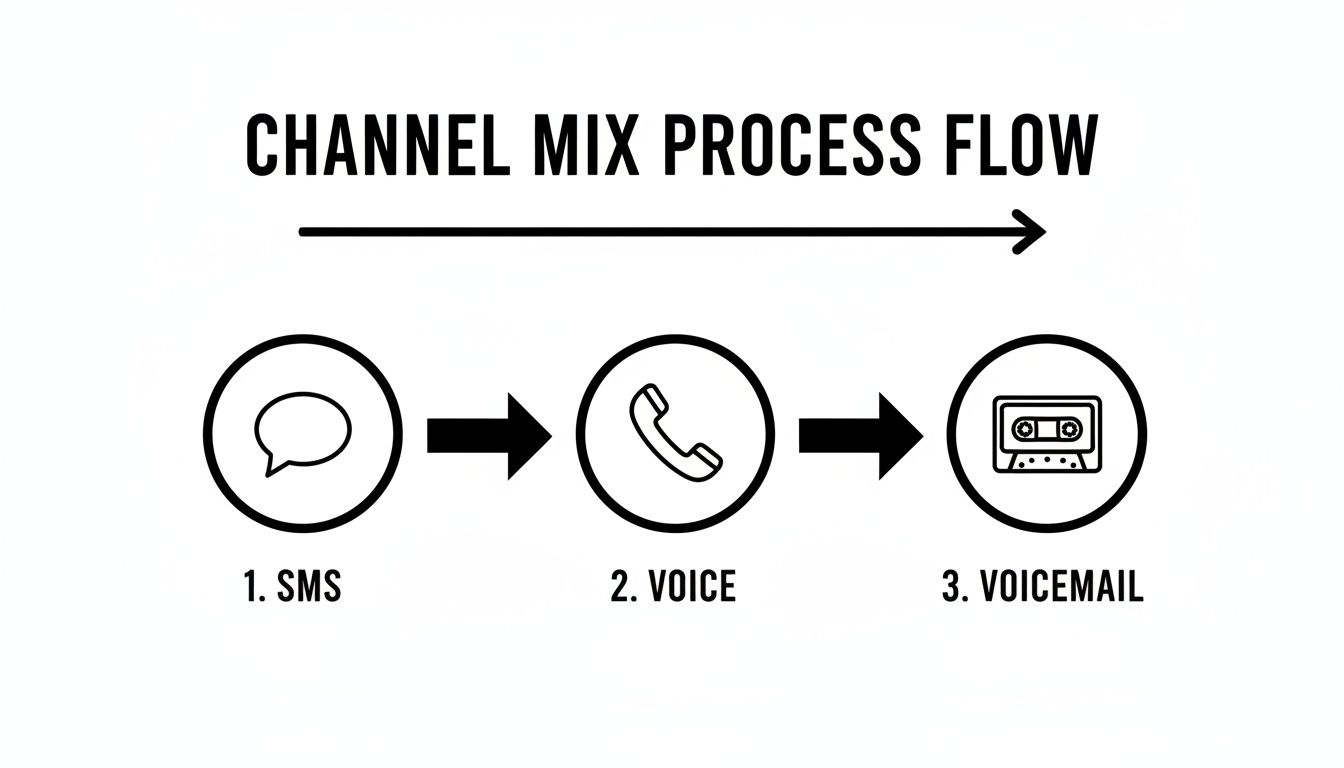
See how the channels build on each other? It kicks off with an instant SMS and then escalates to more personal touchpoints like a voice call or voicemail over the next few days. This layering builds momentum and keeps you top-of-mind.
Let’s walk through a common scenario. A potential customer lands on your website and fills out a "request a demo" form. That form submission is your trigger. Instead of letting that hot lead go cold while you wait to follow up, an automated workflow can engage them instantly. This single move can dramatically boost your conversion rates.
Here’s what a killer welcome sequence could look like:
This entire flow runs without your team lifting a finger, yet it feels incredibly attentive to the new lead. You can get a deeper dive into crafting these types of sequences by exploring how to build a powerful marketing automation workflow.
If you run a service-based business, you know that no-shows are a direct hit to your bottom line. An automated reminder sequence is one of the most powerful—and simple—ways to slash that no-show rate. I’ve seen this simple workflow save businesses thousands of dollars a year.
Here’s a practical example for a healthcare clinic:
These automated sequences aren't just about being efficient; they're about creating a reliable and professional customer experience that people appreciate. By using the right triggers, timers, and channel mix, you build a system that works for you 24/7, making sure no lead or appointment ever falls through the cracks again.
Look, a powerful multichannel strategy is fantastic, but it's only half the story. The other half—the part that protects your business and actually builds trust with customers—is making sure every single message you send is compliant and lands where it's supposed to.
Ignoring the rules isn't just risky; it's a fast track to torching your reputation and getting blocked by carriers. You'll end up talking to a brick wall.
Think of compliance not as a set of restrictions, but as a way to make your outreach smarter. When people know you respect their privacy, they're far more likely to listen to what you have to say. That trust is the bedrock of any long-term customer relationship.
At the heart of it, compliance comes down to a few non-negotiable principles. Get these right, and you’ll stay on the right side of the regulations and keep the mobile carriers happy.
Here's what you absolutely need to nail down:
Think of compliance as the guardrails on the highway to customer engagement. They don't slow you down—they keep you safely on the road, preventing costly crashes and ensuring a smooth journey.
If you're in healthcare, the compliance stakes are even higher. The Health Insurance Portability and Accountability Act (HIPAA) is the law of the land when it comes to Protected Health Information (PHI).
Every single communication, whether it’s a simple SMS appointment reminder or a ringless voicemail with post-op instructions, has to be handled with extreme security. This means your platform must have HIPAA-compliant features, with end-to-end encryption and strict access controls. Dropping the ball on HIPAA can lead to crippling fines, so it has to be a top priority.
Compliance and deliverability are two sides of the same coin. Mobile carriers are in a constant battle to protect their users from spam, and their filtering systems are getting more sophisticated every day. Following the compliance rules we just covered is your first line of defense against getting flagged.
Another huge piece of the puzzle is toll-free number verification. When you verify your toll-free number with the carriers, you're essentially registering it as a legitimate business line. This single step can drastically improve your deliverability rates and stop your messages from being wrongfully tossed into the spam bucket.
When you nail compliance and deliverability, the business results follow. We're seeing a massive shift where omnichannel strategies are blowing single-channel efforts out of the water. One statistic that always stands out to me is that customer retention rates can jump to 89% for companies using an omnichannel approach, compared to a meager 33% for those sticking to just one channel. By making sure your messages are both wanted and delivered, you're setting the stage for that kind of incredible growth.
Launching a multichannel strategy without a way to measure it is like driving with your eyes closed. You might be moving, but you have no idea if you're actually getting closer to your destination. To really make your campaigns sing, you have to measure them. Tracking the right metrics is the only way to turn a good strategy into a great one.
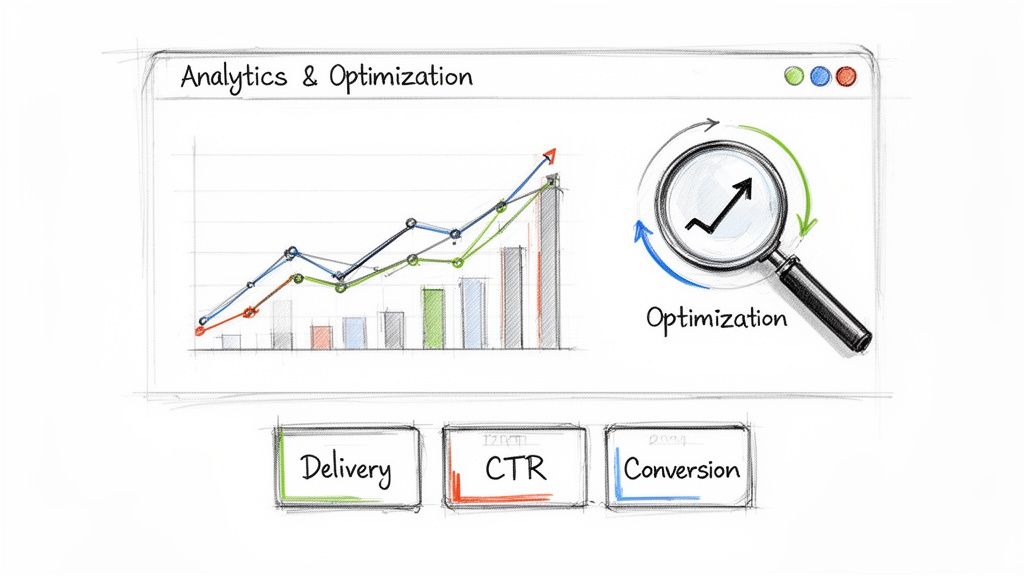
This isn't about chasing vanity metrics. It's about creating a powerful feedback loop that connects your outreach directly to your business goals. You execute, you measure, you learn, and then you optimize. This cycle is what separates campaigns that fizzle out from those that drive real, sustainable growth.
Every channel in your mix tells a piece of the story, and each has its own set of performance indicators (KPIs) you need to watch. Getting a handle on these is your first step.
Here are the essentials for each channel:
For SMS Campaigns:
For Voice & Ringless Voicemail:
Think of these individual KPIs as your tactical diagnostics. They tell you how each channel is performing. But the real "aha!" moments come when you connect these numbers to the outcomes that actually matter to your business.
Sure, a high SMS click-through rate feels good, but what does it actually mean for your bottom line? The real magic happens when you link these channel-specific KPIs to broader business objectives like conversion rates, customer acquisition cost, and lifetime value.
For example, you might find that your ringless voicemail campaigns have a lower initial callback rate than your SMS campaigns, but the leads they generate have a 20% higher conversion rate. That's a game-changing insight you'd completely miss if you were only looking at surface-level metrics. For more ideas on tying activity to results, check out our guide on measuring marketing campaign effectiveness.
Once you have the right data flowing in, you can start making smart, informed decisions to improve your strategy. This is where A/B testing comes into play. It’s a simple but incredibly powerful method for comparing two versions of a message, a sequence, or a channel to see what performs best.
You can A/B test just about anything to find what clicks with your audience:
By consistently testing and analyzing the results, you stop guessing and start knowing what works. This data-backed approach transforms your multichannel plan from a static document into a dynamic, learning system that gets better and better over time.
Even with the best playbook in hand, you’re bound to run into a few questions when you start putting a multichannel strategy into motion. I get it. Let’s tackle some of the most common hurdles I see people face so you can move forward with confidence.
Look, there’s no magic number here. But if I had to give you a straight answer, the sweet spot for most small businesses is two to three well-coordinated channels.
Don't try to be everywhere at once. Quality trumps quantity every single time. Research backs this up, too—campaigns using three or more channels consistently see way higher engagement. Master a few channels that work together seamlessly before you even think about adding more to the mix.
Start with the platforms where your customers actually hang out. For most businesses, that’s a solid combo of:
People throw these terms around interchangeably, but they're not the same thing. It’s a crucial distinction.
A multichannel communication strategy is simply using multiple platforms to talk to your audience. The key here is that these channels often operate in their own little silos. A customer might see your ad on Facebook and later get a text from you, but those two interactions aren't connected. They're separate touchpoints.
Omnichannel is the next level—it's about creating one seamless, unified customer experience where all your channels talk to each other. The customer's journey is a continuous conversation, whether they're switching from an SMS chat to a phone call with your team.
Think of a strong multichannel strategy as the essential foundation. You have to nail that before you can ever hope to build a true omnichannel experience.
Yes, ringless voicemail can be a fantastic—and compliant—tool for marketing, but you absolutely have to do it right. Because the message is delivered directly to voicemail without making the phone ring, it's generally seen as less intrusive than a traditional cold call.
But let me be crystal clear: you still have to follow TCPA and DNC guidelines to the letter. This means you can only contact people who have given you prior express consent, and you must provide a simple, obvious way for them to opt out. It’s best used for warm follow-ups with existing leads or customers who already know who you are.
Ready to build a high-impact, compliant outreach system that actually gets results? Call Loop gives you all the tools you need—SMS, voice, and ringless voicemail—to automate your outreach and connect with customers on their terms. Start your free trial today and see the difference.
Chris Brisson
Chris is the co-founder and CEO at Call Loop. He is focused on marketing automation, growth hacker strategies, and creating duplicatable systems for growing a remote and bootstrapped company. Chat with him on X at @chrisbrisson


Trusted by over 45,000 people, organizations, and businesses like


