
See a Demo
You're just one step away from seeing Call Loop in action.
Enter your information below to watch a demo right now.

You're just one step away from seeing Call Loop in action.
Enter your information below to watch a demo right now.

62% of companies plan to use agentic AI for conversational customer engagement over the next 18 months, and more than three-quarters expect it to manage at least half of customer support interactions in that period. Predictive customer engagement uses historical behavioral data, statistical models, and machine learning to anticipate what a customer may do next, then trigger a timely, personalized response before the customer acts.
A clinic's front desk might see appointments disappear at the last minute, a retailer might notice shoppers abandoning carts, or a software team might watch product usage decline before a renewal conversation. In each case, the hard part isn't spotting the pattern after the fact. It's deciding who needs attention now, which channel is appropriate, what message will help, and whether the business has permission to send it.
That operational gap defines predictive customer engagement. A forecast has value only when it reaches a useful workflow.
A clinic notices that roughly one-fifth of scheduled appointments vanish during the final day before the visit. Staff members respond by sending broad reminders, often at the same time to every patient. Some people need a reminder, some already confirmed, and others would respond better to a phone call than a text.
A predictive approach changes the sequence. The clinic reviews past attendance, cancellation history, booking lead time, appointment type, and prior responses. A model then estimates which upcoming appointments carry the greatest no-show risk. The system can send a reminder to the right people, at a useful time, through an approved channel.
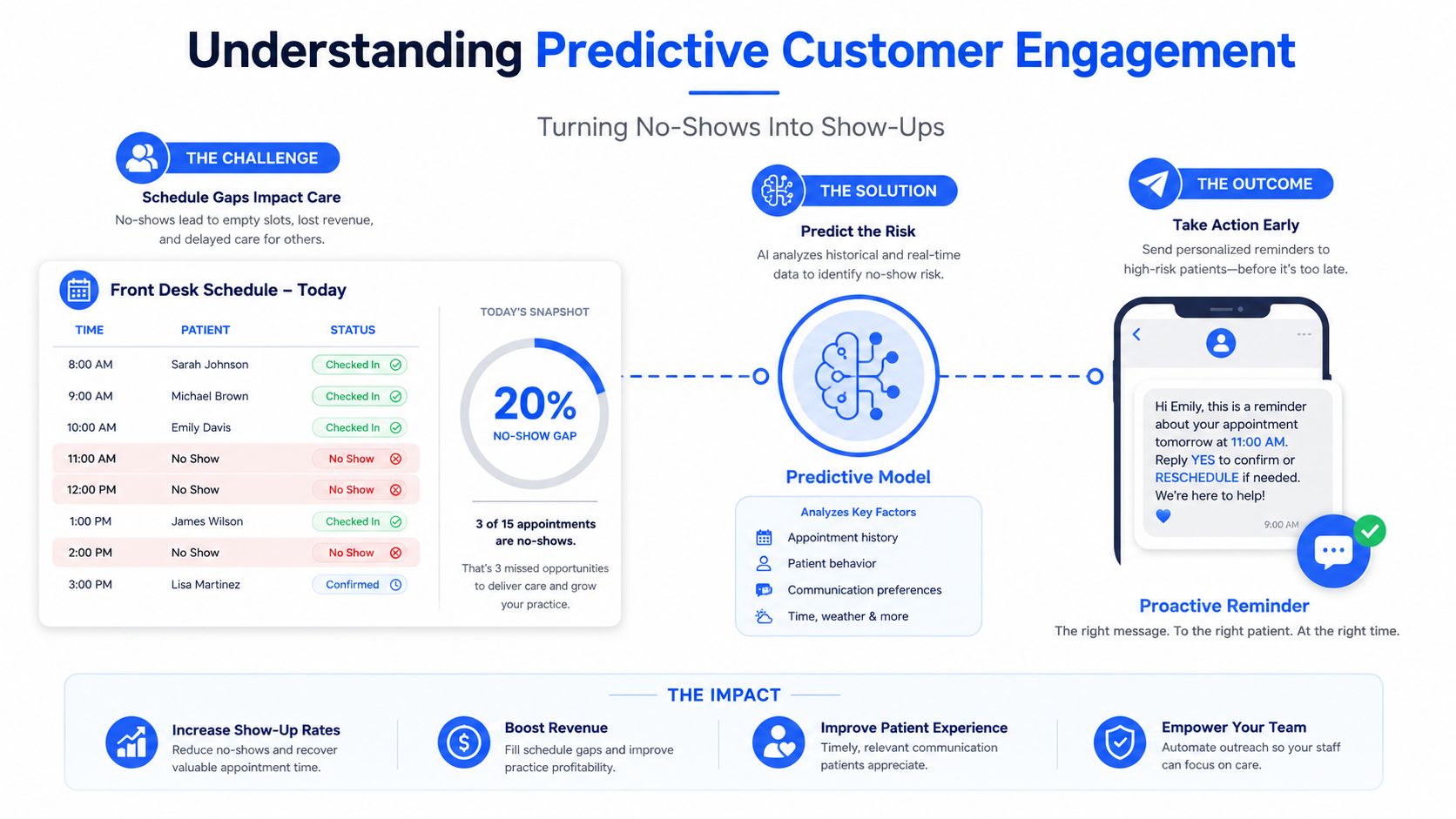
Predictive customer engagement uses historical behavioral data, statistical models, and machine learning to forecast a future action, such as a purchase, cancellation, churn event, response, or appointment absence. The prediction then feeds an action, usually a personalized message, task, offer, or service intervention.
That's different from ordinary segment-based marketing. A segment might group all customers who haven't purchased recently. A predictive system ranks those customers according to their likelihood of returning, their expected response channel, or their risk of leaving. The first approach applies the same rule broadly. The second helps a small team spend limited attention where it has the greatest chance of changing an outcome.
Adobe's 2026 customer engagement research reports that 56% of organizations prioritize more personalized customer experiences, while 46% prioritize improving customer satisfaction, loyalty, and engagement. Those priorities help explain why predictive engagement has moved beyond an analytics exercise. Teams increasingly connect customer signals to retention, service quality, and commercial decisions.
Practical rule: Don't build a prediction unless someone can name the action it will trigger.
A useful system answers four questions:
Adobe's 2026 consumer report found that the buying-decision tipping point can occur within three to five interactions for 40% of customers. The practical implication is clear. Timing, sequencing, and next-best action matter early, so a message sent after intent has faded may be less useful than a carefully timed intervention based on earlier signals.
Think of customer data as a weather station. Each purchase, login, support ticket, appointment change, and message response acts like a sensor reading. One reading rarely tells you what will happen. A pattern across readings can reveal that a customer's behavior is changing.
The most useful inputs usually fall into a few practical groups:
Before modeling begins, teams need to clean duplicate records, standardize event names, resolve identity across systems, and create a usable customer view. A model trained on contradictory consent fields or incomplete timestamps won't become reliable just because the algorithm is complex.
For a practical overview of how behavioral data can support customer insight workflows, see this guide to AI-driven customer insights.
Logistic regression and decision trees can produce understandable scores, which helps operators explain why a customer was flagged. Random forests and gradient boosting can capture more complex relationships and often suit richer behavioral data. Neural networks or sequence models may help when the order and timing of events carry substantial meaning, but they also require stronger data practices and more technical oversight.
A model output shouldn't be an abstract score sitting in a dashboard. It should connect to an action, such as “send a confirmation SMS,” “assign a callback,” or “hold out from promotion.” Feature importance can help a team understand whether the score reflects recent inactivity, contract status, support friction, or another signal.
| Data Signal | Typical Model Output | Engagement Decision |
|---|---|---|
| Recent product usage | Churn or reactivation likelihood | Offer guidance, support, or a callback |
| Appointment history | No-show probability | Send a confirmation reminder |
| Purchase and browsing behavior | Purchase propensity | Present a relevant product message |
| Message responses | Channel or timing preference | Adjust the next outreach step |
| Consent and suppression records | Permitted contact path | Allow, restrict, or block activation |
A telecom example illustrates the potential of well-constructed features. A Random Forest model trained on a publicly available dataset with 2,668 records reached 95.13% accuracy and an AUC of 0.89 on a held-out test set, according to this peer-reviewed predictive churn analysis. That result doesn't guarantee the same performance for another business. It shows why signal quality, feature design, and activation discipline matter more than adding an AI label to an existing campaign.
A small team doesn't need to build an entire data platform before testing predictive engagement. It needs to make the handoffs visible and assign ownership at each point.
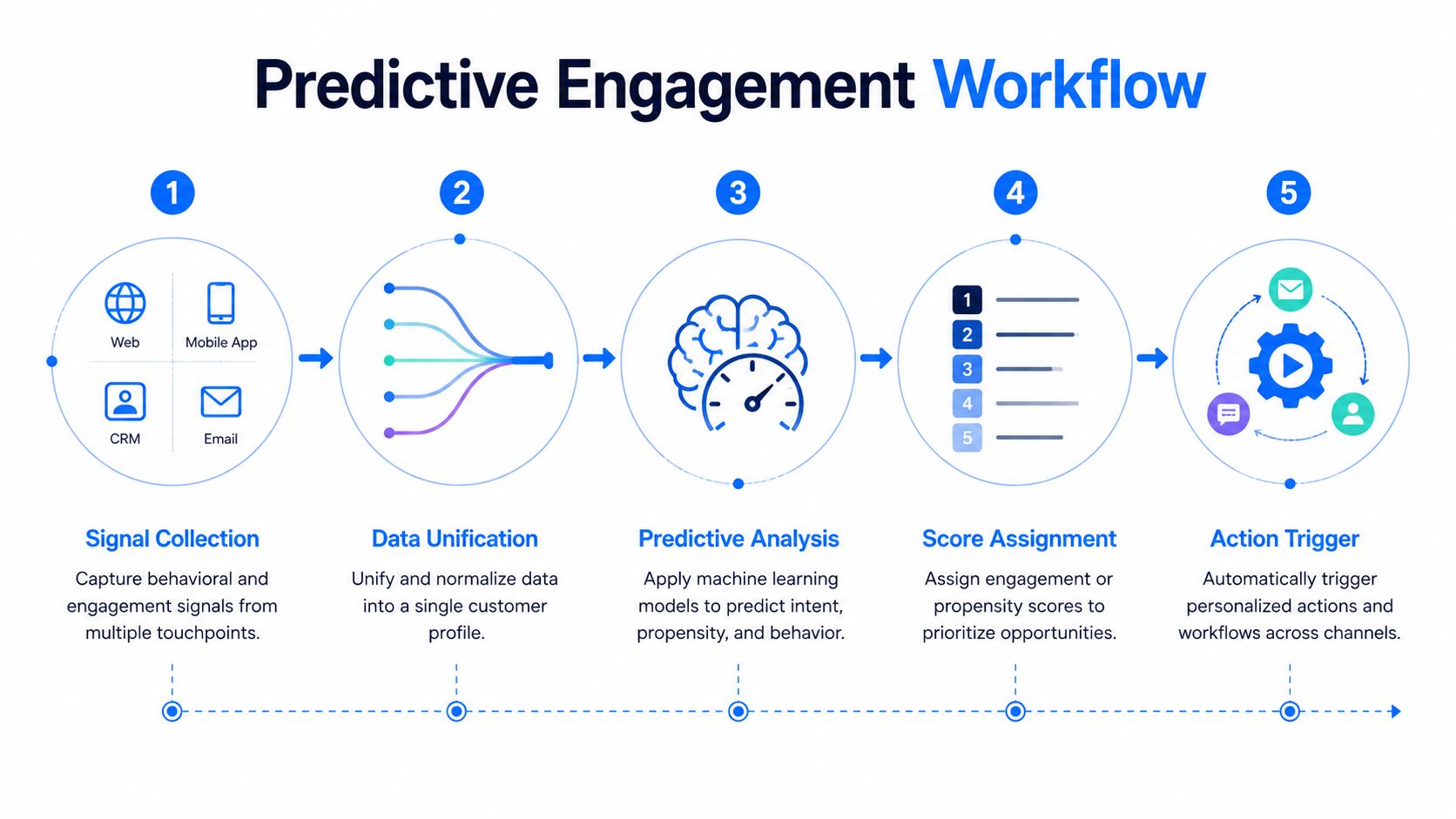
Suppose a customer's usage drops and several support conversations remain unresolved. The scoring layer might assign a high churn risk. The orchestration layer then checks consent, recent contact, and channel history. If SMS is permitted and the customer hasn't received a recent message, the system could send a concise support-oriented text. A voicemail drop or callback task might be appropriate if the account has higher value or the issue requires explanation.
Small and mid-sized teams can often connect existing CRM fields, billing events, and campaign tools rather than commissioning custom infrastructure. The important design choice is to start with one clear action and one accountable owner. A score that nobody reviews, or a trigger that sends without suppression logic, creates noise rather than engagement.
The feedback loop also needs a defined destination. If the team records only delivery, it can't tell whether the message changed behavior. Store the outcome that matters, such as a kept appointment, renewed account, completed purchase, or accepted callback.
Predictive models and rule-based automation solve different problems. A rule says, “If this condition occurs, take this action.” A model says, “Given the available evidence, rank how likely this outcome is, then help the team decide what to do.”
| Dimension | Predictive Models | Rule-Based Automation |
|---|---|---|
| Decision method | Probability or ranked risk | Fixed condition |
| Data requirement | Needs historical outcome data | Can work with limited history |
| Adaptability | Changes as behavior patterns change | Stays constant until edited |
| Explainability | Requires feature review | Usually easy to inspect |
| Best use | Prioritization and timing | Safety gates and deterministic events |
| Main risk | Noisy or poorly calibrated scores | Broad, repetitive treatment |
A renewal reminder rule is usually enough when every customer receives the same contractual notice at the same stage. The date is known, the action is mandatory, and prediction adds little value.
A usage-drop rule can work when a user falls below a simple activity threshold. It may trigger an educational email or support prompt. If the business has enough history to distinguish temporary fluctuation from genuine disengagement, a predictive score can prioritize which users deserve a personal intervention.
A churn score becomes more useful when the team has several signals, such as declining usage, unresolved support issues, payment friction, and reduced response. A low-risk customer might enter an email nurture path, a medium-risk customer might receive SMS and email, and a high-risk account might create a callback task for an account manager.
A 2025 review reported that ensemble methods and deep learning consistently outperform traditional classifiers when behavioral, transactional, and sentiment features are combined, as summarized in this review of predictive engagement modeling. The finding supports a measured approach, not automatic complexity. Richer models can help when the data is rich enough, but rules remain valuable for opt-outs, legal restrictions, missing consent, and low-data customers.
Keep rules around the perimeter. Let prediction rank the work inside the safe operating boundaries.
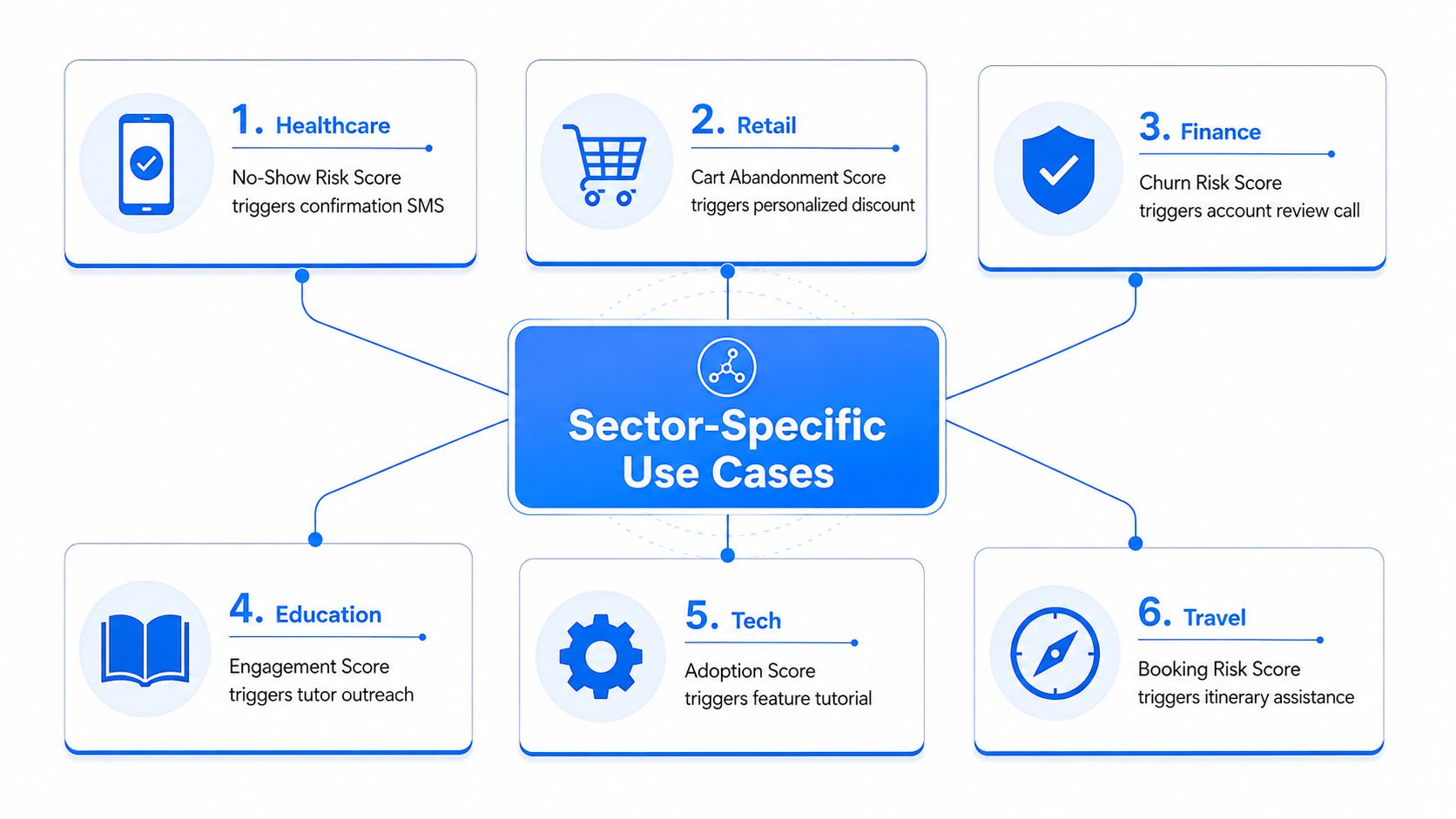
Predictive engagement becomes easier to evaluate when the signal, predicted action, and channel are explicit. The same operating pattern can support very different customer moments.
A provider can combine appointment type, booking history, prior cancellations, and confirmation behavior into a no-show risk score. A higher-risk patient may receive a confirmation SMS and a ringless voicemail before the appointment, while lower-risk patients receive the standard reminder. The outcome to monitor is attendance, not message delivery.
A retailer can combine cart activity, product views, purchase history, and prior response behavior to estimate cart-abandonment propensity. If the customer has permission for SMS and tends to respond there, the system might send a reminder or relevant offer. Another customer could receive email instead. The predicted action is the channel and message sequence, not merely the existence of an abandoned cart.
An event organizer can evaluate registration timing, confirmation activity, prior attendance, and engagement with event information. Low-intent registrants can receive a final-day nudge, while people who already confirmed may be suppressed from unnecessary reminders. The useful result is attendance and completed participation.
A studio can watch class frequency, booking gaps, cancellations, and response to previous reactivation attempts. A decline may trigger a friendly re-engagement sequence with an option to request a personal callback. The team should measure renewed attendance or membership activity rather than clicks alone.
A sales team can rank leads using form engagement, product interest, meeting activity, and response history. The highest-priority leads can route to a same-day voice call, while less urgent prospects enter a structured nurture path. The model should support a clear sales action, not replace the salesperson's judgment.
A customer success team can combine feature adoption, support volume, unresolved issues, and stakeholder engagement into an account health signal. A drop can alert the account manager before a renewal conversation, giving the team time to address the cause rather than reacting to a cancellation notice.
These examples differ by sector, but the discipline is consistent: name the signal, define the predicted behavior, choose an approved intervention, and tie the result to a business outcome.
A predictive score identifies who may need attention. It does not decide whether the team may contact that person. Consent, suppression lists, channel preferences, and recent contact history must be checked before any activation.
Start with channel-specific permission. Apply suppression lists, honor opt-outs, and stop duplicate enrollment when several signals appear close together. For U.S. campaigns, the FCC Declaratory Ruling FCC 22-85 states that ringless voicemail sent to wireless phones requires consumer consent because it is treated as a call using an artificial or prerecorded voice under the TCPA. The prediction determines priority. The permission record determines whether outreach can proceed.
A practical churn workflow can divide contacts into three paths:
Timing belongs in the workflow, not in a separate checklist. Set conditions for quiet hours, customer time zones, recent-message limits, and response windows. Independent compliance guidance recommends treating ringless voicemail with the same caution as traditional autodialed calls, including Do Not Call restrictions, permitted calling hours of 8 AM to 9 PM local time, business identification, and an opt-out mechanism. The same guidance notes that Do Not Call penalties can reach $43,792 per call after inflation adjustments. See this ringless voicemail compliance guide for the cited requirements.
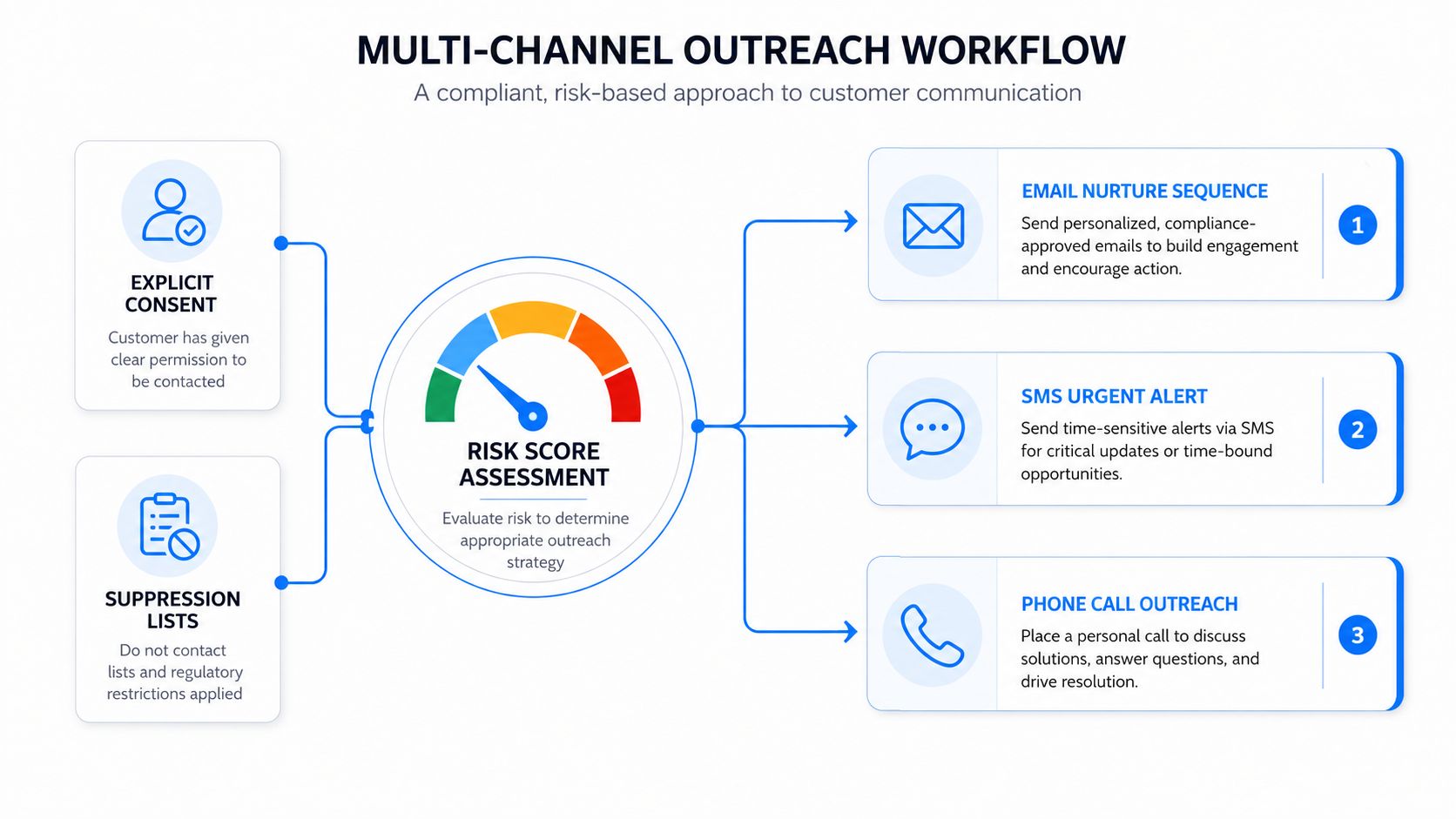
A platform such as Call Loop can support score-band segmentation, custom fields, scheduled SMS, voice broadcasts, ringless voicemail, and CRM-triggered campaign enrollment. A small team can pass a score band into a contact record, insert the predicted action into a message template, and route replies or callback requests to the right owner. For a broader view of journey design, see this guide to the multi-channel customer journey. Document the journey in the CRM, including why a person entered the workflow and which event removes them.
Before launch, check:
Open rates and delivery reports can help diagnose a campaign, but they don't prove that predictive engagement improved the business result. A stronger measurement plan connects the score to an intervention and then to an outcome.
Track engagement signals such as response rate, callback rate, click activity, and opt-in confirmation. Pair them with downstream measures including conversion, repeat purchase, saved churn, kept appointments, attendance, or completed onboarding. The exact metric depends on the use case, but the principle stays the same: measure what the message was supposed to change.
A holdout group helps separate campaign impact from customer intent. If high-risk customers who receive an intervention behave the same as comparable customers who don't, the model may be describing risk without changing it. Pre-and-post comparisons and shifted time windows can add context, but teams should be cautious about attributing every improvement to the campaign.
A practical test design includes:
A model can become noisy when customer behavior changes, data pipelines break, or a channel loses effectiveness. Set confidence thresholds and suppress alerts that don't lead to a meaningful action. Review model drift, segment drift, channel fatigue, and consent status on a regular governance cycle.
A telecom churn study cited in Adobe's predictive engagement research reported that integrating AI with CRM reduced churn by up to 15%, while the same broader research emphasizes the operational importance of personalization and engagement. That prior finding should be treated as context, not a promise for every team. Your own holdout results matter more than a benchmark from another dataset or industry.
Use campaign analytics to inspect replies, callbacks, conversions, suppressions, and channel-level outcomes. A structured campaign performance analytics workflow can help teams move from surface engagement measures to decisions about thresholds, timing, and message design.
Start with one use case where the economic consequence is clear and the data is already available. Appointment reminders, lapse-risk reactivation, and renewal assistance are often easier starting points than a broad “predict everything” program.
Define one outcome, one baseline, and one test cohort. Build a simple score from dependable signals, connect it to one approved channel such as SMS or ringless voicemail, and run a controlled pilot. Document consent, opt-out handling, quiet hours, business identification, and message disclosure before sending anything.
Review the result against the baseline and holdout. If the intervention changes behavior without creating compliance or fatigue problems, add another segment or channel. If it doesn't, improve the data or action before increasing volume. Predictive customer engagement earns its place when a focused forecast helps a small team act earlier and more precisely than a broad rule.
Call Loop provides automated outreach across SMS, voice broadcasting, and ringless voicemail, with segmentation, scheduling, drip campaigns, CRM triggers, consent tools, and campaign analytics. If you're ready to connect predictive scores to a practical, compliant workflow, visit Call Loop and evaluate how its channels can fit your existing customer engagement process.
Chris Brisson
Chris is the co-founder and CEO at Call Loop. He is focused on marketing automation, growth hacker strategies, and creating duplicatable systems for growing a remote and bootstrapped company. Chat with him on X at @chrisbrisson


Trusted by over 45,000 people, organizations, and businesses like


