
See a Demo
You're just one step away from seeing Call Loop in action.
Enter your information below to watch a demo right now.

You're just one step away from seeing Call Loop in action.
Enter your information below to watch a demo right now.

Texting isn't a side channel anymore. By 2025, 84% of consumers had opted in to receive texts from at least one business, with SMS open rates reported at 90 to 98%, about 80% read within five minutes, and average response rates around 45% versus roughly 6% for email, according to SimpleTexting's 2025 SMS marketing statistics.
For a real estate agent, that changes the math of follow-up. Buyers ask about a listing while they're standing in line for coffee. Sellers want a quick answer, not another buried email. If you can respond in the same channel they already use all day, you remove friction and keep deals moving.
Good real estate SMS marketing is not sending more texts. It's sending the right text, to the right person, at the right moment, then backing that up with smart automation, ringless voicemail, and clean CRM follow-up.
Real estate rewards speed. A missed inquiry on a hot listing can turn into a missed showing, then a missed offer. Texting works because it matches how people naturally communicate when decisions are moving fast.
The consumer behavior shift is already here. In a real estate-specific dataset, 94% of Realtors use text messaging as a communication tool, and 58% of buyers prefer to communicate with their agent via text messages, according to AMRA & Elma real estate agent marketing statistics. That's the practical reason SMS now sits at the center of agent workflow instead of on the edge of it.
Texting performs best in moments where delay kills momentum:
Email still matters. Phone still matters. But SMS is the fastest way to create contact and get a response.
Buyers rarely thank you for a beautifully written email they saw tomorrow. They respond to the text they saw in two minutes.
The strongest advantage isn't just open rate. It's context. Text feels direct, personal, and easy to answer. A lead can reply with one word. A seller can confirm a showing from a meeting. A buyer can ask for the address, photos, or a tour time without committing to a call.
That's why real estate SMS marketing works so well when the message is tied to a clear next step. Not “just checking in.” More like “Reply TOUR for times” or “Reply YES to confirm.”
When agents struggle with texting, it's usually not because SMS stopped working. It's because they turned it into a broadcast channel and forgot that people want relevance more than volume.
Compliance is where a lot of agents get sloppy. They collect numbers at an open house, drop everyone into a list, and start sending promotions. That's where trouble starts.
Real estate texting has more moving parts than most guides admit. Most guides treat compliance as a checklist, but the situation is more intricate; real estate SMS involves transactional and promotional messages to people in different consent states, requiring comprehensive consent logging and auditability because one compliance failure can jeopardize an entire pipeline, as explained in VoiceSpin's real estate SMS compliance guidance.
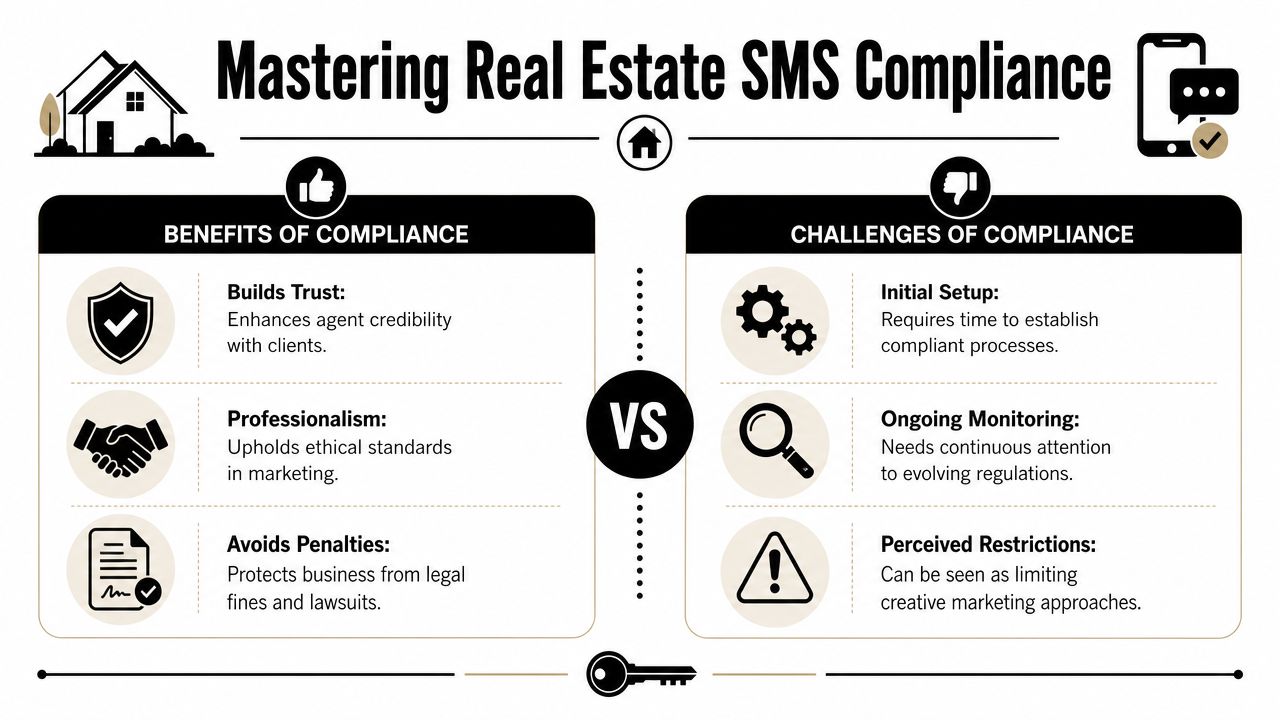
Promotional texting requires clear permission. In practice, that means you should know:
If you want the plain-English version of what qualifies as permission, review this guide to express written consent for text marketing.
A phone number alone is not a texting license. A business card isn't blanket approval. An old lead import isn't proof of consent.
Many real estate teams frequently create risk without realizing it.
A transactional text is tied to an existing interaction, such as a showing reminder or schedule update. A promotional text is marketing, such as a listing blast, nurture campaign, or seller pitch. If your database mixes both without clear labels, your team can easily send the wrong type of message to the wrong person.
Use your CRM or messaging platform to tag contacts by consent status and message type. At minimum, create separate segments for:
Practical rule: If you can't prove consent and message category, don't send the text.
You don't need a legal memo for every campaign. You need repeatable process.
Agents who treat compliance as part of operations, not a one-time setup task, build a list they can use with confidence.
A strong SMS list beats a large weak one. You don't need everyone in your market. You need people who raised their hand and want a specific kind of update.
That's why the best real estate SMS marketing programs start with explicit permission and structured intake. Real estate SMS programs work best when built around explicit opt-in; a shortcode-plus-keyword flow can route leads into segmented lists for buyers, sellers, or specific listings, and automated responses can capture lead data while reducing manual follow-up latency, according to CallHub's real estate SMS marketing guide.
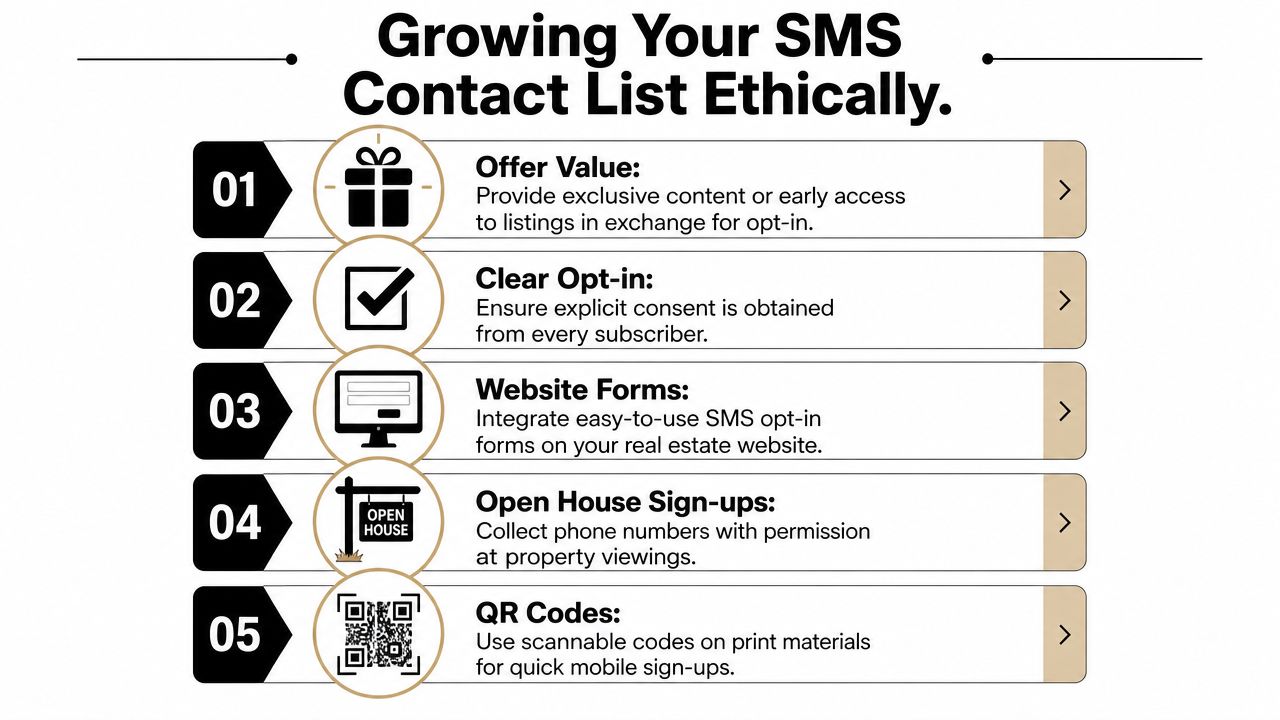
The easiest list-building mistake is dumping every contact into one bucket. Instead, collect opt-ins by use case.
A few list sources work especially well for agents:
If you want a practical setup model, this guide on growing subscribers with text message opt-ins covers the mechanics clearly.
Keyword campaigns work because they're simple. They also help with segmentation from the first touch.
Examples:
When someone texts a keyword, the automated reply should do two things: confirm the opt-in and collect one or two pieces of qualifying information. Keep it tight. Name, email, price range, area, or timing is enough to move the conversation forward.
SMS list building works better when it doesn't live on an island. If you're evaluating systems that combine lead capture, automation, and follow-up, this overview of a Saleswise platform for real estate agents is useful because it frames SMS as part of a broader lead generation workflow rather than a standalone tactic.
The best opt-in source is the one that signals intent. A random contact upload tells you almost nothing. A keyword tied to a listing tells you what that person wants right now.
Keep the offer concrete. “Get listing alerts” is better than “join our VIP list.” “Text for open house details” is better than “contact us.”
People opt in when the value is immediate and specific. In real estate, that usually means one of three things: faster property access, easier scheduling, or timely updates they don't want to miss.
A lot of agent text campaigns fail for one reason. They sound like campaigns.
The messages that get replies usually feel like timely, useful communication from a real person. That doesn't mean you avoid automation. It means your automation should feel connected to the lead's action.
Lead response texts should fire as soon as someone inquires. The job is simple: acknowledge the request and move them to the next step. Don't cram in your bio, market philosophy, and financing pitch.
Open house reminders work best when they reduce confusion. Time, address, parking note, RSVP link, and a reply prompt are enough.
Listing alerts should be segmented tightly. A condo buyer in one neighborhood shouldn't get detached-home inventory from another area.
Post-showing follow-up texts should ask one easy question. “What stood out to you?” works better than “Just wanted to follow up and see if you had any questions or thoughts after today.”
There's also a technical side to real estate SMS marketing. For outbound real estate campaigns, expert guidance recommends keeping sends in a human-like pattern, often under 15 to 60 messages per minute and under 1,000 per day, to avoid carrier filtering. Messages should stay near 160 characters and include a clear CTA, according to OtterText's real estate text messaging guidance.
That matters because deliverability problems often come from behavior, not just wording. If your texts look machine-generated, repetitive, or overly aggressive in volume, carriers may treat them that way.
| Approach | What usually happens |
|---|---|
| Short text with one CTA | Easier reply, cleaner tracking |
| Listing-specific segmentation | Better relevance, fewer unsubscribes |
| Confirmation and reminder messages | More attendance and fewer no-shows |
| Generic monthly blasts | Lower relevance and more fatigue |
| Long texts with multiple links | More friction and weaker response |
Write every text so the recipient can answer in one tap or one sentence.
Good CTAs include:
Bad CTAs are vague. “Let me know what you think” sounds polite, but it creates work for the prospect. Good texting removes effort.
The next step isn't more automation. It's better orchestration.
Real estate teams that rely on SMS alone eventually run into fatigue. That problem is getting harder to ignore. U.S. text-message spam complaints surged from about 19,100 in 2023 to about 333,700 in 2024, which suggests recipient tolerance is tightening and that fewer, more contextual texts combined with channels like ringless voicemail may work better than sending more, according to Sinch's analysis of real estate SMS marketing.

Most agents segment too broadly. “Buyers” and “sellers” aren't enough.
Useful segments look more like this:
Those groups need different timing, different language, and often a different channel mix.
Ringless voicemail is useful when a text alone feels too light, but a live call feels too aggressive.
A good sequence might look like this in practice:
That sequence gives you persistence without hammering the same channel repeatedly.
Ringless voicemail works especially well for:
A text asks for a quick response. A voicemail carries tone. Used together, they feel more human than a string of generic follow-ups.
Instead of asking, “What should we blast this week?” ask, “What should happen when this lead does or doesn't respond?”
That's the upgrade. Set rules based on behavior:
In this kind of setup, SMS does the fast work, ringless voicemail adds personality, and email carries the heavier detail.
Templates save time, but only if they sound natural. Real estate texts should read like one person helping another person take a next step.
Here are practical starting points.
| Campaign Type | Example Message Template |
|---|---|
| New lead auto-response | Hi [First Name], thanks for reaching out about [Property/Area]. I can send details or available tour times. Reply DETAILS or TOUR. |
| Buyer qualification | Hi [First Name], got your request. Are you looking in [Area], and are you hoping to move soon or just starting? |
| Open house invite | Hi [First Name], we're hosting an open house at [Property Address] on [Day] at [Time]. Reply RSVP and I'll send the details. |
| Open house reminder | Reminder for today's open house at [Property Address] at [Time]. Reply YES if you're coming and I'll text parking details. |
| Showing confirmation | You're confirmed for [Property Address] at [Time]. Reply RESCHED if you need a different time. |
| Post-showing follow-up | Thanks for touring [Property Address]. What did you think? Reply with your feedback and I'll send similar options if needed. |
| Price reduction alert | Hi [First Name], [Property Address] has a price update. Reply PRICE if you want the new details and next available showing times. |
| Seller lead follow-up | Hi [First Name], thanks for asking about your home's value. I can text a quick estimate range or set a time to talk strategy. Reply VALUE or CALL. |
| Transaction update | Quick update on [Property Address]. [Short status note]. If you want to review the next step, reply CALL. |
| Past client referral prompt | Hi [First Name], I hope you're doing well in the new home. If anyone you know needs help buying or selling, feel free to send them my way. |
A good nurture sequence changes channel before the lead gets tired of seeing the same format.
Day 0
Send an immediate SMS acknowledging the inquiry and asking one direct question.
Day 1
If there's no reply, send a ringless voicemail with a short personal introduction and a reason to reconnect.
Day 3
Email the listing details, neighborhood info, or a few matching properties.
Day 5
Send one more SMS tied to value, not pressure. Offer tour times, a list of similar homes, or a seller strategy call.
Day 10
If the lead still hasn't engaged, move them to a lower-frequency nurture track.
If you don't track outcomes, texting turns into guesswork. The good news is you don't need a huge dashboard. You need a few metrics that tell you whether your messages are landing, getting action, and moving leads forward.
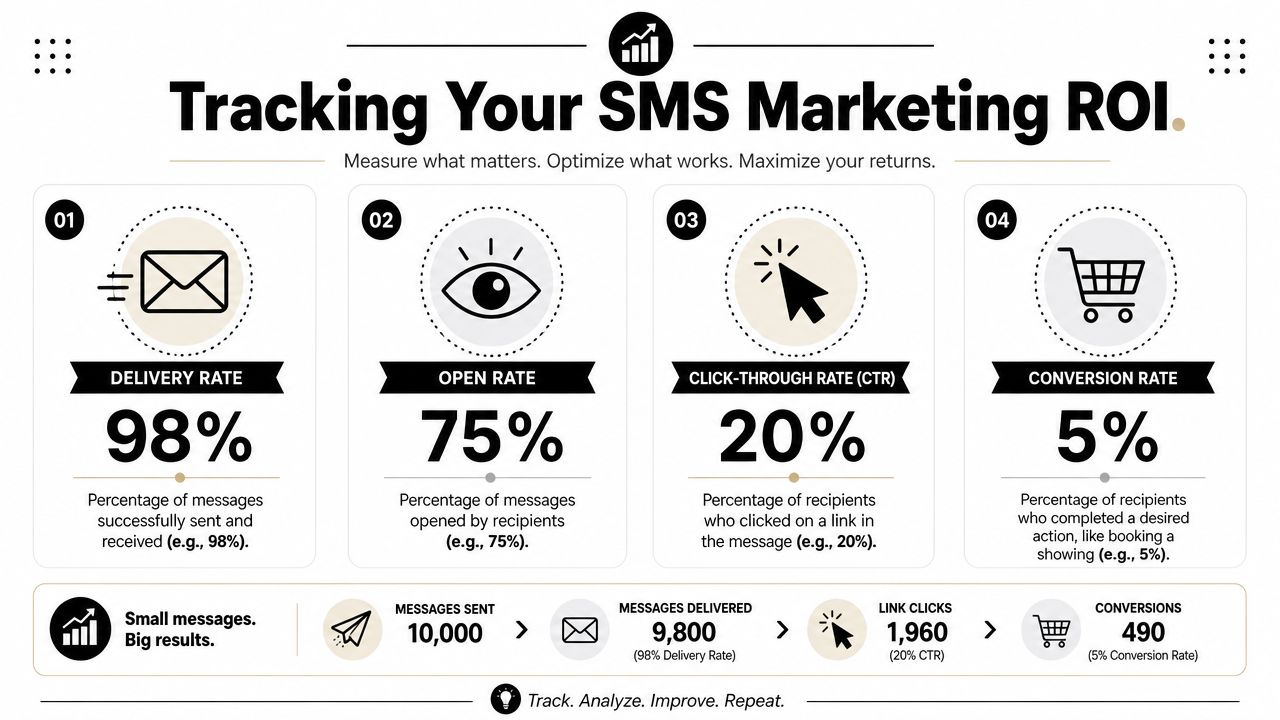
For agents, these are the numbers that matter most:
If you need a framework for setting up those KPIs, this guide on measuring marketing campaign effectiveness is a useful reference.
Significant gains happen when texting connects to the rest of your stack. Your CRM should log messages, track replies, trigger tasks, and move contacts between stages automatically.
That's how you avoid the classic problems:
If you're trying to streamline real estate marketing, focus less on adding isolated tools and more on getting your SMS, email, CRM, and voicemail workflows to work together.
You don't need dozens of platforms. You need a setup that handles keywords, segmentation, automations, analytics, and multi-channel follow-up in one connected workflow. In practice, many teams pair a CRM with a messaging platform that supports SMS, voice, and ringless voicemail. Call Loop is one example because it supports text-to-join keywords, drip campaigns, SMS, voice broadcasting, and ringless voicemail in the same system.
The best reporting setup answers one question fast. Which messages are creating conversations that turn into appointments and deals?
Real estate SMS marketing works when you treat it like an operating system, not a tactic. Build permission-first lists. Send short, contextual texts. Use ringless voicemail when SMS alone starts to feel repetitive. Track responses inside your CRM so every lead gets the next right touch, not just another message.
If you want to put this into practice, Call Loop gives real estate teams a way to run SMS, voice, and ringless voicemail campaigns from one platform, with keyword opt-ins, segmentation, drip sequences, scheduling, and analytics built in. It's a practical fit for agents who need faster follow-up without turning communication into a manual mess.
Chris Brisson
Chris is the co-founder and CEO at Call Loop. He is focused on marketing automation, growth hacker strategies, and creating duplicatable systems for growing a remote and bootstrapped company. Chat with him on X at @chrisbrisson


Trusted by over 45,000 people, organizations, and businesses like


