
See a Demo
You're just one step away from seeing Call Loop in action.
Enter your information below to watch a demo right now.

You're just one step away from seeing Call Loop in action.
Enter your information below to watch a demo right now.

Imagine sending out a single text and watching your reservation book fill up for a slow Tuesday night. That’s not a hypothetical; it's the reality for restaurants that get serious about restaurant sms marketing.
It’s a direct line to your customers that completely cuts through the noise of crowded email inboxes and unpredictable social media feeds.
In the restaurant business, timing is everything. A surprise slow night can sink your weekly profits, and a brilliant daily special is worthless if your regulars don't know about it. This is where the immediate, personal nature of SMS completely changes the game.
Ultimately, the goal is always about attracting and retaining restaurant customers, and SMS is one of the most powerful tools in the shed for doing just that.
Think about it. Your customers have their phones on them constantly. A text message isn't just another notification they might see later; it's a personal ping that gets read almost instantly. No other marketing channel can touch that kind of immediacy.
When you stack the main digital channels side-by-side, the unique power of SMS for restaurants becomes crystal clear. It's not about abandoning email or social media, but about understanding where each channel excels.
| Metric | SMS Marketing | Email Marketing | Social Media (Organic) |
|---|---|---|---|
| Average Open Rate | 98% | 18-22% | 1-5% Reach |
| Average CTR | 15-35% | 2-5% | 0.5-2% |
| Speed of Engagement | Within 15 Mins | 2-6 Hours | 24-48 Hours |
| Conversion Focus | Immediate Action | Nurturing | Brand Awareness |
The data tells a simple story: for driving immediate traffic and sales, nothing beats the direct, high-engagement nature of a text message.
The stats for SMS are staggering. We’re talking about 98% open rates, which absolutely demolishes the 18-22% you're lucky to get with email.
Picture it: you text out a flash deal on your most popular burger. Within 15 minutes, 90% of your subscribers have seen it. Click-through rates often hit 15-35%. It's no wonder top restaurant chains see a return of $6-$12 in sales for every $1 spent on their SMS programs.
My Take: The real magic of SMS isn't just the high open rate. It's the speed. A well-timed text can turn a dead Tuesday into a packed house in under an hour. It’s a powerful lever for driving immediate foot traffic and online orders.
Unlike social media, where you're at the mercy of an algorithm deciding who sees your post, SMS gives you a guaranteed line straight to your customer. You own the list.
This direct access builds a much more personal connection and real loyalty. When a customer gets a text from you, it feels less like a broadcast ad and more like an exclusive tip from a friend.
And it’s not just for blasting out promos. This direct line opens up all kinds of possibilities:
If you really want to get advanced, you can even integrate tools like ringless voicemail drops. Imagine your chef leaving a quick, pre-recorded message about a weekend special that lands silently in a customer's voicemail. It feels incredibly personal without being intrusive.
As you start planning your own campaigns, it’s a good idea to first understand the basics of what is sms messaging and how the technology works behind the scenes.
Your SMS marketing is only as good as the list you build. It’s not about blasting messages into the void; it's about curating a list of people who are genuinely excited to hear from you. This list is the entire foundation of your strategy.
Think of it this way: your SMS list is a real asset. Unlike social media followers, where you're at the mercy of an algorithm, this is a direct line to your customers. You own it. The trick is making the sign-up process so easy and rewarding that customers can't wait to join.
Every single place a customer interacts with your restaurant is a chance to invite them to your SMS club. Your goal is to make the offer a complete no-brainer.
Here are a few of the best places to get sign-ups:
The journey from text to visit is incredibly direct. It's a powerful, simple flow.
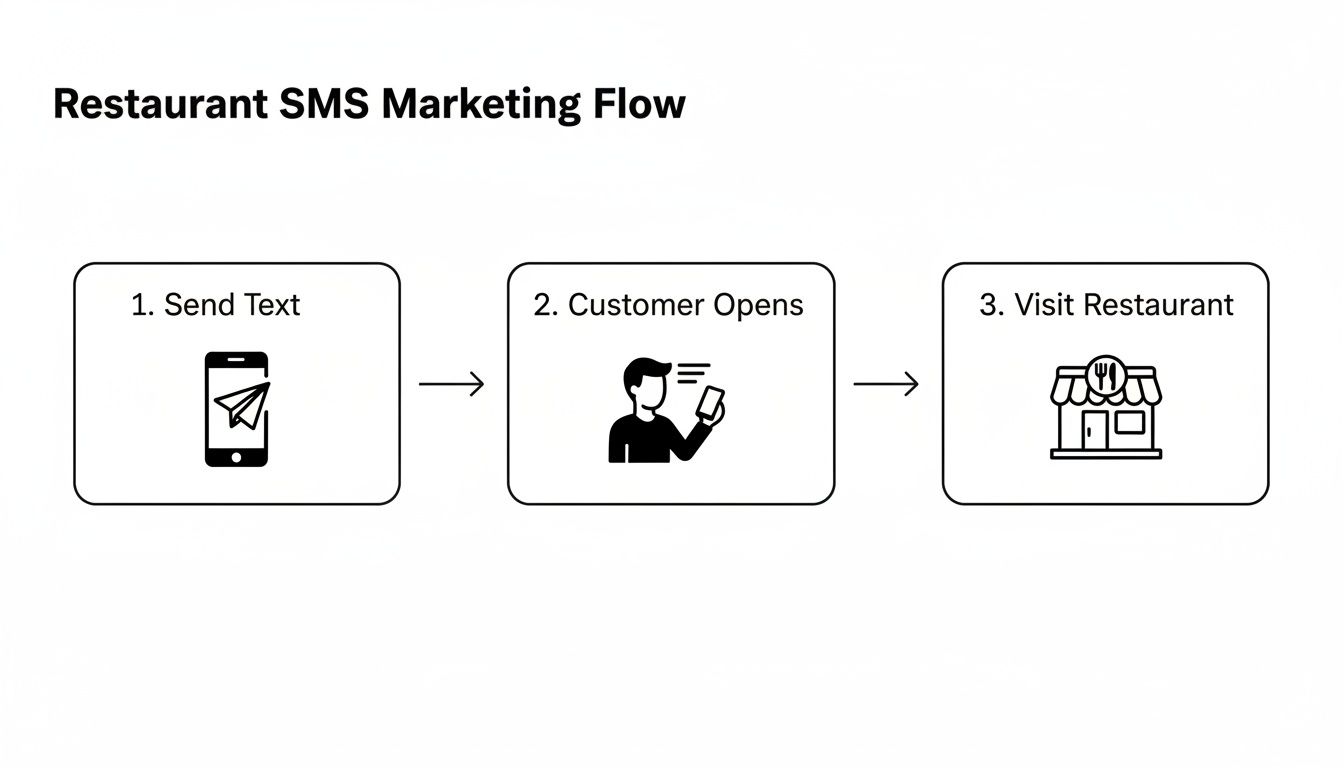
This visual just hammers home how quickly SMS can turn a message on a screen into real foot traffic and revenue for your restaurant.
Okay, now for the most critical piece of this puzzle: compliance. The law you need to know is the Telephone Consumer Protection Act (TCPA). It governs all text message marketing, and getting it wrong can lead to some massive fines.
Don't let that scare you. The rules are pretty straightforward.
The absolute core principle is getting "express written consent" before you send a single marketing text. This means someone has to clearly and knowingly agree to get marketing texts from you. You can't just grab numbers from your reservation book or old receipts—they have to explicitly opt-in for marketing.
Key Takeaway: A customer giving you their number for a reservation is NOT consent to receive marketing texts. You need a separate, explicit opt-in for your SMS program. This distinction is crucial for staying compliant.
To lock in your compliance and build trust, the best practice is a double opt-in.
Here’s how it works:
That second step creates a clear digital record that proves consent. It also ensures your list is full of people who actually want to be there, which means better deliverability and fewer people unsubscribing down the line.
As you build out your list, don't forget that SMS has some powerful cousins. One of my favorite related tactics is ringless voicemail. This tech lets you drop a pre-recorded audio message straight into someone's voicemail without their phone ever ringing.
It feels way more personal than a text but is far less intrusive than a phone call.
Imagine your head chef recording a quick, 30-second message about this weekend's fresh fish special and sending it directly to your top 100 customers. These ringless voicemail drops have a personal touch that really makes you stand out. Platforms like Call Loop often charge per successful drop, so it's a really cost-effective way to make a big impression.
When you combine these list-building tactics with a serious respect for compliance, you create a marketing engine that will pack your restaurant for years to come. For a deeper dive into getting permission, check out our guide on how to get started with opt-in text messaging. Nailing this foundation is how you get to the fun part: crafting campaigns that fill seats.
Alright, you’ve built an engaged, compliant list of subscribers. Now for the fun part: crafting the messages that actually fill your tables and light up your online ordering system. This is where restaurant SMS marketing stops being an idea and starts producing real-world results.
A great campaign isn't just about blasting a discount. It's about sending the right offer, to the right person, at the perfect moment. Think of your SMS channel as a VIP club. Every single message should feel exclusive and valuable, not like another piece of junk mail cluttering up their phone. This is your direct line to your most loyal customers—make it count.
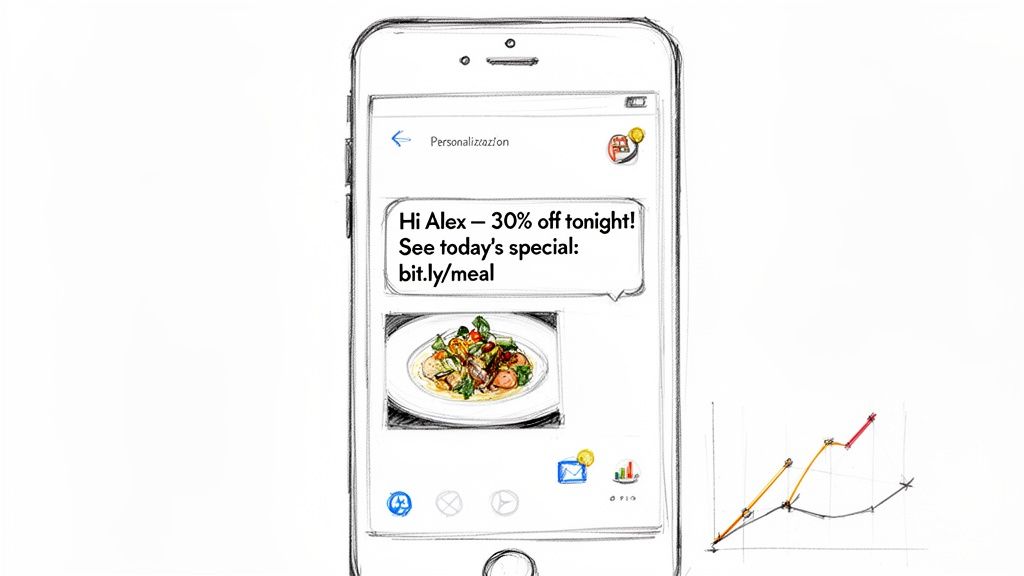
You don't need to come up with a brilliant new idea for every text. I've found that having a playbook of proven campaign types lets you react quickly, whether you're trying to fix a slow Wednesday or announce a new seasonal menu.
Here are a few of the most effective templates you can swipe and adapt for your restaurant:
[Restaurant Name]: Slow Tuesday? Not anymore! Get 50% off all appetizers TONIGHT ONLY from 5-7pm. Show this text to your server. Reply STOP to end.Hi [FirstName]! As a VIP, you've earned a FREE dessert with your next entree. Congrats! Redeem this week. See you soon! [link to your menu]You're invited! Join us for our annual Summer Patio Party this Sat @ 6pm. Live music & chef's specials. Limited spots! Reply YES to save your seat.Generic blasts get generic results. The real magic happens when you get personal. Just using a customer's first name can make a huge difference in how they respond. Most SMS platforms, including Call Loop, let you use merge tags (like [FirstName]) to pop their name right into the message. Simple, but effective.
But why stop there? Take it a step further with MMS (Multimedia Messaging Service), which lets you send pictures and GIFs. Instead of just telling them about your new burger special, show them. A mouth-watering photo of a juicy burger or a decadent dessert is infinitely more powerful than words alone.
Pro Tip: Keep in mind that sending an MMS costs a bit more than a standard SMS (it usually counts as 3 text credits). I always recommend saving them for your most visually stunning dishes and highest-value offers to get the biggest bang for your buck. That visual punch is almost always worth it.
The data doesn't lie. SMS response rates are a game-changer for restaurants, hitting an incredible 45% compared to email's 6%. It’s the perfect channel for time-sensitive promos. In fact, we see many restaurants hitting conversion rates of 20-30% or more from their SMS campaigns. You can find more stats in the latest SMS marketing trends.
While SMS is your go-to workhorse, don't sleep on its powerful sidekick: ringless voicemail. This tech lets you drop a pre-recorded audio message directly into a subscriber's voicemail without their phone ever ringing. It's way less intrusive than a cold call but feels much more personal than a text.
Imagine your head chef leaving a quick, enthusiastic message about a special dish they've personally created for the weekend. A ringless voicemail drop like that feels exclusive and cuts right through all the digital noise. It's a fantastic tool for big announcements or re-engaging your top-tier customers.
So, how do you know if your "Taco Tuesday" text is actually working? You have to track everything. A smart campaign has measurement baked in from the very beginning.
Here’s how we do it:
First, use unique promo codes. Create a specific code for every SMS campaign you send (e.g., TEXT20 for 20% off). When customers use that code, your POS system gives you hard data on exactly how much revenue that one text generated.
Second, use shortened, trackable links. When you're sending people to your menu or online ordering page, don't use the full URL. Platforms like Call Loop have built-in link shorteners that also track click-through rates (CTR). This tells you precisely how many people were interested enough to tap the link.
By looking at this data, you'll quickly see which offers your customers love, what time of day gets the best response, and which messages drive the highest ROI. This is the feedback loop that turns good marketing into great marketing, helping you fine-tune your strategy until every text is working hard for your restaurant.
Imagine if you could bring customers back through your doors and fill up tables, all while you're busy running the kitchen or managing your staff. That's the power of automation in your SMS marketing. It's not about being robotic; it's about building a smart, reliable system that works for you 24/7.
Think of it as your most dependable employee—one that never sleeps and executes your marketing plays perfectly every time. By setting up automated workflows, or what we call "drips," you can make sure every customer gets the right message at the right time, turning first-time visitors into regulars without you lifting a finger.
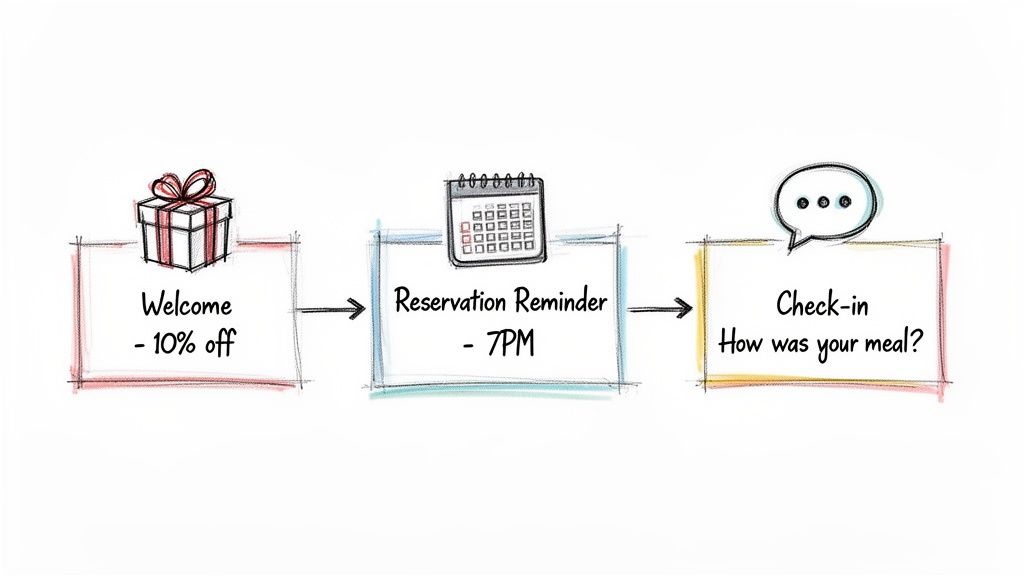
First impressions are everything. When someone texts your keyword to join your list, they're at their most interested. This is a golden opportunity, so don't waste it. An automated welcome series is the perfect way to kick off the relationship.
A good welcome sequence does more than just say "hi." It can drive an immediate sale and start building that crucial customer loyalty from day one.
Here’s a dead-simple, highly effective welcome flow:
Thanks for joining the [Restaurant Name] VIP list! Here's 15% OFF your next order: [Link to coupon]. Can't wait to see you!Hi [FirstName], just a friendly reminder your 15% OFF coupon for [Restaurant Name] is waiting for you! Don't miss out on your next favorite meal.This simple two-step automation works tirelessly in the background, turning fresh subscribers into paying customers.
Is there anything more frustrating than a no-show? That empty table can kill your profit margin for the night. This is exactly where automated reservation reminders become a restaurant owner's best friend.
Instead of having your host spend precious time making confirmation calls, an automated SMS can handle it all. It’s a simple text that can dramatically cut your no-show rate and protect your bottom line.
Just set up an automation to fire off 24 hours before a reservation:
Hi [FirstName], this is a reminder of your reservation for 2 at [Restaurant Name] tomorrow at 7:00 PM. Please reply YES to confirm or call us to modify. Thanks!This gives customers a frictionless way to confirm or cancel, which lets you open that table back up if their plans changed. It’s a small touch that delivers a massive return.
Key Insight: The goal of automation isn't to be robotic; it's to be reliably helpful. Automated reminders feel like a personal service to the customer, improving their experience while simultaneously solving a major business problem for you.
What about those customers who haven't stopped by in a while? Winning back someone who already knows you is way cheaper than finding a brand-new customer. This is where you can get a little more sophisticated with your automation.
You can combine the power of SMS with other channels, like a ringless voicemail, to create a sequence that's hard to ignore. A ringless voicemail drops a pre-recorded audio message straight to their voicemail box without making their phone ring. It’s far more personal than a text but less intrusive than a cold call.
Try this re-engagement play for a customer who hasn't visited in 90 days:
This kind of multi-channel follow-up makes sure your message gets through, all without any extra work from your team. To see how these sequences are pieced together, you can learn more about building a marketing automation workflow and apply the same logic to your restaurant's campaigns.
Alright, you've got the hang of sending out promos and automated reminders. That's a huge step. But if you really want your restaurant SMS marketing to create a buzz, it's time to dig into the strategies that build serious loyalty.
Basic texts are fine, but they won't make you unforgettable. These next-level tactics are about creating a personalized experience that makes every customer feel like a VIP, turning casual diners into your biggest fans.
Texting is quick and effective, but sometimes you need to make a bigger splash. This is where ringless voicemail comes into play. It's a slick way to drop a pre-recorded audio message straight into a customer's voicemail, but here’s the kicker—their phone never actually rings. It’s a powerful method for adding a human touch that a simple text just can't replicate.
Just imagine your head chef recording a quick, 30-second message on a Friday morning, buzzing with excitement about the fresh scallops that just came in for the weekend special. With a few clicks, that message lands in the voicemails of your top 100 customers. It’s personal, memorable, and feels completely exclusive.
I've seen restaurants use these ringless voicemail drops to great effect for things like:
Because platforms like Call Loop often charge per successful delivery, it's an incredibly cost-effective way to make a huge impression on your most important diners.
The true pros of restaurant SMS don't just blast the same message to everyone on their list. They slice their audience into small, targeted groups—or segments—to send offers that are insanely relevant. It’s the difference between shouting a deal to a crowd and whispering a recommendation to a friend.
When you segment, you’re not just sending texts; you're starting conversations based on what you already know about your customers' tastes and habits.
Key Insight: Sending a steakhouse special to a customer who has only ever ordered vegetarian dishes isn't just ineffective—it feels tone-deaf and is a fast track to an "unsubscribe." Smart segmentation makes every message feel like it was sent just for them.
Your POS and SMS platform are collecting a goldmine of data. Here are a few powerful segments every restaurant should be putting to work.
This is hands-down one of the most effective ways to segment. You're targeting people based on what they already love, making your offers a near-guaranteed hit.
Hey [FirstName], it’s Wine Wednesday at The Gilded Spoon! As one of our resident wine lovers, we’re pouring you 50% off any bottle tonight. Hope to see you! Cheers!Your regulars are your lifeblood, and they deserve to be treated that way. At the same time, you need a plan to bring back customers who have fallen off the map. Segmenting by visit frequency lets you do both.
The Gilded Spoon: We miss you, [FirstName]! It's been a while. Come back in this week and enjoy a complimentary appetizer on us. We've saved you a spot.Your big spenders are your most valuable customers, period. Acknowledging their loyalty with exclusive perks is a surefire way to keep them coming back for more.
As one of our top supporters at The Gilded Spoon, we'd like to personally invite you to an exclusive tasting of our new fall menu before it’s released. Reply YES for the details.When you start combining these advanced tactics—the personal feel of ringless voicemail and the laser precision of deep segmentation—your marketing shifts from simple broadcasting to real, revenue-driving conversations.
Jumping into SMS marketing for your restaurant? I get it, you’ve got questions. It’s a direct line to your customers, so you want to make sure you get it right from the start. Let's walk through some of the most common things restaurant owners ask me.
This is always the first question, and the answer isn't about the price tag—it’s about the return.
Most SMS platforms work on a per-message or credit basis, meaning each text only costs a few cents. But think about it this way: a well-aimed campaign that costs you $50 could easily bring in 10 guests who each drop $30. That’s $300 in revenue from a tiny investment. The ROI speaks for itself.
Quick tip: More advanced tools like a ringless voicemail drop are often billed per successful delivery. You only pay when the message actually lands in a customer's voicemail, so you're not wasting a dime. It's a great way to add a personal touch without breaking the bank.
Getting this right isn't just a good idea; it's the bedrock of your entire SMS strategy. The big one is the Telephone Consumer Protection Act (TCPA), which demands "express written consent" before you send a single marketing text.
This means your opt-in methods have to be crystal clear.
Here are the rules I tell everyone to live by:
If you can't measure it, you can't improve it. Luckily, tracking the return on your SMS investment is pretty straightforward if you set it up correctly.
The simplest method? Unique promo codes.
Send out a text offering 20% off with the code "TEXT20". Your POS system will show you exactly how many times that code was used. From there, the math is easy: (Revenue - Cost) / Cost. This little formula gives you a hard number to prove what's working.
Absolutely. In fact, this is one of the fastest and most impactful ways to see an immediate return. No-shows kill your revenue, and automated reminders are the perfect fix.
Think of all the time your host spends making confirmation calls. You can automate that entire process.
Set up a simple text to go out 24 hours before a booking. Something like, "Hi [FirstName], just a reminder about your table at our place tomorrow at 7 PM. Please reply YES to confirm." This dramatically cuts down no-shows. It gives guests a frictionless way to confirm or cancel, letting you either lock in that revenue or open the table for someone else.
Ready to put these powerful SMS, voice, and ringless voicemail strategies to work for your restaurant? With Call Loop, you can automate your outreach, personalize your messages, and see a real return on your marketing efforts. Start your free trial today and see how easy it is to fill more tables.
Chris Brisson
Chris is the co-founder and CEO at Call Loop. He is focused on marketing automation, growth hacker strategies, and creating duplicatable systems for growing a remote and bootstrapped company. Chat with him on X at @chrisbrisson


Trusted by over 45,000 people, organizations, and businesses like


