
See a Demo
You're just one step away from seeing Call Loop in action.
Enter your information below to watch a demo right now.

You're just one step away from seeing Call Loop in action.
Enter your information below to watch a demo right now.

Dana had just watched a competitor generate three callbacks from one voicemail drop campaign. Her team had been dialing prospects manually, watching connection rates hover near 4%, and now the idea of skipping the ring altogether looked almost too efficient to ignore.
Then the practical questions arrived. Is a ringless voicemail service legal? Will carriers flag the traffic? Can the drop connect directly to Salesforce? What happens when someone replies “remove me” by text after receiving a voice message?
Those questions matter more than the novelty of the delivery method. Ringless voicemail isn't a silver bullet. It's a sequencing node that still requires consent, disciplined scripting, accurate suppression, and a follow-up path. A poorly operated campaign can exhaust a phone list in one afternoon. A well-run campaign can create another useful touch across email, SMS, and sales calls.
Teams building the human follow-up layer may also benefit from a structured resource such as Hire SDRs, especially when callbacks need prompt qualification rather than an unattended inbox.
Dana's first instinct was operational: load the list, upload a recording, press send. Her second instinct was more important: find out whether the tactic fit the company's consent records and sales process before putting the brand at risk.
The appeal is obvious. A traditional call asks the prospect to stop what they're doing. A ringless voicemail drop lets the recipient listen later, which can make the message feel less disruptive. But “less disruptive” doesn't mean “unregulated,” and it doesn't mean every number on a CRM export is eligible.
Operator's rule: Treat a voicemail drop as a permission-based campaign touch, not as a loophole around calling rules.
Dana needed answers to four questions before approving a test:
The best use case is usually warm re-engagement. A prospect opened an email, viewed a quote, attended an event, or previously asked for information. The voicemail then reminds the person why the company is reaching out and gives one clear next step.
The worst use case is indiscriminate broadcasting to an old or purchased list. That approach ignores consent, list hygiene, timing, and audience fatigue. Start with a narrow segment, document eligibility, record a concise message, and define the callback outcome before sending anything.
A ringless voicemail service uses a server-side connection to the carrier's voicemail infrastructure rather than a normal call that rings the handset. The platform deposits the recording into the mailbox, and the recipient generally sees a standard voicemail notification. A plain-language explanation of the delivery mechanism describes this as a direct connection to the voicemail system.
The process is easier to understand as a sequence:
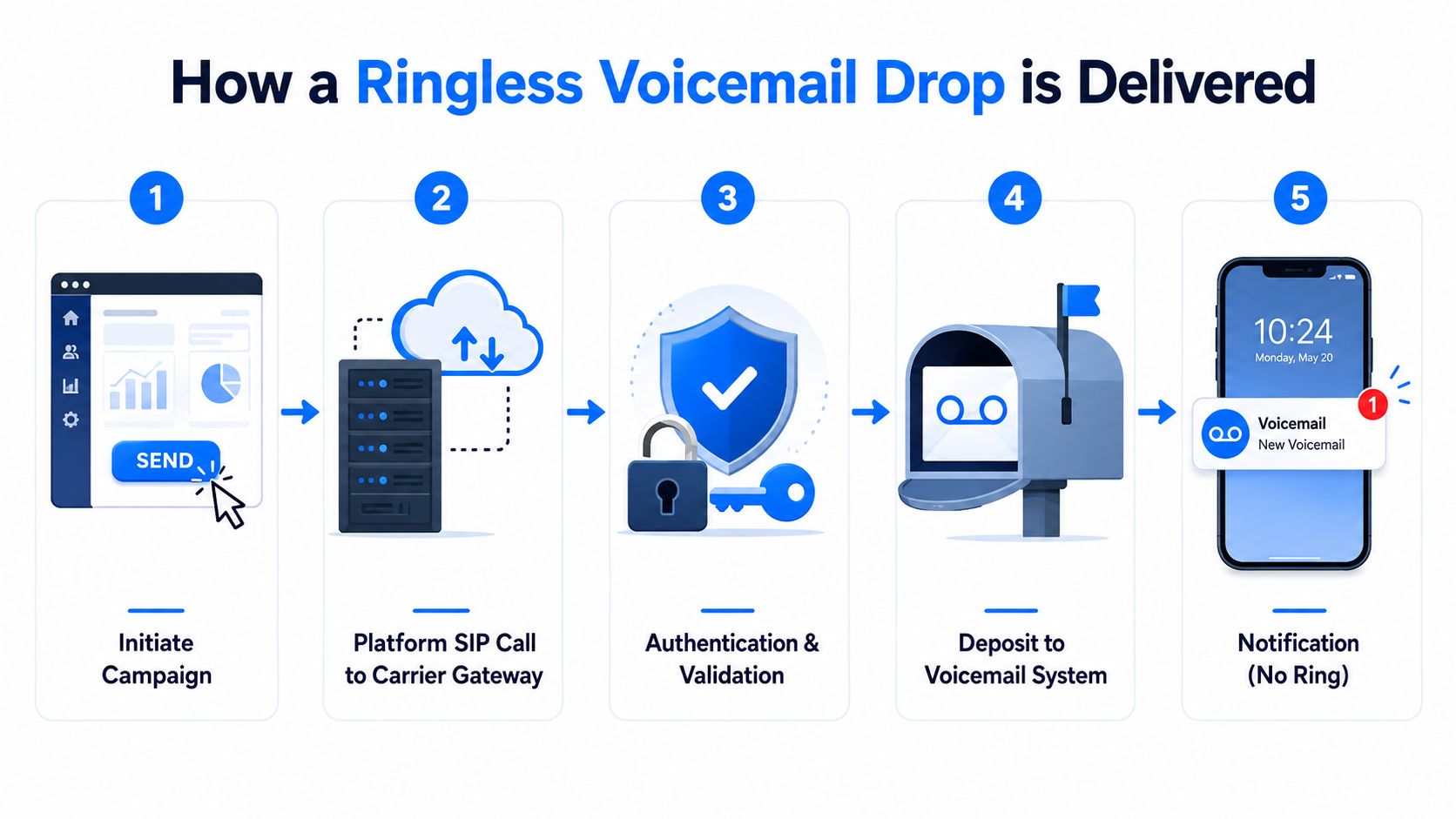
The useful analogy is sliding a sealed envelope under a closed door. The recipient doesn't hear a ringtone, and the handset doesn't participate in a normal answered call. The message appears in the mailbox interface.
That distinction creates trade-offs. Delivery isn't guaranteed inbox placement. Published guidance associated with Call Loop says deliverability on deliverable numbers can range from 60% to 85%, while 45% to 65% is considered strong for many campaigns, so operators should plan for unreachable, invalid, or carrier-rejected numbers. The cited deliverability guidance makes list quality a central operating concern.
Carrier behavior also varies. Some networks may block, transform, delay, or otherwise handle the audio differently. Audio format, latency, mailbox routing, and number validity all affect the outcome. Don't promise that every uploaded contact will receive the recording, and don't treat a successful API submission as proof that a human heard the message.
Compliance needs to live in the workflow, not in a footer or a vendor sales page. In the United States, the FCC ruled on November 21, 2022 that ringless voicemail sent to wireless phones is a “call” made with an artificial or prerecorded voice under the TCPA. The Commission rejected the idea that avoiding a handset ring removes the message from robocall coverage. The FCC's declaratory ruling is the federal starting point for campaign design.
A later federal ruling in U.S. v. Stratics Networks treated ringless voicemails as telephone calls for Telemarketing Sales Rule purposes, narrowing the argument that voicemail deposits sit outside traditional robocall regulation. The ruling analysis reinforces the same operational conclusion: delivery mechanics don't erase telemarketing obligations.
Build the process around evidence:
The FCC ruling also matters because penalties can reach $500 per unlawful message and up to $1,500 for willful violations, as summarized in this TCPA compliance analysis. A Sixth Circuit decision further held that receipt of one ringless voicemail can represent concrete injury sufficient for Article III standing, so a small send doesn't automatically mean small litigation exposure. The standing decision should change how managers think about test campaigns.
Healthcare teams need an extra control layer. A voicemail referencing a patient's condition, appointment, or lab result requires minimum-necessary safeguards, secure handling, and appropriate authorization. Don't leave sensitive health information in an unsecured drop because the phone didn't ring.
For implementation details, use a documented TCPA compliance checklist and have counsel review the policy for the jurisdictions where recipients live.
| Regulation or Source | Operational Rule for Drops | Evidence to Retain |
|---|---|---|
| TCPA and FCC ruling | Obtain required prior consent for covered wireless outreach | Consent language, timestamp, number, source |
| Telemarketing rules | Treat marketing voicemail deposits as regulated calls | Campaign purpose, audience criteria, approval |
| Do-not-call controls | Suppress ineligible and revoked contacts before delivery | Suppression export and pre-send check |
| Consumer revocation | Stop future outreach across connected channels | Request event, processing time, sync result |
| Healthcare privacy obligations | Use minimum-necessary content and secure handling | Authorization, message version, access record |
Ringless voicemail occupies a narrow but useful position in the channel mix. It's stronger than email when a human voice helps restore context, less interruptive than a live call, and less conversational than SMS.
Email remains useful for education, links, documents, and longer nurture sequences. SMS works well when the recipient has confirmed permission and can respond inside the same thread. Cold calling still earns a place for high-value accounts where a live conversation justifies the labor. A voicemail drop fits between those channels when the objective is recall plus callback.
| Channel | Cost per Contact | Attention Capture | Best Use Case |
|---|---|---|---|
| Ringless voicemail | Varies by provider and successful delivery | Audio notification without a live ring | Warm re-engagement and callback prompts |
| SMS | Varies by provider, carrier, and registration requirements | Immediate text-thread visibility | Confirmed-consent follow-up and short replies |
| Usually low marginal delivery cost | Depends on inbox attention and subject line | Education, nurture, and detailed information | |
| Cold calling | Labor-intensive and dependent on live availability | Direct conversation when answered | High-value prospects and complex qualification |
Don't import unsupported benchmark numbers into a business case. The relevant comparison is your cost per qualified conversation, not the nominal price of a send. A cheap message that produces no attributable callback is still expensive when it occupies sales capacity and damages list trust.
Use email first when the prospect needs context. Use a voicemail drop after a meaningful signal, such as an inquiry, quote review, or prior conversation. Use SMS only when the contact has the required permission and the message benefits from a two-way thread. Reserve live calls for accounts where a salesperson can create more value than an automated touch.
The main weakness is interaction. A recipient can listen and call back, but there's no native two-way thread like SMS. Testing is also slower because script tone, timing, callback routing, and audience quality all influence the result.
A practical comparison of SMS and email marketing can help teams assign each channel a distinct job instead of sending the same message everywhere.
Consent is evidence, not a feeling. A contact who once downloaded a document hasn't necessarily agreed to receive prerecorded marketing voicemail, and a purchased list doesn't give the operator a defensible permission record.
Start at capture. Store the agreement against the phone number, identify the purpose, and preserve the form or recording that created the permission. Then place that record inside the CRM, not in an employee's inbox or a spreadsheet that nobody updates.
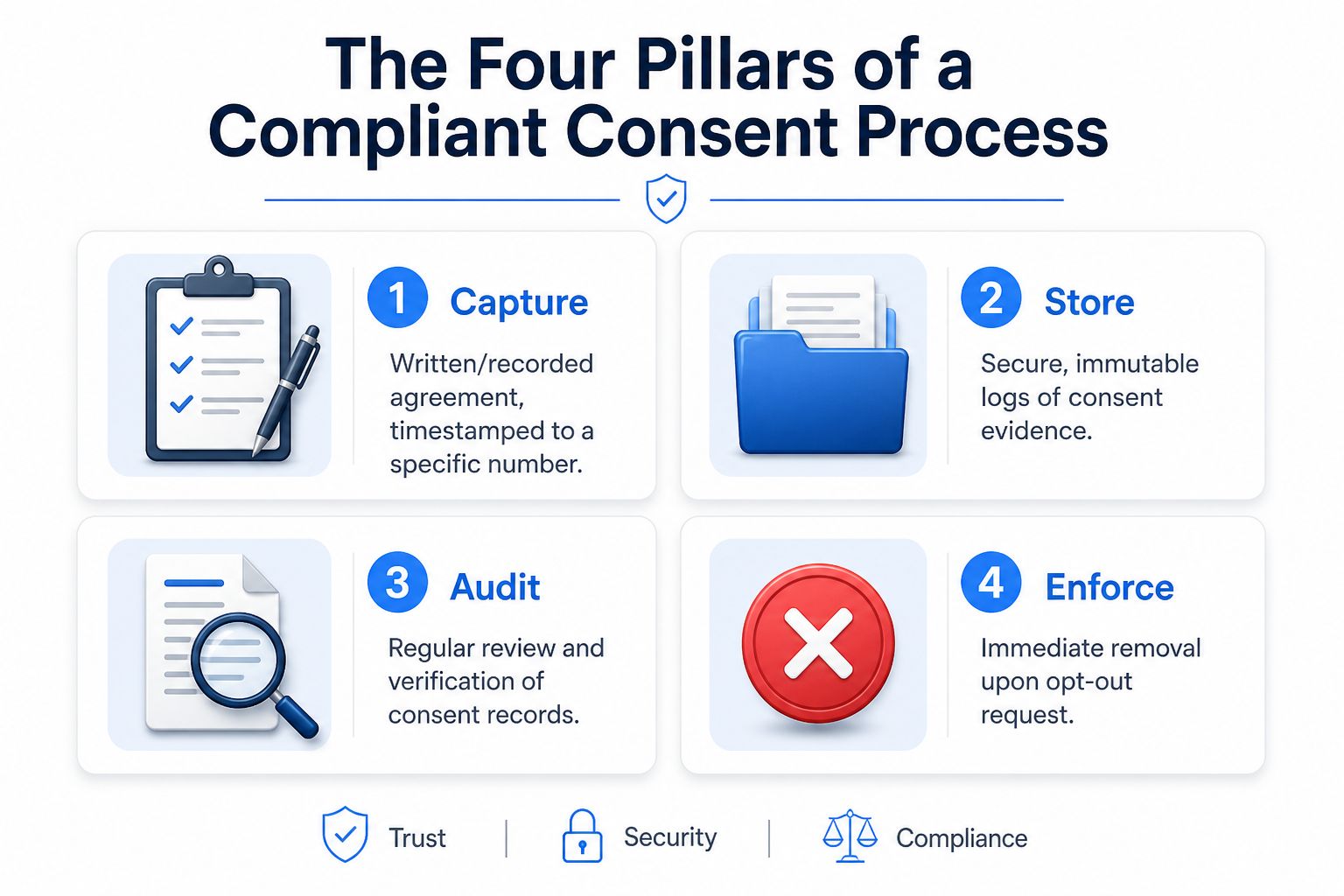
Revocation should move faster than campaign scheduling. For example, a recipient texts “STOP.” A webhook records the event, the CRM consent flag changes, the master suppression list updates, and the drop vendor receives the exclusion before another queued message can run. Send a confirmation only when the channel and applicable rules allow it.
Quiet hours need the same automation. Store the recipient's timezone, convert every scheduled send before launch, and stop campaigns during emergency conditions or special internal restrictions. Healthcare teams should use stricter scheduling policies where their compliance program requires them.
Audit test: For any delivered message, your team should be able to show who consented, when they consented, what they agreed to receive, when they revoked permission, and why the system considered the number eligible.
At minimum, the audit record should connect five events: consent capture, list import, suppression check, delivery attempt, and opt-out status. If one of those records lives in a separate system, create a reliable export or integration rather than expecting an auditor to reconcile disconnected files manually.
A drop should be a workflow node, not a one-off blast. The trigger might be a CRM stage change, a delayed follow-up after an email interaction, or a prospect viewing a quote. The important point is that the event carries enough context to make the voicemail relevant.
Pass the lead ID, phone number, timezone, eligibility status, and recording variant to the voicemail API. Receive the delivery result and write it back to the CRM. A failed delivery should not look like a completed touch, and a callback should not leave the lead trapped in an automated sequence.
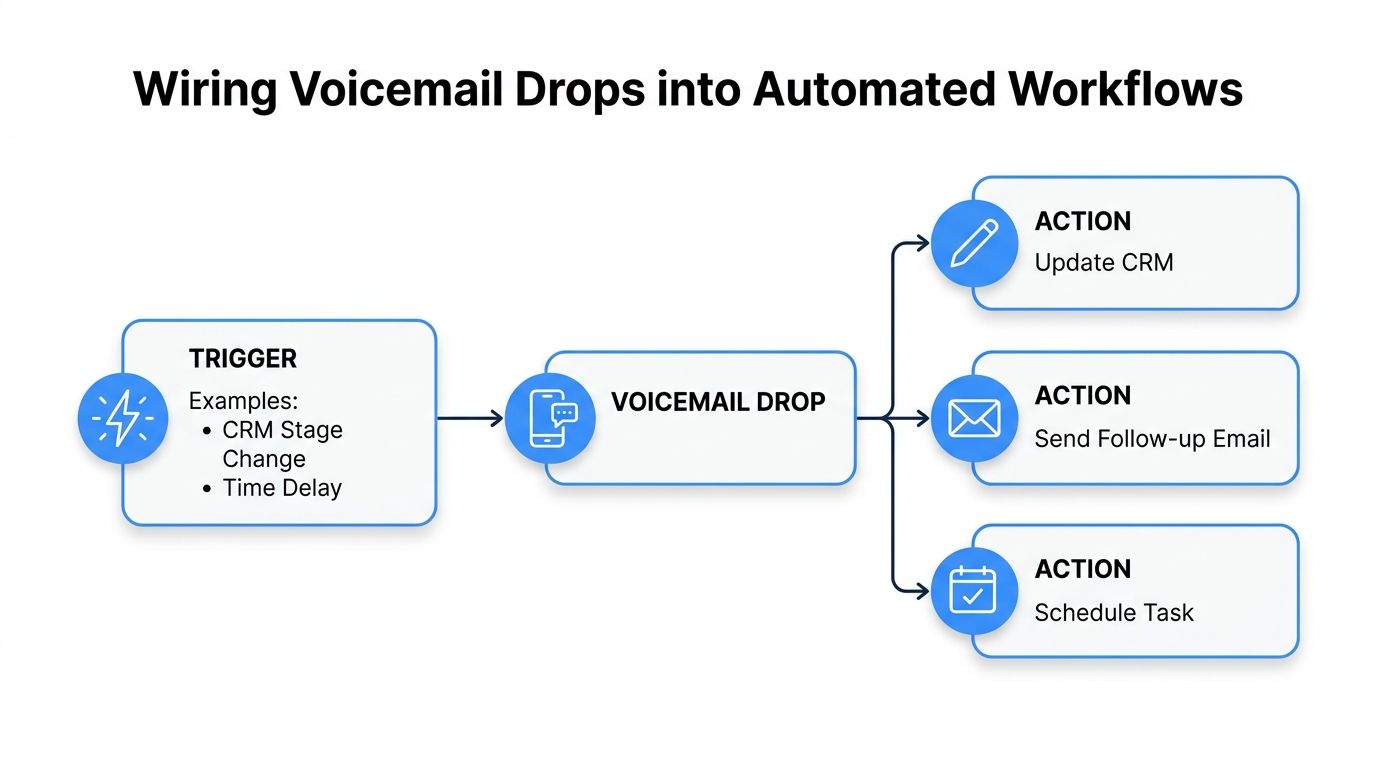
A sensible sequence might look like this:
Use HubSpot Workflows, Salesforce Flow, GoHighLevel automations, Zapier, Make, or a vendor's direct REST endpoint to pass events between systems. Providers such as Slybroadcast and Drop Cowboy can also fit into a broader workflow architecture, but evaluate each integration for consent fields, delivery callbacks, suppression behavior, and error handling.
The branching logic is where campaigns become useful. If delivery fails, queue an email only when that channel is permitted. If the lead clicks a tracked link, suppress the next voicemail and let the sales process take over. If the lead responds, cancel automation and create a human-owned task. If the lead stays inactive, move them into a longer nurture track rather than increasing message pressure.
Document the workflow before building it. A drip campaign best-practices guide can help teams map triggers, delays, branches, and stop conditions without turning the sequence into an uncontrolled cascade.
Pricing usually falls into two structures. Per-drop billing charges for each attempted or successful voicemail, depending on the provider. Per-recipient or subscription billing may suit larger programs, but fixed platform costs can punish a small team with a narrow, high-value audience.
Ask what happens when a number is invalid, unreachable, blocked, or retried. Also ask whether audio re-records, list validation, integrations, and reporting sit inside the stated price. A low unit price can become expensive when the campaign repeatedly targets stale records.
| Pricing Model | Best For | Typical Cost | Effective Cost at 5,000 Contacts | Risk Factor |
|---|---|---|---|---|
| Per successful drop | Focused, permissioned lists | Depends on vendor | Depends on successful deliveries and rate | Failed delivery definitions vary |
| Per attempt | Teams prioritizing predictable send volume | Depends on vendor | Budgeted against all attempts | You may pay for unreachable numbers |
| Subscription or platform fee | Ongoing multi-campaign programs | Depends on plan | Fixed fee plus usage may apply | Small lists can carry unused capacity |
| Hybrid pricing | Teams needing tools plus usage flexibility | Depends on contract | Platform fee plus delivery charges | Contract terms can hide add-ons |
For a worked scenario, use the assumptions supplied for a 5,000-contact SMB campaign: $0.08 per drop, a 2.5% callback rate, 12% lead-to-customer conversion, and a $1,200 average deal size. That produces 125 callbacks, 15 customers, and $18,000 in revenue, against $400 in delivery cost. The arithmetic doesn't produce $19,200 under those assumptions, so don't publish that figure as if it follows from the inputs.
The breakeven formula is simple:
Required customers = total campaign cost ÷ gross profit per customer
Use gross profit, not revenue, and include labor, creative, CRM, compliance review, follow-up, and failed-delivery costs. For teams comparing production expenses, a separate resource on budget-friendly AI music pricing may be useful when evaluating audio creation costs, but it shouldn't be mixed into delivery economics without a clear allocation.
Most first campaigns don't fail because the technology can't deposit audio. They fail because the operator ignores the surrounding process. A valid delivery to the wrong person is still a bad campaign outcome.
Run this pre-flight checklist before every send:
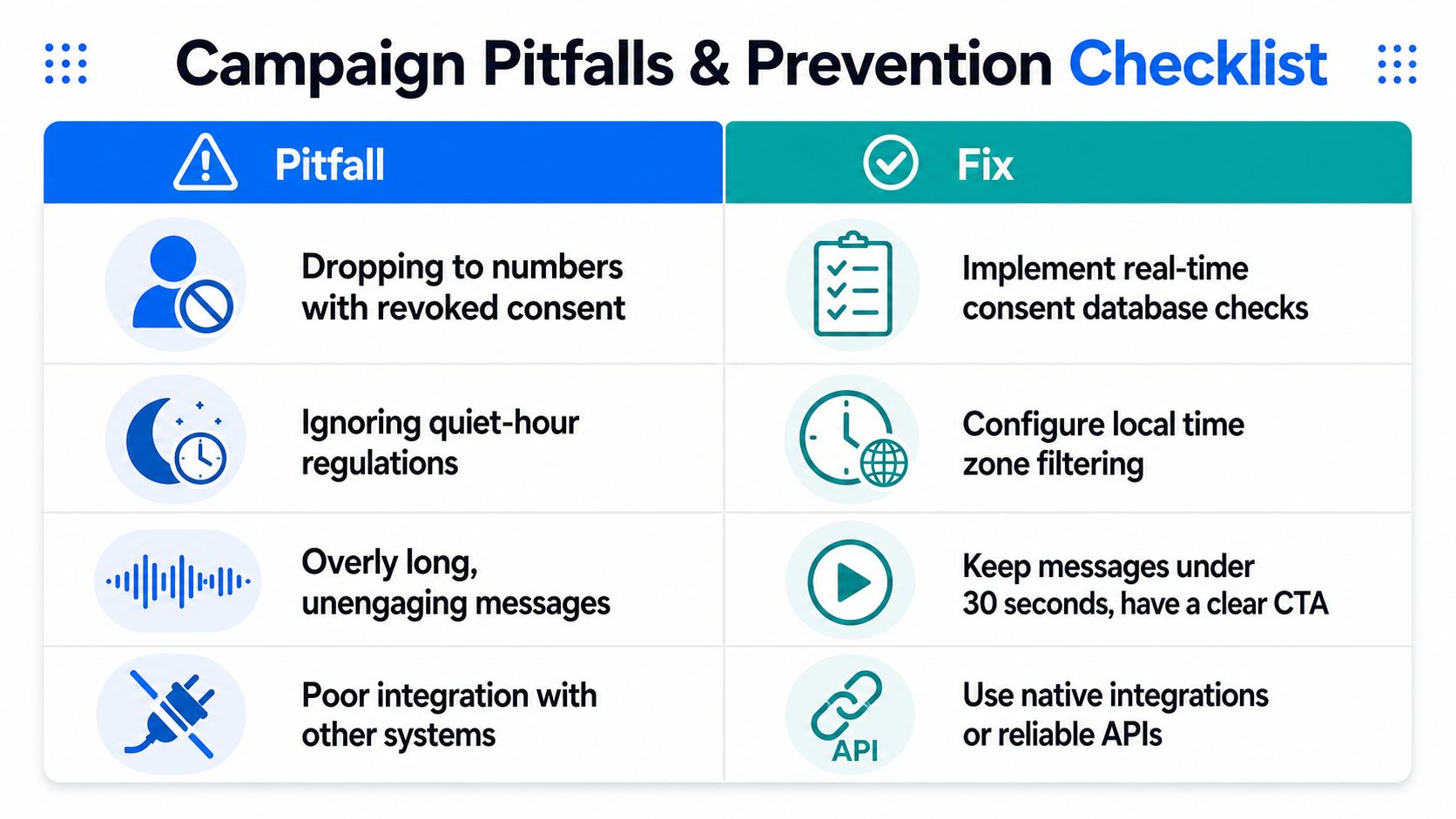
Test with internal numbers first. Listen on different devices, verify the message arrives as intended, check the callback route, trigger an opt-out, and confirm that the suppression reaches every connected system. Then launch to a small, documented segment before expanding.
The right success metric isn't delivered messages alone. Track eligible contacts, successful drops, callbacks, qualified conversations, opt-outs, complaints, and revenue attributed to the sequence. That dashboard tells you whether the ringless voicemail service is helping the sales process or merely creating more activity.
Call Loop offers ringless voicemail delivery that sends recorded audio directly to voicemail without ringing, alongside SMS, voice broadcasting, drip automation, scheduling, integrations, and campaign analytics. If your team has documented consent and needs to connect voicemail drops with follow-up actions, visit Call Loop to evaluate the workflow against your compliance and response requirements.
Chris Brisson
Chris is the co-founder and CEO at Call Loop. He is focused on marketing automation, growth hacker strategies, and creating duplicatable systems for growing a remote and bootstrapped company. Chat with him on X at @chrisbrisson


Trusted by over 45,000 people, organizations, and businesses like


