
See a Demo
You're just one step away from seeing Call Loop in action.
Enter your information below to watch a demo right now.

You're just one step away from seeing Call Loop in action.
Enter your information below to watch a demo right now.

The usual SMS vs email marketing argument starts with opens, but that framing is too narrow to be useful. SMS open rates are commonly reported around 98%, with 90% of texts read within 3 minutes, while average email open rates are typically around 20% to 28% according to Vonage's summary of industry benchmarks. That gap matters, but it doesn't settle the decision.
A better question is this. Which message deserves immediate interruption, and which message needs room to explain, educate, or persuade?
That distinction changes everything. If you treat text messaging like a smaller email, you'll drive opt-outs, compliance risk, and audience fatigue. If you use email for urgent reminders, short-lived promotions, or time-sensitive follow-up, you'll leave attention on the table. Better results are achieved when this is no longer treated as a winner-take-all channel fight, and each message is assigned to the format it fits.
The practical version is simple. SMS is the fast lane. Email is the deep lane. Ringless voicemail and voice can support both when timing, reinforcement, or reach matters.
A channel decision is really a risk decision. The question is not which format gets more attention in the abstract. The question is which message earns an interruption, which one needs room to explain, and which one creates unnecessary compliance exposure if you send it the wrong way.
That distinction matters more than the headline metrics. I have seen teams get strong short-term response from text, then damage list health by pushing messages that belonged in email. I have also seen revenue lost because a time-sensitive reminder sat in an inbox until it expired. Channel fit affects response, opt-outs, complaint rates, and how much trust you keep after the campaign.
SMS is best treated as a high-attention, low-space channel. Email is a lower-attention, high-context channel. Ringless voicemail sits in a useful middle ground for specific cases, especially follow-up on missed appointments, stalled leads, and outreach where a human voice adds credibility without starting a live call.
The practical mistake is easy to spot. A retailer sends a long promotional text with multiple offers and no clear action. Opt-outs rise. A clinic sends an appointment reminder only by email. No-shows rise. An agency copies the same message into SMS, email, and voicemail without adjusting timing or content. Engagement drops because every touch feels repetitive.
The better approach is message matching.
A lot of comparisons stay too shallow. For many businesses, especially healthcare, legal, financial services, franchises, and agencies sending on behalf of clients, the right question is not just response rate. It is whether the campaign can be sent legally, documented properly, and repeated at scale without creating avoidable risk.
SMS usually demands tighter consent controls and clearer operational discipline. Email has its own requirements, but text and voice campaigns can trigger much higher exposure under rules like TCPA if opt-in, timing, message type, or recordkeeping are handled poorly. Healthcare teams also have to account for HIPAA before sending any message that could expose protected health information. That alone changes how reminders, follow-ups, and voicemail drops should be written and automated.
Strong teams build the rule set before they build the campaign. They define what can go by email, what requires express consent for text, what should be stripped of sensitive information, and where ringless voicemail fits without creating overlap fatigue. They also measure channel performance beyond opens by tracking reply quality, conversion speed, unsubscribe rate, complaint rate, and cost per completed action. A disciplined marketing campaign effectiveness measurement framework makes those trade-offs visible.
The useful version of sms vs email marketing is simple. Choose the channel based on urgency, complexity, consent, and customer tolerance. Then use the other channels to support the message, not duplicate it.
The cleanest way to compare SMS and email is to look at what happens between send and action. Not just opens, but visibility, click behavior, and whether the message reliably reaches the person you meant to contact.
| Metric | SMS marketing | Email marketing |
|---|---|---|
| Open rate | Commonly reported around 90% to 98% | Typically much lower and more variable |
| Click-through rate | Typically 8% to 10% for average programs, 17% to 24% for high performers | Lower and more variable |
| Deliverability | Commonly reported around 95% to 99% | More dependent on inbox placement and sender reputation |
| Best fit | Immediate visibility and action | Detailed content and slower consideration |
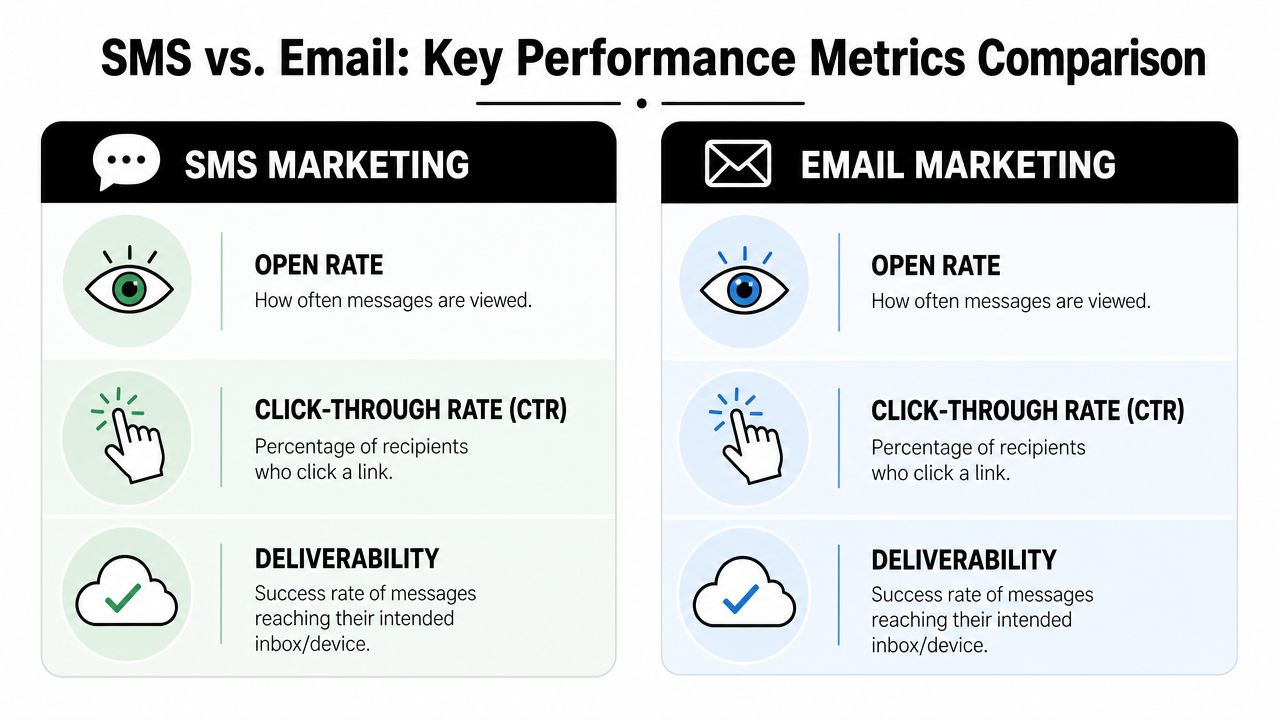
Across major-market benchmarks, SMS open rates are commonly reported around 90% to 98%, delivery rates around 95% to 99%, and CTR typically 8% to 10% for average programs and 17% to 24% for high performers according to ActiveCampaign's SMS metrics summary. That combination makes SMS unusually strong for messages tied to a deadline or immediate decision.
Email still matters because engagement quality isn't only about speed. A buyer comparing vendors, reviewing a proposal, or learning a service process often needs an inbox record with links, images, and explanation. Text gets attention fast. Email supports thought.
The device isn't the whole story. User expectation is. People treat text messages like personal alerts and email like a review queue.
That expectation changes campaign design. In SMS, every extra word competes with urgency. In email, structure and relevance matter more than raw brevity. A promotional email can still work well, but it has to survive filters, inbox crowding, and user deferral.
The mistake is assuming stronger top-line engagement means stronger performance in every case. It doesn't.
A practical measurement model should track more than sends and opens. Teams should compare channel performance against the actual business outcome. Marketing campaign effectiveness metrics matter more when they tie delivery, click behavior, reply activity, and downstream conversion into the same view.
Three common misreads show up in audits:
If you need immediate attention, SMS usually has the edge. If you need the recipient to compare, evaluate, or revisit details, email still carries more weight.
Channel cost gets discussed superficially. Teams compare the per-send expense of SMS with the lower apparent cost of email and stop there. That's not how good channel planning works.
The cost question is what you pay relative to the outcome you need. If the campaign depends on immediate action, SMS often justifies its higher send cost because the channel is built for speed and visibility. If the campaign depends on storytelling, education, or multiple links, email usually delivers that more efficiently.
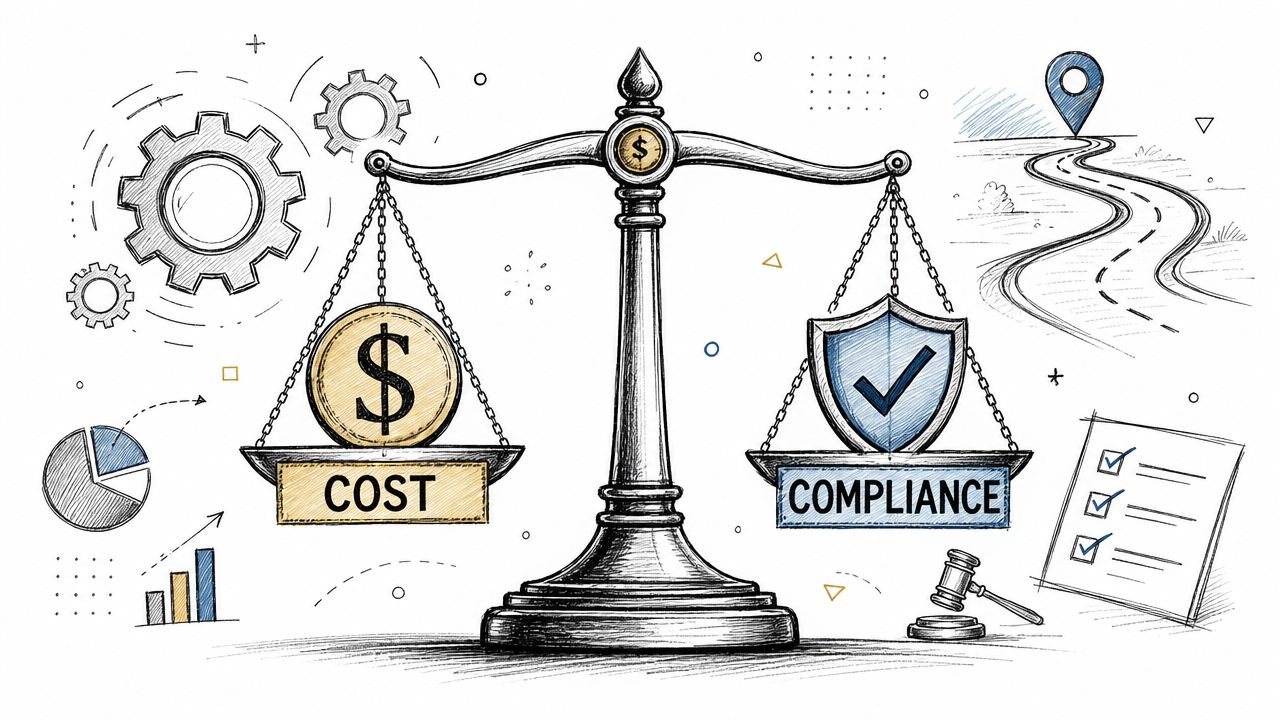
The business case for SMS has long rested on both engagement and return. Industry sources report SMS marketing ROI in the range of $21 to $41 for every $1 spent, with some newer summaries citing averages as high as $71 per $1 and reports of flash-sale campaigns exceeding 3,000% ROI. Email is also highly efficient, with commonly cited ROI figures around $36 per $1 spent according to this Kixie comparison.
That range tells you something important. SMS can be expensive in the wrong use case and extremely profitable in the right one. Email can be remarkably efficient, but it won't rescue an urgent campaign that needed instant visibility.
SMS vs email marketing gets serious. The legal risk profile isn't the same.
For SMS, TCPA issues sit at the center of execution. Consent, opt-out handling, timing rules, and message relevance aren't nice-to-haves. They're operational requirements. If you're texting promotions, reminders, or follow-ups without a clean permission trail, you're creating risk before performance even enters the conversation. Teams that need a refresher on consent standards should review express written consent requirements.
Email has its own compliance framework, usually centered on opt-out processes, sender identity, and truthful message practices. It's generally less interruptive and often lower-friction to subscribe to, but that doesn't mean it's casual. Poor list hygiene and aggressive sending still create reputational and deliverability problems.
Compliance isn't separate from performance. A channel you can't use confidently at scale is not a strong channel.
Healthcare deserves its own rulebook. Once protected health information enters the picture, HIPAA affects how messages are created, transmitted, stored, and accessed. That applies to appointment workflows, care reminders, intake instructions, and follow-up communications. Even if a text reminder seems harmless, teams still need to consider whether the content reveals more than it should.
Practical safeguards include:
If a business also uses ringless voicemail, the same caution applies. Voice can feel more personal and improve message recall, but it still needs consent management, clear audience rules, and careful scripting. In regulated industries, the safest approach is a message hierarchy. Text for reminders, email for documentation, ringless voicemail for selective reinforcement.
The most effective teams don't ask whether SMS should replace email. They build workflows where each channel handles a specific job.
Independent guidance on the topic keeps arriving at the same conclusion. SMS and email are strongest when used together as a coordinated workflow, with SMS used for urgency and immediate action, and email used for longer-form context, education, and nurture according to Attentive's discussion of coordinated channel use. That aligns with what works in practice.
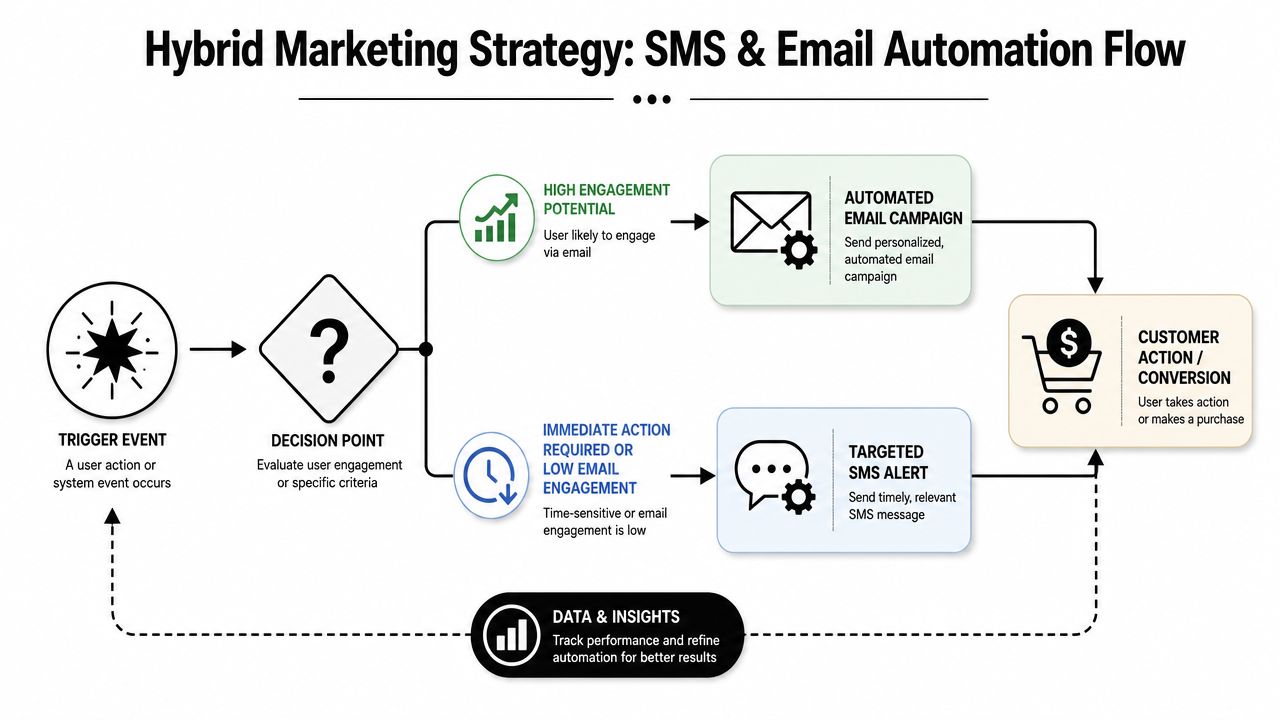
Good hybrid automation usually follows a trigger, intent check, and escalation path.
For example:
That sequencing is what many teams miss. They send all channels at once, then wonder why customers feel bombarded.
Ringless voicemail belongs in the hybrid conversation because it solves a different problem. It's not a replacement for text or email. It's a reinforcement layer.
Use cases where it often fits well:
The key is restraint. Ringless voicemail works best when the message benefits from voice, not when it's just another promotional blast.
Automation gets easier when campaigns, triggers, and contact data live in one system or at least sync reliably. Teams often connect their CRM and messaging stack through integrations with HubSpot, ActiveCampaign, Keap, or Zapier so behavior in one system triggers outreach in another. A useful starting point is this overview of combining text and email in one workflow.
One platform that supports this broader outbound model is Call Loop. It combines SMS, voice broadcasting, and ringless voicemail with automation, scheduling, segmentation, and integrations. For healthcare teams, its HIPAA-compliant setup is especially relevant because workflow convenience can't come at the expense of privacy controls.
If your automation sends the same message through every channel, that's not orchestration. That's duplication.
The better pattern is intent-based sequencing. Email explains. SMS prompts. Ringless voicemail reinforces. Each channel earns its place.
Decision-makers often don't need another abstract comparison. They need a channel decision they can use this week. The easiest way to handle sms vs email marketing is to match the channel to the business goal.
| Business Goal | Primary Channel | Example Scenario |
|---|---|---|
| Flash sale or deadline push | SMS | A retail store sends a short time-sensitive offer that expires the same day |
| Appointment reminder | SMS | A service business reminds customers about tomorrow's scheduled visit |
| Lead nurture | A B2B company sends product education, FAQs, and proof points over time | |
| Webinar follow-up | Hybrid | SMS reminds registrants shortly before start time, email sends recap and materials after |
| Abandoned cart recovery | Hybrid | SMS nudges quickly, email follows with product detail and reassurance |
| Customer update or documentation | A business sends policy updates, receipts, onboarding steps, or resource links | |
| Missed response follow-up | Ringless voicemail plus SMS | A sales team leaves a voicemail drop, then sends a brief text prompt to reply |
SMS should be your first choice when the value of the message drops fast.
Examples include:
What doesn't work is using SMS to deliver long explanations, broad brand storytelling, or low-importance promotions. The more often a text feels optional, the faster the audience starts treating your number like noise.
Email is still the stronger tool for communication that needs structure.
That includes onboarding, educational series, comparison content, policy messages, service explanations, newsletters, and visual offers with multiple sections. If your team needs help tightening creative and improving inbox interaction, this guide for improving email engagement is a useful operational reference.
A few common fits:
The hybrid model tends to outperform single-channel thinking because each message does one job well.
A practical sequence might look like this:
If the recipient needs to think, use email. If the recipient needs to act, use SMS. If the recipient needs a human nudge, add voice carefully.
That framework is simple, but it's reliable. It also helps teams avoid one of the biggest problems in outbound messaging, which is using the most interruptive channel for the least urgent message.
Different industries should not run the same playbook. Channel fit changes with buying cycle, regulation, customer tolerance, and how often the business needs a response.

SMBs usually get the biggest lift from using SMS selectively, not constantly. A restaurant, med spa, gym, repair company, event organizer, or karate studio can use text for confirmations, reminder flows, waitlist openings, and short-lived offers. Email should carry newsletters, monthly promotions, and longer customer education.
The mistake is overusing text because it works fast. Neutral guidance consistently stresses that text messaging is highly personal and permission is essential, with users expecting brief, relevant, time-sensitive updates rather than broad promotional volume, as discussed in Unlayer's email versus SMS article. SMBs need that discipline more than anyone because local customers remember annoying outreach.
Agencies need a system they can explain to clients. That means channel rules, attribution logic, and clear message roles.
A clean agency recommendation:
Agencies also need to protect clients from channel fatigue. If every campaign becomes a blast across email, text, and voicemail, performance erodes and complaints rise.
Healthcare teams should be the most conservative and the most structured. The operational upside of text reminders is obvious, but so is the privacy risk if workflows are sloppy.
The right approach is narrow and disciplined:
The core question for healthcare isn't just delivery. It's whether the content, channel, and workflow protect patient privacy while still improving adherence and attendance.
The most useful way to think about sms vs email marketing isn't performance alone. It's interruption level. As neutral industry commentary puts it, the key question is which message deserves the interruption of a text versus the lower-friction inbox. That standard keeps teams honest.
When a message is urgent, brief, and permission-based, SMS is hard to beat. When it needs detail, nuance, or a lighter touch, email is usually the better channel. When follow-up needs more presence, ringless voicemail can support the sequence, but only when it's used with restraint and clear consent logic.
If you need one system to run compliant outreach across SMS, voice broadcasting, and ringless voicemail, Call Loop is built for that kind of workflow. It supports segmentation, automation, scheduling, integrations, and HIPAA-compliant communications, which makes it a practical option for SMBs, agencies, and healthcare teams that want coordinated outbound messaging without stitching together separate tools.
Chris Brisson
Chris is the co-founder and CEO at Call Loop. He is focused on marketing automation, growth hacker strategies, and creating duplicatable systems for growing a remote and bootstrapped company. Chat with him on X at @chrisbrisson


Trusted by over 45,000 people, organizations, and businesses like


