
See a Demo
You're just one step away from seeing Call Loop in action.
Enter your information below to watch a demo right now.

You're just one step away from seeing Call Loop in action.
Enter your information below to watch a demo right now.

At its core, sending scheduled text messages is simple: you write a message, pick who gets it, and tell your platform when to send it in the future. But this simple act is what transforms your communication from a constant, manual chore into an automated, strategic asset.
Ever wished you could hit "send" on a flash sale promo at the exact moment your customers get their paychecks? Or remind every single webinar registrant an hour before you go live, without lifting a finger on the day? That's the magic of scheduling texts.
Timing is everything in customer communication. And when it comes to getting a message seen, SMS is king. The ability to prep your messages days or weeks in advance and have them land at the perfect moment is a total game-changer. You stop reacting and start orchestrating.
This isn't just about making your life easier; it's about connecting with people when they're most receptive. Think about a local gym that schedules class reminders to go out 24 hours in advance. No-shows plummet, and classes stay full. Or an e-commerce store that schedules a flash sale text for noon on a Friday. The impact is immediate and measurable.
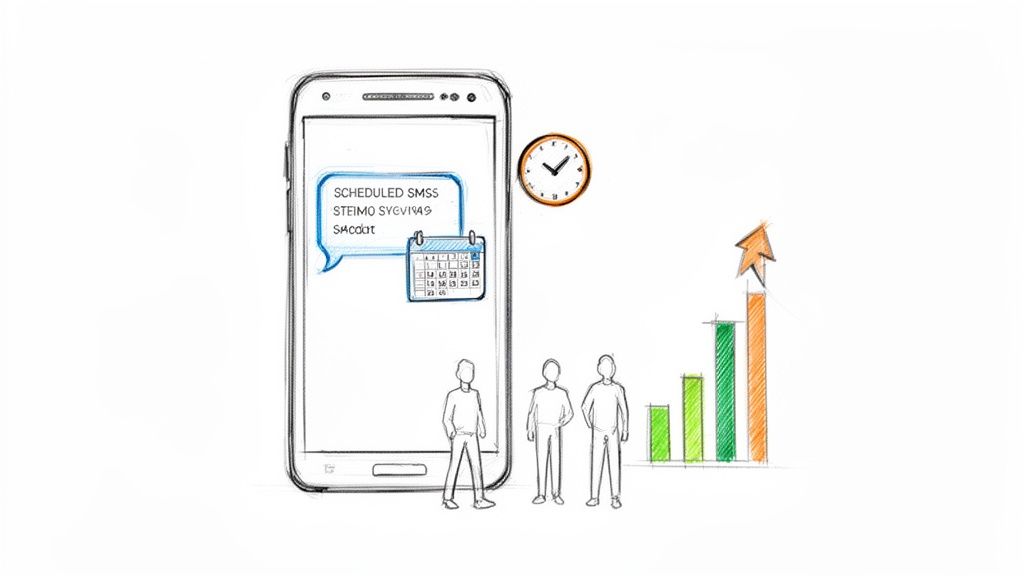
The numbers don't lie. In a world where everyone is busy, scheduled texts give businesses a massive leg up in engaging their audience without burning out their team.
SMS open rates are still an unbelievable 98%, with most people reading a text within just three minutes of receiving it. Email can't even come close. It’s no surprise the global SMS marketing market is set to hit $9.96 billion by 2026, largely thanks to automated scheduling features in platforms like Call Loop.
The real advantage of scheduling is precision. It lets you put the right message in front of the right person at the exact moment they're most likely to act. That's how a simple text becomes your most powerful conversion tool.
Scheduled SMS is a fantastic starting point for automating your outreach. Below is a quick look at how different industries are using it to get ahead.
By planning ahead, you can execute these campaigns flawlessly without any last-minute scrambling.
While scheduled texts are powerful on their own, they become even more effective when you pair them with other communication channels. This is how you create a truly personal and memorable customer experience.
Consider mixing and matching these strategies:
Mastering this simple technique delivers real results, from more sales to happier, more loyal customers. You can see how these tactics fit into a bigger strategy in our guide on how to increase customer engagement. When you plan your communications, you regain control and start driving interactions that truly matter.
Jumping into your first campaign to send scheduled text messages can feel a bit overwhelming, but it’s honestly simpler than you think. The real secret is to ditch the generic templates and craft a message that feels personal, timely, and actually valuable to the person on the other end. A great text isn't just about what you say, but when you say it.
First things first: the copy. With SMS, you're working with limited real estate, so every single character has to pull its weight. Focus on one, crystal-clear call to action. Are you trying to drive them to a sale? Confirm an appointment? Share a critical update? Whatever it is, make it obvious from the first word.
Next up is segmentation. This is your best friend in SMS marketing. Blasting the same exact message to every single person on your list is a surefire way to see your opt-out rates skyrocket. Instead, think about how you can split your audience into logical groups. For example, a brand-new lead should get a completely different welcome message than a loyal customer who's been with you for years.
Good SMS copy feels direct and personal, like it’s coming from a human. The easiest win here is using merge tags—those little placeholders that automatically pull in customer info like their first name. A message that kicks off with "Hey [FirstName]," is instantly more engaging than a cold, generic "Hello."
Let's look at a couple of real-world examples you can steal and adapt:
The Happy Birthday Offer: Schedule this to go out on the morning of a customer’s birthday. "Happy Birthday, [FirstName]! To celebrate, here's a 20% off coupon just for you. Come visit us today! [Link]" This feels like a thoughtful gift, not just another ad.
The Post-Purchase Follow-Up: Set this to send three days after an order. "Hi [FirstName], how are you enjoying your new [ProductName]? We'd love to hear your thoughts! As a thank you, here’s 15% off your next order. [Link]" This simple message shows you care about their experience and gives them a good reason to come back.
If you want to get a better handle on the basics, it helps to explore a solid guide on the fundamentals of sending texts online for business. Understanding the core methods first makes the automation part much easier to master.
Once you've got your message dialed in and your audience segmented, the final piece of the puzzle is the scheduling. Precision is everything here. You have to consider not just the day, but the exact time—and, critically, the recipient's local time zone. Firing off a promotional text at 9 AM Eastern Time means it lands at a rude 6 AM for your customers on the West Coast. Not a great look.
A scheduling interface like the one in Call Loop makes this foolproof. You can visually pick the date, time, and timezone, ensuring your message lands at the perfect moment. This takes all the guesswork out of the equation and prevents those costly timing mistakes.
A text message delivered at the right time feels like helpful service; the same message at the wrong time feels like spam. The scheduling tool is what makes the difference.
This level of control means you can plan out entire campaigns weeks or even months ahead of time. You could set up your Black Friday promotions in September or schedule a whole year’s worth of birthday texts in a single afternoon. That kind of foresight frees you up to focus on other parts of your business, turning your marketing from a reactive scramble into a well-oiled, strategic machine.
Sending a single, scheduled text is useful, but the real magic happens when you move beyond one-off messages. This is where you can build an entire communication engine that works for you 24/7, creating sophisticated workflows that build relationships and drive action on autopilot.
Think about it. A new lead fills out a form on your website. Instead of just sending one welcome text, you can kick off an entire drip campaign. This is simply a pre-built sequence of messages designed to nurture that lead over days or weeks. Maybe they get an instant welcome text, a follow-up with helpful resources two days later, and a special offer on day five. All without you lifting a finger.
A truly effective workflow often layers in more than one channel. This is your chance to get creative by strategically adding other tools, like ringless voicemail. If you haven't used it, ringless voicemail drops a pre-recorded audio message directly into someone's voicemail box without their phone ever ringing. It's a powerful, non-intrusive way to add a personal, human touch to your automation.
Here’s what a multi-channel sequence could look like:
This kind of multi-touch approach helps you stand out and forge a much stronger connection. To really get the most out of scheduled texts, it helps to understand the broader array of workflow automation benefits so you can see how this strategy fits into your bigger business goals.
The flowchart below breaks down the simple, three-step process that forms the foundation for these advanced workflows.
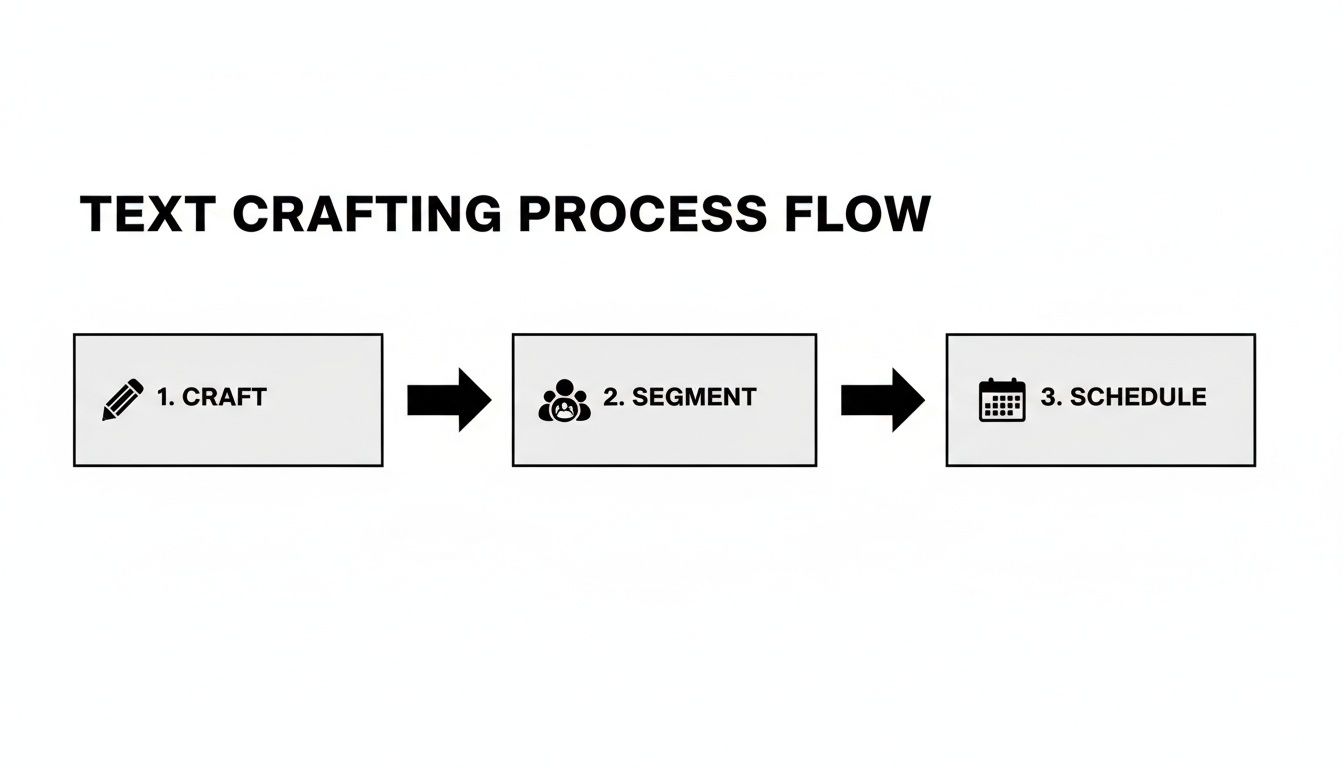
This core loop—crafting the message, segmenting the audience, and scheduling the delivery—is the fundamental building block for any powerful, multi-step communication sequence you can imagine.
The smartest workflows aren't just based on a calendar; they're triggered by what your contacts actually do. This creates an experience that feels incredibly relevant and responsive. For instance, you could set up a trigger to automatically send a follow-up text 24 hours after someone clicks a link in your first message.
This is event-driven marketing at its best. Instead of just sending messages based on a calendar, you’re responding directly to your customer’s behavior, making every interaction feel timely and personal.
There’s a reason karate studios and e-commerce brands are all-in on scheduled texts for customer retention. We're seeing SMS automation, including drip campaigns, surge 30-40% across industries, powering everything from follow-ups to flash sales. Platforms like Call Loop make it easy to orchestrate these multi-channel sequences—combining SMS and ringless voicemail—with precise timing, leading to 56% higher ROI for businesses with omnichannel strategies.
When you connect these tools, you can map your automated communications to the entire customer journey, ensuring no lead ever falls through the cracks. To dive deeper into building these powerful sequences, check out our guide on workflow marketing automation.
Scheduled texts are fantastic, but if you want to create a truly powerful outreach strategy, you need to layer your communication. Think of it as creating a multi-touch experience that actually gets remembered.
One of the best tools to pair with SMS is ringless voicemail. It's a slick piece of tech that delivers a pre-recorded audio message straight to someone's voicemail inbox—their phone never even rings. This makes it a super respectful and personal way to connect without interrupting their day.
The real magic of ringless voicemail is the human touch it adds to an otherwise automated sequence. A text is perfect for quick, scannable info. A voicemail, on the other hand, can carry your tone, personality, and genuine sincerity in a way text just can't. It feels less like a mass broadcast and more like a personal check-in.
For example, let's say you schedule a text on Monday promoting a new service. Then, on Wednesday, you can schedule a ringless voicemail drop. The message could be something simple like, "Hey [FirstName], it's Sarah from [YourCompany]. Just wanted to follow up on the text I sent about our new service and see if you had any questions. No need to call back, just wanted to put a voice to the name. Have a great day!"
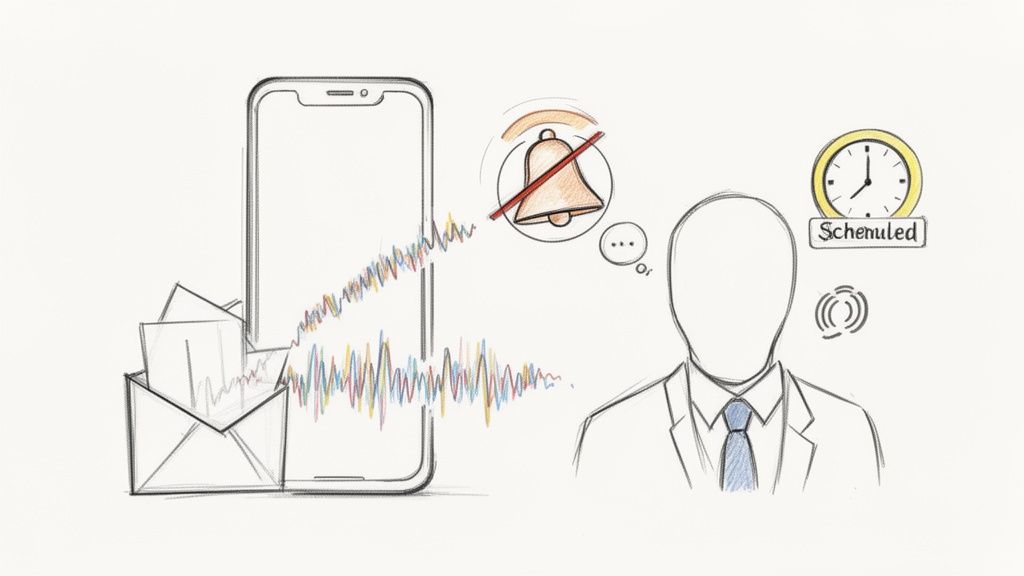
This really gets to the heart of modern outreach. It’s about being non-disruptive. Tools like scheduled texts and ringless voicemail let you connect with people on their own terms, which is exactly how you build trust.
Putting together a great voicemail message is pretty simple. The number one rule is to sound natural and authentic. Ditch the stiff, corporate script.
Just speak clearly, keep it short (under 30 seconds is the sweet spot), and always say who you are and where you're from right at the beginning.
Once you have your audio, scheduling it is just as easy as setting up a text:
Combining a scheduled text with a follow-up ringless voicemail is a serious one-two punch. The text delivers the raw info, and the voicemail adds the personality. It makes your brand impossible to forget.
This approach works especially well for high-value leads or important customer follow-ups where that personal touch can seal the deal.
If you want to dive deeper, check out our complete ringless voicemail for business getting started guide. It covers everything from writing scripts to staying compliant, so you can add this powerful tool to your playbook with confidence.
Anyone can hit "send" on a text. But if you want to run a professional operation, you know the real work is making sure those messages are both legal and actually land in your subscribers' inboxes.
When you're scheduling text messages, you're not just blasting out information; you're building a relationship based on trust. That foundation starts with rock-solid compliance and a relentless focus on deliverability.
Think of compliance as your license to operate in the world of SMS. Mess this up, and you're not just looking at hefty fines, but serious damage to your brand's reputation.
The absolute cornerstone of compliance is permission. You must have express written consent before a single automated message goes out. This isn't a friendly suggestion—it's the law.
Just as critical is giving people a simple, clear way to leave. The standard "Reply STOP to unsubscribe" isn't optional. Honoring those requests instantly, along with respecting Do Not Call (DNC) lists, is non-negotiable. It’s what keeps your campaigns welcomed instead of reported as spam.
Once you’ve got the legal side buttoned up, the next challenge is getting your messages delivered. You can write the most compelling message in the world, but it's completely useless if it never arrives. A few technical details make all the difference.
To run campaigns with confidence, you have to master both the legal rules and the technical game. A compliant message that actually gets delivered is the bedrock of any winning SMS strategy.
Scheduled text messaging isn't just about convenience; it's a powerful revenue driver backed by some seriously impressive numbers. With mobile traffic expected to blow past 280 trillion messages annually by 2026, businesses that nail their timing with drip campaigns are going to have a massive advantage.
With open rates sitting at an incredible 90-98%, SMS is the one channel you simply can't afford to get wrong. And considering 65% of the global population now prefers texting for business communication, the opportunity is huge. For small service-based businesses, something as simple as scheduled reminders can boost production by 67%.
Dive deeper into SMS wholesale insights and see why it's a critical channel for 2026. This is your playbook for launching campaigns that are effective, legal, and built for the long haul.
As you start scheduling text messages, a few questions always pop up. It's totally normal. Getting the answers sorted out now means you can launch your campaigns with confidence and see results from day one.
We'll run through some of the most common questions we hear, covering everything from the perfect send time to managing campaigns across the country. Let's dive in.
Honestly, the "best" time really depends on why you're sending the text and who you're sending it to. There isn't a magic one-size-fits-all answer, but we've seen some solid patterns over the years.
If you’re sending out a promo, like a flash sale or a new product announcement, you'll want to aim for business hours. Think about when people are active but not totally swamped. We typically see the sweet spot fall between 10 AM and 2 PM on weekdays.
For appointment reminders, it's a different story. The gold standard is about 24 hours in advance. This gives your client plenty of time to confirm or reschedule without the appointment slipping their mind.
Yes, you absolutely can—and you really should. This is one of those non-negotiable features for any business with customers spread across the country.
A solid scheduling platform makes this a piece of cake. Instead of picking a single time, you can schedule a message to go out at "9 AM local time." This is a game-changer. It means your customer in New York gets the text at 9 AM Eastern, and your customer in California gets it at a civilized 9 AM Pacific. No more accidental 6 AM wake-up calls, which keeps your brand looking professional and considerate.
Most professional SMS platforms, including Call Loop, let you schedule messages weeks or even months ahead of time. This is where you can really get strategic and plan for the long haul.
Imagine setting up your entire holiday marketing campaign back in October. Or, in a single afternoon, scheduling a full year's worth of birthday greeting texts for your customers. It's completely doable.
This is one of the biggest wins of using a dedicated platform. You can batch your work and build out sophisticated campaigns without the stress of doing everything last minute. It frees you up to think about the big picture.
This kind of foresight takes your marketing from a reactive scramble to a smooth, well-oiled machine. It paves the way for more thoughtful, creative campaigns that land perfectly, every single time.
Ready to harness the power of perfectly timed outreach? With Call Loop, you can easily schedule SMS, ringless voicemails, and automated drip campaigns to connect with your audience at the perfect moment. Start your free trial today and see the difference for yourself.
Chris Brisson
Chris is the co-founder and CEO at Call Loop. He is focused on marketing automation, growth hacker strategies, and creating duplicatable systems for growing a remote and bootstrapped company. Chat with him on X at @chrisbrisson


Trusted by over 45,000 people, organizations, and businesses like


