
See a Demo
You're just one step away from seeing Call Loop in action.
Enter your information below to watch a demo right now.

You're just one step away from seeing Call Loop in action.
Enter your information below to watch a demo right now.

You wrote the message. The offer is good. The link works. The script sounds natural. Then the second-guessing starts.
Should the SMS go out at lunch? Should the voice broadcast run mid-morning? Should the ringless voicemail drop hit before work, after work, or during the drive home? Most small businesses still solve that question with a guess, a habit, or a blog post that says “Tuesday at 10 AM” as if every customer lives the same day.
They don't.
One contact checks messages between job sites. Another ignores unknown calls until the evening. Another listens to voicemail during a commute but never taps promotional links before noon. The right message sent at the wrong time still underperforms. That's precisely the problem send time optimization solves.
Instead of asking, “What's the best time to send this campaign?” send time optimization asks a better question: “When is each individual person most likely to engage?” It uses behavior, not hunches. If someone usually clicks text links after dinner, the system learns that. If another person tends to answer calls later in the day, the model adjusts. If the data isn't strong enough, good systems fall back to a standard scheduled time instead of pretending they know more than they do.
For businesses using SMS, voice, and ringless voicemail, that shift matters. These channels are immediate, interruptive, and personal. Timing isn't a cosmetic tweak. It often determines whether your outreach feels helpful or annoying.
A lot of campaign problems aren't copy problems. They're timing problems.
A discount text sent during a customer's work shift can sit unread until the offer feels stale. A voice campaign launched when prospects are in meetings can pile up as missed calls. A ringless voicemail delivered at the wrong part of the day can get buried under appointment reminders, personal messages, and every other notification competing for attention.
That's why marketers end up with timing anxiety. They know the message matters, but they also know delivery timing changes what happens next. A message seen now can drive action. The same message seen hours later can be ignored.
Practical rule: Don't treat timing like the last checkbox before launch. In direct-response channels, timing is part of the message.
Send time optimization gives you a cleaner way to handle that decision. Instead of using one batch send time for everyone, it looks at engagement history and tries to match delivery to each person's habits. In plain English, it stops forcing your whole audience into one schedule.
That matters even more outside the inbox. Email can wait a bit. SMS, voice, and ringless voicemail feel more immediate because they land on devices people carry all day. When you mistime those touches, recipients notice. When you time them well, the outreach feels more relevant without changing a single word of copy.
Simple rules can still help when you're starting. Send in local time. Avoid obvious quiet hours. Don't push a reminder after the event starts. Those basics still matter.
But they don't solve the harder reality:
Most businesses outgrow “best time to send” advice once their audience becomes varied. That's where send time optimization starts earning its keep.
Think of send time optimization like a smart barista who knows the regulars.
One customer wants a latte early. Another shows up later and orders espresso. A third swings by in the afternoon for tea. The barista doesn't make one drink at one hour and hope everyone likes it. The barista learns each person's routine.
That's what send time optimization does with digital messaging. It watches engagement patterns and uses them to decide when each recipient is most likely to respond.
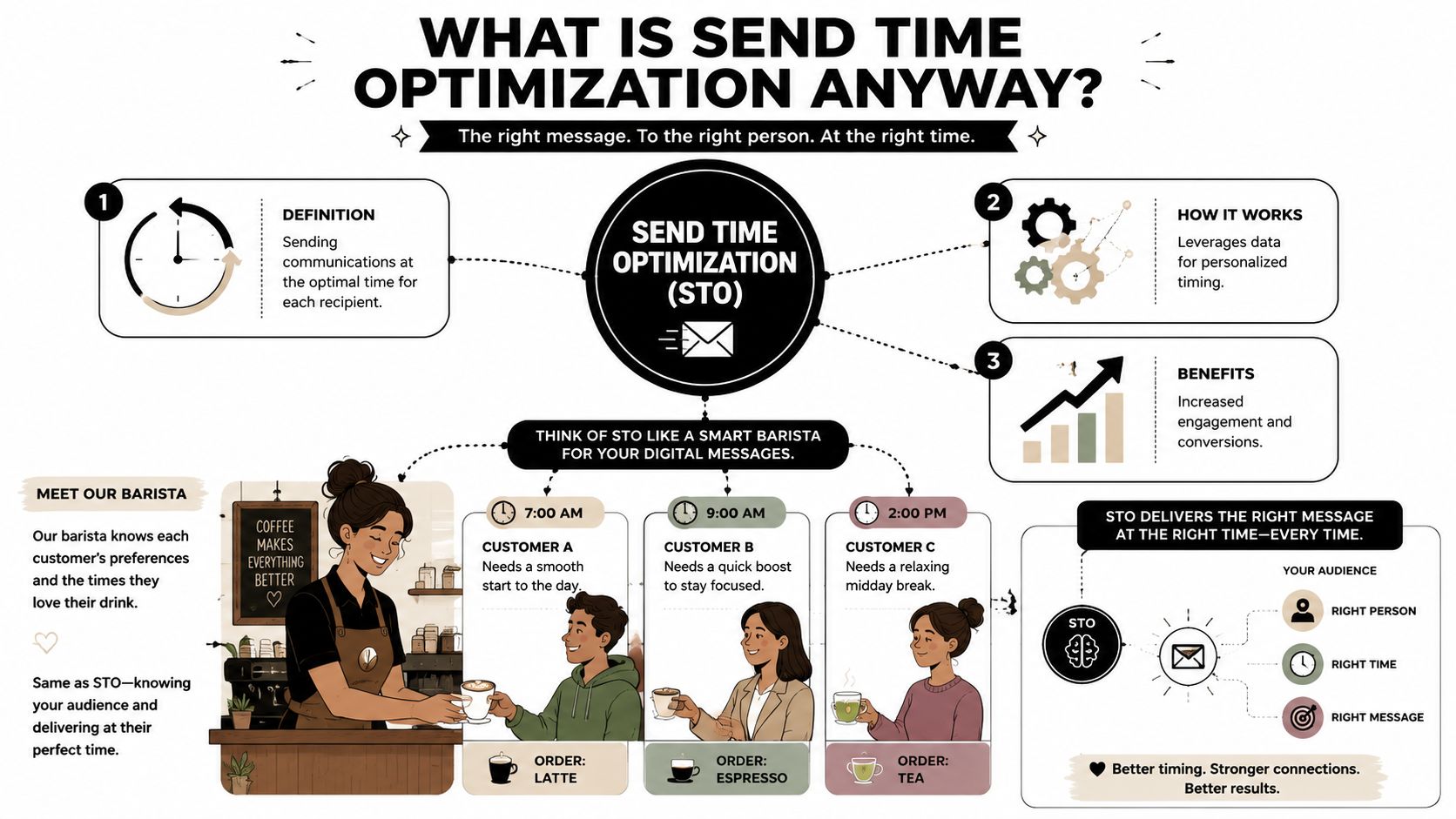
At the core, STO uses historical engagement patterns. One implementation note explains that these systems use prior open or click timing to calculate a delivery window for each recipient, and some platforms add a throttle window so large sends are spread across several hours instead of fired all at once, assigning people to the hour where they historically engage most often, according to Higher Logic's send time optimization overview.
That sounds technical, but the operating idea is simple:
If the system can't find a reliable pattern, it shouldn't fake precision. It should fall back to your original schedule or a simpler rule set.
STO is not just “send by time zone.”
Time-zone delivery is useful, but it only answers where someone is. It doesn't answer how that person behaves. Two customers in the same city can have opposite routines. One clicks links before breakfast. Another won't touch a message until late evening.
STO also isn't a magic button that fixes bad campaigns. If the offer is weak, the segment is wrong, or the call to action is muddy, better timing won't save it. It improves when people see the message. It doesn't rewrite the message for you.
Better timing usually improves visibility first. The business result comes only if the message and offer already make sense.
For SMS, voice, and ringless voicemail, that distinction matters. These channels already feel direct. STO doesn't make them less direct. It makes them better timed, which often makes them feel more respectful.
Most STO conversations stay trapped in email marketing. That misses where timing can feel most obvious to the recipient.
An email opened later is still an email. A text that lands during the wrong moment can feel like an interruption. A voice call at the wrong hour gets declined. A ringless voicemail dropped too early or too late can be ignored without a second thought. In these channels, timing changes perception.
SMS works because it's fast. That's also the risk.
If you send a promo text while a customer is driving, in a meeting, or handling pickups at school, your message may get seen only after the moment has passed. The copy didn't fail. The timing did. STO helps by aiming for the periods when that individual typically engages with messages on their phone.
Voice broadcasting has a sharper penalty for bad timing. If someone is busy, they won't “save the call for later” the way they might save a text. They miss it and move on.
For teams using voice to drive confirmations, transfers, outreach, or reminders, the value of STO is straightforward: place the call when the person is more likely to be available, not when your staff happens to be ready to launch a batch.
Ringless voicemail is often treated like “send anytime” inventory. That's a mistake.
People don't check voicemail at random. Many have patterns. Some listen during commutes. Some clear voicemails in late afternoon. Some only open voicemail when they see it tied to a real need. A ringless voicemail campaign performs better when it lands near those listening habits, not hours before or after them.
Here's the business case. Adobe documents an STO model where 95% of send events are optimized and 5% are reserved for exploration, with a recommended send window of 6 to 24 hours. Adobe also says STO can increase email click rate and push open rate by approximately 2% to 10% across optimized messages, based on historical engagement signals in Adobe Journey Optimizer send time optimization guidance. The channel examples there are email and push, but the operating logic applies cleanly to SMS, voice, and voicemail: behavior-based timing beats one-size-fits-all scheduling.
STO is especially useful when your campaign falls into one of these buckets:
If the message is urgent for everyone at the same exact moment, STO may not be the right choice. But for anything with timing flexibility, it can make a direct channel feel less like a blast and more like a well-timed nudge.
Not every “smart send” feature is send time optimization. Some tools offer simple scheduling tricks and market them like personalization. If you run SMS, voice, or ringless voicemail campaigns, you need to know what kind of timing logic you're buying.
The easiest way to think about it is in layers. Each layer gets more personalized, but it also depends more on data quality.
| Method | How It Works | Pros | Cons |
|---|---|---|---|
| Heuristics | Uses fixed rules like local time delivery or a chosen hour for all contacts in a region | Easy to set up, predictable, useful for small lists | Assumes similar behavior across many people |
| Segmentation | Groups contacts by broad timing behavior, then sends to each group at a chosen time | Better than one batch send, practical for mid-sized lists | Still treats groups as averages |
| Machine-learning personalization | Predicts timing for each recipient based on behavior signals and updates over time | Most tailored approach, adapts as habits change | Needs enough data and steady sending |
A heuristic is a rule of thumb. For example, send the campaign at local lunchtime, or call in the late afternoon by time zone. That's not complex, but it's often the right first step for smaller databases.
This method works best when you lack engagement history. It also works when compliance windows are tight and operational simplicity matters more than precision.
Segmentation moves past blanket timing. Maybe one segment tends to engage on weekends, another responds on weekdays, and another group interacts later in the day. You're still sending in batches, but they're smarter batches.
This is often where small businesses can make real progress without jumping immediately into machine learning. It's also a good bridge if you're still collecting enough data for something more advanced.
Segment-based timing is useful when your data can describe groups better than individuals.
If you're already working on message timing across conversational channels, the Cart Whisper cart recovery guide is a useful companion read because it shows how timing, channel choice, and follow-up logic affect recovery flows when messages need to feel well paced instead of spammy.
Modern STO is usually a machine-learning problem, not a rules engine. Braze describes it as a model that learns from signals such as open and click timing, reach and frequency, device and session patterns, then continuously updates predictions. In practice, this often appears as recipient-local-time delivery with fallback logic for contacts who don't have enough data, as explained in Braze's send time optimization article.
That's the gold standard because it doesn't ask, “What do people like this usually do?” It asks, “What does this person usually do?”
Before you trust a timing feature, ask these:
Those answers will tell you whether you're getting a scheduler, a segmentation tool, or real send time optimization.
The biggest mistake with send time optimization is treating it like a switch. Turn it on, wait a week, declare victory or failure. That's not how it works.
STO is more like training a good assistant. The system needs enough history, enough repetition, and a clear job to do. If the inputs are thin or messy, the timing recommendations will be thin or messy too.
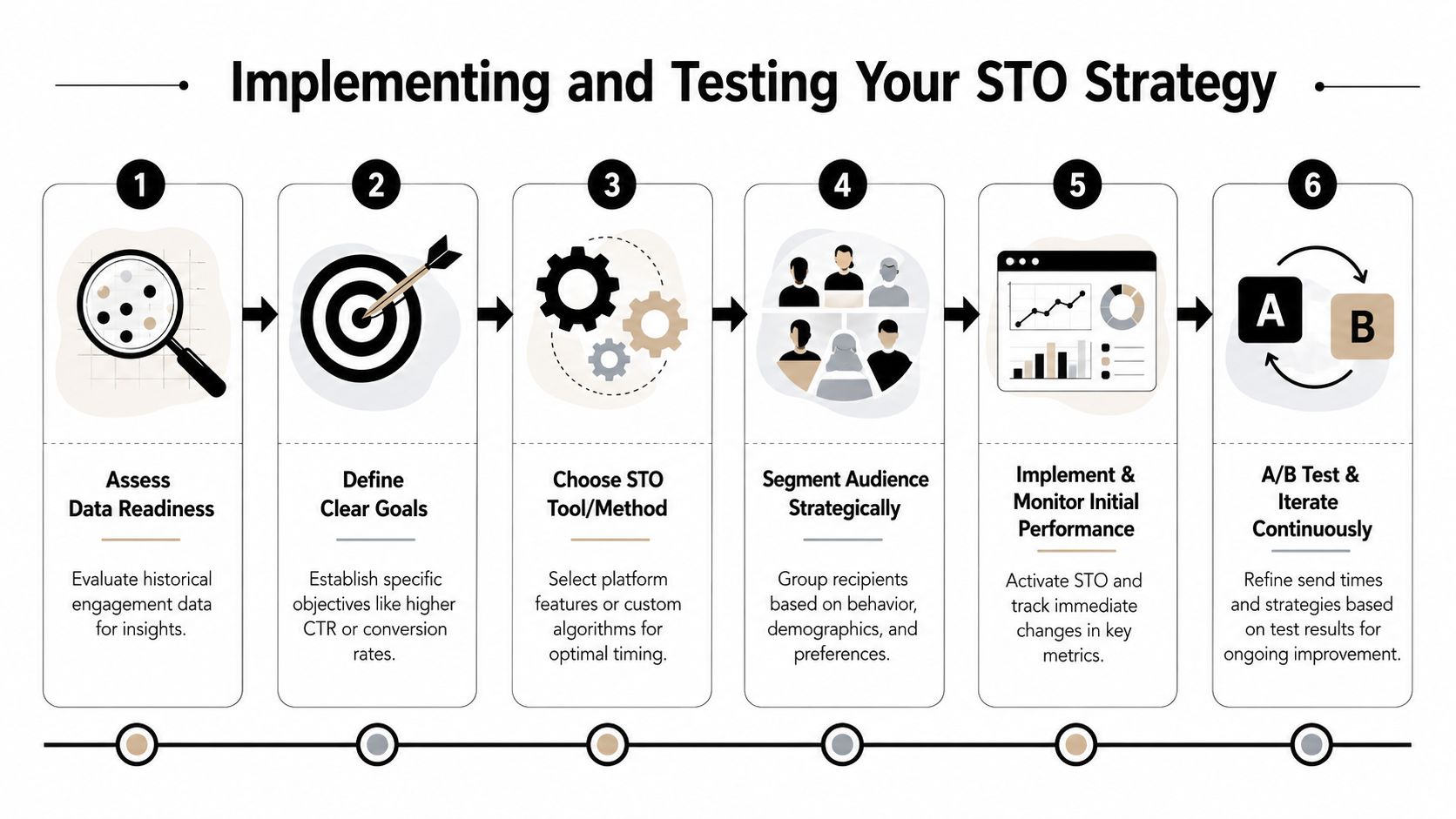
One practical explanation says effective STO typically requires 3–6 months of engagement history, regular sending, and clean open or click tracking to identify stable patterns. It also notes that many marketers see initial improvements within 2–4 weeks, while fuller optimization usually develops over 2–3 months of consistent sending, according to Monday.com's send time optimization guide.
For a small business, that means two things:
If your current process is still manual, a timed sending workflow is the first operational step. A simple guide to sending a timed text message helps frame that baseline before layering on optimization logic.
The wider the send window, the more room the model has to find a better time. But wider isn't always better.
A broad window can make a message feel stale. That matters for appointment reminders, same-day offers, and callback campaigns. A narrower window preserves relevance, but it also gives the model fewer options. The right window depends on how long the message stays useful.
Don't test STO against your memory. Test it against a control.
A practical setup looks like this:
Don't compare different messages and call it a timing test. Compare the same message with different delivery logic.
Not every campaign should use STO.
It tends to fit best when:
It tends to fit poorly when:
The discipline here is simple: treat STO like an ongoing optimization process, not a launch-day trick.
The first sign of progress is usually visibility. More people see the message at the right moment. But if you stop there, you can fool yourself.
A timing strategy should be judged by what happens after the message lands.
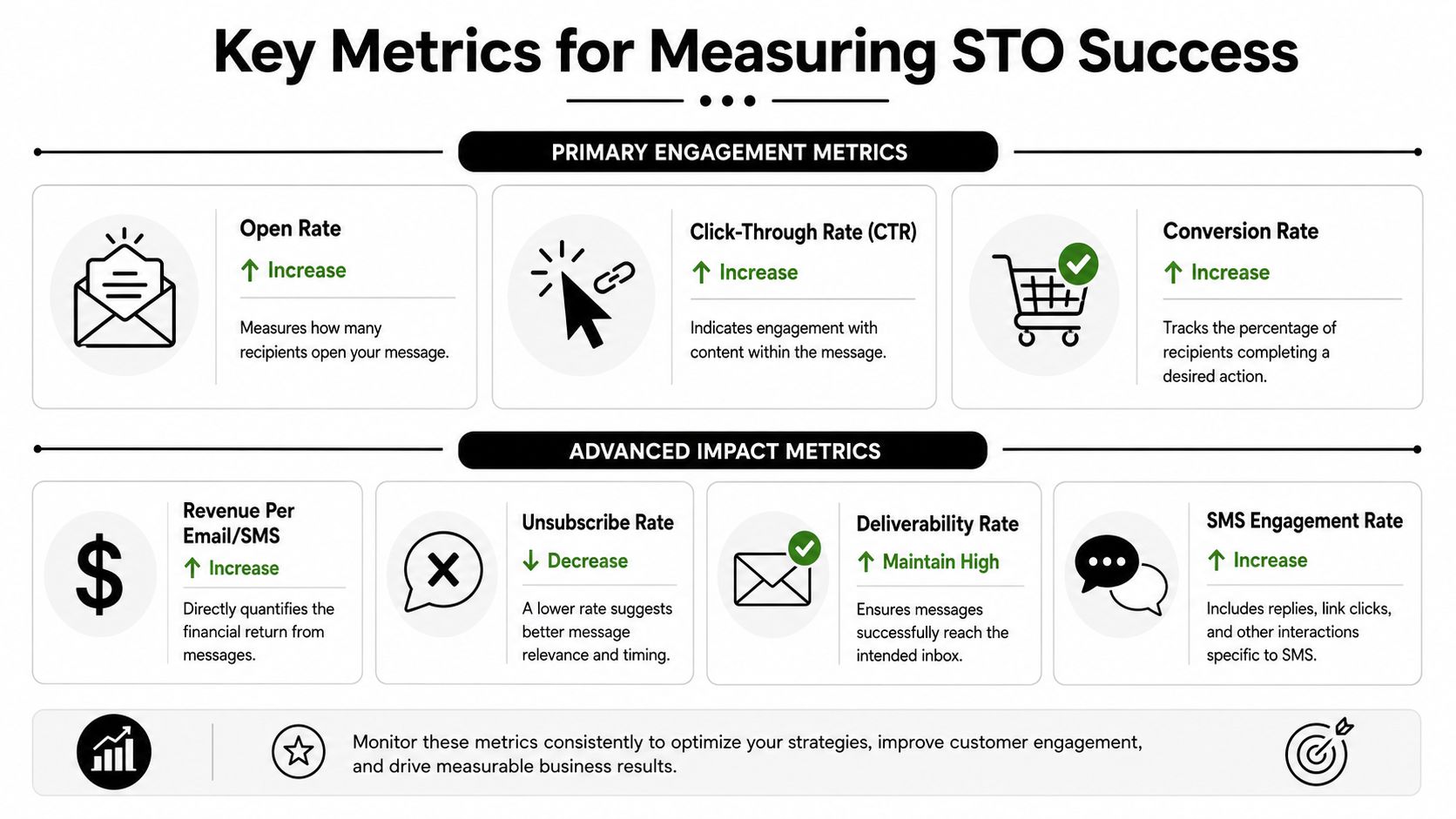
Different channels reveal success in different ways.
Those measurements tell you whether timing improved attention. They also tell you whether the audience was ready to act, not just ready to glance.
A useful STO dashboard should answer two separate questions.
| Question | What to measure |
|---|---|
| Did more people engage? | Opens where available, clicks, replies, listens, transfers |
| Did engagement turn into value? | Bookings, purchases, callbacks, confirmed appointments, qualified conversations |
That second layer matters more. Better timing that raises clicks but doesn't raise action may only mean curiosity improved. Better timing that lifts response quality is what you want.
For teams that need a stronger reporting setup, this guide to campaign performance analytics is a solid reference for connecting engagement metrics to outcomes that matter.
Success isn't only about more activity. It's also about fewer signs of friction.
If timing improves, you may also see:
The best timing often shows up as reduced resistance, not just increased clicks.
That's especially important for voice and ringless voicemail. These channels create strong reactions when used badly. A well-timed campaign often feels smoother even before the hard conversion numbers tell the story.
Send time optimization is powerful, but it doesn't override common sense, consent, or calling rules.
The model may think a recipient is likely to engage at a certain hour. That doesn't mean you should contact them then. Legal windows, channel rules, and your own brand standards still come first. Timing optimization should operate inside those boundaries, not around them.
For SMS, voice, and ringless voicemail, permission matters. Quiet hours matter. Recordkeeping matters.
If you're contacting customers in regulated environments or using direct channels for promotional outreach, make sure your consent process is solid before you worry about timing science. This overview of express written consent requirements is a practical place to review the basics.
A key readiness question is data sufficiency. One implementation guide notes that Salesforce Einstein STO needs about 90 days of regular sending to gather enough enriched data, and it points out that smaller lists or seasonal senders may not get the same value from the model, based on Offprem's Einstein send time optimization overview.
That doesn't mean smaller businesses should ignore timing. It means they should use a stepped approach.
Try this instead:
The strategic point is simple. Not every audience is ready for full send time optimization on day one. That's fine. Good timing maturity starts with discipline, not fancy features.
If you want to apply smarter timing across SMS, voice broadcasts, and ringless voicemail from one platform, Call Loop gives you the scheduling, automation, analytics, and compliant outreach tools to do it without turning your campaigns into guesswork.
Chris Brisson
Chris is the co-founder and CEO at Call Loop. He is focused on marketing automation, growth hacker strategies, and creating duplicatable systems for growing a remote and bootstrapped company. Chat with him on X at @chrisbrisson


Trusted by over 45,000 people, organizations, and businesses like


