
See a Demo
You're just one step away from seeing Call Loop in action.
Enter your information below to watch a demo right now.

You're just one step away from seeing Call Loop in action.
Enter your information below to watch a demo right now.

Your email calendar is full, your social posts are getting polite indifference, and sales still wants more conversations booked this month. That's where many organizations land before they get serious about sending bulk messages. They're not short on channels. They're short on direct attention.
Bulk messaging works because it meets people where they already respond. A text gets seen quickly. A voice broadcast can deliver urgency without waiting for an inbox check. A ringless voicemail can feel more personal than a blast email when it's used well and targeted correctly. The mistake is treating these as separate tactics run by different teams with different rules. The better approach is to use SMS, voice, and ringless voicemail as one coordinated system.
That system only works if you respect compliance and deliverability from day one. I've seen well-written campaigns fail because the list was sloppy, the opt-in was weak, or the team used the wrong channel for the moment. The channel didn't fail. The operating discipline did.
A common pattern looks like this. A local service business sends a promotional email on Tuesday, posts the same offer on social on Wednesday, and waits for leads that never really come. The message isn't bad. It's just competing with everything else.
Then the team changes one thing. Instead of asking email to do all the work, they send a targeted text reminder to recent customers, follow up with a ringless voicemail to a warmer segment, and reserve voice broadcasting for urgent updates or time-sensitive events. Suddenly the outreach feels direct instead of crowded.
That shift matters because sending bulk messages isn't just about volume. It's about choosing channels that create a faster path between your business and the customer action you want. That action might be a booking, a callback, a confirmation, a reorder, or a response from someone who ignored the last three emails.
SMS works well when you need speed and a simple action. Voice works when tone and clarity matter. Ringless voicemail works when you want a human-sounding touch without interrupting the recipient with a ringing phone. Used together, they cover more situations than email ever will on its own.
A few examples:
Bulk messaging performs best when each channel has a job. Teams struggle when every campaign becomes “send the same thing everywhere.”
If you're still defining bulk SMS, this short guide on what bulk SMS is and how teams use it is a useful primer. The bigger point is simpler. If your current channels are noisy and indirect, bulk messaging gives you a cleaner route to response.
Random blasts create random outcomes. Before you send anything, decide what success looks like, who should get the message, and which channel fits the moment.
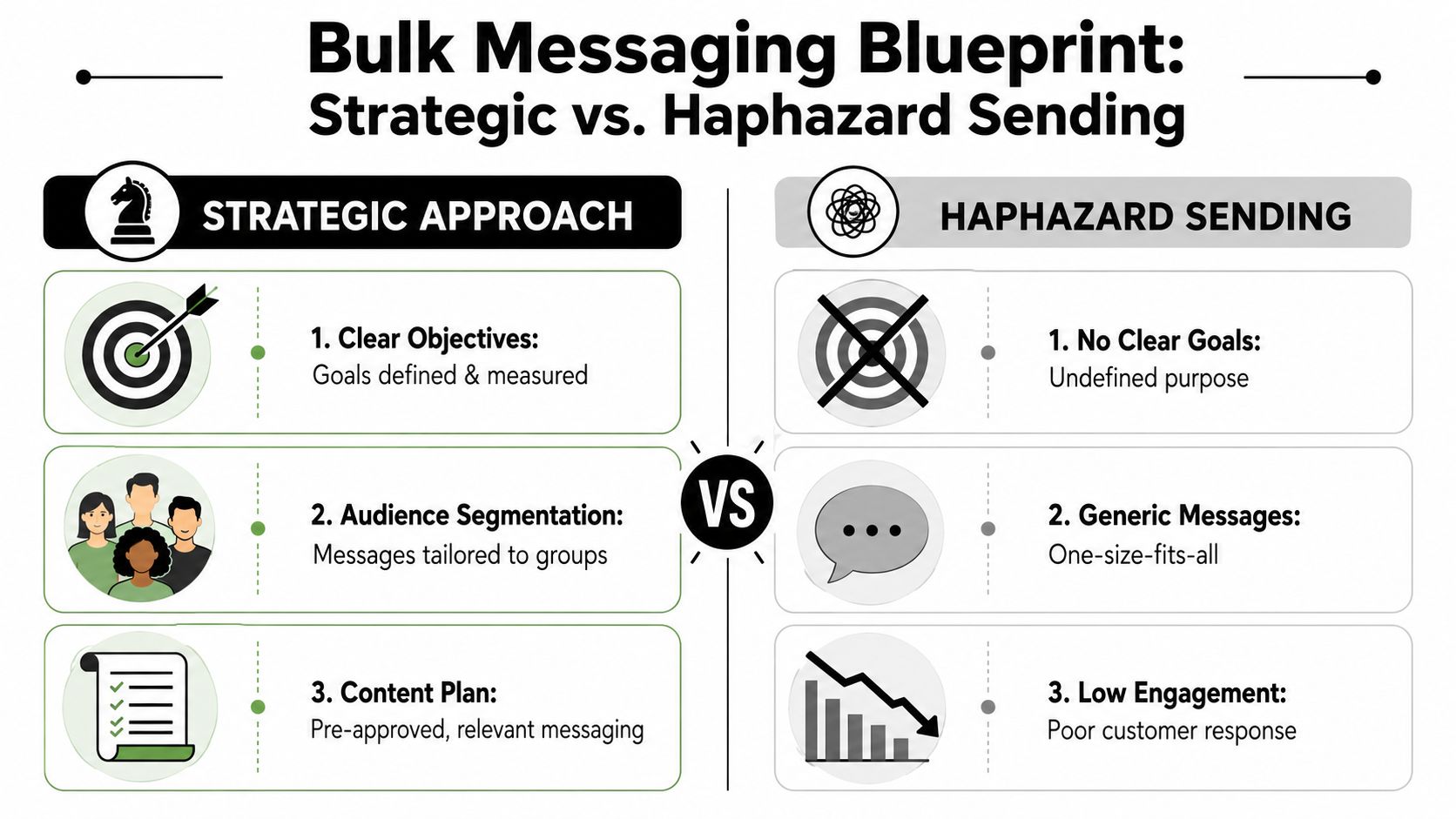
Most campaigns break because the objective is mushy. “Engagement” isn't a useful campaign brief. “Fill tomorrow's open appointment slots” is. “Reduce no-shows.” “Get webinar registrants to confirm attendance.” “Bring back customers who haven't purchased recently.” Those are usable.
Use this test. If your team can't answer “what should the recipient do next?” in one sentence, the campaign isn't ready.
A clean objective also tells you what not to send. If the goal is to confirm appointments, don't add a promotional offer. If the goal is to collect callbacks, don't send a long MMS with three options.
Segmentation isn't optional in sending bulk messages. It's the difference between relevance and irritation.
Useful segments usually come from operational data you already have:
Here's a practical rule. Build segments based on what the customer has done, not what your team hopes they'll do.
Not every message belongs in SMS. Not every audience wants a call. Ringless voicemail isn't a replacement for texting. It's a complement.
| Channel | Best use | What works | What usually fails |
|---|---|---|---|
| SMS/MMS | Quick action and short updates | Confirmations, reminders, links, simple offers | Long explanations, multiple asks |
| Voice broadcasting | Urgent announcements and tone-sensitive communication | Closures, event changes, time-sensitive notices | Casual promos sent too often |
| Ringless voicemail | Personal follow-up without a live interruption | Warm lead callbacks, renewal nudges, service follow-ups | Cold outreach with generic scripts |
Practical rule: If the message needs a tap, use SMS. If it needs a voice, use voicemail or broadcast. If it needs both, sequence them instead of stacking them at once.
Strong teams don't write campaigns in the dashboard five minutes before send time. They build a small library of approved messages by segment and channel. That keeps the tone consistent and reduces last-minute compliance mistakes.
Include:
If you're using a platform that supports SMS, voice, and ringless voicemail in one place, document the channel logic too. That makes automation cleaner later.
A good campaign plan still falls apart if the message sounds robotic, vague, or overstuffed. The fastest way to improve response quality is to write for the channel instead of copying the same script into SMS, voice, and ringless voicemail.
Good SMS copy gets to the point fast. It sounds specific, timely, and easy to act on. Bad SMS tries to explain everything.
Compare these:
Use merge tags for names, appointment times, location names, rep names, or order details. Personalization works when it adds context, not when it just sprinkles in a first name.
A simple SMS framework:
Examples:
Voice messages fail when teams read text copy into a microphone. Spoken messages need shorter sentences, clearer pacing, and a single callback reason.
For voice broadcasting, decide whether you need a recorded human voice or AI text-to-speech. Human recordings usually sound warmer for customer care, follow-up, and community updates. AI text-to-speech is useful when you need speed, consistency, and frequent message changes. Neither is automatically better. It depends on whether credibility or scale matters more for that campaign.
Ringless voicemail deserves its own script style. The best ringless voicemail messages sound like a genuine missed call follow-up. They don't sound like an ad read.
Try this structure:
Ringless voicemail works best when the recipient can tell why they're hearing from you and what to do next within a few seconds.
A clinic reminder shouldn't sound like a retail promo. A doula support message shouldn't sound like an appointment bot. Here, context matters more than templates.
If you work in care-centered or emotionally sensitive communication, the examples in this Bornbir blog on doula support messaging show a useful principle: calm, clear, personal language tends to outperform stiff institutional wording when trust matters.
A few message habits that usually hurt response:
When in doubt, shorten the message and sharpen the ask.
Compliance isn't a legal box you check after campaign setup. It determines whether your messages should be sent at all, whether carriers are likely to trust your traffic, and whether customers will keep responding over time.
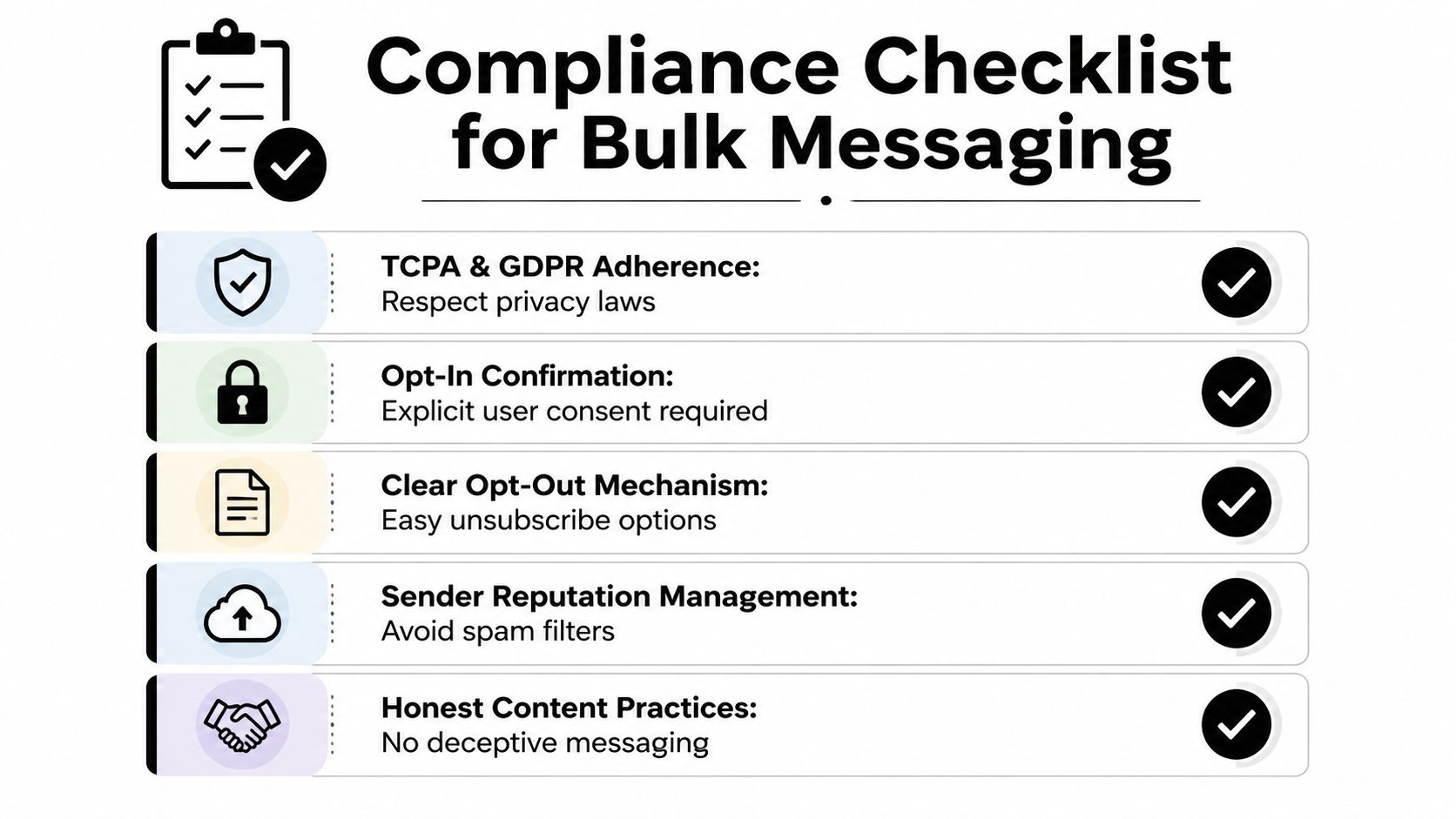
If you're sending bulk messages through SMS, voice broadcasting, or ringless voicemail, you need clear consent practices and documented opt-out handling. This is not optional. Failing to comply with TCPA regulations can lead to fines ranging from $500 to $1,500 per unsolicited message, as the FCC notes in its guidance on unwanted robocalls and texts.
That one fact should reset how you think about list growth. Purchased lists, old spreadsheets, and “they gave us their number once” logic create legal exposure fast.
The teams that stay out of trouble usually do the basics with discipline:
A practical resource for reviewing your process is this SMS compliance checklist for operational teams.
A compliant list is usually smaller than a sloppy one. It's also far more usable.
A lot of teams think deliverability starts after they hit send. It starts earlier. Number type, sender reputation, list hygiene, message consistency, and opt-out behavior all affect whether your messages get through cleanly or get filtered.
Toll-free number verification matters if you're using toll-free messaging. So does keeping content aligned with what people consented to receive. If someone signed up for reminders and you start sending broad promotions, carriers and recipients both notice.
Use this quick table to pressure-test deliverability risk:
| Operational area | Safer approach | Riskier approach |
|---|---|---|
| Audience source | Permission-based contacts | Imported or unclear consent lists |
| Content pattern | Consistent, expected message type | Sudden promotional spikes |
| Opt-out handling | Automatic suppression | Manual removal later |
| Sender setup | Verified and documented | Unverified or inconsistent sender identity |
For healthcare providers and covered entities, compliance goes beyond TCPA. Protected health information changes the standard. You need secure tooling, controlled access, and message policies that don't expose sensitive details. Even a well-intended reminder can create risk if it includes more patient information than necessary.
That's why healthcare messaging workflows should be built differently from standard retail campaigns. Limit sensitive content, define who can send what, and use a platform configured for HIPAA-compliant communications when patient data is involved.
Some marketers treat compliance as friction that slows growth. In practice, noncompliance slows growth more. It creates filtering problems, support headaches, and avoidable legal risk. Worse, it teaches your audience to distrust your messages.
Clean consent, disciplined sending, and clear unsubscribe handling don't reduce performance. They protect it.
Execution is where strategy turns into actual conversations. This is also where teams either build a repeatable engine or fall back into one-off blasts sent whenever someone remembers.
A working campaign setup should control timing, sequence, and follow-up logic. The goal isn't to send more. It's to send on purpose.
The best send time is usually tied to the action you want, not a universal “magic hour.” Appointment reminders should land early enough for rescheduling. Event reminders should leave enough room for logistics. Promotions should arrive when someone can act.
A simple scheduling rule set helps:
A single text can work. A coordinated sequence usually works better because each channel carries part of the load.
A basic example:
This approach is especially useful for appointment reminders, reactivation campaigns, lead follow-up, and event attendance. Ringless voicemail sits in a useful middle ground here. It feels more personal than text, but it doesn't force a live pickup the way a call does.
Manual list exports are where errors creep in. If your CRM, forms, scheduling tool, or ecommerce system already knows when someone booked, canceled, purchased, or lapsed, your messaging should react to that.
Automation platforms and integrations offer assistance. Zapier is a common choice for moving contact events between tools. Native integrations with CRMs such as ActiveCampaign, HubSpot, or Keap can keep contact records and message triggers aligned. For example, one option in this category is Call Loop's guide to bulk text messaging services, which reflects the kind of platform setup teams use when they need SMS, voice, ringless voicemail, segmentation, scheduling, and CRM-connected workflows in one environment.
If a rep has to remember every follow-up manually, the process will break under volume.
Automation fails when it keeps sending after the customer has already acted. Build stop conditions into every sequence.
Useful stop rules include:
That last point matters. Not every conversation should stay automated. Once someone raises a specific question or shows buying intent, hand it to a person.
Teams often look at results backward. They ask whether the campaign “worked” before they ask where the process broke. Measurement gets more useful when you diagnose by stage.
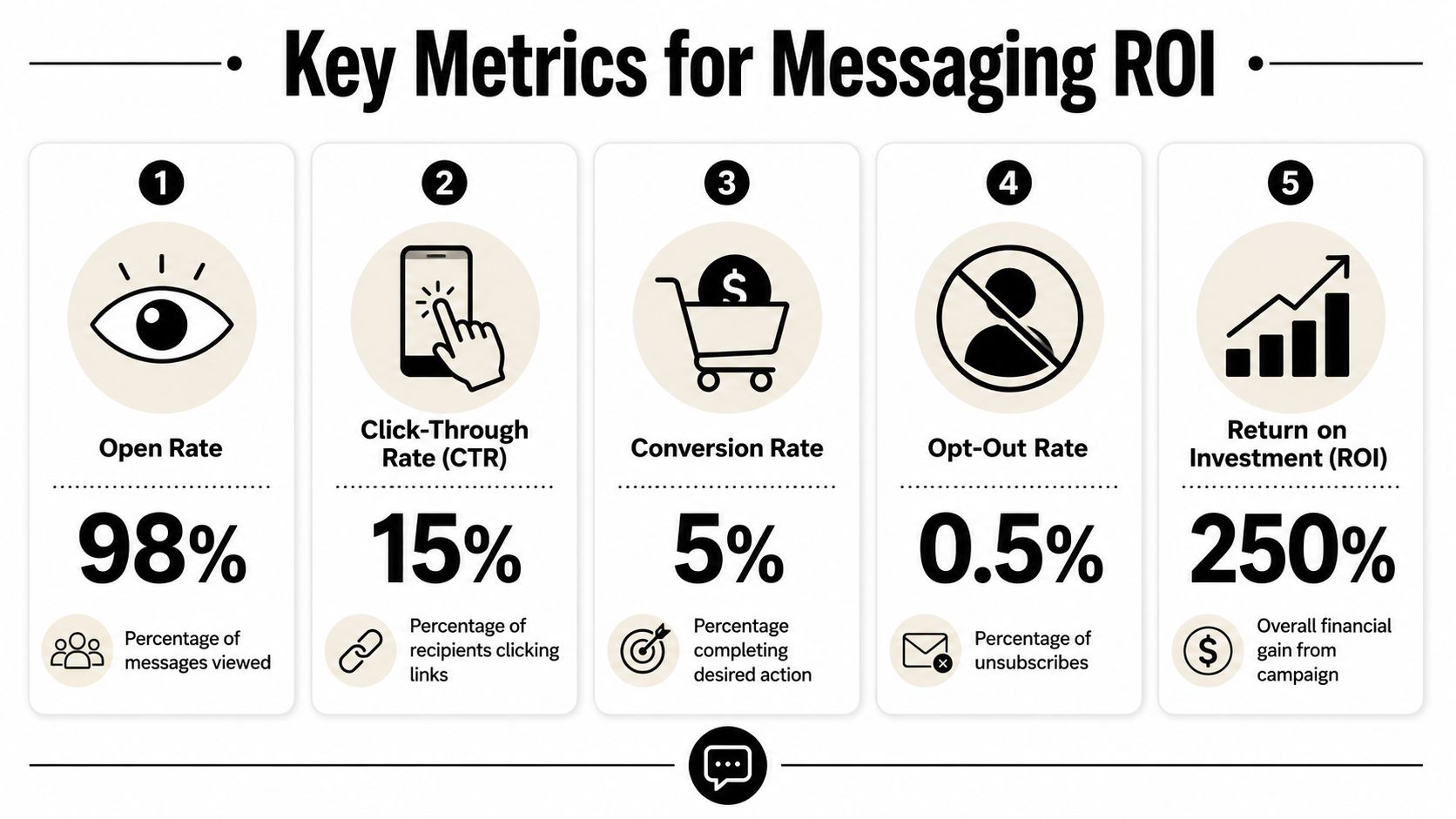
For SMS, start with delivery, then clicks or replies, then conversion. For voice broadcasts, look at answer behavior, call transfers if you use them, and downstream actions. For ringless voicemail, focus on successful drops, callbacks, and assisted conversions that happen after the message lands.
The infographic above displays example KPI values, but your actual benchmarks should come from your own campaign history, offer type, audience quality, and channel mix. Don't copy someone else's dashboard and assume those numbers mean anything for your business.
Use this diagnosis table instead:
| Signal | Likely issue | First fix to test |
|---|---|---|
| Delivered but low engagement | Copy or offer mismatch | Rewrite the message and simplify the CTA |
| Low delivery quality | Sender setup, filtering, or bad list hygiene | Review consent source, sender configuration, and contact quality |
| Good response but weak conversion | Landing page or handoff problem | Tighten the next step after the message |
| High opt-out activity | Poor targeting or too much frequency | Narrow the segment and reduce campaign pressure |
A/B testing in messaging doesn't need to be elaborate. Keep it controlled.
Good variables to test:
What usually doesn't work is changing everything at once. If you rewrite the copy, change the send time, and swap the audience, you won't know what caused the result.
Better ROI usually comes from fewer mistakes repeated less often, not from louder campaigns.
The strongest operators review messaging by cohort, not just by campaign. They look at how new leads behave differently from returning customers. They compare reminder flows against promotional flows. They separate ringless voicemail performance from voice broadcast performance instead of calling both “voice.” That's how sending bulk messages becomes predictable instead of experimental.
If you need a system for sending bulk messages across SMS, voice broadcasting, and ringless voicemail without piecing together separate tools, Call Loop is built for that workflow. It supports segmentation, scheduling, automation, merge tags, integrations, and compliance-focused outreach, which makes it a practical fit for teams that need one coordinated messaging operation rather than disconnected campaigns.
Chris Brisson
Chris is the co-founder and CEO at Call Loop. He is focused on marketing automation, growth hacker strategies, and creating duplicatable systems for growing a remote and bootstrapped company. Chat with him on X at @chrisbrisson


Trusted by over 45,000 people, organizations, and businesses like


