
See a Demo
You're just one step away from seeing Call Loop in action.
Enter your information below to watch a demo right now.

You're just one step away from seeing Call Loop in action.
Enter your information below to watch a demo right now.

Let's be honest, SMS 2 way communication is just a fancy term for a text message conversation. It’s when a business and a customer can text back and forth, just like you would with a friend. This is a world away from those one-way alerts that just blast information at you. It’s a real dialogue.
Think of it this way: a company using a megaphone to shout announcements at a crowd is using one-way SMS. It gets the word out, sure, but it’s completely impersonal. There's no room for a conversation.
Now, imagine that same company representative stepping down into the crowd to chat with people one-on-one. That's the magic of SMS 2 way communication. It turns a monologue into a genuine, engaging conversation.
This isn't just a minor feature update; it's a total shift in how you can connect with your audience. Instead of just getting a notification, your customers can now reply with questions, confirm their appointments, leave feedback, or even buy something right there in the text thread.
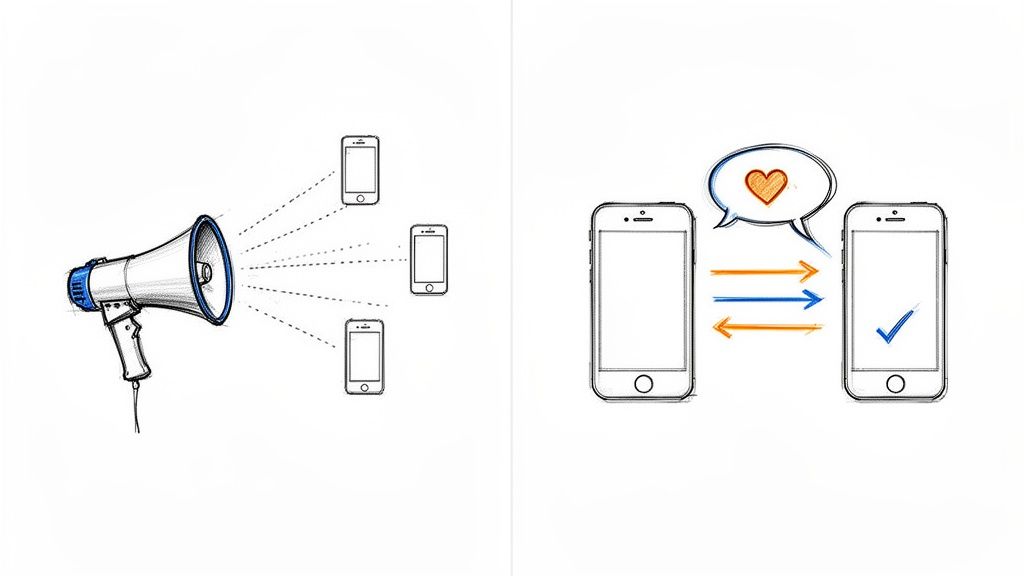
Traditional one-way texting has its place. It’s great for quick alerts, like a flash sale announcement or a mass weather update. The problem is, it leaves the customer hanging with no easy way to respond. If they have a question, they have to hunt down another way to contact you, which just adds friction to their experience.
Two-way SMS knocks down that wall. It opens a direct line for instant back-and-forth, making every interaction feel more personal and human. This conversational style is exactly what people have come to expect—they want convenience and answers now, not later.
To help you see the difference clearly, here’s a quick breakdown:
As you can see, moving from a broadcast model to a conversational one completely changes the dynamic, turning a simple notification tool into a powerful relationship-building channel.
People are tired of being passive targets for marketing messages. They want to interact, ask questions, and get help on their own terms. This shift is what's behind the explosive growth of conversational commerce, a market now valued at a whopping $11.26 billion.
The numbers don't lie. Recent data shows that 28% of consumers specifically want the ability to have two-way text conversations with businesses. Another 27% prefer managing their subscriptions via text. This isn't just a trend; it's a clear signal of what customers want. You can check out more SMS marketing statistics that show just how big this shift is.
A two-way SMS system turns a customer's phone into a direct portal for support, sales, and feedback. It’s not just about sending messages; it's about building relationships, one text at a time.
But two-way SMS doesn't have to work in a silo. The real power comes when you integrate it with other channels. For example, you could send a non-intrusive ringless voicemail with a detailed offer, then immediately follow up with a text asking, "Any questions about the offer I just left you?" This strategy is highly effective because it delivers a detailed message without interrupting their day, followed by a convenient way to respond. Ringless voicemail drops, when used correctly, can significantly increase engagement.
This multi-channel approach makes sure your messages are not only received but also acted upon. By combining tools like SMS 2 way, voice broadcasting, and ringless voicemail, you can create a seamless communication strategy that meets customers where they are and drives incredible results.
Sending an email can feel like dropping a note in a bottle into the ocean. You hope someone finds it, but you have no idea if they ever will. Sending a two-way text? That’s like tapping someone on the shoulder. It's immediate, personal, and you almost always get a reaction.
This is the fundamental difference that makes two-way SMS a powerhouse for engagement, not just another marketing channel. The numbers don't lie, and they show a massive performance gap that directly impacts your bottom line.
The stats behind texting are staggering. Text messages have an almost unbelievable open rate of 90–98%. Think about that—nearly every single message you send gets seen, usually within just a few minutes. Emails, on the other hand, can sit unread in a cluttered inbox for hours, if they get opened at all.
This immediate visibility leads to incredible responsiveness. SMS pulls in a response rate of over 45%, while email limps behind at just 6%. For any business that wants to actually talk with their customers, that’s not a small difference; it’s a landslide victory for texting. The efficiency gains are real, too; public-sector studies even found that using SMS led to a 67% increase in transfer production and cut down transfer time by 40%. You can dig deeper into these impressive numbers in recent industry reports.
Two-way SMS is, by its very nature, a conversation starter. It’s not a one-way broadcast, and that simple fact is the secret sauce behind its wild engagement rates.
So what makes texting so darn effective? It really just comes down to human nature and how attached we are to our phones.
This mix of instant access and a personal feel is what turns a simple message into a powerful tool for connection.

High open and response rates are great vanity metrics, but what really matters is whether they lead to actual business results. This is where two-way SMS really delivers, turning simple conversations into conversions and customer action.
When you actively encourage people to reply, you can get results that are just impossible with one-way blasts. A simple "Reply YES to confirm" text can practically eliminate appointment no-shows. A quick follow-up message after a sale can solve a customer's problem in minutes, stopping a bad review before it ever gets written and building serious loyalty.
You can even take it a step further by pairing two-way SMS with other powerful tools like ringless voicemail. Imagine this: you drop a detailed update via a ringless voicemail, then immediately follow up with a text asking, "Any questions about the voicemail I just sent?" This combo grabs attention without being annoying and opens the door for an immediate, easy conversation. Ringless voicemail marketing, when paired with SMS, creates a seamless flow for confirming appointments, getting feedback, and solving problems faster than ever before.
Knowing what sms 2 way communication can do is one thing, but seeing it in action is where the magic really happens. The true value pops up when you move past the theory and see how a simple text exchange can solve a tricky problem, lock in a sale, or even improve a patient's health.
The best part about two-way messaging is how flexible it is. This isn't some high-tech tool just for giant corporations. It's a direct, effective channel that works just as well for small businesses, local healthcare clinics, and service providers. Let's dig into some real-world examples of how this tech gets results.
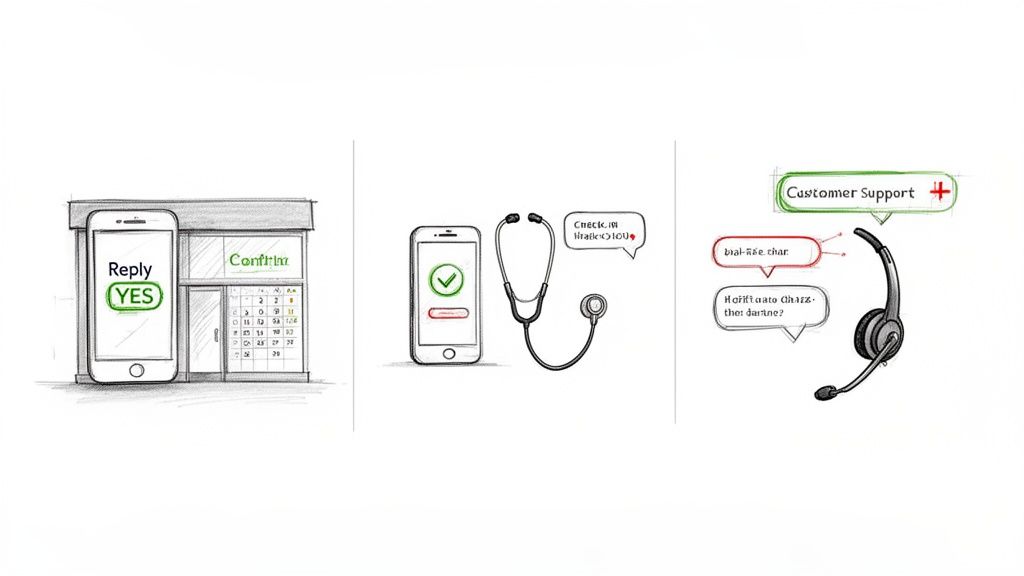
For a small business, every single customer interaction matters. Two-way SMS opens up a conversation that feels personal and immediate, helping you build real connections and streamline how you operate.
One of the biggest wins is with interactive appointment reminders. Sending a quick text can massively cut down on costly no-shows, which is a huge headache for service-based businesses like salons, mechanics, and consultants.
Example: Appointment Confirmation Flow
That simple back-and-forth confirms the booking and opens a line for more questions if they have them—all without anyone needing to pick up the phone.
Beyond just reminders, sms 2 way completely changes the game for customer service. A customer can text a quick question about their order and get a helpful response in moments. That kind of real-time support stops frustration in its tracks and builds loyalty that lasts.
Here are a few other powerful ways SMBs can use it:
In healthcare, communication has to be timely, secure, and crystal clear. Two-way SMS offers a HIPAA-compliant channel that makes the patient experience better while taking a huge administrative load off clinic staff. It helps you stay connected with patients between visits and keeps them involved in their own care.
Post-procedure follow-ups are a perfect fit. A quick, automated text can check in on a patient's recovery, helping you catch potential problems early and showing them you genuinely care.
Example: Post-Procedure Check-In
This proactive approach makes patients feel safer and gives them peace of mind.
By opening a direct line for patients to ask questions or report symptoms, healthcare providers can improve outcomes and build stronger, trust-based relationships. This turns communication from a simple reminder tool into a vital part of the care plan.
Here's how healthcare providers can put sms 2 way communication to work:
If you really want to make your outreach effective, you can layer sms 2 way with other non-intrusive channels like ringless voicemail. This one-two punch lets you drop a more detailed message right into someone's voicemail without their phone ever ringing. This is a game-changer for businesses that want to provide context without causing interruption. A ringless voicemail drop is an ideal precursor to a text message.
Think about a dental clinic needing to remind patients to use their annual insurance benefits before they run out.
Example: Integrated Campaign Flow
This combination grabs attention on two fronts. It provides helpful context with voice and then offers a super simple way to take action via text. It’s a powerful approach for any business looking to drive a specific action without being disruptive.
Jumping into an interactive, conversational approach with sms 2 way messaging is a lot easier than you might think. It's not about ripping out your whole communication plan and starting from scratch. Instead, think of it as laying a solid foundation and then adding some smart automation to handle the back-and-forth.
Let's walk through the key steps to get your first two-way SMS campaign off the ground, from picking the right phone number to creating automated conversations that actually connect with your audience. Getting this right from day one ensures your strategy is effective and, just as importantly, compliant.
Before you can have a conversation, you need two things: a phone number and permission to text. These first steps are absolutely non-negotiable. They set the stage for everything else, protecting your business and building trust with your contacts from the get-go.
First up, you've got to pick a phone number. There are three main options, and each one serves a different purpose:
Once you've got your number, the next critical step is getting explicit opt-in consent. TCPA regulations are crystal clear on this: you must have permission before you send a single message. This means people have to knowingly agree to get your texts, usually by texting a keyword to your number or ticking a checkbox on a web form.
With the groundwork laid, you can start building the automated workflows that are the engine of your sms 2 way strategy. This is where you transform a simple text line into a powerful tool that can qualify leads, confirm appointments, and answer common questions 24/7.
The heart of this automation is the keyword trigger. A keyword is just a specific word or phrase that, when someone texts it to your number, kicks off a pre-built sequence of actions or replies.
Think of a keyword as a conversational shortcut. It tells your system exactly what the person wants, letting you fire back an instant, relevant response without lifting a finger.
For instance, a real estate agent could tell prospects to "Text HOME to 12345" to get new property listings. That keyword instantly triggers an auto-response that gets the ball rolling. From there, you can design a whole automated flow to gather more info. To go deeper on this, check out our guide on how to set up an auto SMS reply for more detailed examples and strategies.
Automation handles the first touch, but personalization is what makes it feel human. Using merge tags—like [FirstName] or [AppointmentTime]—lets you pull customer data right into your messages. It’s a small detail that turns a generic blast into a personal note.
Segmentation takes this a step further. By grouping your contacts based on their interests, what they've bought, or how they signed up, you can send laser-focused messages. A customer who texted "DEALS" wants to hear about promotions, while someone who texted "SUPPORT" needs help. Sending the right message to the right group makes a massive difference in engagement and keeps people from opting out. This targeted approach is the secret sauce to a successful two way SMS system.
While two-way SMS is a powerhouse on its own, its true impact really shines when you start pairing it with other channels. Think of it like a band—the lead singer is great, but the sound is so much richer with a full ensemble. By layering interactive texting with tools like voice broadcasting and ringless voicemail, you create a much deeper, more effective way to reach people without being annoying.
Picture this all-too-common scenario: a lead shows interest, you have a good chat, and then... crickets. Instead of chasing them with repeated, intrusive phone calls, you could start with a gentle nudge—a ringless voicemail. It lands your message right in their voicemail inbox, letting them listen whenever they have a free moment. No pressure.
Immediately after that voicemail drops, an automated SMS can pop up on their screen. Something simple like, "Hi [FirstName], just left you a quick voicemail with more details. Any questions I can answer for you right here via text?"
This one-two punch is incredibly effective for a few reasons:
To really get the most out of your SMS efforts, you have to think about an integrated marketing approach where all your channels work together. This creates a smooth, cohesive experience that guides the customer from one touchpoint to the next.
So, what exactly is ringless voicemail? It’s a clever bit of tech that lets you drop a pre-recorded audio message directly into someone's voicemail server without their phone ever ringing. It's subtle, non-disruptive, and a fantastic tool for follow-ups or nurturing leads who aren't quite ready to buy. The best ringless voicemail services ensure high deliverability and clear audio quality, making it a reliable part of your communication strategy.
This simple three-step process gives you a bird's-eye view of how to get your basic SMS strategy off the ground.
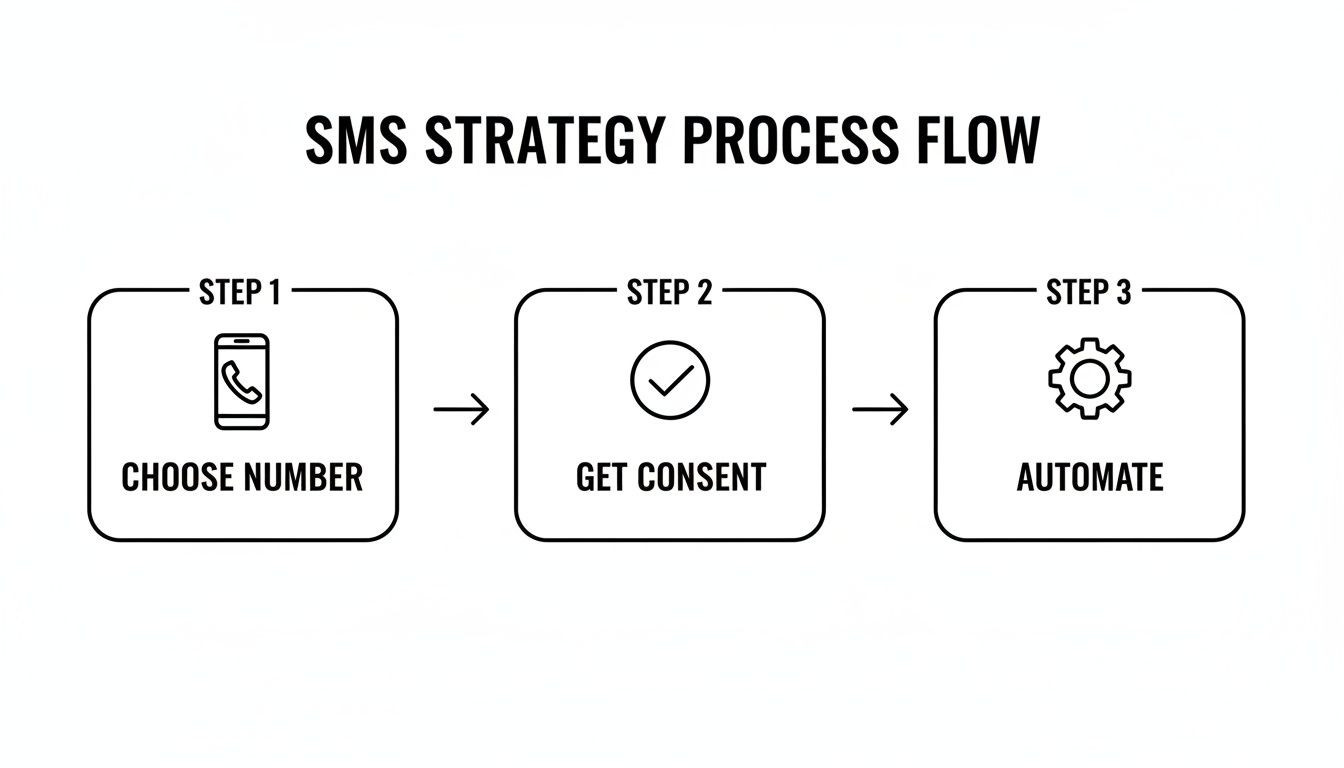
This visual breaks down the fundamentals: picking a number, getting consent, and setting up automation. These are the essential building blocks you need before you can start layering in other channels. By combining these core SMS principles with a tool like ringless voicemail, you can build out some seriously sophisticated and respectful communication flows.
By combining a personal, detailed message via ringless voicemail with the immediacy of two-way SMS, you create a powerful one-two punch that grabs attention and prompts a response.
This combination is perfect for all sorts of situations, from simple appointment reminders to rolling out special promotions. A healthcare clinic, for example, could drop a voicemail with detailed pre-op instructions and then send a follow-up text asking the patient to confirm they've listened and understood. This multi-channel flow makes sure nothing gets lost in translation.
Getting your two-way SMS strategy off the ground is exciting, but real success comes down to two things: compliance and deliverability. Think of it this way: compliance is following the rules of the road to keep you out of trouble, and deliverability is making sure your messages actually get to where they're going. You absolutely need both.
Ignoring them is like building a house on a shaky foundation. It doesn't matter how great your messages are if they're illegal or get tossed into a spam filter before anyone sees them.
In the U.S., the big one you need to know is the Telephone Consumer Protection Act (TCPA). This law is not messing around: you must have express written consent before you send a single marketing text. It’s not a suggestion; it’s a hard-and-fast rule designed to keep consumers from getting spammed.
Just as critical is how you handle opt-outs. When someone replies with "STOP," "END," or "UNSUBSCRIBE," your system has to remove them from your list immediately. No exceptions, no delays. Messing this up can lead to huge fines and seriously tarnish your brand.
Getting clear consent upfront and offering an easy, instant way to opt out are the cornerstones of good SMS marketing. This isn't just about avoiding legal headaches; it's about building trust with your audience from day one.
Okay, so you have permission. Now you have to make sure your texts actually get delivered. Mobile carriers have smart filtering systems designed to block junk messages. To stay on their good side, you need to get your business registered.
For businesses texting in the US, this involves completing the A2P 10DLC (Application-to-Person 10-Digit Long Code) registration. This process basically tells carriers you're a legitimate business, which dramatically improves the chances of your messages getting through and boosts how many you can send.
Here are a few other things to keep in mind to make sure your messages land:
Sticking to these principles is a must. As of 2025, an estimated 6 billion people around the world use SMS, showing just how massive this channel is. To reach them, your messages have to be both compliant and deliverable. For a deeper dive into crafting campaigns that work, check out our guide on SMS marketing best practices.
When you start looking into interactive texting for your business, a few practical questions always pop up. It's smart to get a handle on things like cost, how to manage messages, and the nitty-gritty of getting set up. Let's walk through some of the most common questions we hear about two-way SMS.
Not at all. In fact, it's often way more affordable than you'd think, especially when you stack it up against traditional advertising. Most platforms work on a pay-as-you-go model, so you only pay for the messages you send. This keeps your budget predictable and easy to manage.
You can start small with just one campaign and scale up as you see the results roll in. Between the boost in customer engagement, the huge drop in no-shows, and the ability to solve support issues faster, two-way SMS often delivers one of the best ROIs of any tool in your kit.
This is a great question, and the good news is you don't have to glue yourself to your phone. Modern platforms are built to manage a high volume of texts without overwhelming you or your team. A lot of the heavy lifting can be done with simple automation.
For example, you can set up keyword-based replies to instantly answer common questions. For anything more complex, incoming messages can land in a shared team inbox where anyone available can jump in and respond. It's the perfect mix of smart automation and human touch, ensuring every customer gets a fast response without bogging down your workflow.
Yes, and you absolutely should! In most cases, you can "text-enable" your existing landline or VoIP number. This means you can send and receive texts from the same number your customers already have saved in their phones.
It’s a huge win for brand consistency. You don’t have to confuse people by advertising a separate number just for texting, which makes the whole experience feel seamless and professional.
Think of it like this: two-way SMS is the road, and a chatbot is a type of vehicle that can drive on that road.
Two-way SMS is the channel itself—the ability for you and your customer to have a conversation via text. At its simplest, this might use basic keyword automation (like "Reply YES to confirm"). But you can also integrate an AI-powered chatbot to handle more complex back-and-forth conversations over that same SMS channel.
The key thing, though, is that a real person can always step into the conversation. That's what builds genuine relationships and trust, and it's something a pure chatbot just can't replicate.
Ready to see what a real conversation can do for your business? Call Loop gives you the tools to build powerful SMS, ringless voicemail, and voice campaigns that get people to respond. Start your free trial today and discover just how easy it is to connect with your customers.
Chris Brisson
Chris is the co-founder and CEO at Call Loop. He is focused on marketing automation, growth hacker strategies, and creating duplicatable systems for growing a remote and bootstrapped company. Chat with him on X at @chrisbrisson


Trusted by over 45,000 people, organizations, and businesses like


