
See a Demo
You're just one step away from seeing Call Loop in action.
Enter your information below to watch a demo right now.

You're just one step away from seeing Call Loop in action.
Enter your information below to watch a demo right now.

A patient misses a morning appointment. The front desk expected a confirmation, the clinician kept the slot open, and another patient who wanted the time never got a call. By noon, everyone's asking the same question: did the reminder fail, or did the workflow fail around it?
I've seen the same pattern in clinics, sales teams, fitness businesses, and event operations. A single text gets sent, nobody knows whether it was seen, and staff discover the problem only after the appointment has passed. SMS appointment reminders work best when they're treated as part of an attendance system, not as an isolated broadcast.
The practical system combines timely texts, confirmation capture, sensible escalation, ringless voicemail for selected appointments, and light drip workflows that continue after booking. It also respects the uncomfortable truth in the evidence: results vary by audience, appointment type, and operating context. That variation gives operators something useful to optimize.
The first missed appointment usually looks harmless. A customer forgets, a sales prospect doesn't join the demo, or a patient arrives on the wrong day. The second creates a scheduling hole. After a pattern develops, staff spend more time chasing confirmations, filling cancellations, and explaining empty calendar slots than serving the people who did show up.
That's why the reminder problem appears across very different organizations. A medical practice needs neutral, privacy-conscious messages. A sales team needs to protect valuable conversations without sounding desperate. A gym or fitness studio needs quick confirmations and easy cancellation paths. An event organizer needs logistics, check-in details, and last-minute changes. The channel may differ, but the operational weakness is similar: one generic message is expected to solve memory, commitment, rescheduling, and arrival friction at once.
The practical guidance in tactics from Fitness GM is useful because it treats no-shows as a process problem rather than a customer character flaw. That distinction matters. People often miss appointments because details change, reminders arrive at poor times, or the business makes cancellation harder than ignoring the booking.
SMS should usually carry the core appointment details and the clearest response path. Ringless voicemail can reinforce a high-value or high-risk booking without forcing the recipient to answer a call. A short drip workflow can then handle confirmation, rescheduling, post-appointment follow-up, and rebooking.
The objective isn't to send more messages. It's to assign each channel a job:
A useful reminder text message workflow starts with the booking event, then branches based on the appointment time and the recipient's response. Before launch, map the data source, message timing, confirmation logic, escalation rule, and staff handoff. That sequence prevents the common failure where a perfectly written text fires for a cancelled appointment.
The strongest evidence supports SMS reminders, but it doesn't support the claim that every text program will produce the same result. A landmark 2008 ophthalmology study recorded a non-attendance rate of 11.2%, or 50 of 447, among patients who received an SMS reminder, compared with 18.1%, or 1,720 of 9,512, among those who didn't receive one. The difference was a 6.9 percentage-point absolute reduction and a 38% relative reduction in missed appointments, as reported in the ophthalmology study.
That early result became influential because it showed a practical operational effect, not merely high message engagement. Later evidence broadened the picture. A systematic review of 28 studies, including 13 randomized controlled trials, found that SMS reminders consistently improved attendance. The randomized trials produced a pooled odds ratio of 1.62, with a 95% confidence interval of 1.35 to 1.94.
A large mixed-setting meta-analysis reported the same pooled odds ratio and found no significant difference associated with reminder timing, frequency, or message content. For an operator, that suggests the first technical win is reliable delivery at scale. Endless copy tweaks won't rescue a workflow that sends late, uses stale contact data, or fails to process replies.
A more concrete comparison appears in the Cochrane review of mobile phone messaging reminders. Across seven studies involving 5,841 participants, attendance rose from 67.8% without reminders to 78.6% with mobile text reminders, while phone calls reached 80.3%. The review also cautioned that SMS didn't reduce non-attendance in every study and that outcomes varied by population, clinic type, and baseline no-show rate.
That conditionality is a setup lever. Test by appointment type, lead time, patient segment, and existing attendance behavior. A generic reminder may work well for routine visits, while a new patient, high-value consultation, or complex event booking may need a different sequence and a stronger escalation path.
Start at capture, not at message composition. During booking, collect the mobile number, preferred channel, time zone, and the specific consent needed for the communication. Repeat the capture opportunity across web forms, phone intake, event registration, and CRM-created appointments. If the record lacks a reliable contact preference, automation can only guess.
Next, connect the booking source to the messaging workflow. The calendar, practice-management system, CRM, or event platform should pass the appointment date, local time, appointment type, assigned staff member, location, status, and customer identity. The workflow must also receive updates, because a rescheduled or cancelled appointment should immediately alter pending messages.
Schedule the confirmation as soon as the appointment is created. Later reminders should calculate from the appointment's local time, not from the server's default setting. When a recipient replies with a confirmation keyword, update the record and suppress unnecessary follow-ups. When the person requests a change, route the response to the rescheduling path rather than treating it as a failed delivery.
Ringless voicemail belongs in a conditional branch. Use it for a high-value demo, a procedure with meaningful preparation, or an appointment with a history of non-attendance. It shouldn't repeat the SMS word for word. The voicemail can provide a warmer explanation or ask the recipient to check the text for confirmation and rescheduling options.
For teams designing their first workflow, SMS campaign setup help can help organize campaign inputs, triggers, and response handling. The important design principle is to keep the staff handoff explicit. An unanswered text should create a task, flag, or queue entry when the booking warrants human attention.
Before activating the workflow, test:
A reliable message stack gives each touchpoint one clear job. The confirmation secures the booking. The primary reminder asks the person to verify or change it. The day-of ping removes arrival friction. The no-show follow-up makes recovery easy without pretending the missed appointment didn't happen.
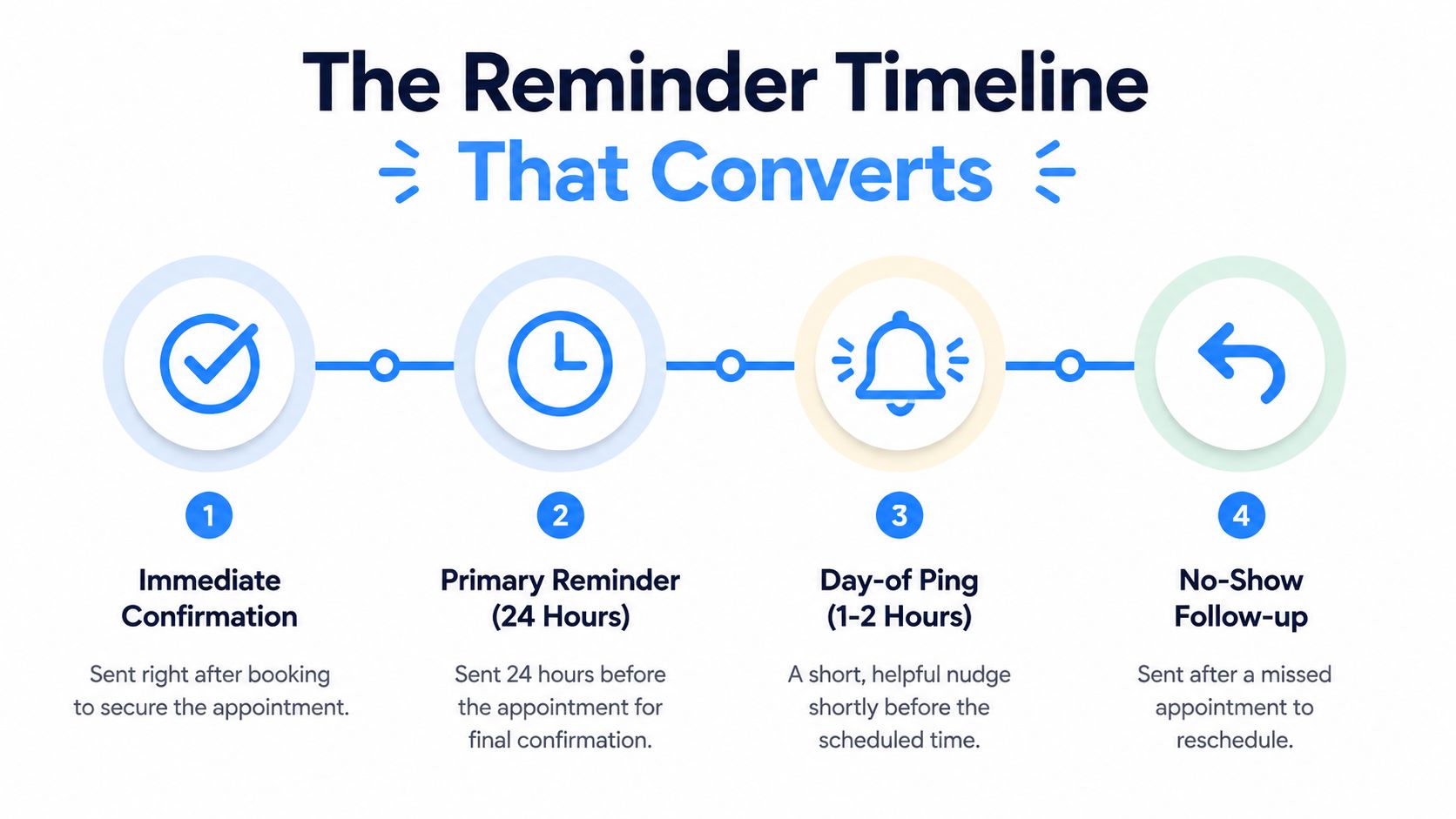
Use a practical cadence of T-24h, T-2h, and T+30m after a missed appointment, while sending the booking confirmation immediately. A confirmation message might read: “Hi [Name], your [appointment type] with [business] is booked for [date] at [time]. Reply C to confirm, R to reschedule, or STOP to opt out.” Keep the details necessary for action, and move lengthy preparation instructions to a secure page or email where appropriate.
Personalize with the recipient's first name, appointment type, provider or host, local time, and location when those details help someone arrive. Don't rely on an ambiguous time zone abbreviation. Use the recipient's local date and time, and include a map or directions link for unfamiliar locations.
Useful fragments include:
Keep reply keywords short. C, R, and STOP are easier to process than natural-language instructions, though the system should still handle common variations and route uncertain replies to staff.
For teams building CRM automation for appointment reminders, the key is message suppression. Once someone confirms, don't keep sending confirmation prompts. Ringless voicemail can reinforce selected bookings, but it should support the text rather than create a second, repetitive campaign.
Compliance belongs in the workflow design, not in a footer added after launch. Healthcare teams need to separate healthcare privacy rules from texting-consent rules. Neutral appointment details may be permitted for care communications, while automated texting can still require prior express consent, a clear opt-out path, and jurisdiction-specific review. The practical guidance on HIPAA text reminders captures that distinction and also highlights that GDPR treatment can differ when a booked-visit reminder is part of service delivery.
Use explicit opt-in language during booking and retain the consent record. For marketing-adjacent workflows, a double opt-in can help verify intent. Every message should identify the sender and honor STOP and HELP promptly. Review carrier and CTIA expectations alongside TCPA obligations, and involve qualified counsel for the jurisdictions and use cases involved.
A standard SMS appointment reminder shouldn't include a diagnosis, lab result, or detailed treatment information. Neutral wording such as “your appointment with Dr. Lee at 2:15 PM” gives the person the logistics needed without exposing unnecessary health information. The same minimum-necessary discipline should guide links, voicemail recordings, and staff notes.
Account for age and contact authority when minors are involved. Store consent history, template versions, opt-out events, and changes to communication preferences. Quiet-hour rules should be configured using local time, with a stated window of 8 a.m. to 9 p.m. for routine sends.
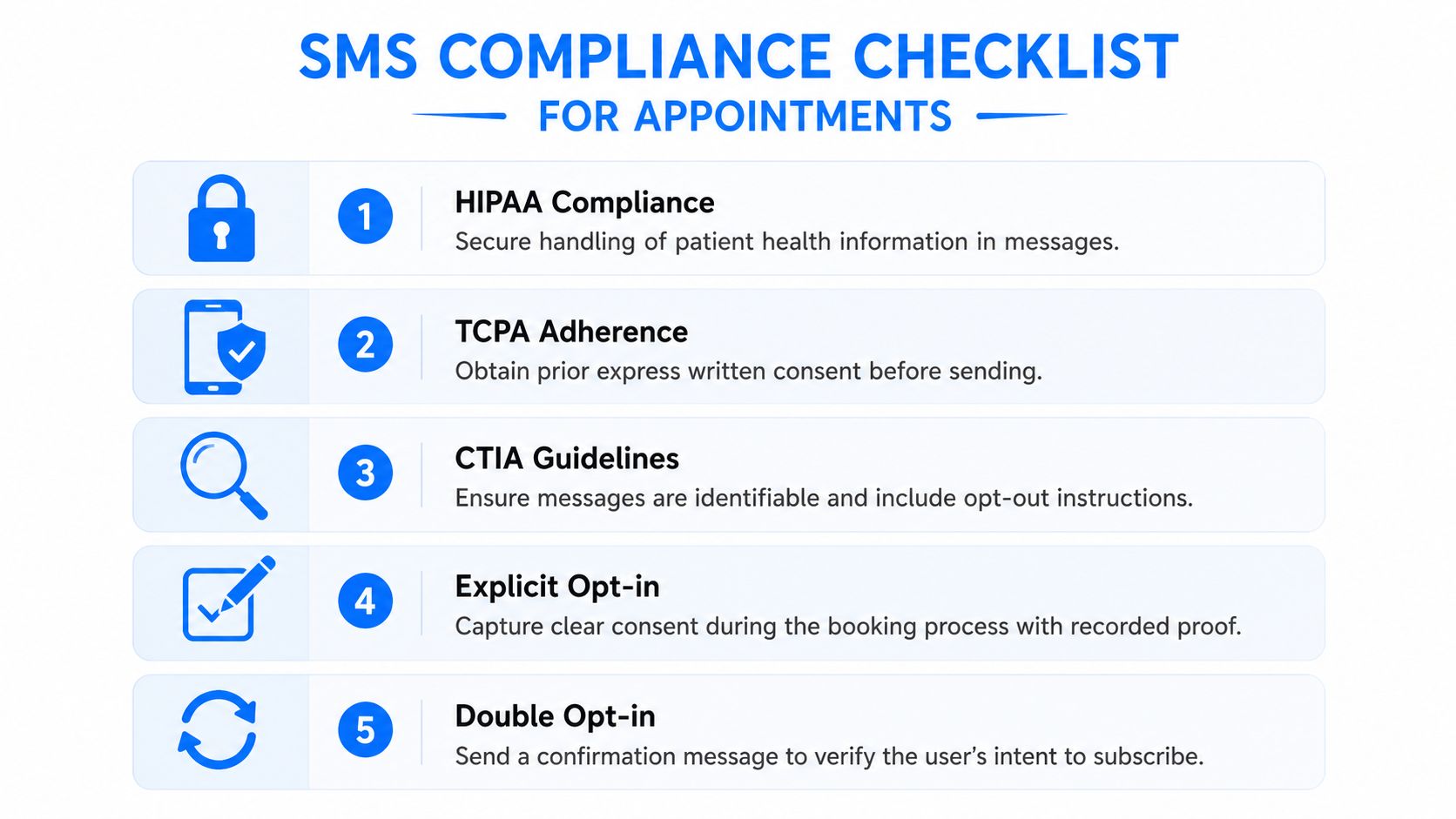
Use this operator checklist before every major workflow change:
The HIPAA-compliant appointment reminder guidance provides a useful implementation reference, but it doesn't replace legal advice or a review of local requirements.
The same reminder engine behaves differently depending on what attendance means. A clinic protects a care schedule and patient experience. A sales team protects pipeline time. An event organizer protects check-in flow and the attendee's overall experience. Each needs a different balance between message volume, detail, and human escalation.
| Industry | Reminder Cadence | Primary KPI | Voicemail Pair |
|---|---|---|---|
| Healthcare | Confirmation, pre-visit reminder, day-of logistics | Show rate and rescheduling activity | Selected high-risk or high-value visits |
| B2B sales | Booking confirmation, pre-demo reminder, short day-of prompt | Demo attendance and recovered meetings | Useful for high-value demos |
| Events | Booking confirmation, logistics reminder, check-in prompt | Check-in rate and support volume | Useful when travel or arrival coordination matters |
A dental or medical clinic should keep the SMS neutral and operational. The message can confirm the provider, date, time, location, and preparation instructions without putting clinical information into the text. A reschedule option helps staff recover a slot before it becomes an unexplained absence.
A B2B sales team has a different trade-off. The rep may want to protect a valuable demo without making the prospect feel chased. SMS can handle the concise reminder, while ringless voicemail adds a personal reinforcement for selected prospects. The voicemail shouldn't deliver a long pitch. It should make it easy to find the appointment details or request a new time.
Events introduce logistics that ordinary appointment reminders often miss. Attendees may need a check-in QR code, venue entrance, parking guidance, or a last-minute schedule notice. They often need more lead time when travel is involved, but the final message should still be short enough to scan at the door.
The evidence supports local measurement rather than universal promises. The 2022 pragmatic randomized study found that an extra targeted text reduced no-shows and same-day cancellations, but the effect varied by visit type. That's the right operating mindset across industries: test the audience and workflow, not just the copy.
A reminder program earns its place when it changes attendance outcomes, not when it produces a busy sending report. Establish a baseline from your own booking and attendance logs before changing the workflow. Then compare show rate, no-show rate, cancellations, rebookings, and staff intervention by appointment type and audience.
A useful starting dashboard includes the following:
| KPI | How to Calculate | Benchmark Range |
|---|---|---|
| Confirmation rate | Confirmed appointments divided by reminders delivered | Establish a local baseline |
| Show rate | Attended appointments divided by scheduled appointments | Establish a local baseline |
| No-show delta | Baseline no-show rate minus current no-show rate | Track direction over time |
| Reply sentiment | Categorize replies as confirm, reschedule, cancel, question, or unclear | Review qualitatively |
| Opt-out rate | Opt-outs divided by delivered messages | Monitor for increases |
| Rebook value | Rebooked appointments and associated value after a miss | Track by appointment type |
Don't interpret confirmation as attendance by itself. An evidence-based practice project recorded no-show rates of 12%, 10%, and 13% across measured periods, and reported that 82% of patients who confirmed attended. It also found that 58% of patients who received a text but didn't confirm still attended, as documented in the SMS appointment reminder practice project. Confirmation is a useful signal, not a perfect attendance forecast.
During the first 30 days, define one primary outcome, instrument delivery and reply tracking, and separate appointment types before comparing results. Test one meaningful variable, such as T-24h versus an earlier reminder or a concise message versus a more detailed one. Don't change timing, copy, audience, and escalation all at once, or you won't know what caused the movement.
Review opt-outs and unanswered messages alongside attendance. If SMS performs well for routine visits but poorly for high-value consultations, add ringless voicemail or a staff task to that branch instead of increasing every recipient's message volume. When SMS, voicemail, email, and post-appointment drips work as one funnel, channel reports become less important than the final result: more attended appointments, earlier cancellations, and more recovered bookings.
Use responsive visuals in the same spirit as the W3C guidance on images that scale to the available viewport. A full-width layout with preserved aspect ratio keeps workflow diagrams readable on mobile and avoids wasting page space with oversized margins.
Call Loop helps teams coordinate scheduled SMS, voice broadcasting, ringless voicemail, and drip sequences for appointment reminders, with confirmation workflows and campaign analytics in one platform. Visit Call Loop to connect reminder outreach to your existing sales, healthcare, event, or customer-success workflow and build a measured attendance process.
Chris Brisson
Chris is the co-founder and CEO at Call Loop. He is focused on marketing automation, growth hacker strategies, and creating duplicatable systems for growing a remote and bootstrapped company. Chat with him on X at @chrisbrisson


Trusted by over 45,000 people, organizations, and businesses like


