
See a Demo
You're just one step away from seeing Call Loop in action.
Enter your information below to watch a demo right now.

You're just one step away from seeing Call Loop in action.
Enter your information below to watch a demo right now.

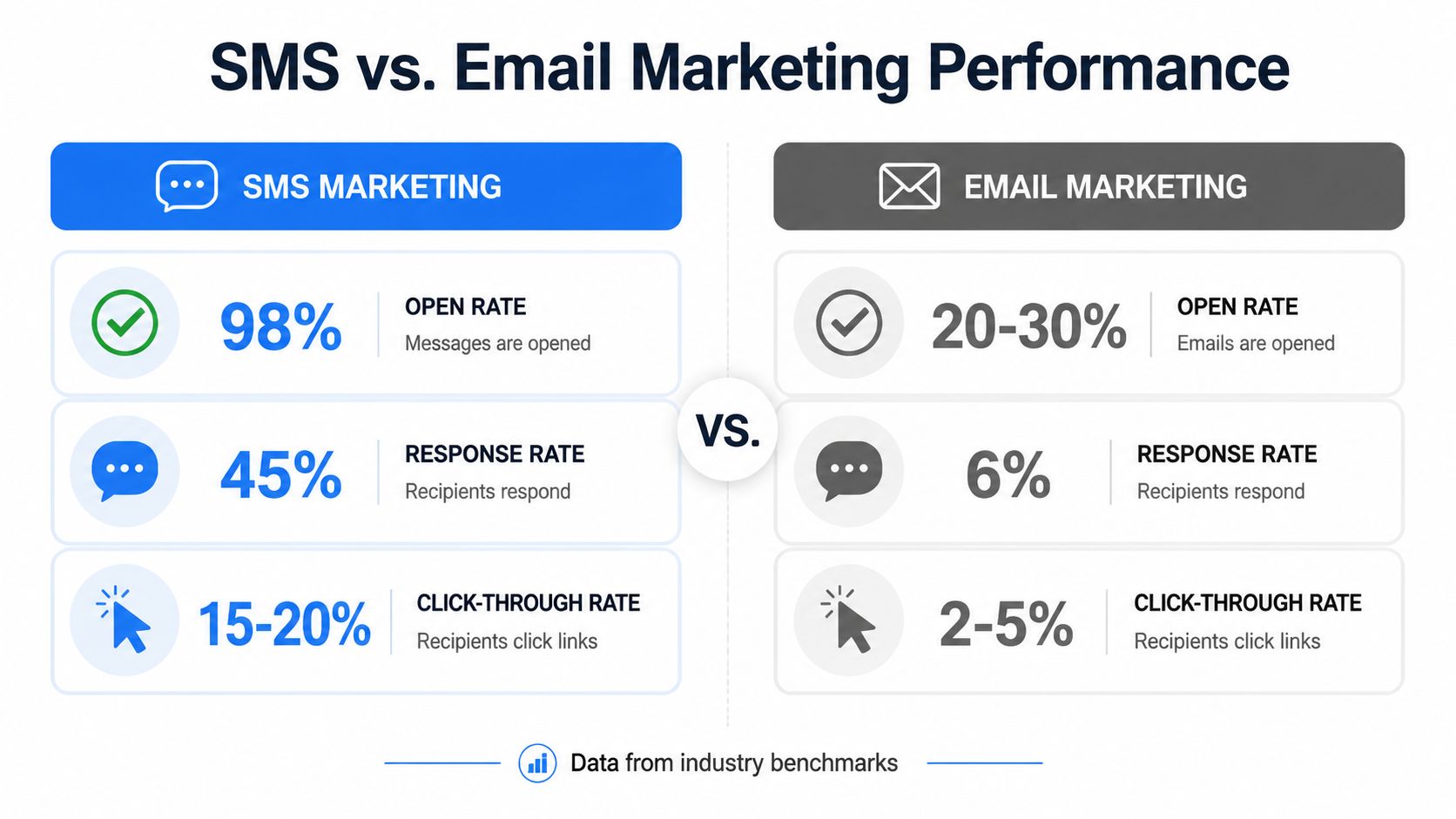
SMS marketing can show around 98% open rates, response rates near 45%, and click-through rates commonly between 15% and 20%, while email often sits around 20% to 30% opens and a response rate near 6% (industry SMS marketing benchmarks). Yet those figures don't guarantee revenue. Standard SMS campaigns convert at only about 0.12% on average, while automated SMS generates approximately $0.74 per message, compared with $0.15 for campaign messages (2026 SMS marketing data).
That gap is the practical story behind SMS in marketing. Texting wins because it reaches people quickly, but performance falls when operators treat the channel like a louder email list. The essential work sits in consent, timing, segmentation, deliverability, and automated follow-up.
A local service business can send a general promotion to its entire list and see immediate activity. That doesn't mean the campaign was well designed. A person who receives a relevant reminder shortly before an appointment is in a different decision state from someone who receives a generic offer during an unrelated part of the customer journey.
That distinction explains why SMS remains so compelling and so easy to misuse. Messages are read quickly, with benchmark reporting citing roughly 81% of recipients reading within 5 minutes and other datasets placing approximately 95% of messages opened within 3 minutes (SMS marketing benchmark reporting). Speed gives an operator a narrow but valuable opportunity to influence an action while it still matters.
A high open rate answers only one question, whether the message was seen. It doesn't tell you whether the recipient understood the offer, trusted the sender, clicked the link, completed the action, or opted out afterward.
A campaign blast often fails because it arrives without context. An automated message can succeed because it follows a cart event, a quote, a renewal date, or a booking. The send is connected to behavior, so the recipient has a reason to care at that exact moment.
Practical rule: Use SMS to respond to customer intent, not to compensate for weak targeting.
The difference between SMS and email marketing becomes most useful when it informs channel selection. Email can carry longer explanations, product education, and visual detail. SMS should handle urgent prompts, concise offers, reminders, and replies that need a fast response.
Raw volume won't solve a timing problem. If the message isn't relevant, sending it to more people creates more opportunities for complaints, filtering, and unsubscribes. The strongest SMS programs therefore begin with a small, clearly defined use case and measure revenue per message, conversion, and opt-out behavior rather than celebrating opens alone.
SMS marketing is the practice of sending permission-based text messages to people who have agreed to receive them. Those messages can be promotional, transactional, or conversational. A discount announcement, a delivery update, an appointment reminder, and a reply from a support team can all use the same basic messaging channel, but each has a different purpose and compliance treatment.
The simplest analogy is a tap on the shoulder in a noisy room. SMS is brief, direct, and hard to overlook. Email is closer to a letter in a mailbox. It gives you more room, but the recipient may read it later or miss it entirely.
Email is better for depth. Push notifications are tied to an installed app and its notification permissions. Social direct messages depend on a platform account, platform behavior, and a more complex inbox experience. SMS reaches a phone number directly, which makes the channel personal and useful, but also more intrusive.
That intimacy creates an obligation. A business needs a clear reason to text, a recorded permission trail, and a simple way for the recipient to stop messages. A text should feel like a useful interruption, not an unexpected demand for attention.
Application-to-person, or A2P, messaging is sent from software to an individual. Marketing platforms, CRMs, appointment systems, and ecommerce tools typically use A2P traffic. Person-to-person, or P2P, messaging describes ordinary individual conversations.
Carriers care about the distinction because high-volume business traffic can affect network quality and consumer trust. Registration, sender identity, campaign purpose, and content hygiene help carriers classify legitimate business messages. An unregistered or suspicious-looking send may face filtering even if the recipients previously engaged with the brand.
For an SMB, SMS sits in the broader messaging stack as the fast layer. Email carries detail, voice broadcasting supports live-answer conversations, and ringless voicemail delivers an asynchronous message to a voicemail inbox. Each channel should have a job, with the contact record coordinating the sequence rather than allowing every channel to compete for attention.
SMS performs best when the recipient has a clear reason to act soon. Four use cases consistently fit that condition: promotions, reminders, sales follow-up, and appointment communication.
A 48-hour coupon can work well for an ecommerce brand when the recipient has opted into offers and the product category matches their prior interest. The message needs one offer, one landing page, and one clear action. Benchmark reporting places SMS click-through rates commonly in the 15% to 20% range, which makes click tracking more useful than counting opens (SMS industry benchmarks).
A weak version says, “We have new deals available.” A stronger version identifies the brand, states the value, gives the deadline, and links directly to the relevant collection. Segmenting by past purchase or browsing behavior makes the interruption easier to justify.
A karate studio can send a class reminder tied to the student's schedule, with a reply option for questions or attendance confirmation. An event organizer can send venue details shortly before doors open. A payment reminder can direct a customer to the correct account page instead of forcing them to search through email.
These messages aren't promotional, but they still need consent, clear sender identification, and useful timing. The operator should measure completed appointments, attendance, support replies, and failed deliveries. A reminder that reduces confusion can create value even when it doesn't generate a tracked purchase.
Post-demo, post-quote, and cart-recovery messages should follow a known action. A sales team might send a concise text after a prospect requests pricing, then route replies to a person who can answer. An ecommerce sequence might remind a shopper that a cart remains open and offer help if checkout failed.
Automation matters because the message arrives while the interaction is still fresh. A manually assembled list sent days later turns a context-rich moment into a cold broadcast.
A clinic, salon, or fitness studio can use an appointment confirmation followed by a reminder and a rescheduling path. The measurable outcome is not just a click. It can be confirmation rate, rescheduling completion, attendance, or the number of calls avoided by providing the right information in advance.
Healthcare teams need additional safeguards around patient information. Keep the content limited to what the recipient needs, avoid unnecessary clinical detail, and make sure the workflow has been reviewed for applicable privacy obligations. The value of the message comes from clarity and timing, not from putting more information into the text.
Compliance starts before the first message. A contact should be able to understand who is requesting permission, what kind of messages will arrive, and how to stop them.
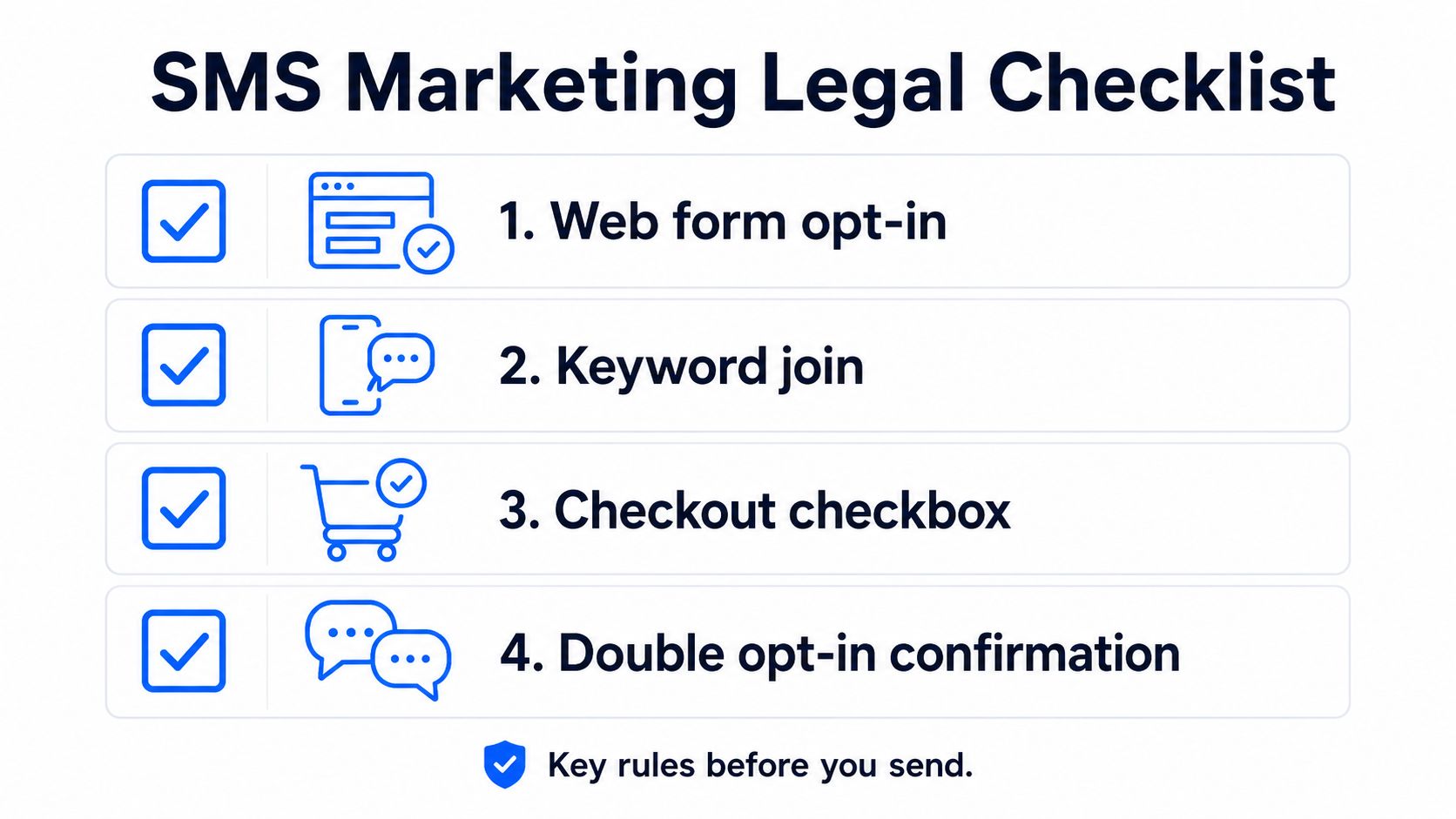
Common collection points include website forms, text-to-join keywords, checkout checkboxes, and appointment forms. A double opt-in adds a confirmation step, which helps verify the number and gives the subscriber another clear statement of what they joined.
Keep records of the form or keyword, the wording shown at consent, the timestamp, and the phone number. Don't hide marketing permission inside a vague general terms acceptance. If promotional texts and service notifications have different purposes, describe those purposes separately.
For U.S. marketing texts, industry compliance guidance commonly uses prior express written consent under the TCPA as the baseline. In practice, that means the person gives written, signed permission with clear scope for the messages they will receive. Consent isn't a permanent asset. It can be withdrawn.
A recipient may reply STOP, but operators also need to recognize revocation through other reasonable channels. A 2026 compliance summary says revocation isn't limited to a STOP reply and may occur through an email or phone call (TCPA consent and revocation guidance). Your systems should suppress future marketing sends when staff receive a valid request through any supported channel.
Businesses building automated workflows can use a resource such as avoid TCPA fines with AI to organize consent checks, opt-out handling, and campaign review. It shouldn't replace legal advice, but it can help teams turn policy into repeatable operating steps.
Healthcare organizations should apply a minimum-necessary approach to appointment and care reminders. A reminder can identify the practice and appointment logistics without exposing more patient information than the recipient needs. Teams should involve their privacy and compliance professionals before sending protected health information through any messaging workflow.
Ringless voicemail isn't a loophole. The FCC states that ringless voicemail delivered to wireless phones is a covered “call” under the TCPA, and its 2022 declaratory ruling says sending it without prior express consent constitutes a robocall (FCC consumer policy information). Anyone pairing SMS with voicemail drops should evaluate consent for both channels and document the basis for each send.
Use this SMS compliance checklist before launching, especially when a campaign combines promotional texts, voice, and voicemail delivery.
A message cannot generate a click, reply, or sale if carriers do not deliver it. In the United States, properly registered A2P traffic generally achieves about 95% or higher delivery, while registered 10DLC campaigns are reported around 97% to 99%. Non-compliant content can fall to roughly 60% to 80% delivery as carriers apply automated content and traffic-classification models (SMS deliverability benchmark).
| Traffic Class | Typical Delivery Rate | Why It Matters |
|---|---|---|
| Properly registered U.S. A2P traffic | About 95%+ | Registration supports reliable business messaging |
| Registered 10DLC campaigns | About 97% to 99% | Verified campaign details can improve carrier acceptance |
| Non-compliant content | Roughly 60% to 80% | Filtering can prevent the message from reaching the recipient |
Register the brand and campaign where required, use a verified sender identity, and keep the content aligned with the declared use case. Sudden traffic changes, unclear opt-in sources, misleading links, and aggressive promotional language can create filtering problems even when the list appears healthy.
Review delivery by campaign, workflow, and audience segment. A lower-performing workflow warrants an audit of contact sources, consent language, sending identity, and message content before you increase volume. A clean list does not compensate for weak registration or inconsistent traffic patterns.
Open behavior can confirm that SMS is being seen, but it does not prove business value. Track:
Consumer expectations make response speed an operating metric. A consumer texting report says 86% of consumers opt in to business texts, 79% are more likely to purchase when subscribed, 57% expect a business response within 15 minutes, and 52% text businesses more often than in prior years (consumer texting behavior report). If a workflow invites replies, assign ownership and measure how quickly someone responds. SMS stops producing revenue when the recipient receives a prompt answer from nobody.
A drip campaign is a timed, event-triggered flow, not a repeated blast. The trigger might be a new lead, a completed purchase, an abandoned cart, an appointment date, a subscription anniversary, or a renewal date.
Start with the event, then define the next decision. For an appointment, the workflow can calculate the reminder from the calendar date. For a subscription, it can use the customer's custom renewal date. The system should suppress irrelevant messages when the customer books, pays, replies, or opts out.
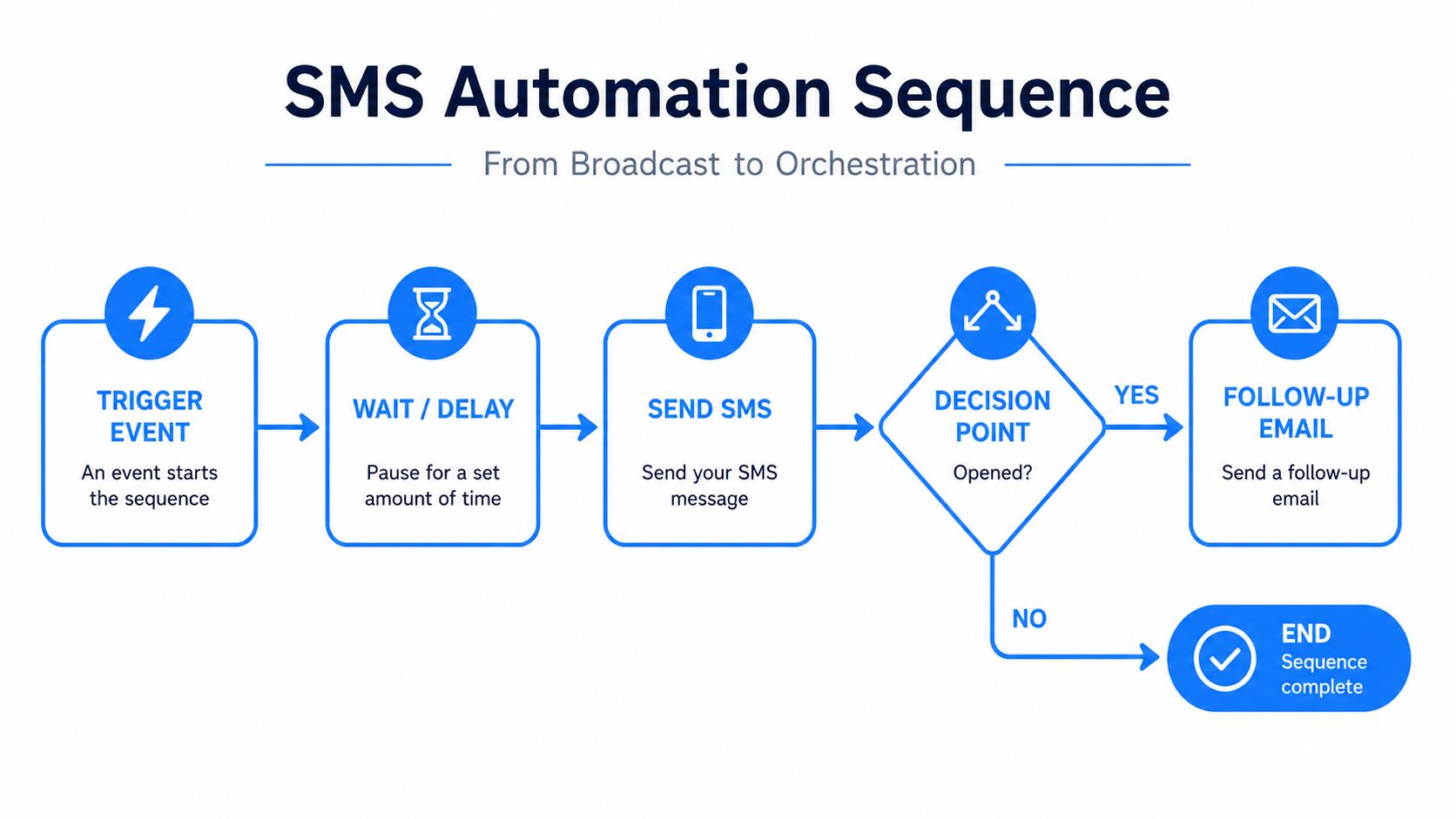
A practical sequence might look like this:
Multi-channel orchestration works when each channel has a distinct role. SMS handles immediacy, voice broadcasting can support live-answer conversations, and ringless voicemail can deliver an asynchronous inbox message. A single contact record should control the order, suppression rules, and consent status.
You don't need to rebuild the CRM to add messaging. Integrations with ActiveCampaign, HubSpot, Keap, and more than 4,000 apps through Zapier can connect events, fields, tags, and outcomes to an SMS workflow. Call Loop, for example, supports SMS, voice broadcasting, ringless voicemail, drip campaigns, appointment reminders, merge fields, segmentation, scheduling, and click tracking in one outbound messaging platform.
The multi-channel marketing strategy should stay subordinate to customer intent. If a recipient replies by SMS, don't send a voicemail and email at the same time unless the workflow has a clear service reason. Orchestration is supposed to reduce friction, not multiply interruptions.
A good SMS template has a recognizable sender, a reason for the message, one action, and a consent-aware opt-out path. Keep the copy concise, use merge fields carefully, and connect every link to click tracking.
These examples use a single CTA because multiple competing actions create hesitation. They also identify the sender, avoid unnecessary clinical detail, and leave room for opt-out language. Review the final rendered message, not just the draft, because merge fields and links can change length.
Do: Send relevant content at an appropriate local time, personalize from reliable fields, track clicks, and honor recorded consent.
Don't: Buy lists, bury the sender identity, stack several offers into one text, or continue messaging after a valid opt-out.
Use the Expressify AI blog for additional ideas on concise marketing copy and workflow content, then adapt every template to the audience, consent record, and business outcome. A polished message still fails if the recipient didn't ask for it or the team can't answer the resulting reply.
A bigger list isn't automatically better. Volume without clear consent can increase filtering and complaints, while a smaller segment tied to a real customer action gives automation something useful to work with.
SMS isn't only a broadcast channel. Consumers increasingly use business texting for conversations, so a reply needs an owner, a response process, and a clear escalation path. Ringless voicemail isn't a TCPA workaround either. The FCC's ruling treats ringless voicemail to wireless phones as a covered call requiring consent.
Use the first month to build the operating base:
Start with one use case, one segment, and one KPI. That narrow test will tell you whether the problem is timing, message relevance, deliverability, or the offer itself.
Call Loop helps businesses coordinate personalized SMS, voice broadcasting, ringless voicemail, drip campaigns, appointment reminders, and CRM-connected follow-up from one platform. Visit Call Loop to build a consent-aware messaging workflow around the customer moments that matter most.
Chris Brisson
Chris is the co-founder and CEO at Call Loop. He is focused on marketing automation, growth hacker strategies, and creating duplicatable systems for growing a remote and bootstrapped company. Chat with him on X at @chrisbrisson


Trusted by over 45,000 people, organizations, and businesses like


