
See a Demo
You're just one step away from seeing Call Loop in action.
Enter your information below to watch a demo right now.

You're just one step away from seeing Call Loop in action.
Enter your information below to watch a demo right now.

A gym member's phone is one of the few marketing channels that can reach almost everyone directly. Around 97% to 98% of business text messages are opened, and most are seen within three minutes, according to mobile marketing statistics compiled by Digital Applied. That speed makes SMS useful for far more than discount blasts. It can confirm a booking, fill a newly opened class spot, prompt a renewal, or prevent a member from drifting away.
The strongest SMS marketing for gyms programs aren't built around sending more messages. They're built around sending the right message, to the right member, for the right reason, with consent that clearly matches the purpose. Operational texts and promotional texts need separate logic, separate permissions, and separate reporting.
SMS open rates commonly reach 97% to 98%, while email is often reported at much lower levels in comparable marketing contexts. Digital Applied's industry data summary also reports that most texts are seen within three minutes, with broader business-texting click-through rates often around 19% to 35% and response rates around 45%. Those figures explain why a text can influence attendance while an email remains unopened until the class has already started.
Email still has an important job. It works well for newsletters, training guides, policy updates, monthly schedules, and other content that benefits from space and detail. SMS is better when the member must act quickly or when the gym needs a direct response.
| Metric | SMS | |
|---|---|---|
| Visibility | Commonly reported at 97% to 98% open rates | Often lower in comparable marketing contexts |
| Speed | Most messages are seen within 3 minutes | Timing varies widely |
| Click-through | Often reported around 19% to 35% | Typically lower in comparable marketing contexts |
| Response | Often reported around 45% | Typically lower in comparable marketing contexts |
| Best use | Reminders, confirmations, urgent changes, short offers | Newsletters, education, long-form updates |
A class confirmation sent immediately after booking reduces uncertainty. A reminder before the session gives the member a chance to cancel properly instead of becoming a no-show. A waitlist notification can reach someone while the opening still matters. A schedule-change text can prevent a frustrated arrival when an instructor calls out or a room becomes unavailable.
Practical rule: Use SMS for time-sensitive action. Use email when the member needs context, education, or a longer explanation.
The channel also benefits from mobile reach. U.S. smartphone ownership is around 91%, and about 98% of adults own a cellphone of some kind, according to the same Digital Applied mobile marketing reference. That doesn't mean every member wants every type of text. It does mean a properly permissioned SMS list can be more immediately accessible than a social audience or an email inbox.
For a broader channel comparison, SMS versus email marketing is useful when deciding which messages belong in each system. Gym owners can also review this practical guide to SMS marketing for gyms for additional campaign ideas, then apply those ideas through a consent-first operating model.
The most dangerous setup is a single checkbox that says, “I agree to receive texts,” while the gym uses that permission for bookings, billing, promotions, events, and reactivation. Consent should describe the message category clearly enough that a member understands what they're agreeing to and the gym can prove how that permission was collected.
Create two communication paths during signup:
The second checkbox should be optional and separate from the first. Store the member's phone number, consent category, wording shown, source, timestamp, and any confirmation response. A front-desk tablet, website form, waiver, and booking page should each pass that information into the same member record.
Gym SMS guidance commonly recommends written permission for commercial texts, a clear opt-out method, disclosure of message frequency, and notice that carrier charges may apply. ABC Fitness's gym SMS best practices also cites potential violations of $500 to $1,500 per unsolicited text, so a loose signup process can create material exposure quickly.
A promotional checkbox might say:
I agree to receive recurring promotional text messages from [Gym Name], including offers, events, and membership updates. Message frequency varies. Consent isn't required to purchase. Message and data rates may apply. Reply STOP to opt out and HELP for help.
That language should match the gym's actual practices. If the gym sends only occasional offers, it shouldn't describe an aggressive campaign. If staff collect permission in person, the tablet or paper process should preserve the same wording and record the member's affirmative action.
For booking forms, keep operational language distinct:
I agree to receive text messages from [Gym Name] about bookings, class changes, billing, and other service updates.
Don't hide promotional permission inside the terms and conditions. Don't treat a member's request for a booking confirmation as permission for a sales campaign. The Call Loop guide to express written consent offers useful context for designing the permission record and confirmation process.
A STOP response should remove the member from promotional automation promptly. Staff should know whether operational notices can continue under the applicable rules and service relationship, rather than assuming every message category can proceed unchanged. Review opt-outs by segment each week, because a sudden rise among one group often signals irrelevant offers, excessive frequency, or confusing consent language.
Local sending windows matter too. Independent gym compliance guidance commonly recommends sending texts only during the recipient's local daytime window, roughly 8 a.m. to 9 p.m., while warning that state mini-TCPA laws can impose stricter requirements. ABC Fitness's TCPA guidance is a useful compliance reference, but gyms should still obtain legal advice for their jurisdictions and campaign structure.
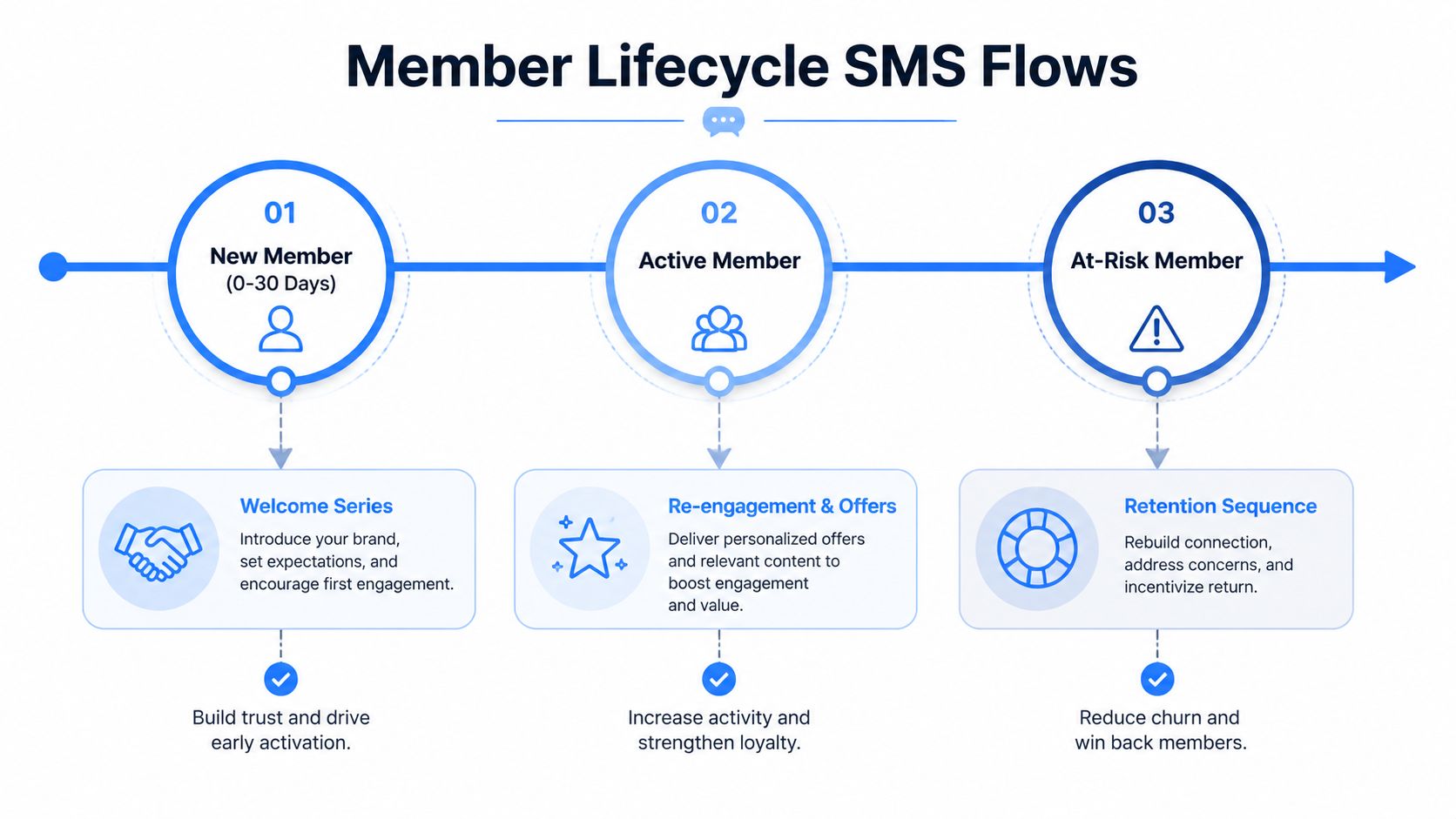
Lifecycle stage should determine the first message decision. A member who joined yesterday needs different communication from someone whose attendance has declined or whose membership is nearing renewal. Refine each stage by membership type, class behavior, attendance, and renewal status. This structure separates operational texts from promotional campaigns, which helps limit irrelevant messages and prevent avoidable opt-outs.
Start the welcome flow after signup with a confirmation and one practical next step. Follow with onboarding content such as a facility tour link, trainer introduction, class-selection guidance, or an invitation to book an introductory session. End the sequence when the member books a class, replies to staff, or reaches the active-member threshold set in the gym's system.
New-member messages should answer questions members are likely to have:
A short, useful text builds confidence. Sending another promotion before the member has attended can make the gym appear focused on selling rather than helping.
Use actual behavior to trigger active-member messages. Send a booking confirmation immediately. A class reminder can arrive 24 hours before the session, followed by another one to three hours before an especially time-sensitive event, consistent with Club Solutions Magazine's fitness SMS guidance. After attendance, send a brief follow-up that requests feedback, recommends a relevant class, or recognizes a milestone.
Separate unlimited members from class-pack users. A class-pack member may need a reminder about remaining sessions. An unlimited member may respond better to schedule suggestions based on preferred class type. Both groups should receive messages connected to their behavior and membership, not a generic product promotion.
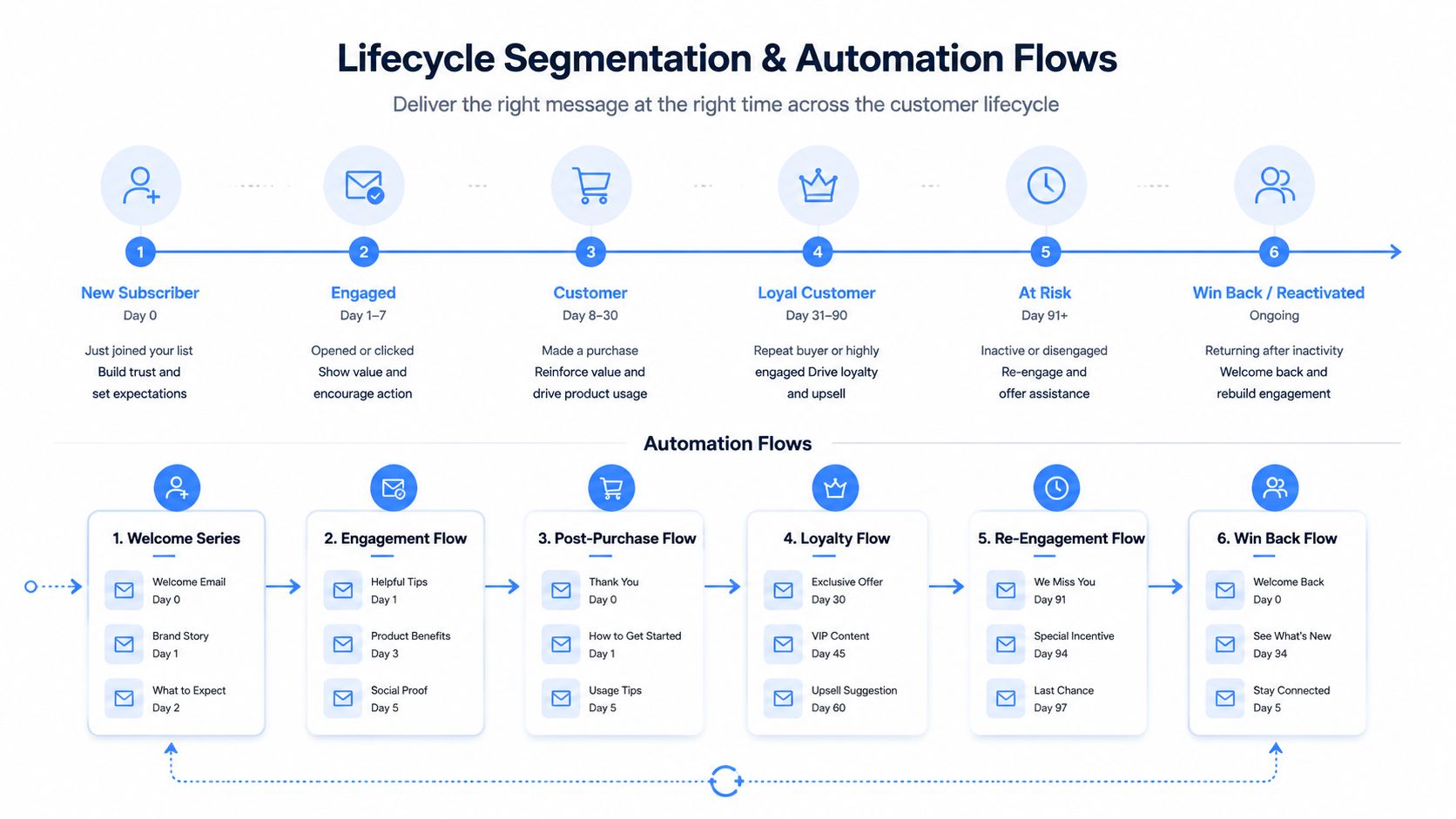
For a closer look at sequencing logic, see our guide to drip campaign best practices. Build exit conditions into every flow so a completed booking, staff reply, visit, or opt-out changes the member's route immediately.
Begin an at-risk flow after a meaningful attendance decline or a defined period without a check-in. The first message should invite a reply or remove friction, perhaps by offering help choosing a class. A later message can present a relevant option. Stop the sequence when the member books, visits, replies, or opts out.
A lapsed-member flow has another objective: reopen the relationship without treating the member as active. Ask what changed, offer a low-friction return path, and make booking obvious. Keep promotional SMS relatively sparse, often two to four messages per month, while behavioral and transactional messages use separate triggers, according to Resamania's guidance for gym SMS marketing.
The useful segmentation question isn't “Who can we text?” It's “What member behavior gives us a legitimate reason to text now?”
Review opt-outs weekly. One industry analysis reported average opt-out rates reaching 7.8% in 2023, compared with 5.9% in 2021, as cited by Club Solutions Magazine. The practical response is clear: keep event-driven messages separate from promotions, cap promotional frequency, and give every automated flow a defined exit condition.
A good gym text has one job. It identifies the member, explains why the message arrived, and gives one clear next action. Operational messages should sound brief and useful. Promotional messages can carry more personality, but they still need a recognizable sender, a meaningful offer, and an opt-out path.
Welcome message
Hi [First Name], welcome to [Gym Name]. Your first step is easy. Browse this week's classes and book your preferred session: [Link]. Reply HELP for help. Reply STOP to opt out of marketing texts.
Class reminder
Hi [First Name], you're booked for [Class] at [Time] today. Need to cancel or change your spot? Manage your booking here: [Link].
Waitlist opening
Good news, [First Name]. A spot opened in [Class] at [Time]. Reserve it here: [Link]. Reply STOP to opt out of marketing texts.
Personalization matters because the message should reflect a real member action. A generic “Don't forget the gym” text creates work for the recipient. A class name, time, and booking link remove that work.
Relevant promotion
[Gym Name]: Your [membership type] includes access to [offer or event]. Reserve your spot for [date] here: [Link]. Reply STOP to opt out.
At-risk check-in
Hi [First Name], we haven't seen you recently. Would a different class time or workout plan make returning easier? Reply HELP and our team will assist. Reply STOP to opt out.
Lapsed-member invitation
Hi [First Name], we'd love to welcome you back to [Gym Name]. Choose a convenient class and restart your routine here: [Link]. Reply STOP to opt out.
A question works well when staff can respond quickly. Don't ask a question just to create engagement if replies disappear into an unattended inbox. Also avoid claiming a discount, deadline, or benefit that the booking page doesn't honor.
| Campaign Type | Timing / Trigger | Template Structure | Key CTA |
|---|---|---|---|
| Welcome | Immediately after signup | Name, welcome, first useful action, help and opt-out path | Browse or book |
| Class reminder | Before a confirmed booking | Class, time, location or change option | Manage booking |
| Promotion | Approved marketing segment | Relevant benefit, deadline or availability, terms, opt-out | Claim or reserve |
| Re-engagement | Attendance decline or lapse event | Acknowledge absence, offer help, provide return path | Reply or book |
| Renewal | Renewal event in membership system | Membership status, renewal action, support option | Renew or contact staff |
Don't compress a message so aggressively that the member can't tell who sent it or what happens next. Clarity beats cleverness, especially when the text concerns billing, cancellation, or access.
Ringless voicemail can place a prerecorded message into a wireless phone's voicemail inbox without making the device ring first. That makes it a different communication format from SMS, but it does not make it exempt from consent rules.
The FCC ruled that ringless voicemail to wireless phones is a “call” made using an artificial or prerecorded voice and is covered by the TCPA. The FCC ruling on ringless voicemail specifically rejects the argument that the method falls outside the rules because the phone doesn't ring. The FCC's 2022 declaratory ruling and order applies the rule to marketing use cases as well, so gyms should obtain prior express consent before sending outreach to consumers' phones.
SMS is the better fit for a class cancellation, check-in confirmation, waitlist opening, or short renewal prompt. Members can scan a link, reply, or update a booking quickly. Ringless voicemail can suit a message that benefits from tone and a human voice, such as a gym owner thanking a member for reaching a milestone or a coach inviting a lapsed member back.
Don't use ringless voicemail as a workaround for missing SMS permission. Keep consent records channel-specific and make the opt-out process clear in the recording and supporting workflow.
A sensible sequence might send a permitted operational SMS first, then offer a callback or additional information through voicemail only when the member has the relevant consent. Use suppression rules so a booking or reply ends the sequence. The same person shouldn't receive several channels for the same event because the automation can send them.
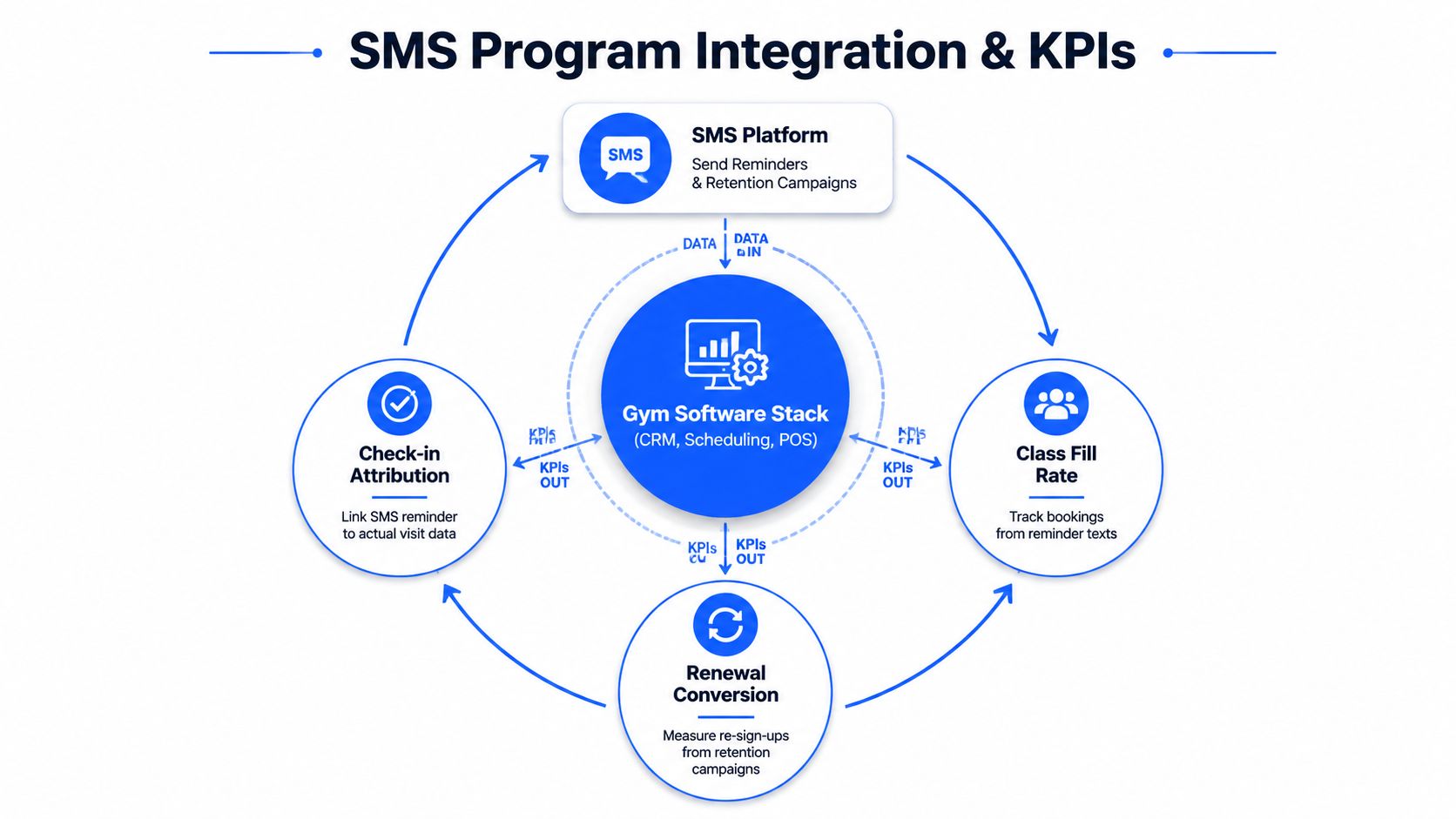
Open rates tell you that a message reached attention. They don't tell you whether a member attended class, renewed, or returned after a lapse. A gym should measure SMS against business outcomes that exist in its membership and booking systems.
Track the following paths:
Review delivery and opt-outs daily when campaigns are active. Review clicks, replies, bookings, and conversions weekly. Analyze retention cohorts monthly, using the gym's own member records rather than relying on platform-level engagement alone.
Map each gym event to a clear trigger. A new membership should create the welcome flow. A prolonged absence should create an at-risk review. An approaching expiration should launch a renewal sequence. Every flow needs an exit trigger, such as a booking, check-in, renewal, reply, or opt-out.
Gym systems such as Mindbody, Glofox, and PushPress can serve as the source of membership and booking events when connected through native integrations, APIs, or workflow tools such as Zapier. The exact connection depends on the gym's software plan and available permissions, so test each event with a small internal record before activating a full audience.
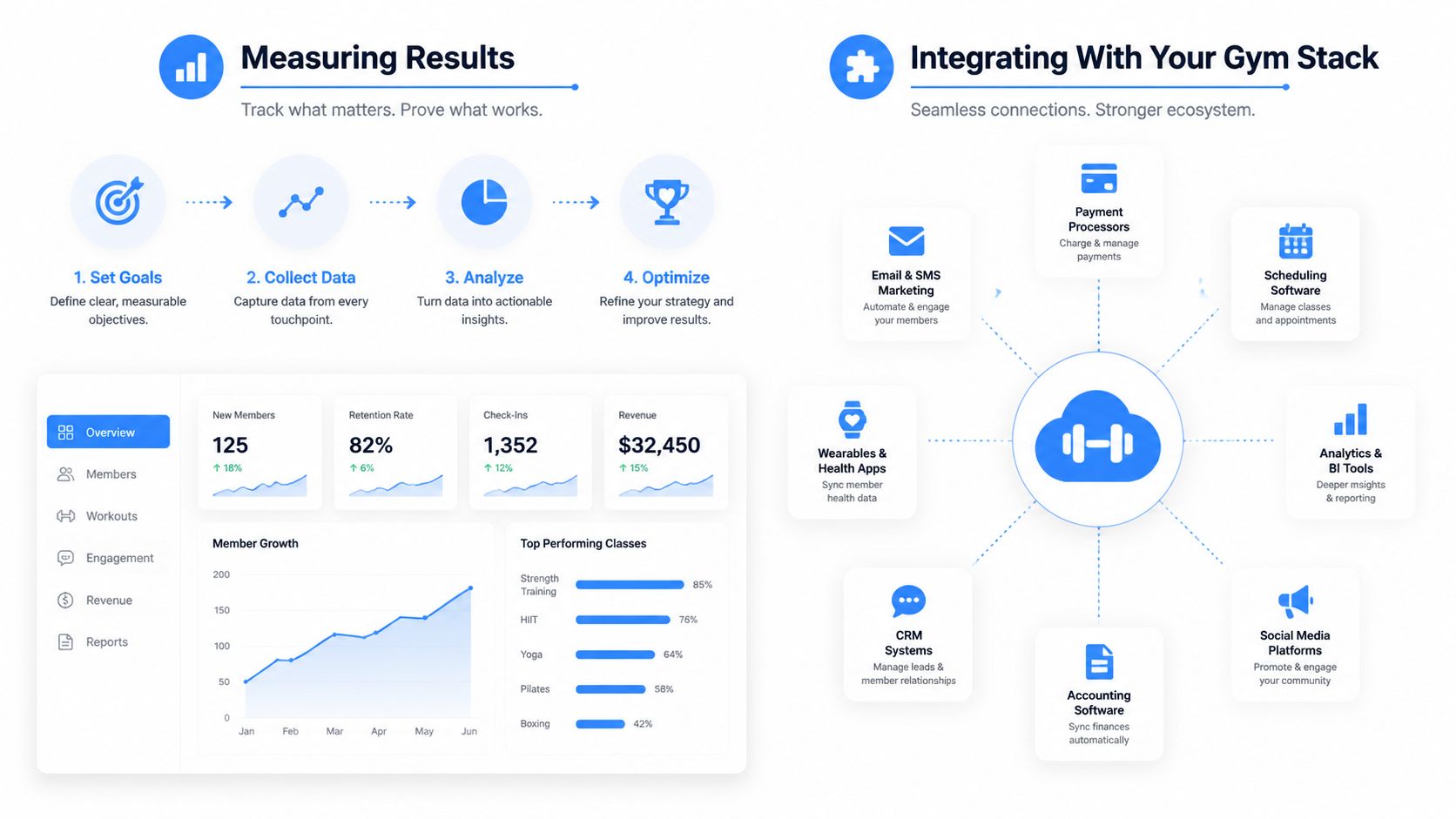
Call Loop is one option for scheduled or immediate SMS, segmented broadcasts, link tracking, opt-in tools, and coordinated voice or ringless voicemail workflows. A gym can evaluate it alongside its existing management software, with the key requirement that campaign events and membership outcomes flow into one reporting view.
The dashboard should answer a retention question, not just a messaging question: which members changed behavior after a relevant, permitted contact?
Start by auditing your current forms, tags, triggers, and opt-out handling. Then build one operational flow and one lifecycle flow, connect both to booking data, and review the results before expanding. Visit Call Loop to evaluate SMS, voice, ringless voicemail, segmentation, scheduling, and analytics for a consent-first gym outreach program.
Chris Brisson
Chris is the co-founder and CEO at Call Loop. He is focused on marketing automation, growth hacker strategies, and creating duplicatable systems for growing a remote and bootstrapped company. Chat with him on X at @chrisbrisson


Trusted by over 45,000 people, organizations, and businesses like


