
See a Demo
You're just one step away from seeing Call Loop in action.
Enter your information below to watch a demo right now.

You're just one step away from seeing Call Loop in action.
Enter your information below to watch a demo right now.

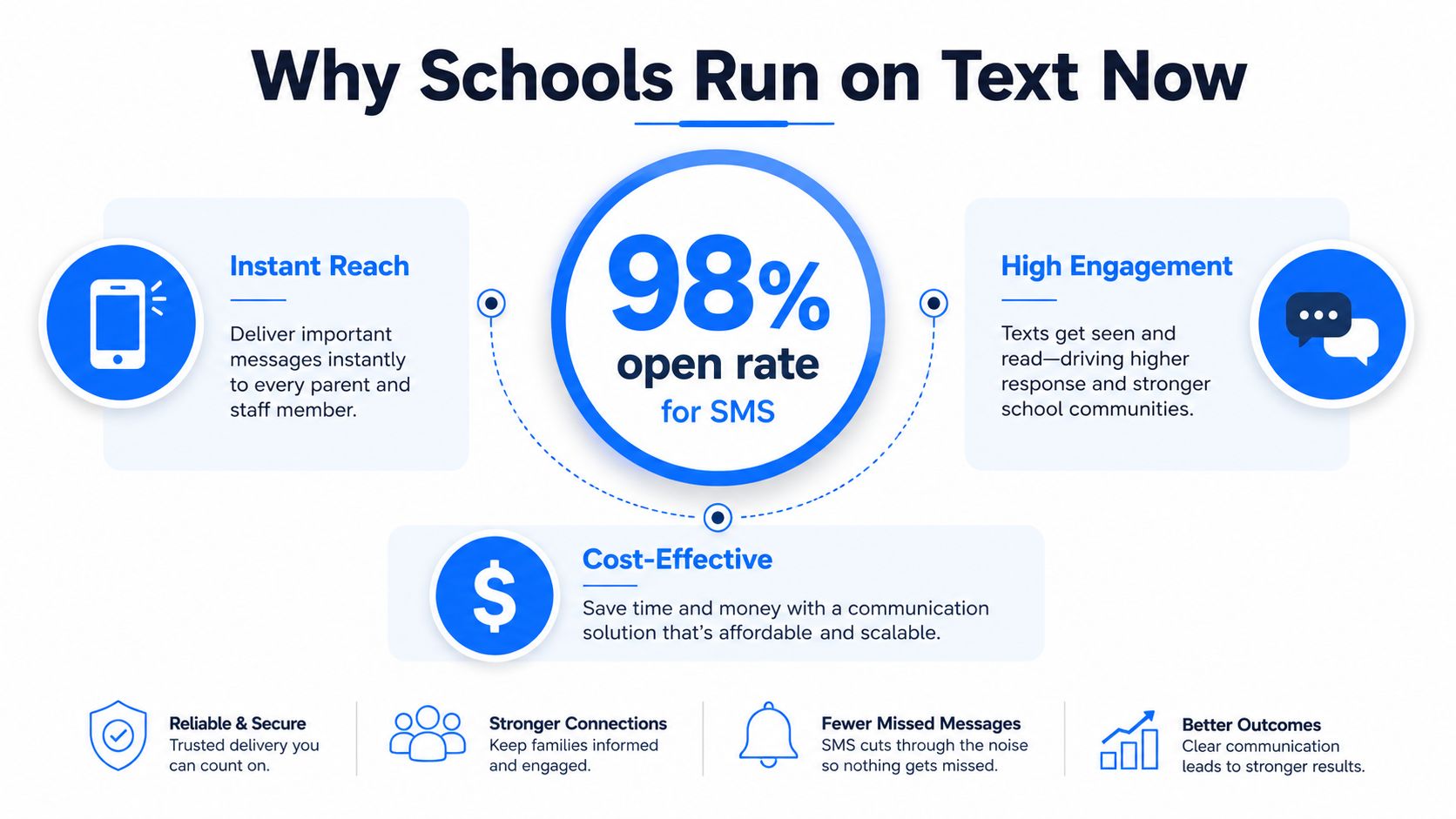
The fastest way to make school texting work is also the part teams often rush past. In higher education, the average SMS open rate is 98%, the average response time is 90 seconds, and the average email reply takes about 90 minutes by comparison, which is why text has become the default channel for urgent school communication and enrollment nudges (education SMS benchmarks, school messaging stats). The catch is simple, if you get consent wrong or over-message families, that speed turns into complaints and opt-outs instead of action.
For sms marketing for schools, the job is not “send more texts.” It's build a system that reaches the right person, at the right moment, with a message they expected to get. That means consent, segmentation, timing, and message design come before templates, because copy can't rescue a broken list.
SMS works in schools because it reaches people on the device they check all day, and it does so without asking them to log in, open an app, or sift through a crowded inbox. One school messaging source reports a 98% open rate for text messages compared with about 20% for email, and a 45% response rate for text messages compared with about 6% for email. It also says the average person responds to email in about 90 minutes but replies to a text in about 90 seconds (school messaging stats).
That speed changes what a district can do well. Snow-day notices, bus delays, fee reminders, enrollment prompts, and campus alerts depend on attention right away, not later in the afternoon after someone has cleared an inbox. Text also works best when the message is short and action-driven, because it is built for quick decisions, not long explanations.
A practical school message stack usually looks like this:
Use SMS for a decision, not for a newsletter. If the recipient needs to act, confirm, reschedule, pay, or show up, text is usually the fastest channel.
I have seen schools send reminders by text that would have vanished in email, while keeping longer updates in email or on the parent portal. The issue is channel fit, not channel loyalty. If the update is urgent, brief, and tied to one action, SMS makes sense. If it needs context, attachments, or long policy language, it does not.
For schools building a text strategy, the right starting point is a working playbook, not a feature pitch. A useful school guide from Call Loop's own Texting for Schools makes the same point, SMS works best when the message is short and the action is simple.
The biggest school texting failure I see is not weak copy. It's weak permission management. If the district can't prove who opted in, what they opted into, and when they did it, every later campaign carries unnecessary risk.
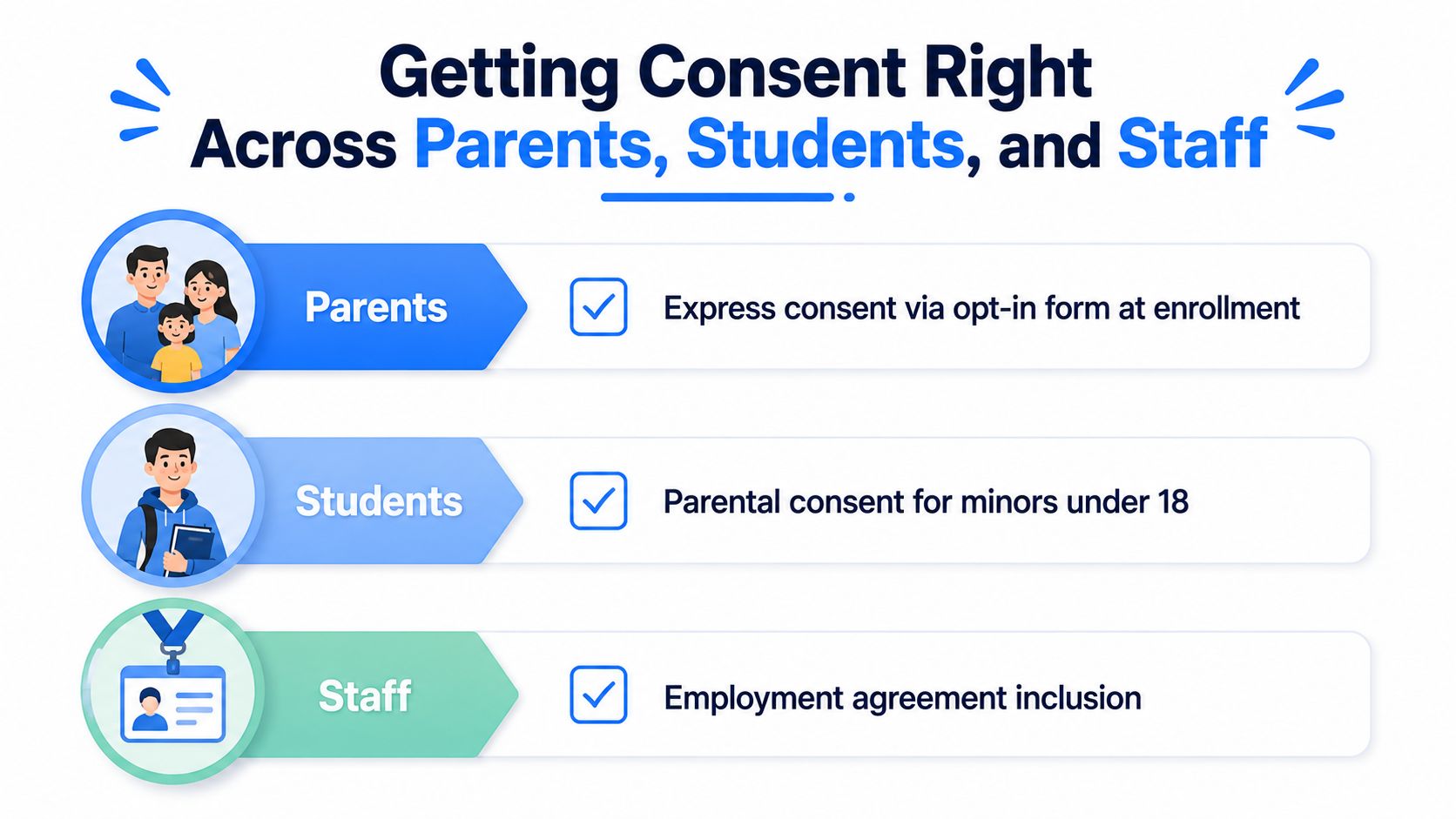
For K-12, the default is straightforward, parents or guardians opt in first, and students are usually secondary recipients unless the district has a separate policy and a clear legal basis. For higher ed, prospective and current students often opt in directly through admissions or student-success forms, but the same rule still applies, consent should be explicit and documented. A practical consent flow includes a checkbox, a clear disclosure, and a record of the timestamp in the SIS or CRM.
The simplest operational path is to capture consent at enrollment, re-enrollment, event registration, and web forms, then sync that status into the student record. If a paper form is still in use, the permission shouldn't live only on paper, someone needs to key it into the system with the date, source, and channel.
Keep the opt-out language on every message. If people can't see how to stop texts, they'll complain first and sort it out later.
For a clean consent workflow, one useful external reference is this MEDIAL guide to pharma marketing. The industries are different, but the operational logic is similar, permission, audience boundaries, and careful message handling matter more than clever wording.
A double opt-in flow helps prevent bad lists from piling up. The first message confirms enrollment, the second confirms the recipient still wants texts. That may feel slower at the front end, but it saves time later because staff aren't chasing down unsubscribes or wrong-number complaints.
A school should also document consent by audience. Parents may be approved for attendance and emergency updates, while students may only receive admissions or campus-life messages, and staff may get internal reminders tied to employment policies. If a family only agreed to emergency alerts, don't slide fundraising or event promotions into the same queue.
For schools that need a practical reference on written permission handling, express written consent guidance is a useful operational anchor. The point isn't to make consent complicated. It's to make it visible, auditable, and hard to misuse.
Most schools don't need a flashy SMS tool. They need one that fits the student record, respects consent, and doesn't trap contact data behind a sales contract. The right vendor evaluation starts with core requirements, then moves to integration depth and exportability.
| Capability | Must-have | Nice-to-have | Skip if missing |
|---|---|---|---|
| Double opt-in | Clear confirmation flow with documented consent | Separate flows by audience | Yes |
| DNC and suppression lists | Automatic suppression for opt-outs and invalid numbers | Role-based suppression rules | Yes |
| Personalization | Merge tags for name, program, grade, or term | Dynamic fields by lifecycle stage | Yes |
| Link tracking | Short links with click tracking | Deep analytics by segment | Yes |
| MMS support | Photo and image messaging | Rich media previews | No, but lower priority |
| Scheduling | Time-based sends and calendar triggers | A/B timing tests | Yes |
| Segmentation | Filter by role, grade, program, or campus | Multi-step audience rules | Yes |
| SIS and CRM sync | PowerSchool, Infinite Campus, Skyward, HubSpot, Salesforce, or Slate sync | Bi-directional updates | Yes |
| Compliance features | Toll-free verification or 10DLC registration support | Workflow alerts for missing registration | Yes |
| Data portability | Export contacts and consent history without friction | API access and backups | Yes |
The integration question matters more than many demos suggest. If the platform can't sync opt-in status, graduation updates, or contact changes with the SIS and CRM, staff end up cleaning lists by hand. That's where mistakes multiply, especially when one office updates a record and another office keeps texting an old number.
Ask the vendor who owns the contact data on day one, not after launch. If the answer is vague, assume the exit will be painful.
Compliance features also deserve a real look. Toll-free verification and 10DLC registration affect deliverability, and schools that ignore them can see their messages filtered or blocked. If the district uses school-based health services, HIPAA considerations may come into play as well, so the messaging workflow should be reviewed with that in mind.
For a practical school use case, Call Loop is one option that combines SMS and MMS, scheduling, segmentation, link tracking, and drip campaigns with text-to-join keywords. It also matters that the data can be moved, because a school should never choose a platform it can't leave.
The strongest school texts are short, specific, and tied to one action. They also arrive from a list that already understands why the text is coming. If the recipient has to decode the message, the district has already lost momentum.
Emergency texts should be calm, not dramatic. They need the event, the action, and the next update path. A good rule is to keep the message under 160 characters and avoid filler language that makes families hunt for the core instruction (educational SMS guide).
Sample:
Bus 14 is delayed by weather. Students are safe. Please expect arrival about 20 minutes late. Reply STOP to opt out.
Trigger, weather closure, delay, or safety event. Segmentation, only families tied to the route, building, or grade level affected.
Attendance texts work best when they go out quickly after the missed period, not at the end of the week. In practice, that means the parent gets a notice while the absence is still actionable. Fee and deadline reminders should include a direct payment or action link, because vague reminders create extra calls to the office.
Sample:
Your student missed first period today. Please reply if there's a reason we should note, or check the attendance portal. STOP to opt out.
Trigger, attendance flag, unpaid fee, or due-date milestone. Segmentation, the specific family or student account tied to the record.
Event reminders should state the date, time, and location, then stop. Admissions nudges work the same way, but they should be personalized by program and start term so the text sounds relevant, not mass-produced.
Sample:
Open House starts Thursday at 6 PM in the main gym. RSVP here: [short link]. Reply STOP to opt out.
Trigger, RSVP deadline, open house, audition, or application step. Segmentation, attendees, applicants, or prospects by program.
Back-to-school texts should be early and practical. Conference reminders should reduce no-shows. Graduation messages should focus on parking, arrival times, and where families need to check in.
A useful confirmation message at the start of every subscription should also disclose frequency and opt-out language. That protects the list and sets expectations before the first campaign ever goes out.
A school texting program works better when staff stop sending one-off messages from memory and start tying sends to clear triggers. Timing matters because parents and students respond differently depending on the moment of the week and the purpose of the message. A reminder about a form deadline can wait longer than an attendance alert. A campus closure note cannot.
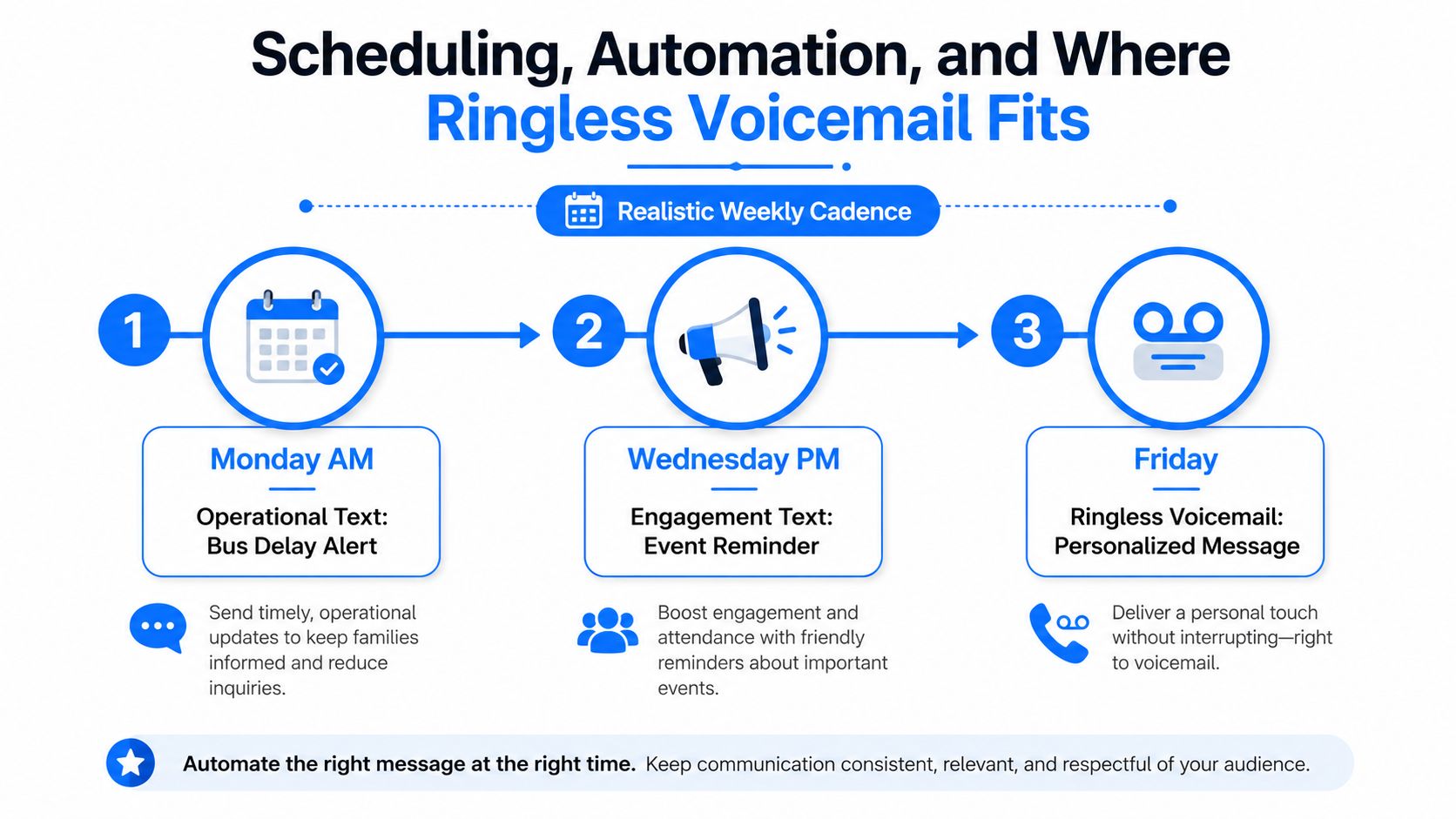
One operational text, one community text, and one strategic text is a workable pattern for many schools. Operational means attendance, closure, or schedule change. Community means event or fundraiser. Strategic means admissions, enrollment, or retention.
That cadence keeps the list active without turning it into background noise. It also gives staff something to test. A district can compare weekday mornings, afternoon sends, and evening sends without hitting families every day of the week.
Admissions workflows work best when they mirror the student journey. Application submitted, document missing, FAFSA reminder, orientation registration, and final enrollment can all be triggered automatically. Parent-teacher conferences, sports physicals, and IEP meetings also benefit from reminder sequences, because those are the appointments families are most likely to miss when life gets busy.
Ringless voicemail fits the messier cases. It drops a voice memo directly into voicemail without ringing the phone, which makes it useful when a reminder needs more context than text allows but does not deserve a live call. The consent rules still apply, so ringless voicemail should be treated as part of the same communication policy. For a practical breakdown of voicemail sequencing, this ringless voicemail marketing guide is a useful reference because it matches the way schools use voice when a reminder is too detailed for a short text.
Channel fit matters more than channel novelty. SMS handles the quick action, ringless voicemail handles the longer reminder, and live calls should stay reserved for the cases that need a conversation.
The best workflow matches the message to the interruption level. SMS is the least intrusive option for urgent brevity. Ringless voicemail works for detail without a live interruption. Voice broadcasts are more disruptive, so they belong in narrower use cases.
The practical rule I use is simple. If a message needs a fast read and a fast reply, text it. If it needs explanation but not a live exchange, use voicemail. If it requires back-and-forth, pick up the phone.
Ringless voicemail should sit inside the same consent and frequency framework as the rest of the program. That means the school knows who approved texts, who approved voice messages, and which contacts should receive each type of reminder. The same discipline matters for the broader communication stack, including the best shared calendar app picks, because missed handoffs usually start with unclear ownership, not weak copy.
Open rates tell you that a message was seen. They do not tell you whether the school got the behavior it wanted. That's the measurement mistake I see most often, leaders celebrate visibility while missing the operational result.
The cleanest measurement framework has three layers, engagement, operational impact, and downstream impact. Engagement includes response rate, link clicks, opt-in growth, and opt-out rate. Operational impact includes attendance lift on reminder days, on-time payment activity, and event RSVPs. Downstream impact includes enrollment conversion and retention among the people who were texted.
A useful control setup is simple, stagger the send or hold back one comparable group and compare the outcomes. If every family gets the same reminder at the same time, there's nothing to compare against and no way to isolate lift. The same issue shows up when schools text the same families who already get email reminders, because the apparent result gets inflated by duplicated touchpoints.
The SIS and CRM should show more than message delivery. They should show whether the family acted after the text, whether the reply was tied to the correct record, and whether the reminder improved a specific process. That's the practical difference between a campaign dashboard and a school operations dashboard.
For families and staff juggling too many calendars, a good reminder system also benefits from a shared schedule backbone. The best shared calendar app picks are a useful comparison point when a school is thinking about how reminders, events, and appointments should sync across teams.
Track the action, not just the message. If you only measure opens and clicks, you'll miss the moments that justify the whole program.
A single-page measurement plan should answer three questions, did the right people receive the text, did they act faster, and did the behavior change persist across the next cycle? If those answers stay fuzzy, the program is just busy.
A school SMS rollout works best when it happens in phases, not all at once. The first two weeks should focus on consent capture, list cleanup, audience segmentation, and message policy. Weeks three through six should launch the highest-impact templates, usually attendance, admissions, and emergency alerts, with a tight cadence and careful review. Weeks seven through twelve can layer in automation, ringless voicemail, and measurement once the basic workflows are stable.
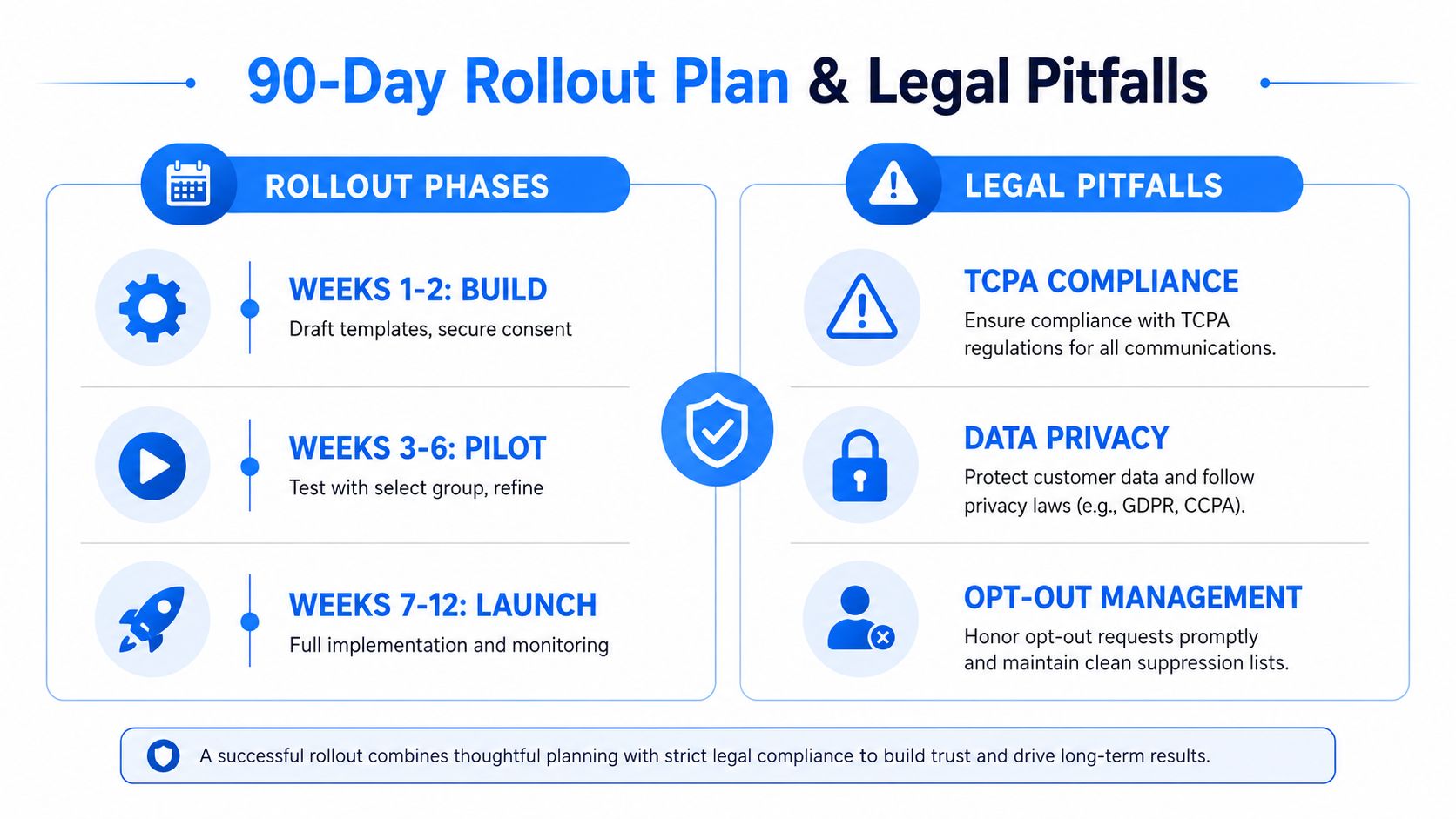
Consent records. Every opt-in should be traceable to a source, date, and audience. If a contact record can't show that, it's not ready for campaign use.
Message purpose. Emergency alerts, attendance nudges, fundraising, and staff notices should not all share the same list unless the consent language clearly allows it. Overreach is where trust breaks first.
Deliverability setup. Toll-free verification or 10DLC registration matters because schools can lose reach when carrier rules aren't handled correctly. If the platform hides that detail, the district usually pays for it later.
The other policy failures are usually predictable. Someone uses parent numbers for a fundraiser they never agreed to. Someone treats staff mobile numbers like a free internal broadcast list. Someone texts minors in a state that requires a more careful consent review. None of that is a copy problem, it's a governance problem.
The value of sms marketing for schools is not the text itself. It's whether the text changes a parent, student, or staff action at exactly the right moment, without violating trust to get there.
If you want a school messaging system that handles SMS, MMS, scheduled sends, segmentation, and ringless voicemail in one place, take a look at Call Loop. It's built for structured outreach where consent, timing, and deliverability all matter, which is exactly what school communication needs when the message has to move someone to act.
Chris Brisson
Chris is the co-founder and CEO at Call Loop. He is focused on marketing automation, growth hacker strategies, and creating duplicatable systems for growing a remote and bootstrapped company. Chat with him on X at @chrisbrisson


Trusted by over 45,000 people, organizations, and businesses like


