
See a Demo
You're just one step away from seeing Call Loop in action.
Enter your information below to watch a demo right now.

You're just one step away from seeing Call Loop in action.
Enter your information below to watch a demo right now.

Imagine having a direct line to your customers. One that cuts straight through the noise of social media and the clutter of packed email inboxes.
That's the real power behind SMS message campaigns. It's a strategy that puts timely, personal messages right onto the one device everyone checks constantly: their phone. This isn't just another marketing channel; it's how you create an immediate, personal connection that can actually scale.
In a world overflowing with digital noise, SMS (or Short Message Service) marketing gets your message seen like nothing else can. Don't think of it as just another marketing tactic. It's more like having a direct, one-on-one conversation with each person in your audience.
While emails can sit unopened for days, text messages are almost always opened within minutes. This gives you a unique chance to make an immediate impact.
This isn't about blasting out spammy, unwanted alerts, either. Real SMS message campaigns are built on two things: permission and value. From a local karate studio sending class reminders to an ecommerce store announcing a flash sale, the uses are endless. The common thread? Delivering the right information at the exact moment it matters most, which builds trust and gets people to act.
The numbers behind this channel are just staggering. The SMS marketing industry is on track to hit a massive $18.6 billion in the US alone by 2030. What's fueling this? Engagement metrics that are simply unmatched.
SMS has an average 98% open rate, and most of those messages are read within just a few minutes of being sent. Let's put that into perspective.
Here’s a quick look at how SMS stacks up against email, the old marketing standby.
| Metric | SMS Campaigns | Email Campaigns |
|---|---|---|
| Average Open Rate | 98% | 20-30% |
| Time to Open | Within 3 minutes | 2-3 hours (or never) |
| Click-Through Rate | 19% | 2-4% |
| Directness | Extremely high (direct to phone) | Low (sits in a crowded inbox) |
As you can see, for speed and getting eyes on your message, there's no contest. With over 5 billion people sending and receiving texts every day, it's the most widespread communication channel on the planet. You can explore more SMS marketing statistics to see the full picture.
An effective SMS campaign feels less like an advertisement and more like a helpful notification from a trusted source. It’s all about being personal, relevant, and timely.
But it’s not just about open rates; SMS drives real action. It’s a seriously powerful tool for:
The secret is to weave SMS into your wider communication strategy. It works incredibly well alongside other channels, like ringless voicemail, which lets you drop a personal audio message right into someone’s voicemail without their phone ringing. Combining tools like text messaging and ringless voicemail drops helps you create a deeper, more human connection that builds lasting relationships and really drives growth.
A great SMS campaign doesn't happen by accident. It's not about blasting a generic message and just hoping for the best. The real magic comes from a solid blueprint—a plan where every piece works together to send a message that feels personal, timely, and actually valuable to the person receiving it.
Think about it: sending the same text to your entire list is a one-way ticket to a high unsubscribe rate. Success starts when you stop treating your audience like a faceless crowd and start communicating with them like individuals, even when you're doing it at scale.
This is the simple, powerful flow you're aiming for. It’s all about turning that initial text into a real connection.
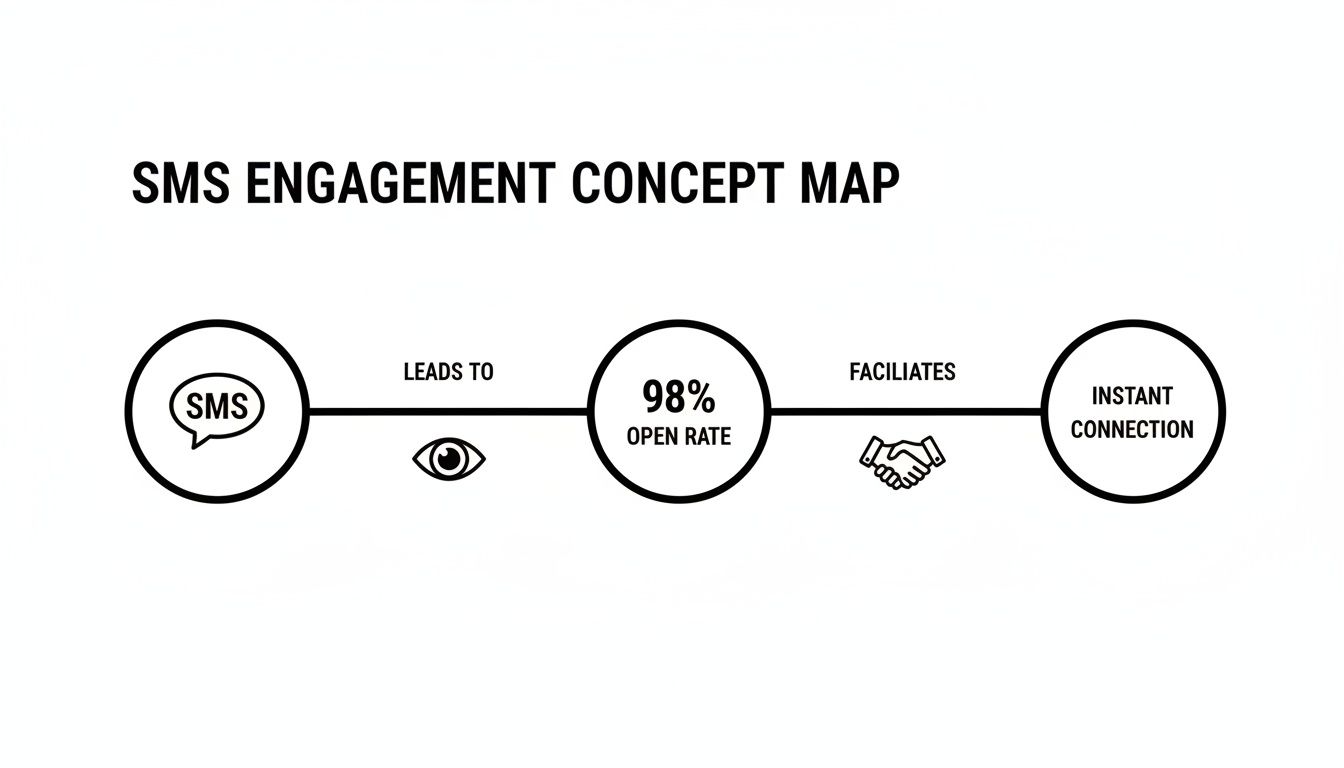
As you can see, that nearly perfect 98% open rate isn't just a vanity metric. It's your direct line to creating an immediate link with your audience.
First thing's first: audience segmentation. This is just a fancy way of saying you need to divide your contact list into smaller, more focused groups. It's like sorting your contacts so you can have conversations that actually make sense to them.
You can slice and dice your audience based on all kinds of data:
This targeted approach makes sure your texts always feel relevant, which dramatically boosts their impact and keeps people from opting out.
Once you’ve got your segments, it’s time for hyper-personalization. And no, I'm not just talking about using a [FirstName] merge tag. Real personalization means using the data you have to make every message feel like it was written just for one person.
A personalized message is a relevant message. When you reference a past purchase or an interest they've shown, you're telling the customer, "Hey, we're paying attention." That builds a ton of trust and gets people to act.
For an e-commerce store, this could be a text like, "Hey [FirstName], we saw you checking out the blue denim jacket. Good news—it's back in stock in your size!" That's not an annoying ad; that's a genuinely helpful update. With a platform that has merge tags and custom fields, automating this kind of thing is surprisingly simple.
With SMS, you’ve got about three seconds to get someone’s attention. Your copy has to be short, sharp, and have one crystal-clear call-to-action (CTA). Ditch the corporate jargon and just get to the point.
But words are only part of the equation. With MMS (Multimedia Messaging Service), you can send images, GIFs, and even short videos, which can seriously crank up engagement. A slick product photo or a fun GIF often says more than a paragraph of text ever could. Use it to show off new products, demo a feature, or just inject a little personality into your campaigns.
Here's where you put your personalization on autopilot. Automation workflows—sometimes called drip campaigns—are just pre-built sequences of messages that get sent automatically when a user does something specific.
Some of the most effective triggers are:
These triggered campaigns are absolute gold because they’re perfectly timed to where the customer is in their journey. You can even mix in other tools, like adding a ringless voicemail drop right into your workflow. It delivers a quick, personal audio message that helps you build an even more human connection, all without you having to lift a finger.
Jumping into SMS campaigns without knowing the rules is a bit like driving without a license—it's a massive risk your business just can't afford. The legal side of text messaging is strict, and for good reason. It’s all about protecting people from spam, and ignoring the rules can lead to eye-watering fines and serious damage to your brand.
In the United States, the big one you need to know is the Telephone Consumer Protection Act (TCPA). This federal law lays down the law for how businesses can text and call consumers. Getting this right is the absolute foundation of any SMS strategy that’s built to last.
The most important piece of TCPA compliance is getting express written consent before you fire off any marketing messages. This means you need clear, documented permission from every single person on your list. Just having their phone number doesn’t cut it; they have to explicitly agree to get promotional texts from you.
Think of it as a formal invitation. Your customers have to knowingly invite you into their most personal digital space—their text inbox.
The TCPA isn't a friendly suggestion; it's a hard-and-fast rule. A single text that breaks the rules can cost you $500 to $1,500 per message. If you have a big list, that kind of penalty can be catastrophic.
To build a clean, compliant list, a double opt-in process is your best friend. It’s a simple two-step dance:
This two-step confirmation creates a rock-solid record of their consent. It protects your business and makes sure your list is packed with people who actually want to hear from you.
Once you have consent, every message you send has to follow a few non-negotiable rules. This isn't just about dodging legal bullets; it’s about building trust and keeping a healthy relationship with your audience.
These are all vital for running responsible and effective SMS message campaigns. For a deeper look at the carrier-specific rules, you can learn more about 10DLC compliance and see how it affects your deliverability.
Compliance isn't just a legal thing; it's also directly connected to technical deliverability. Mobile carriers have filters that are designed to block messages that look like spam. If you follow the best practices, you give your texts the best possible chance of hitting the inbox.
First, get the right kind of number. A 10-digit long code (10DLC) is the new industry standard for business texting. It gives you better deliverability and higher sending speeds than the old-school shared short codes.
Next, keep your list squeaky clean. Use a list validation service to check your contacts and remove any invalid or dead numbers. This cuts down on bounce rates, saves you money, and shows carriers you're a legitimate sender.
Finally, write copy that doesn’t scream "spam!" Stay away from using ALL CAPS, a ton of symbols, or cheesy phrases like "FREE MONEY" or "100% GUARANTEED." Your best bet for hitting the inbox every time is to send thoughtful, valuable content that people actually want to read.
Alright, so you get the theory behind SMS message campaigns. Now, let's get practical. Knowing the "what" and "why" is one thing, but actually putting these ideas to work is what really matters. It's time to move from concepts to a playbook of proven strategies you can adapt for your business, whether you're trying to drive sales, slash no-shows, or get more people to your events.
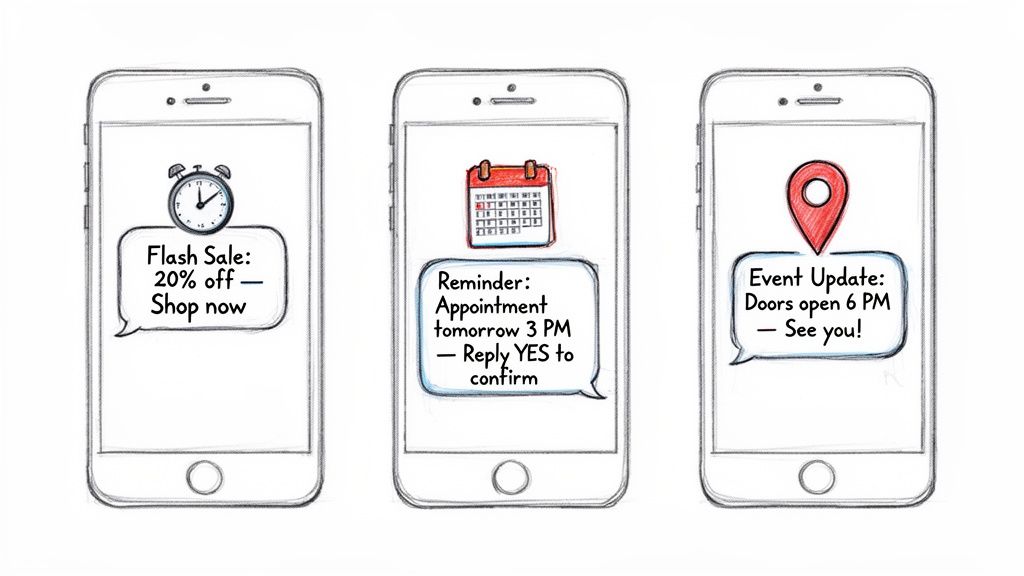
The power here is undeniable. Text messaging campaigns are rewriting the marketing rulebook, with incredible 90-98% open rates. Better yet, 90% of messages are read within three minutes—a speed other channels just can't touch. For small businesses, sales teams, and healthcare pros, 73% are seeing real revenue growth from higher order values and better loyalty. With 75% of marketers planning to keep or even increase their SMS budget, it’s obvious this is a channel you can't afford to ignore.
One of the best ways to use SMS is to create a sense of urgency that gets people to act right now. Flash sales are perfect for this, but your message has to be just right.
Let's look at a classic flash sale template:
Why It Works: This message is a direct response goldmine. It's personal, identifies the sender, creates real urgency with "4 hours ONLY," and gives a dead-simple call-to-action (CTA).
If you run a service business—a salon, a dental office, you name it—no-shows are a silent revenue killer. Automated SMS appointment reminders are a simple and incredibly effective fix.
Here’s a standard two-part reminder sequence that just works:
This one-two punch drastically cuts down the odds of a client simply forgetting. It’s a tiny effort that protects your schedule and delivers a huge return.
You can't send texts if you don't have a list. One of the best ways to grow your subscriber base is with "text-to-join" keywords. It's a simple way for people to opt-in from anywhere.
Imagine you're a restaurant owner. You could put a small sign on each table that says:
"Text DEALS to 555-555-5555 to join our VIP Club and get a free appetizer on your next visit!"
This method is so powerful because it grabs people when their interest is at its peak. It’s immediate, requires almost no effort, and gives instant value—the perfect recipe for growing your list.
Many core campaign strategies are consistent no matter the channel. For example, you can learn how to build B2B lead nurture campaigns that convert and then apply those same ideas about sequencing and value directly to your SMS approach.
A smart SMS strategy can also pull in other message types for a richer experience. This is where a tool like ringless voicemail comes in. A ringless voicemail drop lets you send a pre-recorded audio message straight to someone's voicemail without their phone ringing. You could follow up a flash sale text with a personal voicemail from the founder, adding a human touch that deepens the connection and makes your brand stand out. These layered strategies are what turn simple SMS message campaigns into real growth engines.
Look, SMS message campaigns are a powerhouse. No question about it. But the smartest marketers know that relying on just one channel is like trying to build a house with only a hammer. To really build deep connections, you need to layer in other tools, and one of the most personal and effective additions is voice.
Adding voice-based tools helps you cut right through all the digital clutter. There's something about hearing a human voice that text alone can't replicate. It makes your message stick and feels far more personal.
One of the best ways to do this is with ringless voicemail. It's a clever piece of tech that lets you drop a pre-recorded audio message straight into someone's voicemail without their phone ever ringing. This is the secret sauce for adding a personal touch that doesn't feel intrusive.
Think of it as a respectful tap on the shoulder. You’re delivering your message without blowing up their phone during a meeting or family dinner. They can listen whenever it works for them.
This makes it perfect for things like:
Ringless voicemail gives you the scale of automation but with the personal impact of a real human voice. It’s an incredible way to stand out and make your brand feel more authentic and approachable.
Another fantastic tool is voice broadcasting. This lets you send an automated voice call to a huge list of people all at once. But it's more than just a recording; you can make these calls interactive. Think "press 1 to speak with an agent" or "press 2 to confirm you'll be there."
This is your go-to for time-sensitive news or anything critical where you need to get an immediate response. It’s ideal for emergency alerts, last-minute event changes, or important community-wide announcements. You can get a deeper dive into the tech by exploring what is ringless voicemail and how it all works.
The real magic happens when you start combining these tools. Stop thinking "SMS vs. voice" and start thinking "SMS and voice." When you weave them together, you create a seamless, automated journey for your customer that truly makes an impact.
Imagine setting up an automated sequence like this:
This layered approach doesn't feel like spam; it feels like a thoughtful, guided experience. By strategically combining SMS, ringless voicemail, and even voice broadcasts, your SMS message campaigns go from being simple pings to a sophisticated communication engine that gets real results.
You can’t improve what you don’t measure. Launching an SMS campaign without tracking it is like shooting arrows in the dark—you have no idea if you’re even hitting the target, let alone the bullseye.
Let's walk through the key numbers that show you what’s really going on with your campaigns and how to turn that data into real, measurable growth.
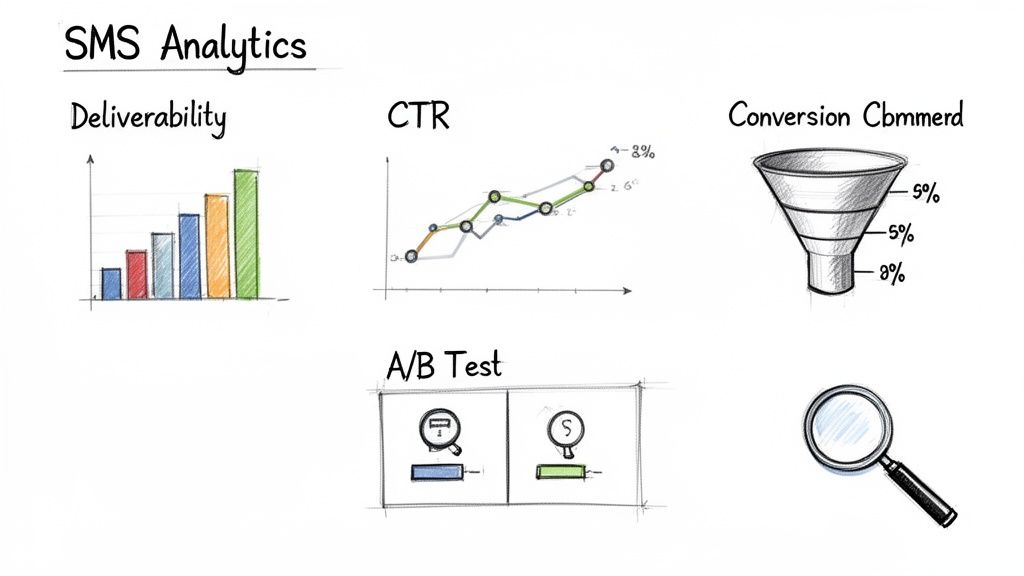
To really understand what's working, you need to know which numbers to watch. These are the core metrics that tell the true story of your SMS efforts.
These numbers don't live in a vacuum; they tell a story together. For instance, a high CTR but a low conversion rate suggests your text was compelling, but your landing page dropped the ball. Getting good at reading this data is fundamental for measuring marketing campaign effectiveness.
Once you know your baseline numbers, it’s time to start making them better. A/B testing, also known as split testing, is your best friend for this. It’s a straightforward process: you create two versions of a message, send them to two different small groups in your audience, and see which one gets better results.
A/B testing takes the guesswork out of your strategy. Instead of wondering what works, you let your audience tell you directly with their actions.
You can test just about anything, but the trick is to only change one thing at a time. Otherwise, you won't know what actually caused the change in performance.
Here are a few common things to test:
At the end of the day, it's all about making sure your efforts are paying off. A huge part of optimization is learning how to calculate Marketing ROI to prove that your SMS budget is money well spent. This connects your texting activity directly to the bottom line.
This is where automation really shines. For example, did you know that automated, behavior-triggered SMS flows generate a massive 45.2% of all SMS revenue, even though they only make up 7.6% of total sends?
It's true. These automated messages get click rates near 10% and conversion rates that can hit 21-30%. It’s proof that sending a timely, relevant message is the most powerful thing you do.
As you get ready to jump into SMS message campaigns, you're going to have some questions. It's a powerful channel, and you want to make sure you start off on the right foot. Here are some straightforward answers to the most common questions we get.
Timing is huge in SMS. The "perfect" time always depends on your specific audience, but looking at data from billions of messages, we've found a sweet spot. The best window for most promotional texts is between 4 p.m. and 7 p.m. You’re catching people as they wind down from work and are more likely to be glancing at their phones.
If you're aiming for immediate action, like clicks and replies, the early afternoon from 12 p.m. to 3 p.m. is another prime time. As for days, Monday and Tuesday usually perform best as people are getting organized for the week.
Absolutely. In fact, you should. The most successful marketing doesn't put all its eggs in one basket. A great play is to mix your SMS with other channels to create a more memorable experience for your customers.
For example, use SMS for a quick, time-sensitive alert, and then follow it up with a ringless voicemail. Dropping a personal audio message right into their voicemail adds a human touch that a simple text can't match. This one-two punch helps your brand stick and builds a much stronger connection.
The cost for SMS message campaigns can vary. It really depends on the platform you choose, how many messages you're sending, and the type of number you’re using (like a 10DLC or Toll-Free number). Most services will either charge you per message or offer monthly plans with a bundle of credits.
But don't just look at the cost per message—think about the ROI. SMS has such high engagement and conversion rates that the return you get, especially for things like appointment reminders or flash sale alerts, almost always outweighs the initial investment.
Finding the right send frequency is a bit of a balancing act. You want to stay on their radar without becoming a nuisance. For most businesses, sending one to two messages per week is a solid starting point.
But always let your goals be your guide. If you’re running a big sale, an announcement text plus a "last chance" reminder makes perfect sense. For your most loyal VIPs, you might get away with sending more frequent, exclusive deals. The real key is to make sure every single message delivers value. When you do that, it feels like a welcome update, not an interruption.
Ready to create SMS and voice campaigns that get results? With Call Loop, you can easily automate personalized SMS, ringless voicemail, and voice broadcast campaigns to connect with your audience. Start your free trial today and see the difference it makes.
Chris Brisson
Chris is the co-founder and CEO at Call Loop. He is focused on marketing automation, growth hacker strategies, and creating duplicatable systems for growing a remote and bootstrapped company. Chat with him on X at @chrisbrisson


Trusted by over 45,000 people, organizations, and businesses like


