
See a Demo
You're just one step away from seeing Call Loop in action.
Enter your information below to watch a demo right now.

You're just one step away from seeing Call Loop in action.
Enter your information below to watch a demo right now.

Text message marketing is your small business's secret weapon. It’s a direct, powerful way to communicate that cuts right through the digital clutter we all deal with every day. It uses the one device your customers always have with them—their phone—to deliver messages they'll actually see, usually within minutes. This makes it one of the absolute best ways to get people to act now.
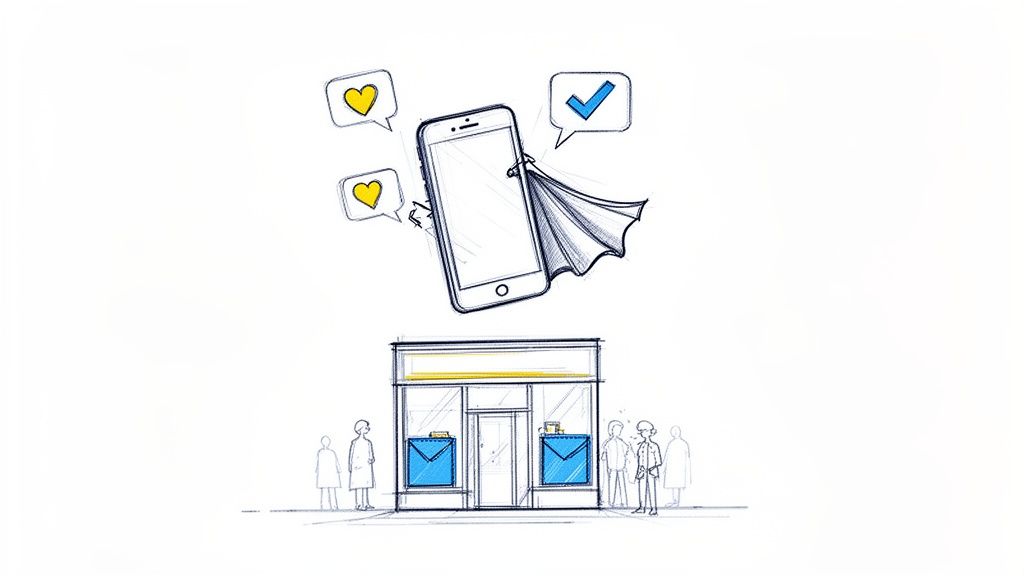
Think about it this way: if you had an urgent message for a friend, would you send an email and cross your fingers? Or would you shoot them a quick text you know they'll see almost instantly? That’s the simple logic behind text message marketing for small businesses. It’s your direct line, letting you bypass jam-packed email inboxes and noisy social feeds where your updates get buried.
Unlike giant corporations with endless ad budgets, small businesses run on personal connections. SMS gives you a real advantage by putting your message in the most personal digital space someone has: their text inbox. This is where conversations with friends and family happen. When you use it respectfully, you can build incredible loyalty and drive sales right away.
The real magic of SMS is its speed. While emails can sit unread for days, most text messages are read within just three minutes of being delivered. That kind of immediacy is a game-changer for time-sensitive offers and important updates.
Just imagine how that speed could work for you:
SMS isn't just another marketing channel; it's a conversation starter. It allows for genuine two-way communication, turning a broadcast message into a personal interaction that builds trust and strengthens customer relationships.
So, how does texting really stack up against the old standby, email? While email is great for longer-form content and newsletters, SMS wins hands-down for speed and attention. Here’s a quick comparison:
The numbers don't lie. For getting a message seen and acted on quickly, nothing beats a text.
But modern outreach isn't just about sending a basic text anymore. A fantastic partner to SMS is ringless voicemail, a tool that drops a pre-recorded audio message straight into a customer's voicemail without making their phone ring. It’s a non-intrusive way to add a personal, human touch that a simple text can't always convey. Other related terms you might hear are voicemail drops or voice broadcasting, which all refer to this direct-to-voicemail technology.
For example, you could send an SMS about a special offer and follow it up with a warm, friendly ringless voicemail from you, the owner, inviting them to check it out. This multi-channel approach combines the punchy efficiency of a text with the personal connection of your voice, creating a much more memorable experience.
And the data backs this up. A huge 63% of all businesses using SMS are small and medium-sized businesses (SMBs), because 58% of consumers say it's the most effective way for brands to reach them. If you want to dive deeper, check out these insightful text messaging statistics and facts.
Jumping into text marketing without understanding the rules is like trying to build a house without a foundation. Sure, the excitement of direct customer access is huge, but it comes with a serious responsibility to respect privacy and follow the law. Get it wrong, and you're looking at hefty fines and, worse, a total loss of customer trust.
The big one you need to know is the Telephone Consumer Protection Act (TCPA). Think of it as the rulebook that makes sure you're a welcome guest in your customers' inboxes, not an unwanted pest. Its main principle is simple but absolutely non-negotiable: you must have permission before you send marketing texts.
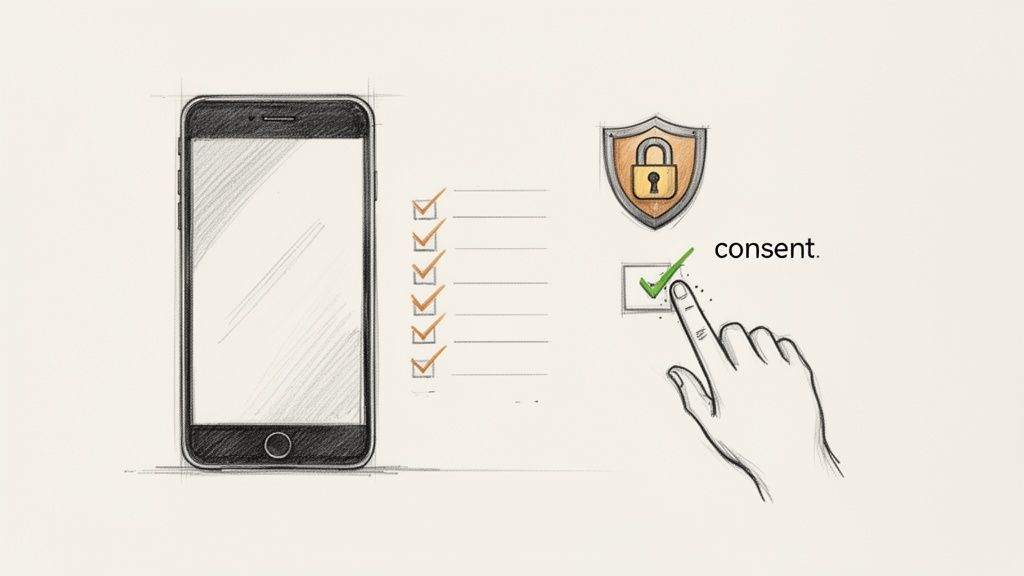
Under the TCPA, you need express written consent before sending any promotional messages. Now, "written" doesn't mean you need a physical, signed piece of paper. It just means you need a clear, documented record showing a customer explicitly agreed to get marketing texts from you.
This is the most critical piece of your entire text marketing strategy. Without it, you're exposed to some serious legal risk—we're talking fines up to $1,500 per text.
So, what does real, valid consent look like? It has to be crystal clear. The customer must knowingly and obviously agree to receive marketing messages. Here are a few solid, compliant ways to get that permission:
The key takeaway here is that consent has to be specific and affirmative. You can't just assume permission because someone gave you their phone number for a delivery or an appointment.
Getting permission is step one, but giving people an easy way out is just as important. Every single text campaign you send must include clear instructions on how to opt-out. Usually, this is as simple as replying with a keyword like "STOP" or "UNSUBSCRIBE."
When someone opts out, your system has to honor that request immediately and automatically. A good platform handles this for you, removing them from all your marketing lists so you don't send them another message by accident. Handling opt-outs gracefully is a cornerstone of building a trustworthy text message marketing for small businesses program. To dive deeper, you can learn more about how to create a perfect text message opt-in process.
Getting consent is only half the battle; you also have to make sure your texts actually show up. Mobile carriers use sophisticated filters to block spam, and if your messages look shady, all your work will be for nothing. High deliverability just means your texts consistently land in your subscribers' inboxes.
Here’s how to stay out of the spam folder and in your customers' good graces:
Alright, you understand the rules of the road. Now it's time to get your hands dirty and actually start sending messages. This is the fun part! Crafting your first campaign might feel like a big deal, but it's simpler than you think. Whether you're announcing a sale, confirming an appointment, or just saying hello, the right message gets instant results.
The most important thing to remember is the medium you're using. Text messages are short, direct, and personal. So, your campaigns need to be the same: concise, valuable, and with a crystal-clear call to action.
Every text that gets a great response has a few key ingredients. Think of it as a simple recipe for getting your customers to act. Nail these four things, and your message will be clear, compliant, and compelling.
A great text message feels less like an advertisement and more like a helpful tip from a friend. Keep it personal, make it valuable, and always respect the direct line you have to your customer.
Getting started is always easier when you have a few examples to work from. Here are some proven templates you can tweak and use for your own small business today.
For Retail & E-commerce (Flash Sale):"Hi from [Your Shop Name]! Our 24-hour flash sale is LIVE. Get 30% OFF everything online with code FLASH30. Shop now before it's gone: [Short Link]. Reply STOP to opt out."
For Salons & Spas (Appointment Reminder):"Hi [Client Name], just a friendly reminder of your appointment at [Your Salon Name] tomorrow, [Date], at [Time]. Please reply YES to confirm or call us to reschedule. See you soon! Txt STOP 2 end."
For Studios & Gyms (Class Reminder):"Ready to sweat? Your [Class Name] class at [Your Studio] is today at [Time]. We can't wait to see you on the mat! Reply STOP to unsubscribe."
These are just a jumping-off point. The best text message marketing for small businesses comes from tailoring your messages to fit your brand’s unique voice and what your customers actually want to hear.
While SMS is king for quick, punchy messages, sometimes you need a bit more humanity. This is where ringless voicemail comes in. It lets you deliver a pre-recorded audio message straight to someone's voicemail inbox without their phone ever ringing. Also known as a voicemail drop, it's a powerful technique because it’s not intrusive. Your customer can listen whenever it's convenient for them. Hearing your actual voice—or a team member's—creates a much stronger, more human connection than text alone ever could. It's perfect for a heartfelt thank you, a special announcement, or any follow-up that could use a little more warmth.
The real magic happens when you use these two channels together. Imagine sending a text with a special offer, and then a few hours later, your customer gets a ringless voicemail drop from you personally inviting them to check it out. That one-two punch is incredibly hard to ignore.
Here’s a simple way to combine them:
This strategy gives you the best of both worlds: the immediacy of text and the personal connection of voice. Your campaigns will be far more memorable and much more effective.
To give you a better idea of how this works in the real world, check out this table. It shows how different types of businesses can combine SMS and ringless voicemail to get great results.
As you can see, the text handles the immediate information, while the voicemail adds a layer of personality and reinforces the message. It's a simple, powerful way to stand out.
Sending one-off texts for flash sales is a great start, but the real magic of text message marketing for small businesses happens when you put it on autopilot. Think of it like a sprinkler system for your customer relationships—it waters your leads and customers at the perfect intervals, so you don't have to stand there with the hose every day. That's exactly what automated drip campaigns do.
These campaigns are just a series of pre-written messages that automatically go out to a subscriber based on a specific trigger. That trigger could be anything: a customer signing up for your list, their birthday, or the anniversary of their first purchase. This "set it and forget it" approach makes sure every new contact gets a consistent, welcoming experience, gently guiding them toward becoming a loyal customer.
A welcome series is the perfect place to start with automation. It's your chance to make a fantastic first impression right when a customer's interest is at its peak. This simple sequence introduces new subscribers to your brand, sets expectations, and usually drops an immediate incentive to get them to buy.
Let’s walk through a simple but powerful welcome series that mixes the speed of SMS with the personal touch of a ringless voicemail.
Message 1 (Immediate SMS): The second someone signs up, a text should hit their phone. This confirms their subscription and delivers whatever you promised them.
Message 2 (Ringless Voicemail - 24 hours later): Time to add a human element. A day later, a friendly, pre-recorded message from you—the owner—can be dropped right into their voicemail without their phone ever ringing.
Message 3 (Follow-up SMS - 3 days later): A gentle nudge can create a little urgency and remind them to use their offer before it disappears.
This three-part sequence works around the clock to turn new leads into customers, saving you a ton of time while making every new subscriber feel like a VIP. If you want to dive deeper into how these sequences are built, you can find more examples of a marketing automation workflow.
This visual breaks down how simple it is to get your automated campaigns up and running.
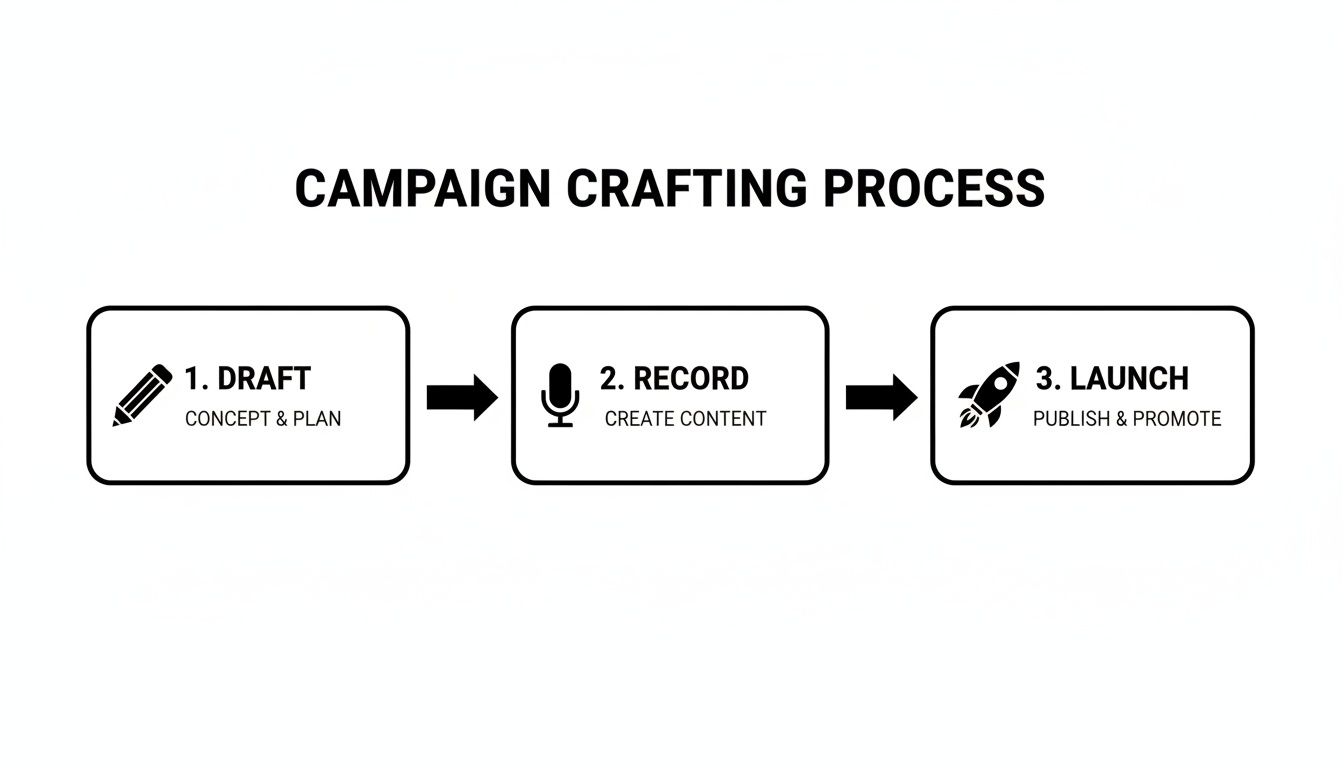
As you can see, it's really just three steps: draft your content, record any audio bits like your ringless voicemail, and hit launch.
Automation gets even more powerful when your messaging platform can talk to the other tools you already use, like your CRM or e-commerce software. This creates a connected system where data flows automatically, triggering messages based on what your customers are actually doing.
For example, you could hook your messaging tool up to your Shopify store. When a customer buys something, it could automatically fire off a thank-you text. If they ditch their cart, it could send a reminder an hour later. These connections transform your marketing from a bunch of manual tasks into a smart, self-running machine.
Think of automation as building a team of digital assistants. They handle the repetitive follow-ups, reminders, and welcome messages, freeing you up to focus on running your business and serving your customers.
As you start planning your campaigns, picking the right tech is a big deal. Take some time to explore the best marketing automation tools for small businesses and find a platform that plays nicely with your existing systems. That’s the key to scaling your marketing without adding more to your to-do list.
Sending out text campaigns without tracking your results is like trying to navigate a new city without a map. Sure, you're moving, but are you even headed in the right direction? To make smart, data-driven decisions, you have to measure what's working, what's not, and how it all connects back to your bottom line.
This is where Key Performance Indicators (KPIs) come in. Think of them as the vital signs for your marketing. By watching just a few key numbers, you can get a crystal-clear picture of your campaign’s health and find ways to make every single message better.
When you're looking at the success of your text message marketing, it's crucial to understand the most impactful marketing metrics to monitor. For SMS, you can zero in on a handful of metrics that tell you the whole story, from delivery all the way to conversion.
Here are the core KPIs you should always have your eyes on:
By looking at these metrics together, you can start to diagnose your campaign's performance. For instance, a high delivery rate but a low CTR tells you the message is reaching people, but the content just isn't compelling enough to get that click. That’s your cue to sharpen your offer or write a stronger call-to-action.
Beyond clicks and opens, the most important question is pretty simple: is your marketing actually making you money? Calculating the Return on Investment (ROI) for your SMS campaigns is surprisingly straightforward, and it’s the best way to prove the value of your efforts.
You can use a simple formula to see exactly what you're getting back for every dollar spent.
ROI Formula: (Revenue Gained from Campaign - Campaign Cost) / Campaign Cost
Let's walk through an example. Say you spent $50 on a campaign sent to 1,000 subscribers, and that campaign brought in $500 in sales.
Here’s how the math breaks down:
($500 - $50) / $50 = 9
To turn that into a percentage, just multiply by 100. That gives you an ROI of 900%. In other words, you earned $9 for every $1 you invested. Not bad at all. For a deeper dive, check out our guide on measuring marketing campaign effectiveness.
The ROI from SMS can be absolutely incredible, especially for small businesses working with tight budgets.
Because the cost per message is so low—we're talking just a few cents—even a handful of conversions can lead to a massive return. This low-cost, high-reward dynamic is one of the core strengths of text message marketing for small businesses.
The numbers often speak for themselves. It’s not unheard of for businesses to see returns as high as $71 for every $1 spent on SMS. That’s a staggering 7,100% ROI. When you consider that some SMS campaigns see conversion rates averaging 45%, it's clear just how powerful this channel is compared to others.
Even with the best game plan, jumping into something new always brings up a few last-minute questions. Let's walk through the most common ones we hear from small business owners so you can get started with total confidence.
This is the big one, and the rule is simple: you absolutely must get express written consent before you send a single marketing text. This isn’t just a good idea; it's the law under TCPA regulations, and it's non-negotiable.
Consent has to be crystal clear. Your customers need to know exactly what they’re signing up for. The best ways to do this are pretty straightforward:
Whatever you do, never buy a list of phone numbers or add people without their direct permission. It’s illegal, and it’s the fastest way to destroy the trust you're trying to build.
Think of these as different tools in your toolbox. Each has its own job, and they work best when you mix and match them to create a great customer experience.
Absolutely. This is actually one of the biggest draws of text message marketing for small businesses. Compared to the money you can sink into social media or Google ads, the cost per message is incredibly low—we’re talking just a few cents.
With open rates hitting as high as 98% and solid conversion rates, your return on investment can be huge. You can start with a tiny, targeted campaign, see what works, and only spend more when you've proven the ROI. It’s a low-risk, high-reward channel that’s perfect for any budget.
This approach lets you test different offers and messages without a big upfront financial gamble. You find out what your audience loves and then simply do more of that.
Finding the right balance is all about providing value without being annoying. There's no magic number that works for everyone, but a good starting point is to focus on quality, not quantity.
For promotions like sales and special offers, shooting for 2-4 messages per month is usually a safe bet. It keeps your business on their mind without clogging up their inbox.
Of course, transactional messages are a different story. Things like these should be sent whenever they're needed:
The key is to set expectations right when people sign up. Let them know what to expect and how often. And always keep an eye on your unsubscribe rate. If it suddenly spikes, that’s your audience telling you to pull back a bit. The goal is to be a welcome guest, not a pest.
Ready to harness the power of direct, personal, and automated outreach? Call Loop provides all the tools you need—from SMS and MMS to ringless voicemail and automated drip campaigns—to build stronger customer relationships and drive real growth.
Chris Brisson
Chris is the co-founder and CEO at Call Loop. He is focused on marketing automation, growth hacker strategies, and creating duplicatable systems for growing a remote and bootstrapped company. Chat with him on X at @chrisbrisson


Trusted by over 45,000 people, organizations, and businesses like


