
See a Demo
You're just one step away from seeing Call Loop in action.
Enter your information below to watch a demo right now.

You're just one step away from seeing Call Loop in action.
Enter your information below to watch a demo right now.

So, you're wondering if you can text from a different number. The short answer is yes, and if you’re running a business, you absolutely should be. Using a platform like Call Loop lets you grab a dedicated local or toll-free number. This keeps your personal number out of the mix and gives you access to a whole suite of professional tools.
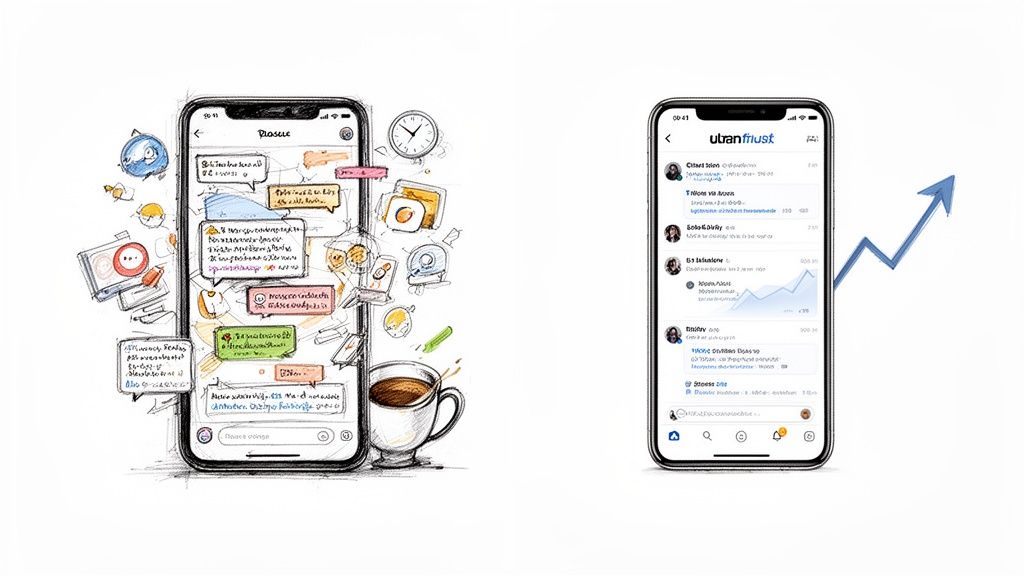
If you’re still texting customers from your personal cell, you know the drill. It’s a mess of missed messages, zero work-life balance, and an unprofessional look that can hurt your brand. Getting a dedicated number isn't just a nice-to-have; it's a game-changer for how you operate and how customers see you.
This one move instantly makes you look more professional. When texts come from a consistent business number, it builds trust. Think about it: a local contractor confirming an appointment from a local number feels right. A national brand using a toll-free number looks established.
The biggest win? Getting your personal life back. When business texts aren't blowing up your phone at all hours, you can actually switch off. This isn't just about avoiding burnout; it’s about being fully present during work and fully disconnected after.
It also streamlines things for your whole team. Instead of messages scattered across everyone's personal phones, everything is tracked in one central place. No more leads slipping through the cracks or customers left waiting.
A dedicated number transforms customer communication from a scattered, personal effort into a structured, scalable business system. It’s the first step toward building a professional messaging strategy that can grow with your company.
A dedicated business number is your key to unlocking powerful tools you just can't get on a personal phone. Suddenly, you can schedule mass texts, automate replies, and see exactly who’s opening and clicking your messages.
Just look at what you can do:
You can even take it a step further. Many businesses are now using an AI text message responder to provide instant support over SMS. If you want to dig deeper into the process, we have a whole guide on how to buy a phone number for your business.
The SMS marketing world is exploding. Projections show the global market hitting anywhere from $9.96 billion to $38.4 billion by 2030, with a massive compound annual growth rate of 20.8%. For small businesses, healthcare, and e-commerce, texting is no longer optional—it's a core part of a modern growth strategy.
Not all business numbers are created equal. When you're sending texts from a number that isn't your personal cell, the type you pick says a lot about your brand. It directly affects how customers see you, how many messages you can send, and what it’s going to cost you.
Getting this choice right is foundational. It sets the stage for your entire communication strategy. Let's break down the main options—local numbers, toll-free, and dedicated short codes—with some real-world scenarios to help you pick the perfect fit for your business.
10-Digit Long Codes (10DLC) are just standard, 10-digit local phone numbers. These have become the workhorses of business texting, especially for companies that want to build a real community presence and have actual two-way conversations with customers.
Imagine you're a local HVAC company. If you send an appointment reminder from a number with a familiar local area code, it just feels right. It’s personal, not like a blast from some faceless corporation miles away. This is the real magic of 10DLC; it makes your business feel accessible, like a neighbor.
The true power of a local number is its ability to feel human. It’s perfect for personalized, conversational messaging like appointment scheduling, asking for customer feedback, and direct sales follow-ups.
This approach is a no-brainer for service-based businesses, real estate agents, healthcare clinics, and anyone where building a one-on-one relationship is the goal. The message throughput is designed for a conversational pace, not for massive, simultaneous blasts. If you want to get into the nitty-gritty, you can learn more about what a DID number is and how these local lines work behind the scenes.
If your business operates on a national scale, a toll-free number (like an 888, 877, or 866 number) is probably your best bet. These numbers are instantly recognizable and give off the vibe of a larger, more established company. Plus, they're free for customers to call or text, which removes any friction.
Think about an e-commerce brand that ships all over the country. Using a toll-free number for customer support and promotional alerts makes perfect sense. It creates a single, consistent point of contact for every customer, no matter what state they're in. They also have a higher message throughput than 10DLC, so they're solid for larger marketing campaigns.
Toll-free numbers are also fantastic for integrating your communication channels. You can advertise one number for both voice calls and text support, which really simplifies your marketing. This versatility makes them a go-to choice for:
When you absolutely have to send a massive volume of texts in a very short amount of time, a dedicated short code is the undisputed king. These are the 5 to 6-digit numbers (like 55555) that you see big brands lease for their exclusive use. They offer the highest possible messaging speed and deliverability, period.
Picture a major brand running a Super Bowl commercial with a "Text WIN to 55555" call to action. They need to handle hundreds of thousands of messages in minutes. A 10DLC or even a toll-free number would completely buckle under that load. A short code is built for exactly this kind of high-speed, high-volume traffic.
But all that power comes with a hefty price tag and a lengthy carrier approval process. Short codes are a serious investment, typically reserved for large enterprises with huge marketing budgets and a clear need for that kind of throughput.
To make the decision a little easier, here's a side-by-side look at how these number types stack up. Think about your specific use case, expected volume, and budget to see which one makes the most sense.
| Number Type | Best For | Message Throughput | Key Advantage |
|---|---|---|---|
| Local (10DLC) | Conversational, localized messaging; building trust. | Lower (Regulated) | Feels personal and community-focused. |
| Toll-Free | Nationwide customer support and marketing. | Medium-High | Professional look, free for customers. |
| Short Code | High-volume, time-sensitive mass marketing. | Very High | Maximum speed and deliverability. |
Ultimately, there's no single "best" number—only the best number for your business goals. A local service business and a national retailer have completely different needs, and their choice of number should reflect that.
So you’ve picked the right kind of number for your business. Now comes the fun part: getting it set up. With a modern messaging platform, this is way more straightforward than you might think. Getting your new number ready for prime time involves a few key moves to make sure your texts look professional, stay compliant, and actually land in your customers' inboxes.
First up is provisioning a number. That’s just the industry term for claiming a new phone number through your platform of choice. It's often as simple as plugging in an area code to find a local 10DLC number or picking from a list of available toll-free options. In just a few minutes, you’ll have a brand-new number ready to roll.
If you went with a local 10-digit number, your next and most critical step is A2P 10DLC registration. "A2P" simply stands for "Application-to-Person," and this registration process is how you officially tell mobile carriers like Verizon and T-Mobile that you're a legitimate business sending messages people actually want—not a spammer.
Let me be clear: this is non-negotiable. If you skip this, your messages will get hit with slow delivery speeds, aggressive filtering, and you risk getting blocked entirely. Think of it like a business license for texting. It validates your operation and clears the path for your messages.
A2P 10DLC registration isn't just bureaucratic red tape; it's your express lane to better deliverability. It's the system that separates professional business messaging from unwanted spam, and completing it is crucial for any serious texting strategy.
The good news is that platforms like Call Loop walk you through the entire thing. You'll give them some basic info about your business and your texting plans, and the platform handles all the heavy lifting with The Campaign Registry, which is the central hub for A2P 10DLC.
This infographic breaks down how that initial choice of number type guides the rest of your setup.
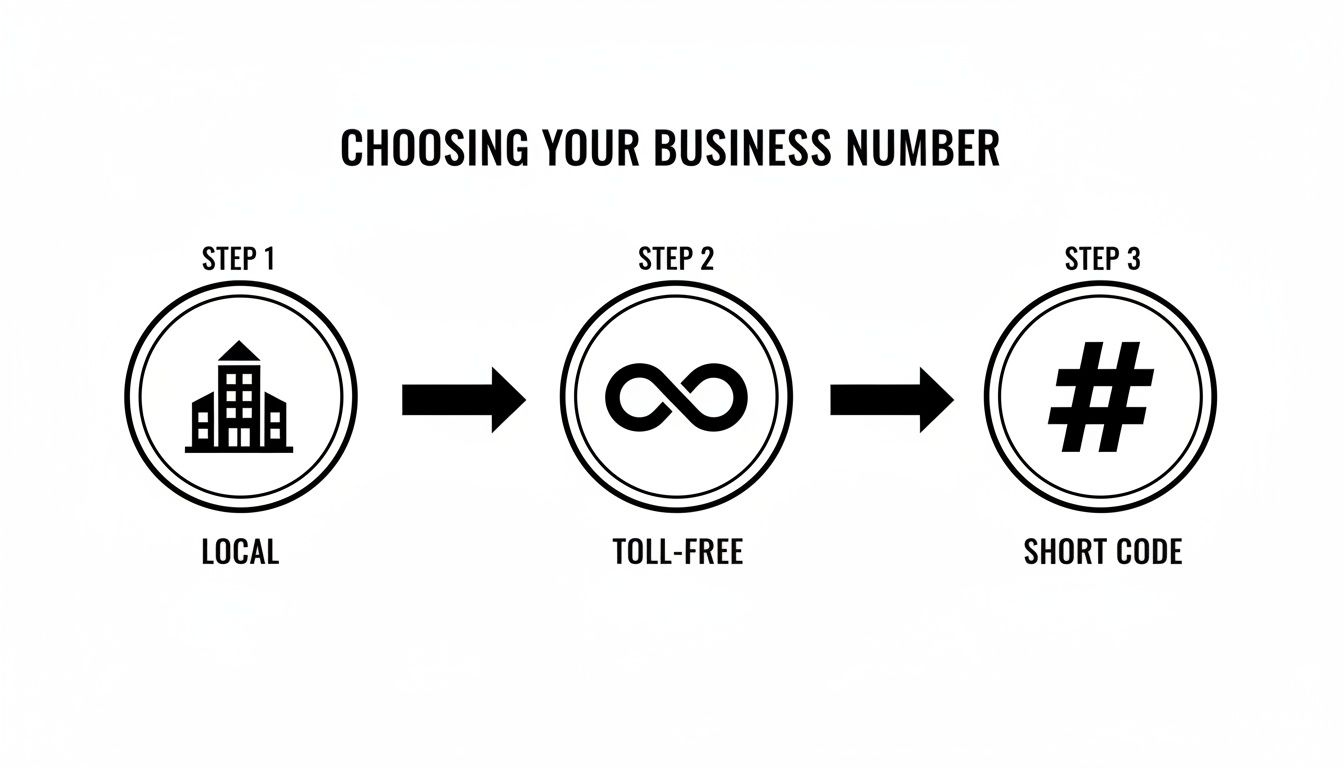
As you can see, whether you pick a local, toll-free, or short code number is the foundational decision that dictates all the setup and compliance steps that follow.
Once your number is secured, you’ll want to configure your Custom Caller ID. This is what lets you decide which number shows up when you send a text or make a call through the platform. For SMS, you’ll set this to your newly provisioned number.
If you’re also using voice calls or ringless voicemail, you can set the caller ID to that same dedicated number or another existing business line. Consistency is everything here. When a customer gets a text and then a call from the same number they recognize, it builds trust and reinforces your brand. An unknown or blocked number? That’s an instant ignore.
A consistent Caller ID is a game-changer because it delivers:
While you’re getting set up, there’s a whole carrier vetting process happening behind the scenes. This is where your messaging platform works directly with the mobile carriers to get your brand and campaigns approved. The carriers need to know who you are, what you’re sending, and that you have permission from your contacts.
Honestly, this process is a huge reason why you want a professional platform in your corner. Trying to navigate carrier compliance by yourself is a nightmare of technical jargon and red tape. A platform like Call Loop handles all of that for you.
They take care of the technical submissions and make sure your campaigns play by the carriers' rules, which is what ultimately ensures your texts get delivered. This background work saves you tons of time and prevents the costly mistake of getting your number blacklisted. It's a small investment upfront for a massive payoff, especially when you consider the power of this channel. SMS open rates are between 90% and 98%, with response rates averaging 45%—a figure that is 7.5 times more effective than email. You can explore more about why SMS marketing continues to dominate other channels.
Having a dedicated business number is a great start, but it's just that—a start. The real breakthroughs happen when you start stacking your communication tools. While texting from a different number is a massive upgrade, the secret to building a powerful outreach strategy is combining SMS with tools like ringless voicemail and voice broadcasts.
This multi-channel approach lets you connect with your audience in different ways, which naturally boosts engagement and your response rates. Instead of hitting them with the same message on the same channel, you can create a smarter customer journey. If a text doesn't land, an automated follow-up can go out on a different channel. You get your message across without being repetitive or, worse, annoying.
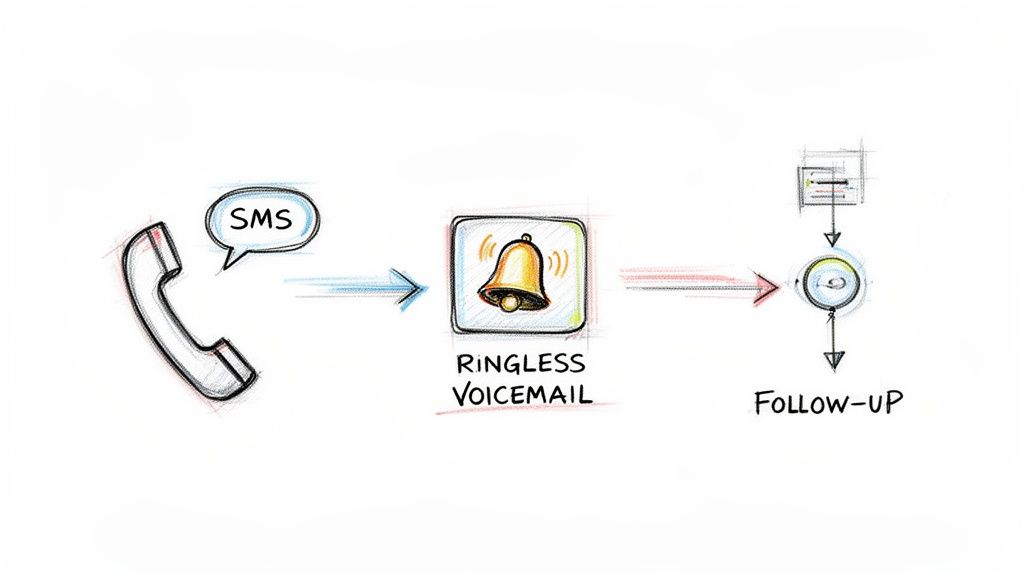
One of the most effective partners for SMS is ringless voicemail. This cool piece of tech drops a pre-recorded audio message straight into someone’s voicemail inbox—without their phone ever ringing. It’s a subtle, personal, and incredibly non-intrusive way to follow up.
Think of it like leaving a direct-to-voicemail audio note. Your contact just sees a voicemail notification and can listen whenever it's convenient. You get all the warmth and personality of your voice across without the interruption of a live call. This technique, also known as a ringless voicemail drop, is perfect for adding a human element to automated campaigns. If you want to get into the weeds on how it works, you can learn more about what ringless voicemail is and see how it can fit into your campaigns.
A ringless voicemail drop feels less like a marketing blast and more like a personal message. It’s the perfect way to follow up on an initial text, add a human touch to an automated sequence, or re-engage a cold lead without being pushy.
This strategy really shines in situations where a simple text message just won’t cut it. Imagine a real estate agent dropping a quick, personal voicemail after a showing or a local business owner sending a "thank you" message to a new customer. It adds a layer of depth that plain text can't compete with.
Now, the real magic happens when you bring these tools together in a multi-channel drip campaign. These are automated sequences that intelligently combine SMS, ringless voicemail, and even voice broadcasts to guide a customer through a journey.
Let’s walk through a practical example for an e-commerce store:
This sequenced approach is so much more effective than just blasting three texts. Each touchpoint uses a different medium, which prevents your contacts from tuning you out and boosts the chances they'll actually engage. It also aligns with how people prefer to communicate today. Recent data shows that for 68% of Americans, messaging has already replaced phone calls as the go-to.
By integrating these advanced tools, you’re no longer just texting from a different number. You're building a sophisticated, responsive communication system that lets you be persistent without being a pest. It's all about delivering the right message on the right channel, at exactly the right time.
Using a dedicated business number is a smart move, but you’ve got to handle it with care. Getting compliance right isn’t just about dodging fines; it’s about building a real, trustworthy line of communication with your customers.
When you nail this part, you get the peace of mind to focus on growth, knowing your outreach is built on a solid foundation.
Let's start by clearing up something that trips a lot of people up: the massive difference between legitimate business texting and illegal phone number “spoofing.”
When you're texting from a different number using a platform like Call Loop, you're using a phone number that has been properly set up and registered to your business. This is a totally legitimate, transparent practice that both carriers and customers recognize.
Illegal spoofing, on the other hand, is when a bad actor deliberately fakes the caller ID to make it look like the text is coming from someone else—like your bank or a government agency. Their goal is almost always malicious, usually fraud or harassment, and it's strictly against the law.
Your business texting falls squarely in the first camp. You're building a brand identity with a consistent, registered number, not hiding behind a fake one.
If you remember only one rule in business texting, make it this one: consent. You absolutely must have clear, documented permission from every single person you text. This isn't just a friendly suggestion; it’s a legal requirement under the Telephone Consumer Protection Act (TCPA).
Getting consent can be pretty straightforward:
Sending marketing messages without explicit consent is a fast track to some hefty fines and a seriously damaged reputation.
Gaining explicit consent isn't just a legal hoop to jump through. It's the start of a respectful relationship with your audience. It guarantees you're only messaging people who actually want to hear from you, which skyrockets your engagement and ROI.
Thankfully, modern messaging platforms have compliance features baked right in. For example, when someone texts "STOP," "CANCEL," or "UNSUBSCRIBE," the system should automatically add them to your opt-out list. This automated opt-out management is a critical safety net for your business.
Beyond individual opt-outs, you also have to respect the National Do Not Call (DNC) Registry. Professional platforms will automatically scrub your contact lists against the DNC registry to stop you from messaging numbers on it, protecting you from violations without you even having to think about it.
It’s also crucial to think about when you send your messages. TCPA guidelines restrict telemarketing to specific hours, generally between 8 a.m. and 9 p.m. in the recipient's local time zone. Firing off a promotional blast at 3 a.m. isn't just a compliance risk—it's a surefire way to annoy your audience and get them to opt out.
If you’re in the healthcare world, compliance goes even deeper. Any communication that includes Protected Health Information (PHI) has to be managed through a HIPAA-compliant platform.
This is non-negotiable for doctors' offices, clinics, and other healthcare entities. Using a standard, non-compliant texting app for patient communication is a major violation waiting to happen. A platform like Call Loop provides the security controls and Business Associate Agreements (BAAs) needed to keep patient data private and secure, allowing for compliant appointment reminders and other patient outreach.
By keeping these best practices at the forefront, you can confidently turn texting into a safe, reliable, and incredibly effective channel for your business.
As you get ready to start texting from a different number, a few practical questions always seem to come up. Let's tackle them head-on so you can get your business texting strategy rolling with confidence.
Yes, and you absolutely should. It’s a brilliant way to keep your branding consistent.
Modern messaging platforms can "host" your current business landline or VoIP number. This doesn't mess with your voice service at all—your phone will still ring just like it always has. What it does is give your trusted business number the power to send and receive text messages through the software.
Now, customers can text the same number they've been calling for years. It's a seamless, unified experience, and a massive advantage. You don't have to advertise a new number or confuse your existing customers.
This is a huge concern, especially if you're trying to move away from using personal cell phones. Juggling replies across multiple devices is pure chaos and just isn't scalable.
The solution is a unified inbox, which is a non-negotiable feature for any serious business messaging platform.
A unified inbox pulls every single incoming SMS reply into one shared dashboard. Instead of messages getting lost on individual phones, your entire team can see and respond to conversations from one central hub.
This gives you a few key advantages:
A unified inbox transforms texting from a messy, one-to-one activity into a structured, team-based operation. It’s the control center that makes managing a high volume of customer conversations not just possible, but efficient.
By funneling all your texts into one dashboard, you get a professional and organized system that can easily grow with your business. For even more tips and deep dives into dedicated texting numbers, the ReceiverHQ Blog for Business Texting Insights is a fantastic resource to explore.
You'll probably be surprised at how affordable it is. For most businesses, this is a small operational expense, not some massive investment. The cost really just comes down to the type of number you pick.
Local (10DLC) and toll-free numbers are very easy on the wallet. In many cases, a dedicated number is just part of a platform’s monthly plan. If it's extra, you’re usually only looking at a few bucks a month to lease it. That small fee unlocks all the powerful features like automation, analytics, and that all-important unified inbox.
Things change in a big way with dedicated short codes. These are the 5-6 digit numbers built for massive, high-volume messaging, and they come with a serious price tag—often thousands of dollars per month. They’re incredibly powerful, but they’re really for huge enterprises with equally huge marketing budgets.
For the vast majority of small and mid-sized businesses, a local or toll-free number hits the sweet spot of professionalism, capability, and cost.
Ready to see how a dedicated number can change the game for your customer communication? Call Loop gives you all the tools you need—from SMS and ringless voicemail to automated drip campaigns—to build a professional, compliant, and seriously effective outreach strategy. Start your free trial with Call Loop today and begin texting from a different number in minutes.
Chris Brisson
Chris is the co-founder and CEO at Call Loop. He is focused on marketing automation, growth hacker strategies, and creating duplicatable systems for growing a remote and bootstrapped company. Chat with him on X at @chrisbrisson


Trusted by over 45,000 people, organizations, and businesses like


