
See a Demo
You're just one step away from seeing Call Loop in action.
Enter your information below to watch a demo right now.

You're just one step away from seeing Call Loop in action.
Enter your information below to watch a demo right now.

A DID number—short for Direct Inward Dialing—is basically a virtual phone number that funnels calls straight to a specific person or department, completely bypassing an old-school switchboard. Think of it as a private, direct line into your business, making it dead simple for customers to connect with the right person instantly.
Imagine your company is a huge office building. A general phone number is like the main front desk—every single visitor has to stop there first and ask for directions. It’s slow and inefficient.
A DID number, on the other hand, is like giving each department its own direct entrance. Customers can go straight to sales, support, or a specific team member without any waiting or transfers. It’s a direct path.
This isn’t some brand-new tech. It actually dates back to the 1960s with AT&T, but its use has exploded with modern business needs. Today, these virtual numbers are the bedrock of business communication, powering everything from massive customer support centers to highly targeted marketing campaigns.
To really get what makes a DID number tick, you first have to understand what is VoIP technology and how it’s changed the game. VoIP, or Voice over Internet Protocol, is the tech that lets you make phone calls over the internet instead of traditional phone lines.
Most DIDs today run on VoIP, and that’s what gives them their incredible flexibility.
Because they’re virtual, DID numbers aren't chained to a physical location or a specific phone. This means a DID with a New York area code can be answered by an employee in California—on their desk phone, computer, or even a mobile app. This single feature opens up a world of possibilities for businesses of any size.
A DID number gives your business the power to create a local presence anywhere in the world, manage multiple conversations efficiently, and connect advanced tools like automated SMS, voice broadcasts, and even ringless voicemail.
To put it all together, here’s a quick breakdown of the core components of a DID number.
Simply put, DIDs are a fundamental tool for creating a modern, streamlined, and scalable communication system for your business.
When someone dials one of your virtual numbers, a whole sequence of events kicks off behind the scenes. It’s a lightning-fast process that connects them to the right person or department in seconds, all thanks to a clever handoff between old-school phone networks and modern internet-based systems.
Let's walk through what actually happens.
The call starts its journey on the Public Switched Telephone Network (PSTN). Think of this as the classic, global telephone grid that’s been around for decades. When your customer's call hits this network, the DID number they dialed acts like a unique signpost.
The PSTN immediately sees this isn't a standard number tied to a physical phone on a desk. It knows that this specific number is managed by a VoIP provider, so it instantly reroutes the call over to that provider's network. This redirect is the secret sauce that makes DIDs so incredibly flexible.
Once the call lands on your VoIP provider's servers, their system looks up the routing rules you’ve already set for that specific DID. This is where you get to play traffic cop and decide exactly where that call, text message, or even a ringless voicemail drop should go.
For example, let's say you have a DID number on a landing page for a new product. You can program that number to ring every single salesperson's phone at the same time. The first one to pick up gets the lead. Simple, right? But it completely cuts out the need for a receptionist to manually transfer the call, connecting hot prospects to a sales rep in an instant.
This diagram breaks down that simple journey from the customer's phone straight to your employee, all thanks to the DID.
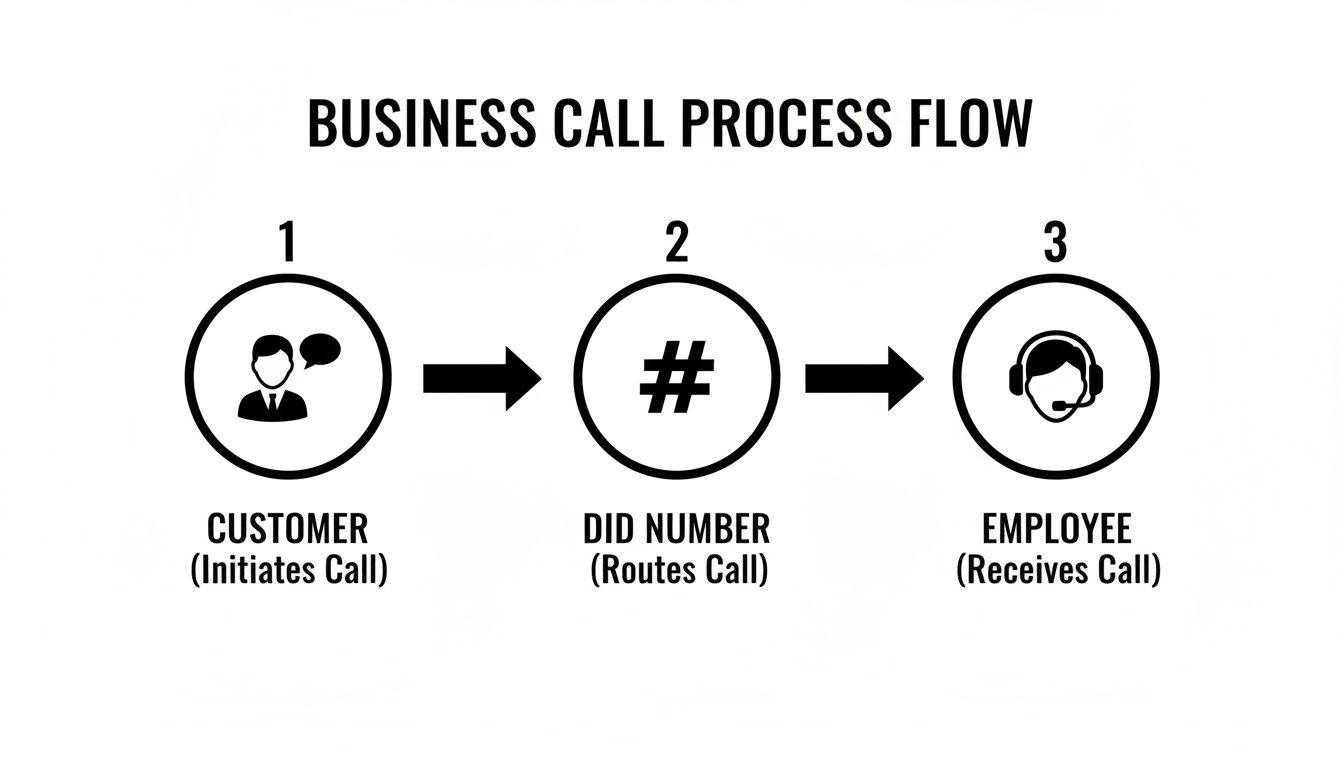
As you can see, the DID number acts like an intelligent routing system. It gets rid of the old-fashioned switchboard and creates a direct, efficient line of communication.
The real power of DIDs comes alive when you start assigning unique numbers to different parts of your business. This lets you route calls with precision and track everything, turning your phone system into a surprisingly powerful analytics tool.
You can set up different DIDs for all sorts of things:
Each DID number is like a unique digital doorway into your business. You get to decide exactly who or what is behind each door, whether it’s a specific person, an entire department, or an automated marketing message.
This ability to give every number a unique job is what turns a simple phone call into a smart, measurable interaction. By grabbing a block of DIDs, you can scale this strategy across your entire company, managing hundreds of different conversations from one central platform.
Not all phone numbers are created equal. Picking the right DID number is like choosing the right tool for a specific job—a local number can build instant trust in a new city, while a toll-free number gives you a nationwide presence overnight. Getting this choice right is fundamental to your entire communication strategy.
The number you choose directly shapes how customers see your business and can make or break your campaigns. Let's dig into the main types so you can match the right number to your goals.
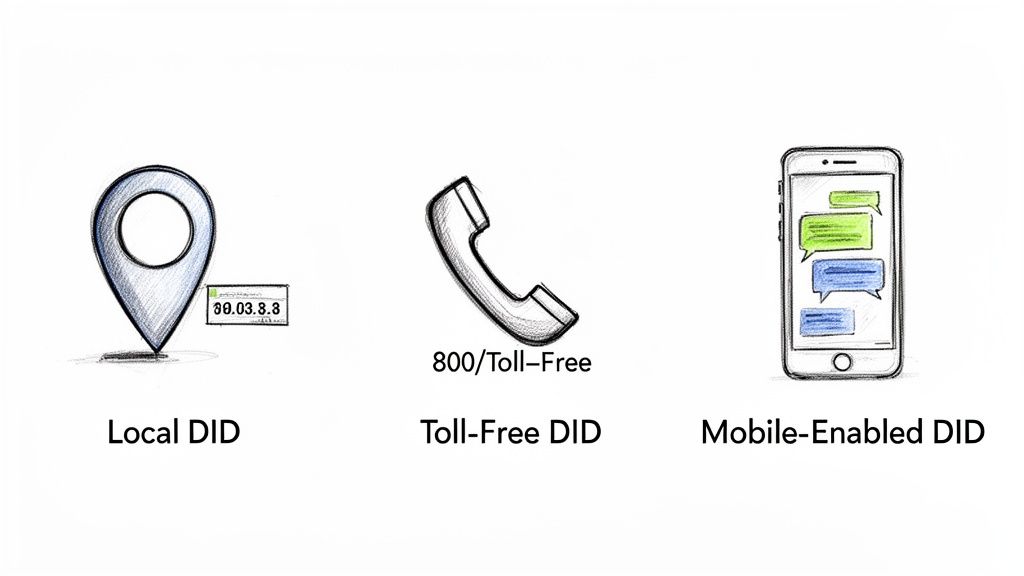
A local DID number is just what it sounds like: a phone number with an area code tied to a specific city or region. It might seem like a small detail, but it’s incredibly powerful for building an immediate sense of familiarity and trust. Think about it—you're far more likely to answer a call from a local area code you recognize.
This makes local DIDs a perfect fit for:
When you use a local number for outbound campaigns, like voice broadcasts or ringless voicemail drops, you can see a huge jump in how many people pick up and listen. It changes the dynamic from a cold, corporate outreach to a friendly, local conversation.
A local DID number mirrors a customer's own area code, instantly breaking down the barrier of a distant, faceless company. This single detail is often the difference between a call that gets answered and one that goes straight to voicemail.
On the flip side, toll-free DID numbers (the ones starting with 800, 888, or 877) project a completely different image. They signal that your business is established, professional, and operates on a national scale. Since customers are never charged for dialing them, they make your business feel serious and accessible.
A toll-free number is your go-to when the goal is to build a credible, nationwide brand. Customers from California to New York can call without a second thought, which is why they're the standard for primary company phone numbers, customer support lines, and sales hotlines advertised across the country.
Finally, we have mobile-enabled DID numbers. These are an absolute must-have if you plan to connect with customers through text messages. These numbers are specifically set up to handle two-way SMS and MMS, transforming your DID from a simple phone line into a powerful tool for interactive marketing and support.
While many DIDs can handle voice calls, only mobile-enabled ones can run SMS marketing campaigns, send automated text alerts, and actually receive replies from your customers. This is crucial for building relationships and driving action through what is arguably the most direct communication channel we have today. To learn more, check out our guide on how to determine if a number is mobile or landline.
Choosing between local, toll-free, and mobile-enabled DIDs really comes down to what you're trying to achieve. Each one has a unique strength. This table breaks down the core benefits to help you decide.
Ultimately, you might even use a mix of all three. A local number for your Dallas sales team, a toll-free number for your main support line, and a mobile-enabled DID for your nationwide SMS promotions. The key is to be strategic and align your choice with your business goals.
Alright, let's move past the theory. How do these DID numbers actually make you money?
Think of them less like simple phone numbers and more like strategic tools. When you use them correctly, they have a massive impact on your connection rates, how you track campaigns, and overall customer engagement.
When you start pairing DIDs with automation, you unlock some seriously scalable and effective ways to reach people. Let's dig into how smart businesses are using them to see measurable growth across different channels.
If you're running outbound voice campaigns for things like event reminders or sales follow-ups, the Caller ID you show is everything. A generic toll-free number gets ignored nine times out of ten. But a local DID number that matches the person's area code? That feels familiar and instantly builds trust.
It's a small change, but it can dramatically boost your answer rates. When a prospect sees a local number pop up, they’re far more likely to pick up the phone, giving your message a real chance to connect. You can learn more about this approach in our guide on voice broadcast software.
This is where DIDs get really powerful for SMS marketing. By assigning a unique DID number to each of your campaigns, you unlock some amazing analytics.
Imagine you're running two different promos: one on social media and another in your email newsletter. Use a different mobile-enabled DID for each one, and suddenly you can track exactly which channel is driving the most texts, engagement, and revenue.
This takes all the guesswork out of it. You can see which campaigns your audience actually responds to and shift your budget based on real performance data.
DID numbers give small businesses a competitive edge by creating a local presence in major markets, reducing costs while increasing engagement. In fact, U.S. businesses using local DIDs for SMS see open rates of 98%, compared to 82% for generic short codes. Learn more about the economic forces shaping business in 2026.
Ringless voicemail is a fantastic way to drop a message right into someone's inbox without their phone ever ringing. But the whole strategy lives or dies by the Caller ID you use for the drop. Also known as a voicemail drop, this technique relies on a local DID to appear trustworthy and prompt a callback.
When that voicemail notification shows a familiar local DID, people are way more likely to listen to the message and—most importantly—call you back. That little personal touch turns a passive message into an active lead-gen machine.
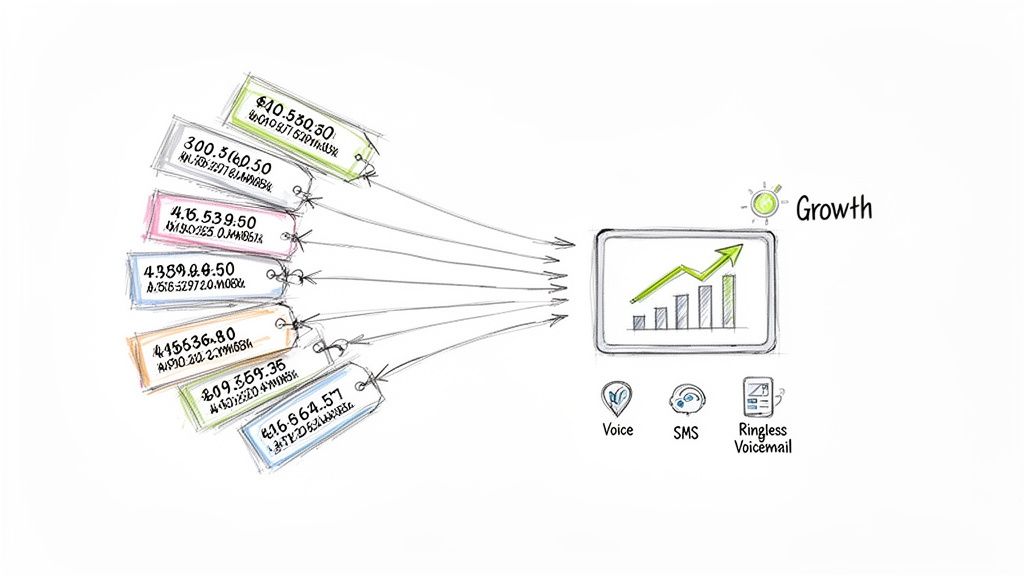
By strategically using DIDs across voice, SMS, and ringless voicemail, you're not just communicating; you're building a growth engine. Each number becomes a dedicated tool for connecting with customers, tracking what works, and scaling your outreach effectively.
Getting your DID numbers set up is the first real step to building a smarter way to talk to your customers. It's a pretty simple process, whether you're grabbing brand new numbers or want to bring your existing business line over to a more powerful platform.
Let's walk through how to get your DIDs and manage them like a pro. You've basically got two paths: buying new numbers or porting one you already own. Both are easy and give you the control you need to run targeted campaigns.
Buying a new DID number is usually the quickest way to get rolling. Platforms like Call Loop let you instantly add numbers right from their system. This gives you total control over what kind of number you get and where it appears to be from.
Here’s how it usually goes down:
This is perfect for setting up dedicated numbers for marketing campaigns because it gives you clean, easy-to-read tracking from day one.
But what if you've already got a business number that your customers know and trust? No problem. You can move it to a new provider through a process called porting. This lets you keep your number while unlocking all the cool features of a modern messaging platform.
Porting is just the fancy term for transferring your phone number from your old carrier to a new one. It means you can upgrade your tech without having to change your contact info everywhere, keeping your brand recognition intact.
To get it done, you'll need to show your new provider proof that you own the number. They'll handle the rest, coordinating the switch with your old carrier. It can take a little time, but it’s a smooth way to level up your communications without losing the number your customers rely on. Once it's ported, you can manage it just like any other DID—set up call forwarding, automated SMS replies, you name it.
Just getting the numbers is the easy part. How you manage them is what really moves the needle.
A great first step is to organize your DIDs by what they do. Assign one number to your Facebook ads, another to your sales reps, and a third to your support queue. Then, set up smart call forwarding rules so calls always get to the right person without a hitch.
Finally, use custom Caller IDs to keep your branding consistent. For example, show a local number when you're reaching out to a specific region—it's a small tweak that can seriously boost your answer rates.
Using a DID number effectively isn't just about strategy; it's about playing by the rules. If you don't, you risk tanking your number reputation, which can cause carriers to flag your messages as spam and block them from ever reaching your audience. Getting a handle on these regulations is crucial for any long-term success.
The whole system is governed by rules designed to protect consumers, and your business has to follow them. This includes regulations from the mobile carriers themselves and federal laws that dictate exactly how you can communicate with your customers.
In the U.S., one of the most important frameworks is A2P 10DLC (Application-to-Person 10-Digit Long Code). Think of this as the official system carriers use to register and approve business traffic sent over local numbers. When you register your DIDs through A2P 10DLC, you're essentially telling carriers you're a legitimate business. This simple step dramatically improves message deliverability and cuts down the risk of being filtered.
Another massive piece of the puzzle is the Telephone Consumer Protection Act (TCPA). This law sets the ground rules for telemarketing calls, auto-dialed calls, and text messages. Its core principle is simple: consent. You must have clear, documented permission from people before you send them marketing messages, whether it's a voice broadcast, an SMS campaign, or a ringless voicemail drop.
Following A2P 10DLC and TCPA guidelines isn't just about avoiding hefty fines; it's about building a foundation of trust. When customers know you respect their communication preferences, they are far more likely to engage with your brand.
Staying compliant directly leads to better results. It's a straight line. When your number has a good reputation, carriers trust it, and your messages actually get delivered.
Here are a few non-negotiables:
Building a compliant communication strategy means picking a platform that puts deliverability and regulatory rules first, ensuring your messages hit their mark every time.
Jumping into the world of virtual phone numbers can feel a little technical at first. Let's break down some of the most common questions business owners ask when they start using DIDs.
You bet. Modern DID numbers are built for both voice and SMS/MMS. This is huge because it lets you create a single, unified experience for your customers—they can call you and text you on the very same number.
They're closely related, but there's a key difference. Think of it like this: the DID is the actual virtual phone number someone dials to reach you. VoIP (Voice over Internet Protocol) is the technology that makes the call happen over the internet.
So, while not technically the same thing, almost all DIDs today run on VoIP technology to connect your calls.
This really comes down to your goals. You could easily start with just one number for all your general business contact.
But where DIDs really shine is when you start using multiple numbers for specific purposes. For example, you could assign different DIDs to track the ROI of your Facebook ads vs. your Google ads, give direct lines to your sales reps, or even set up local numbers in cities where you want to build a presence.
Yes, and you absolutely should. Using a DID number is the standard—and most effective—way to deliver ringless voicemail.
Pro tip: Use a DID with a local area code that matches your recipient's. A voicemail from a familiar local number feels way more personal and dramatically increases the chances they'll listen and call you back.
Ready to put DID numbers to work for your business? With Call Loop, you can instantly purchase local or toll-free numbers, run powerful SMS and voice campaigns, and deliver targeted ringless voicemails. Start your free trial today and see how easy it is to scale your outreach.
Chris Brisson
Chris is the co-founder and CEO at Call Loop. He is focused on marketing automation, growth hacker strategies, and creating duplicatable systems for growing a remote and bootstrapped company. Chat with him on X at @chrisbrisson


Trusted by over 45,000 people, organizations, and businesses like


