
See a Demo
You're just one step away from seeing Call Loop in action.
Enter your information below to watch a demo right now.

You're just one step away from seeing Call Loop in action.
Enter your information below to watch a demo right now.


When you hit 'send' on a text and it never shows up, the culprit usually falls into one of four buckets: aggressive carrier filtering, a bad phone number, temporary network glitches, or compliance issues. More often than not, the message gets trapped by a mobile carrier’s spam filter or the contact's number is simply no good.
Asking "why won't my texts deliver?" is one of the most frustrating parts of running an SMS campaign. Every failed message is a lost opportunity and a wasted credit. To fix the problem for good, you first have to understand the journey a text takes—it’s not a straight line. Your message has to pass through multiple checkpoints before it ever hits a recipient's screen, and a failure at any one of them can stop it cold.
The good news is that the root cause often comes down to factors you can actually control. Poor contact list hygiene is a huge one that people tend to overlook. It absolutely plagues SMS campaigns. In fact, industry data shows that outdated, deactivated, or just plain wrong phone numbers are the #1 reason messages bounce without a trace, throwing your metrics out of whack and costing you money. You can get the full picture by checking out these SMS notification best practices.
Most delivery problems can be traced back to a few core areas. Once you pinpoint which one is affecting your campaign, you can take direct action to fix it.
This decision tree gives you a great visual of the path a text takes and where things can go wrong.
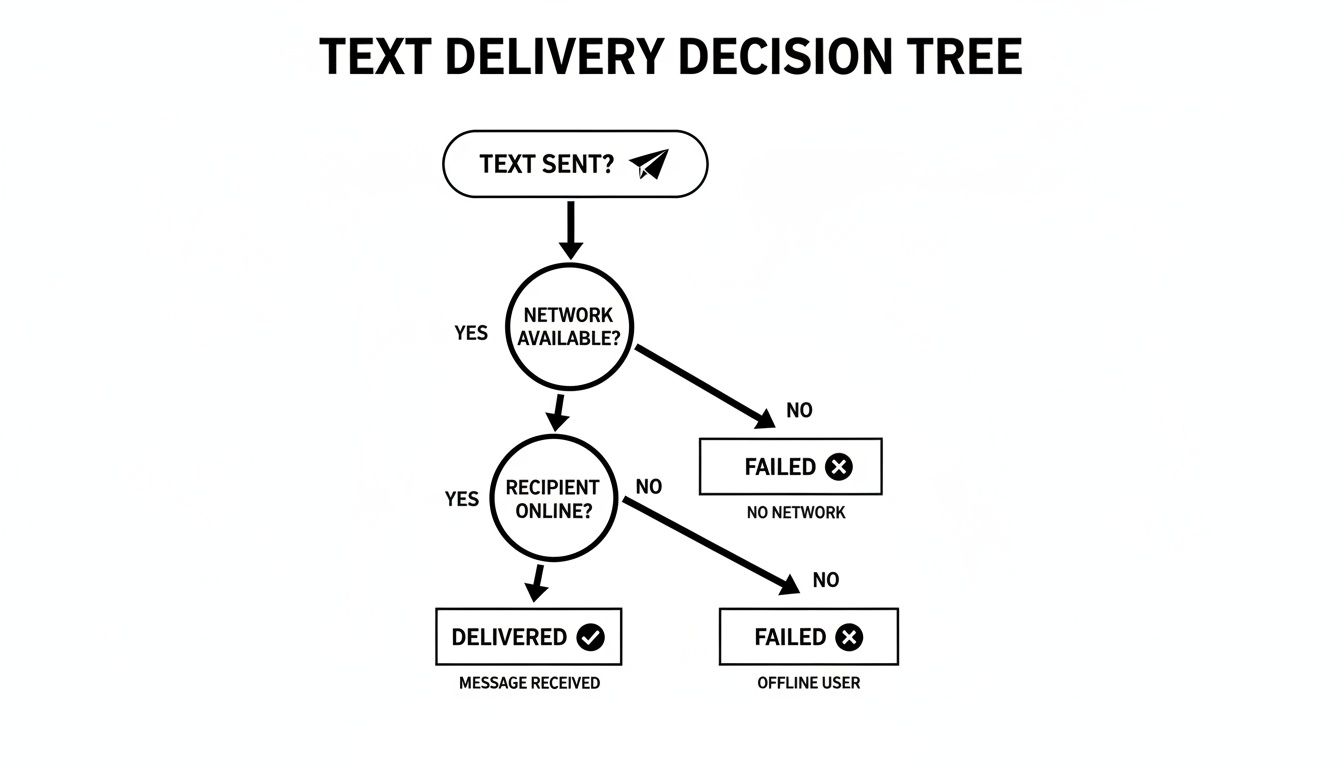
As you can see, a delivery failure isn’t just one thing. It's the result of several potential roadblocks, from carrier-side blocks to simple issues with the recipient's phone.
To help you quickly identify what might be going wrong, here's a quick-reference table summarizing the usual suspects.
This table should give you a solid starting point for troubleshooting. By matching your issue to the problem area, you can figure out where to focus your efforts.
Key Takeaway: Most text delivery failures aren't random. They are symptoms of underlying issues in your contact list, message content, or regulatory compliance. Fixing them requires a systematic approach, not just resending the message.
It’s also smart to think beyond just SMS. Sometimes, a different approach is needed. For example, ringless voicemail can be a great addition to your strategy. This method delivers an audio message directly to a contact's voicemail server, completely bypassing the carrier SMS filters that cause so many headaches. It's a powerful tool for important, non-urgent messages that you absolutely need people to receive, and is a great solution when you're facing low ringless voicemail drops rates or other delivery challenges.
Ever sent a text message that just… vanished? It never arrived, and you got no error message. Welcome to the world of carrier filtering.
Mobile carriers are the gatekeepers of texting. Think of them as extremely strict bouncers at an exclusive club, and your text is trying to get past the velvet rope. Their number one job is to protect their users from spam and scams. To do that, they use sophisticated, automated filtering systems that scan every single message for anything that looks even remotely suspicious. If your perfectly legitimate message accidentally trips one of their alarms, it gets blocked. No questions asked.
These filters aren't just looking for obvious junk. Their logic is much deeper, analyzing everything from the specific words you use to the links you include. The tricky part? These systems are always learning and adapting. A message format that sailed through last week might get flagged tomorrow.
This whole system operates on Application-to-Person (A2P) messaging standards, which are the official rules of the road for how businesses can text consumers. If you want your messages to land in the inbox, you have to play by these rules. To get the full picture, check out our guide on what is A2P texting.
So, what exactly are these filters looking for? They’re making a split-second decision based on a cocktail of signals: your content, your sending patterns, and your sender reputation. A single red flag probably won’t get you blocked, but a few small issues can quickly add up and sink your deliverability.
Imagine you're a local pizza shop sending out a weekly special. If your message uses vague language, contains a public link shortener like Bitly, and you blast it to thousands of people at once from an unregistered number, you look exactly like a spammer. The carrier's algorithm doesn't know you’re a real business with great pizza; it only sees data points that match a high-risk profile.
Key Insight: Carrier filters don't judge your intent; they judge your behavior. Your goal is to make your messaging behavior look as human and legitimate as possible, even when sending at scale.
This is why you have to get inside the filter's "head" and understand what triggers it. Let's break down the most common reasons your content gets flagged.
Certain words and phrases are almost guaranteed to draw unwanted attention. Carriers have secret, constantly-updated lists of high-risk keywords tied to common scams. While we don't know the exact lists, we see clear patterns.
Real-World Scenario: A real estate agent we know sent a text blast that included the phrase "fast cash offer." Even though their list was 100% opt-in, their delivery rate tanked. Why? The carrier filter flagged "fast cash" as a high-risk financial term often associated with predatory lending scams. A huge chunk of their messages never even made it to their recipients' phones.
It’s not just what you send, but how you send it. Carriers are watching your sending velocity and patterns to spot robotic behavior. Any abrupt change in your activity can look like your account was hacked and is now being used to send spam.
A classic mistake is to go silent for weeks and then suddenly blast a message to 10,000 people at once. That sudden spike looks completely unnatural and raises immediate suspicion. A much better approach is to "warm up" your number by gradually increasing your sending volume over a few days.
[FirstName]) to personalize each text. Even small variations make your campaign look more organic to the carriers.Ultimately, navigating carrier filters is all about building a trustworthy sender profile. When you craft clean, personalized copy and adopt smart sending habits, you prove to the carriers that you're one of the good guys. That’s how you make sure your messages consistently land right where they belong: in your customer's inbox.
Carrier filters are a huge hurdle, sure. But they often take all the blame when the real culprit is sitting right in your own backyard: your contact list. A poorly maintained list is the silent killer of text message campaigns. It's often the reason your texts won't deliver, even when your content is perfectly crafted and 100% compliant.
Think of it this way: your contact list is the foundation of your entire SMS strategy. If that foundation is cracked and full of holes, everything you build on top of it is at risk of collapse. Sending messages to bad numbers doesn't just waste your money—it actively damages your sender reputation, making it even harder for your legitimate messages to get through.
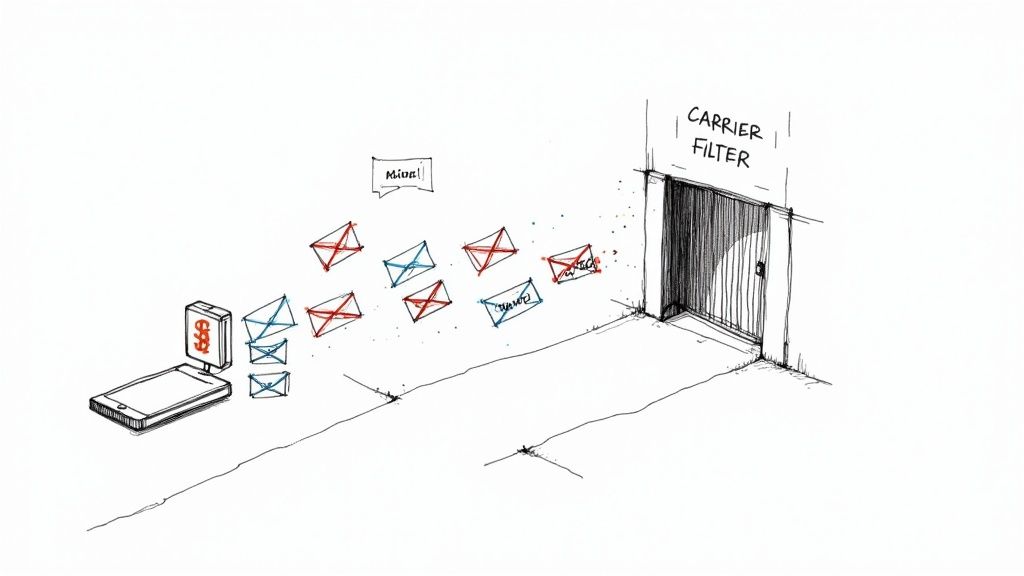
This cleanup process, often called list hygiene, is non-negotiable if you want good deliverability. Let's break down the types of "bad numbers" that are most likely sabotaging your efforts right now.
Not all bad numbers are created equal. Some are permanently unreachable, while others might just be formatted incorrectly. Figuring out which types are polluting your list is the first step toward cleaning it up.
Imagine a local gym that hasn't cleaned its member contact list in over a year. They're likely sending appointment reminders and class updates to dozens of old landlines, disconnected numbers from members who have moved, and numbers with typos from sloppy data entry. Their delivery rate plummets, their costs go up, and carriers start seeing their sending number as a source of undeliverable traffic—a huge red flag.
The only way to combat a decaying list is to be proactive. You can't just import contacts and forget about them. A healthy list requires ongoing maintenance and a commitment to quality over quantity.
A robust platform should give you the tools you need for this. For example, a good contact manager helps you organize, segment, and clean your lists efficiently, making list hygiene a manageable part of your workflow.
Key Takeaway: A smaller, highly engaged list is infinitely more valuable than a massive, unverified one. High delivery rates and a strong sender reputation start with clean data.
Your delivery reports are a goldmine of information. Don't just glance at the overall success rate; dig into the details. Look for specific error codes that indicate a number is permanently invalid.
When you see error codes signaling an "undeliverable" or "invalid destination" number, that's your cue. These aren't temporary issues like a phone being turned off; they're permanent failures.
Create a routine—maybe monthly or quarterly—to export these failed numbers and remove them from your active sending lists for good. This single action can dramatically improve your overall delivery metrics and protect your sender reputation.
The best way to keep your list clean is to prevent bad numbers from getting on it in the first place. This means validating numbers right when a user signs up.
This two-pronged approach ensures you're only adding high-quality, verified contacts to your list from the very beginning, saving you a massive cleanup headache down the road. It’s the most effective way to solve the "why won't my texts deliver" problem before it even starts.
It's not always about your content or contact list. Sometimes, the real reason your texts aren't landing is hidden in the technical plumbing—the digital highway your message travels to get from you to your customer's phone.
Think of it like shipping a package. You can pay for a premium courier like FedEx that guarantees delivery with real-time tracking. Or, you could use a sketchy, no-name service that sends your package through a dozen third-party handlers just to save a few bucks. That’s the difference between official A2P (Application-to-Person) routes and shady "grey routes."
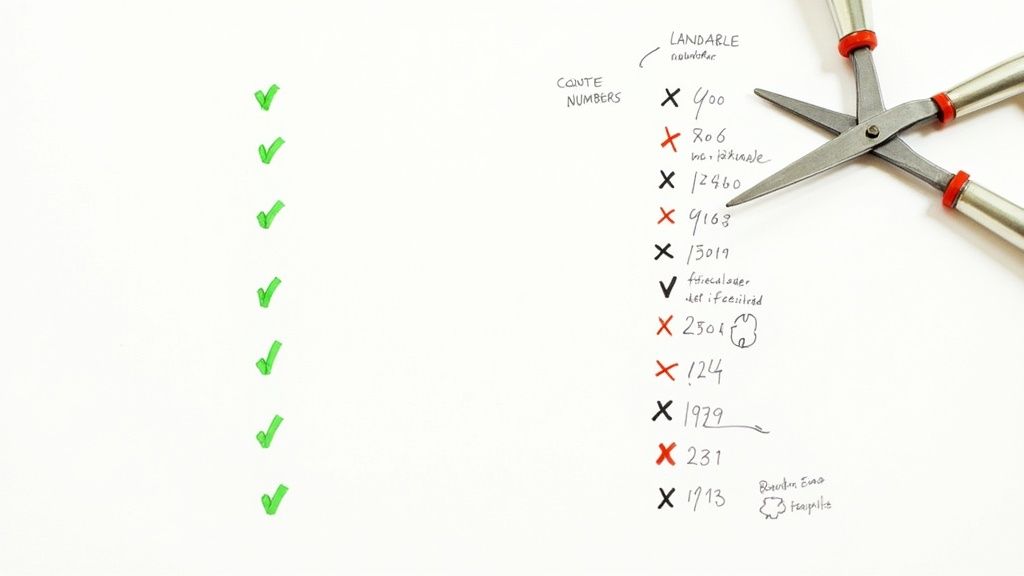
Understanding this technical foundation is probably one of the most overlooked parts of SMS deliverability, but it’s absolutely essential.
High-quality A2P routes are the official, carrier-approved pathways built for business texting. They're direct, reliable, and designed to handle massive volumes of messages. When your SMS provider uses these routes, carriers see your messages as legitimate business traffic, giving you a VIP pass to the inbox.
Grey routes, on the other hand, are the back alleys of the texting world. They try to sneak business messages through personal (P2P) channels, exploiting loopholes in carrier agreements to offer rock-bottom prices. It might seem like a good deal, but it’s a huge gamble. Carriers are always on the lookout for this kind of traffic, and when they find it, they shut it down hard. Your messages will get throttled, delayed, or just plain blocked, often without any warning.
If you've ever hit "send" and had your messages disappear into thin air, there's a good chance they got lost on a grey route. With the world projected to send billions of SMS messages every single day, carriers are cracking down. Low-cost providers often rely on these unstable routes, which means you get unpredictable delivery and have zero recourse when things go wrong.
Think of your sender reputation as a credit score for your phone number. Mobile carriers are constantly grading your sending behavior to decide if you’re a trustworthy sender or a spammer.
They’re looking at a few key things:
A good sender reputation gets you in the carriers' good graces, ensuring your messages face less scrutiny. A bad one gets you flagged, and your texts will get filtered heavily, even if your content is perfectly fine. Sticking to high-quality A2P routes is the first step to building that solid reputation.
If you're doing business texting in the U.S., the single most important technical requirement today is A2P 10DLC registration. This is the system that carriers created to register and approve businesses that send texts from standard 10-digit long codes (regular phone numbers).
Crucial Insight: Let's be clear: A2P 10DLC is not optional. If you're a business texting U.S. numbers from a 10-digit phone number, you must be registered. Failing to do so is a direct ticket to the spam filter.
The process has two main steps:
By registering, you're being transparent with the carriers about who you are and what you're sending. In return, they give your messages better deliverability and higher sending speeds. Unregistered traffic is now facing the toughest filtering yet, making registration the most critical technical step you can take.
So you’ve cleaned your list, dialed in your content, and registered your sender ID, but your texts still aren’t hitting the mark. It's frustrating, but sometimes you have to think outside the SMS inbox. The problem isn't always your message; it can be the channel itself. Carrier filters can be relentless, and even the slickest SMS strategy can’t always break through.
This is exactly when you need a reliable plan B. For us, ringless voicemail has been one of the most effective tools for cutting through the noise. It’s a completely different play that sidesteps the common hurdles of SMS entirely.
Instead of trying to squeeze a text message through spam filters, ringless voicemail technology delivers a pre-recorded audio message straight to the carrier's voicemail server. The recipient’s phone never actually rings. They just get a simple voicemail notification, letting them listen to your message whenever it’s convenient for them.
This server-to-server delivery is the secret sauce. It completely bypasses the SMS filtering system, making it an incredibly reliable way to make sure your message is actually received. You stop fighting for inbox space and start placing your message directly in their personal message bank.
Key Insight: Ringless voicemail isn't a replacement for SMS, but a powerful complement to it. It gives you a direct line to your audience for messages that are important but not time-sensitive, ensuring your communication gets through when SMS might not.
While SMS is king for quick alerts and two-way chats, ringless voicemail really shines in scenarios where a human voice and guaranteed delivery matter more.
Think about these situations:
The goal is to use the right tool for the job. If you want to dive deeper into the nuts and bolts, our guide on ringless voicemail for business has a complete walkthrough.
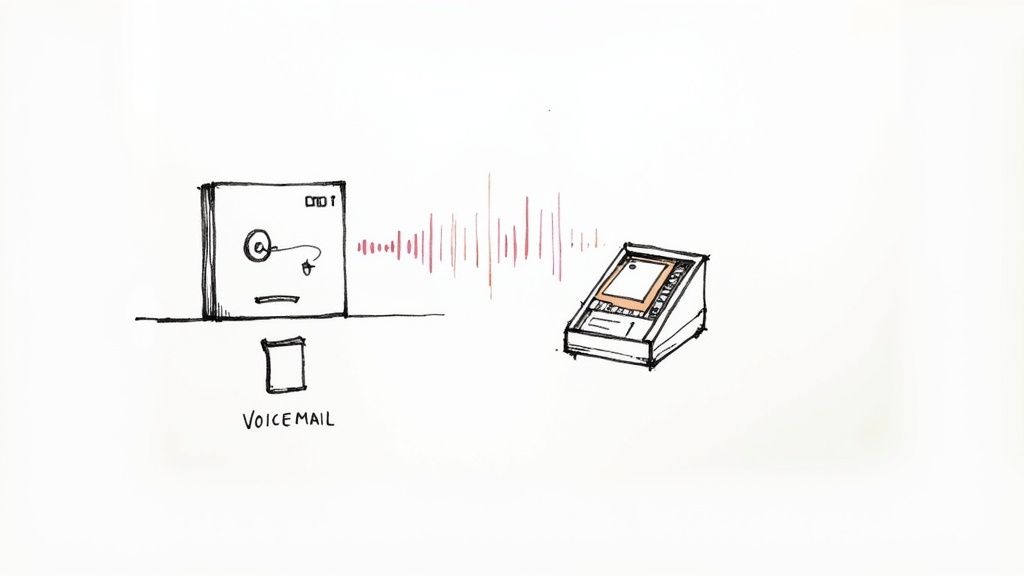
The most obvious win with ringless voicemail is its knack for getting around SMS delivery problems. But the benefits don't stop there. This approach gives you a unique mix of reliability and a personal touch that standard texting can’t always deliver.
That high listen-through rate is a big deal. Because the experience is less intrusive than a ringing phone, people are often more receptive. It feels less like an interruption and more like a personal note left just for them. This makes it a fantastic channel for building stronger customer relationships, especially when you're stuck wondering "why won't my texts deliver" with traditional methods.
Even after digging into delivery issues, a few specific questions always seem to pop up. You might be scratching your head about why a campaign that was a hit last week is suddenly falling flat, or how to deal with that one contact who's gone completely dark. This is where we get into the nitty-gritty and answer some of the most common follow-up questions we hear from folks trying to solve the "why won't my texts deliver?" puzzle.
We'll tackle everything from sudden blocks to individual contact problems. Plus, we'll dig a bit deeper into how an alternative channel like ringless voicemail can be your secret weapon for getting your message through, every time.
This is a classic. One day everything is great, the next, your messages are hitting a wall. This almost always points to one of two things: a change in carrier filtering or a recent ding to your sender reputation. Mobile carriers are constantly tweaking their spam algorithms, so a message that sailed through last month might trip a brand-new filter today.
A few common triggers are usually behind this:
The first thing to do is review your most recent campaigns for any of these changes. Then, dive into your delivery reports to see if any new error codes are popping up. It's also a good idea to double-check that your A2P 10DLC registration is still active and in good shape, as compliance hiccups can cause sudden blocks.
The short answer is no. Unfortunately, there’s no alert or special delivery status that says, "This person blocked you." It's a deliberate privacy feature on the carrier's end.
From your perspective, the message will often show up as "Delivered." That's because your platform did its job—it successfully handed the message off to the recipient's carrier. The carrier accepts it, but then its system sees the block in place and just drops the text before it ever hits the person's phone.
Key Takeaway: If you suspect a specific contact blocked you because they've stopped responding entirely, there's no technical way to confirm it through your SMS logs. The only way to know for sure is to try reaching them through a different channel.
Ringless voicemail is a game-changer because it skips the SMS network entirely and uses a much more direct channel. Think of it as a powerful workaround when you're banging your head against the wall with text delivery problems.
Instead of sending a text that has to run the gauntlet of complex carrier spam filters, ringless voicemail deposits a pre-recorded audio file directly onto the carrier's voicemail server. The person's phone never actually rings. This direct server-to-server handshake completely bypasses the SMS filtering system.
This unique delivery method makes it an incredibly reliable tool for making sure your message is received. It's perfect as a complementary strategy for important, non-urgent messages, allowing you to connect with people who might not be responding to texts or when you just want to add a more personal, human touch.
Ready to bypass frustrating SMS filters and ensure your messages get heard? Call Loop offers a powerful suite of tools, including reliable SMS, voice broadcasting, and ringless voicemail to connect with your audience every time. Discover how Call Loop can transform your outreach strategy today.
Chris Brisson
Chris is the co-founder and CEO at Call Loop. He is focused on marketing automation, growth hacker strategies, and creating duplicatable systems for growing a remote and bootstrapped company. Chat with him on X at @chrisbrisson


Trusted by over 45,000 people, organizations, and businesses like


